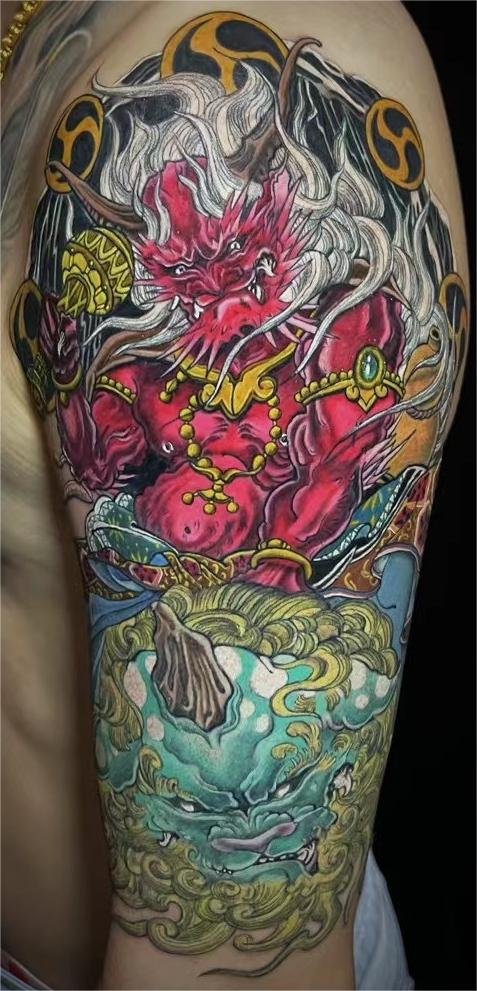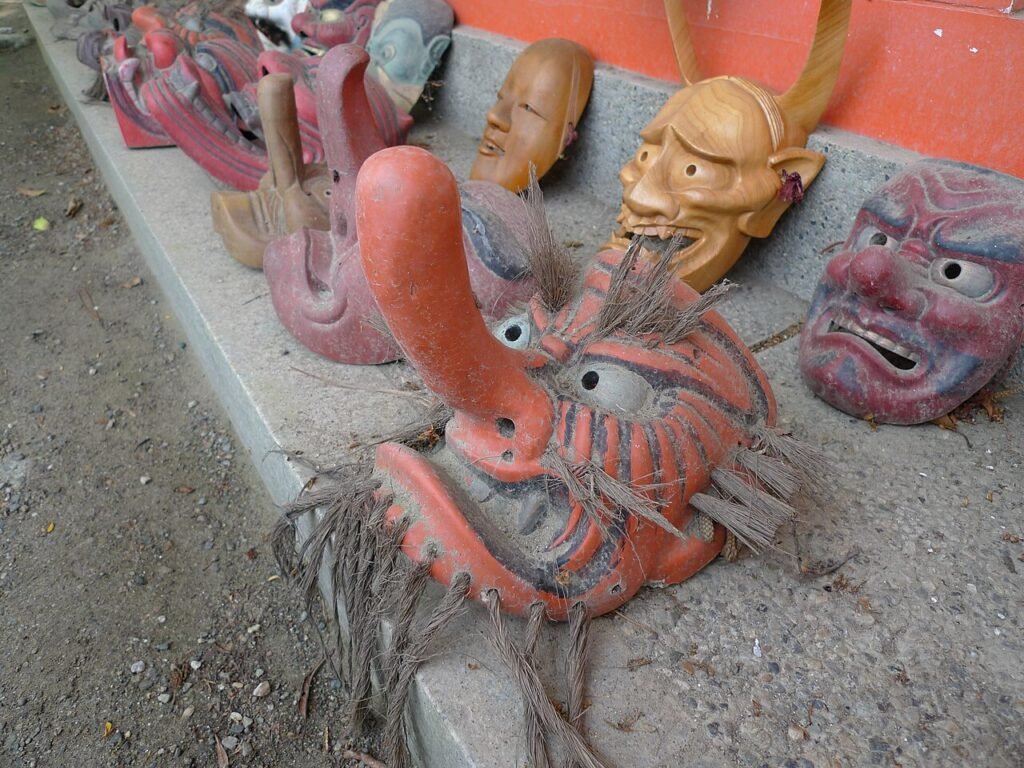
Tengu tattoo meaning is not one fixed symbol. In Japanese visual culture, Tengu have appeared as birdlike supernatural beings with beaks and wings, as human-shaped mountain figures with long noses, and as masks used in performance and popular religious settings. A tattoo can communicate severity, pride, danger, discipline, mischief or mountain power depending on the form and source you choose.
The first design decision is therefore not “What does every Tengu mean?” but “Which Tengu am I showing?” A long-nosed mask, a crow-like head, a winged full figure, a feather fan, yamabushi clothing, a staff, a confrontational pose or a quiet mountain setting each changes the reading. Choose those details from documented references before deciding scale and placement.
Why the image changed over time
The characters used for Tengu, 天狗, are often translated as “heavenly dog,” yet the familiar Japanese image is not simply a dog. The University of Oregon’s Yōkai Senjafuda Tengu project traces a fading canine connection, medieval crow associations and later red-faced, long-nosed priestly forms.
The visual types carry different associations. A beaked, winged figure can feel airborne and uncanny. A human face with a long nose and stern brow can read like a commanding mask or mountain ascetic. Mix them only as a deliberate hybrid.
The University of Hawai‘i Press description of Haruko Wakabayashi’s The Seven Tengu Scrolls shows why a single positive or negative definition is unreliable. It notes that modern Tengu are often understood as mountain guardians associated with yamabushi, while medieval Buddhist material could present them in darker roles connected with pride, passions and obstacles to enlightenment. That shift gives clients a better framework than a list that says “Tengu equals protection.”
Long-nosed Tengu and birdlike Tengu
Two broad visual directions are especially useful when organising Tengu tattoo ideas.
The long-nosed human form
This is the familiar Tengu mask: prominent nose, strong brow, human mouth and often a red complexion. Facial hair, a small cap and priestly clothing may frame it. The nose creates a strong side profile, but foreshortening can make a frontal nose look short or unclear. A three-quarter or side angle preserves the silhouette.
Do not treat red as a mandatory code. The popular long-nosed type is often red, but museum objects show wider variation. The British Museum records an Edo-period Tengu dance mask for kagura painted blue. Colour should follow the chosen reference and the role it plays in the whole tattoo, not an invented rule that one colour always has one meaning.
The crow-like or bird-headed form
The birdlike form uses a beak, wings and a more animal head. It can feel more dynamic and less mask-like. The Spencer Museum of Art describes crow-like and long-nosed Tengu forms, noting bird features alongside the human physique, long nose and feathered wings of the other form.
“Karasu Tengu” is commonly used for the crow-like direction, but a client still needs to show the exact reference. Beak length, eye shape, feather mass and the balance between human and bird anatomy vary. A label alone does not tell an artist whether you want a compact masked head, a predatory bird profile or a fully winged humanoid figure.
Mask or full figure
A mask keeps attention on expression. It can work when the client wants an intense face, a strong nose silhouette and a compact set of supporting details. It also leaves room for a fan, rope, maple leaves, cloud or framing shape without requiring the whole body to fit.
A full figure changes the subject from an emblem to a scene. A standing Tengu with folded wings can feel controlled and watchful; a crouched or airborne figure can feel disruptive. A staff and layered robes emphasise the mountain ascetic, while a birdlike body emphasises the supernatural creature.
Decide whether the design shows a literal mask or the face of a being. A visible strap, empty eye opening or hand holding the mask clearly says “object.” A face attached to hair, neck, wings and costume says “character.” Leaving this ambiguous can be interesting, but it should be intentional.
If your interest is specifically an ogre or demon mask, the planned Oni mask tattoo meaning guide keeps that subject separate. Horns, fangs and an ogre-like face do not automatically turn a design into Tengu imagery.
Expression controls the first reading
The same long nose can sit above a furious mouth, a restrained closed mouth or a faintly mocking expression. Those choices affect the emotional tone before a viewer notices the background.
For a severe Tengu, use a clear brow angle, focused eyes and a firm mouth. For a more mischievous figure, a sideways glance or asymmetrical mouth can change the mood without turning the face into a caricature. For an aged mountain figure, hair, wrinkles and a quieter posture may carry more weight than exaggerated teeth.
Avoid asking for every signal at once. Huge eyes, open fangs, deep wrinkles, flowing hair and a long nose can compete in a small space. Choose the expression’s main carrier. At a distance, the brow and outer silhouette will usually read before fine skin texture.
The direction of the gaze also matters. A face looking toward the body’s centre can connect with a second motif. A face looking outward can confront the viewer. On a limb, test both directions while the arm or leg is relaxed and moving. A reference that works as a flat print may need to rotate to remain readable on the body.
What the feather fan contributes
A feather fan is one of the clearest Tengu attributes. The Met records a nineteenth-century netsuke of the child Yoshitsune and a Tengu with a fan; the University of Oregon project also records fans in performance and print contexts.
The fan can identify a partly obscured subject, create a diagonal against the nose and lead into wind, cloud or leaves. An open fan forms a broad mass; a closed fan leaves more negative space.
Do not attach a universal personal meaning to the fan without a source. If you want it to represent authority, wind, strategy or transformation in your own design, state that as your intended reading. The artist can then make the fan visually important enough to support it.
Wings, posture and movement
Wings distinguish a supernatural figure from a detached mask, but require space. One folded wing may establish the idea. Two extended wings create a wide composition better suited to a back, chest or thigh than a narrow forearm.
Decide whether the wings behave as an outline, a dark backdrop or a moving part of the scene. Long separated feathers can point through the composition. A compact feather mass can frame a pale face. If every feather receives equal detail, the face and fan may disappear into texture.
Posture should agree with the wing state. An airborne pose needs a clear body axis and room around the limbs. A seated or standing Tengu can carry folded wings, robes and a staff with more visual stability. A crouched figure fits a triangular area but can hide the costume and make the limbs hard to read.
Use photographs of your own body area when deciding. The visible outline should survive the curve of a calf, shoulder or forearm. The artist needs to know which part must face forward when the body is at rest.
Yamabushi details and mountain setting
Tengu imagery is often linked with yamabushi, mountain ascetics associated with Shugendō. The University of Oregon project points to the small cap as part of this garb, and the Spencer Museum record describes monk’s robes and a ringed staff in its painting. These details can anchor a human-shaped Tengu in a documented visual context.
A cap, layered robes, sandals, staff and fan are not generic fantasy accessories. Use references that identify what you are borrowing and keep the costume coherent. A head-only design may need just one or two attributes.
Mountains, old trees, cloud and wind can create place without writing a literal folklore scene. Background should direct the eye and provide contrast. The Japanese tattoo background guide explains how waves, clouds, wind bars and negative space connect forms. For Tengu, cloud and wind can support height and movement, while a rocky or wooded setting can make the mountain association clearer.
Do not let the background turn the Tengu into a small label inside a landscape. Decide the foreground subject first, then use the setting to reinforce it.
Pairings should come from a clear story
Yoshitsune is one documented pairing. The Met object title places the child Yoshitsune with a fan-bearing Tengu, and other performance traditions connect the figures. If that is your direction, research the particular scene rather than using “warrior and Tengu” as a generic symbol of training.
Flowers and seasonal elements can set mood and colour. A fan with wind-tossed maple leaves suggests different movement from a still figure among pine branches. Ask whether the second motif contributes time, place, contrast, narrative or balance.
Keep fox-spirit imagery separate unless the design has a reason to combine them. The Kitsune tattoo meaning guide focuses on fox form, masks and tails. Tengu and Kitsune belong to broad Japanese folklore, but they do not share one interchangeable meaning.
For a wider check on dragons, koi, masks, flowers and other subjects, use the Japanese tattoo meanings overview. A motif hub can help compare options, while the final brief should stay specific to the Tengu form you chose.
Scale and placement decisions
Test the design close up, at arm’s length and across a room. The nose, beak, fan and wing outline should not depend on tiny lines. If feather texture is needed to identify the subject, the hierarchy needs work.
Common placement questions include:
- Does the nose or beak point along the body rather than into a tight edge?
- Is there enough width for the fan to open?
- Can the wing remain distinct from hair and robes?
- Will a joint fold through the eyes, nose or mouth?
- Does the background have somewhere to continue if the project expands?
- Which view should read first when the body is relaxed?
A forearm may suit a mask or narrow bust with a strong vertical profile. An upper arm or calf can carry a fuller head, fan and partial wing. A thigh, chest or back offers more space for a full figure and setting. These are compositional possibilities, not fixed rules.
Build an evidence-led Tengu brief
Before contacting an artist, choose one primary historical or museum reference and two or three visual references for composition. Label what you want from each image. For example:
- primary form: long-nosed human Tengu rather than bird-headed form;
- expression: stern, closed mouth, eyes looking outward;
- attributes: open feather fan and one folded wing;
- costume: restrained yamabushi cues;
- setting: mountain cloud and wind, with negative space around the nose;
- colour: black and grey with a limited red accent, or a researched full-colour direction;
- placement: right outer upper arm, with the profile facing forward.
Also state what should not appear. If you do not want horns, an Oni-like club, fox tails or a floating mask strap, saying so prevents visual drift.
Send the brief, references, placement photos and approximate size through the Yuyi Tattoo contact page. The design can then be discussed as a specific composition. No portfolio example or folklore source should be taken as a promise that Yuyi has completed the exact Tengu image you describe.
Sources and review date
- University of Oregon — Yōkai Senjafuda: Tengu — reviewed 24 August 2026.
- University of Hawai‘i Press — The Seven Tengu Scrolls: Evil and the Rhetoric of Legitimacy in Medieval Japanese Buddhism — reviewed 24 August 2026.
- Spencer Museum of Art, University of Kansas — Karasu Tengu (Crow Tengu) — reviewed 24 August 2026.
- The Metropolitan Museum of Art — Netsuke of Yoshitsune as a Child and Tengu with a Fan — reviewed 24 August 2026.
- The British Museum — Tengu dance mask for kagura performance — reviewed 24 August 2026.
Frequently asked questions
What does a Tengu tattoo mean?
It can suggest mountain power, severity, pride, mischief, danger, discipline or guardianship, but no meaning applies to every period and image. The chosen form, expression, costume, fan, wings and setting determine the reading.
What is the difference between a long-nosed Tengu and a Karasu Tengu?
The long-nosed type has a more human face and is often shown with priestly or yamabushi features. The birdlike type uses a beak, wings and stronger crow associations. Historical images vary, so choose a specific reference rather than relying on the label alone.
Does a Tengu tattoo have to be red?
No. Red is common in popular long-nosed Tengu imagery, but museum records include other colours, including a blue kagura mask at the British Museum. Colour should follow the reference and composition, not a universal code.
Is a Tengu the same as an Oni?
No. They are different subjects in Japanese folklore and visual culture. Tengu commonly use long noses, beaks, wings, fans or mountain-ascetic details. Oni are usually treated as ogre or demon figures with their own forms and stories.
What placement works for a Tengu tattoo?
A forearm can suit a narrow mask, an upper arm or calf can hold a head with a fan or partial wing, and a thigh, chest or back offers room for a full figure. The nose, beak and wings must remain readable on the chosen body curve.
What references should I send for a Tengu design?
Send one reliable cultural or museum reference, a small set of composition references, clear placement photos and notes identifying the desired form, expression, attributes, background and colour direction. Explain what you want from each image instead of requesting a copy.