
Yes. A tattoo on your body is not, by itself, prohibited by a tattoo-specific Singapore law. In a written reply published by the Ministry of Home Affairs (MHA) on 8 July 2019, the Minister said that tattooing a minor was not an offence, that there was no requirement for parental consent, and that MHA did not then see a need to regulate the tattoo industry. That is the clearest official statement located for this question, but it is a dated public position, not a promise about every studio or every situation.
For a real appointment, separate four questions: is the tattoo itself generally lawful, what age and consent rules does the chosen studio apply, could the design or conduct raise a different legal issue, and what must a tourist arrange before travelling? The answer to the first question does not automatically answer the other three. Check the current position with official sources and confirm the studio’s own requirements in writing.
The short legal answer
The MHA reply is useful because it answers the common fear that having a tattoo is automatically illegal in Singapore. It says tattooing a minor is not an offence and that minors do not have a statutory requirement to seek parental consent. It also records that MHA did not see a need to regulate the tattoo industry at that time. The page identifies a minor by reference to the Women’s Charter definition quoted in that reply: generally, a person under 21 who is not married or a widower or widow.
That statement should be read precisely. It does not create a guaranteed right to be tattooed by a private business. It does not set the policy of a particular artist. It does not decide whether a design is suitable for a particular client. It also does not mean that a tattoo can be used to commit another offence or that every public display of every image will be treated the same way.
The MHA page is dated 2019, so treat it as the published government position cited here and check for later official updates before relying on it for a disputed or unusual case. This article is general information rather than legal advice.
Law, age and studio policy are different layers
People searching for tattoo laws in Singapore often combine statutory rules with the rules of individual businesses. Keep them separate:
| Question | What the public record says | What you still need to confirm |
|---|---|---|
| Is having a tattoo itself banned? | The MHA reply does not describe tattooing a minor as an offence and says MHA did not see a need to regulate the industry at that time. | Whether another law applies to a specific act or design. |
| Is there one nationwide tattoo age number? | The cited MHA reply does not set a tattoo-specific minimum age. | The studio’s current minimum age, ID and consent process. |
| Is parental consent always required by statute? | The MHA reply says there is no requirement for minors to seek it. | A studio can still ask for consent, an accompanying adult or decline. |
| Will every legal tattoo be accepted? | No government page promises that. | Artist capacity, design boundaries and appointment terms. |
If your main question is the minimum age, read the separate legal-age guide for tattoos in Singapore. This article is broader: it explains why the answer “tattoos are legal” should not be mistaken for “every studio must accept every request.”
What a studio may ask before accepting a booking
A studio can make its own operational decisions within the law. Before you travel, ask for the current policy rather than quoting another shop’s rule. Useful questions include:
- What minimum age does the studio currently use?
- Which original identification documents are accepted?
- Does a younger client need written consent or a parent or guardian present under the studio’s policy?
- Are there designs, body areas or situations the artist will not take on?
- Is the message only an enquiry, or has a date and artist actually been confirmed?
- Which aftercare instructions will be supplied after the appointment?
Do not infer a policy from a website headline. A studio may change its policy, check identification at the door or ask for further information after seeing a design. Yuyi Tattoo’s current age, consent and artist-assignment rules are not stated as a universal promise in this article; confirm them directly before you plan a visit.
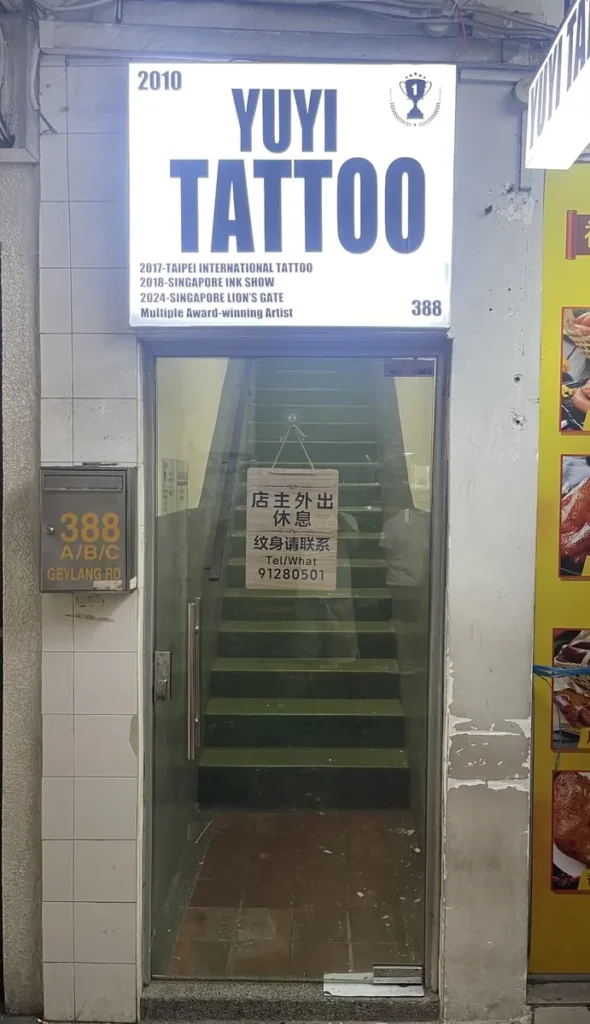
Yuyi Tattoo is in Geylang, Singapore. Use the contact page to confirm visit details and send your design, approximate size, placement, preferred dates and any age or ID question.
Public display: do not turn a tattoo question into a guarantee
A tattoo being lawful to have is not the same as every public use of an image being lawful. Singapore has laws dealing with conduct, public order, unlawful societies and other specific circumstances. The Singapore Police Force has stated that it takes action against people who associate themselves with unlawful societies, including by displaying gang hand signs or slogans. That does not mean an ordinary tattoo is automatically treated as gang activity. It does mean that context matters when an image is deliberately used as part of unlawful conduct.
Likewise, a tattoo that is visible in public is not automatically an offence simply because other people can see ink. Yet no responsible guide should promise that any content, gesture, slogan or public act is always acceptable. If your design references a political cause, a gang, a protected symbol, religion or graphic sexual material, ask a qualified lawyer about the exact circumstances rather than relying on a tattoo blog. Keep the tattoo question separate from the conduct question.
The safest practical rule is simple: choose an image for its personal and artistic meaning, do not use it to signal unlawful affiliation, and follow venue-specific instructions. A studio can also decline a design even when having the tattoo would not itself be a criminal offence.
Does Singapore’s healthcare law make tattoos illegal?
No conclusion that tattoos are illegal follows from the Healthcare Services Act 2020. The Act’s definition of a healthcare service expressly excludes “body tattooing” and “body piercing” from the listed procedures in the relevant provision. That is a scope point about the healthcare-services licensing framework; it is not a statement that every tattoo business has no other premises, workplace or general legal obligations. It also is not a hygiene certification.
Use the statute carefully. It can help explain why a routine tattoo should not be described as a licensed medical treatment under that Act. It cannot answer your age, consent, appointment, design or aftercare questions. If you need a legal opinion about a business structure or a disputed incident, use Singapore’s official legislation portal and obtain professional advice.
Practical checks for local clients
For a resident, the most efficient sequence is:
- Write a clear brief. Include the subject, placement, approximate dimensions, colour direction and reference images you have permission to share.
- Ask the policy questions early. Age, ID, consent, design boundaries and artist assignment are easier to settle before a date is discussed.
- Wait for written confirmation. A friendly reply is not necessarily a booking or a held slot.
- Keep the legal question narrow. If you are concerned about a symbol or public display, identify the exact image and context instead of asking whether “all tattoos” are legal.
- Save current instructions. Studio policy and official information can change; keep the dated response you relied on.
If you are comparing a same-day request with a planned visit, read walk-in versus appointment tattoo planning. It explains why a lawful request can still require an availability check.
Practical checks for tourists
Tourists often ask, “Can tourists have tattoos in Singapore?” The general legal answer does not change merely because the client is visiting. The practical part is planning: a visitor has less time to resolve an age or identification question and less flexibility if the requested design needs a longer consultation.
Before you fly or commit to a day, send the studio:
- your age bracket, without placing sensitive identity documents in an open group chat;
- the type of ID you will bring and whether the studio wants to inspect an original;
- your arrival and departure window;
- the body area, size and style direction;
- whether you want a consultation only or are asking about a tattoo appointment;
- a question about the artist and slot, without assuming either is available.
Read getting a tattoo in Singapore as a tourist for travel-planning questions. It is not a visa or customs guide. Do not assume that an airline, border agency or employer has the same rules as a tattoo studio. Those are separate authorities and separate questions. If a border or visa issue is the concern, check Singapore’s current official immigration information directly.
A tourist should also plan conservatively around healing and activities. Do not book a tattoo immediately before an activity that conflicts with the aftercare instructions you receive. The studio should provide the current instructions for your appointment; this article does not prescribe a medical timeline.
What “legal” does and does not promise
“Legal” is a starting point, not a quality guarantee. It does not promise a particular line quality, healed result, price, time, artist or design approval. It does not verify that a listing’s hours match a live artist’s availability. It does not replace a consultation or a written booking confirmation.
For Yuyi Tattoo, the safe next step is to send a focused brief and ask the unanswered operational questions directly. The studio’s documented portfolio includes black-and-grey realism, large-scale work, portraits and Japanese/Asian-inspired compositions. That portfolio direction can help you decide whether to enquire; it should not be turned into a promise that every concept will be accepted.
Sources and review date
- Singapore Ministry of Home Affairs: Written Reply to Parliamentary Question on Minors Getting Tattoos; reviewed 24 August 2026.
- Singapore Statutes Online: Healthcare Services Act 2020; reviewed 24 August 2026.
- Attorney-General’s Chambers: Singapore Statutes Online; reviewed 24 August 2026.
- Singapore Police Force: Woman to Be Charged for Acting as Member of an Unlawful Society; reviewed 24 August 2026.
Frequently asked questions
Are tattoos legal in Singapore?
The MHA’s published 2019 reply says tattooing a minor is not an offence and that there is no tattoo-specific parental-consent requirement. Having a tattoo is therefore not described as generally prohibited, but specific conduct, design or venue circumstances may raise separate questions.
Is there a legal age to get a tattoo in Singapore?
The cited MHA reply does not set one nationwide tattoo-specific minimum age. A studio may use its own minimum age, ID and consent rules. Confirm the chosen studio’s current policy before travelling or paying anything.
Can tourists have tattoos in Singapore?
Tourists are not given a separate tattoo rule in the MHA reply. Contact the studio early with your travel dates, age and identification question. This article does not provide visa, border or customs advice.
Can a tattoo be illegal because it is visible in public?
Visibility alone is not presented here as a blanket offence. However, a separate law may apply to the conduct, message, image or context. Do not assume that every public display is guaranteed lawful; ask for qualified legal advice about a specific concern.
Does a studio have to tattoo me if the design is legal?
No. A private studio may apply its own age, consent, design, availability and booking policies. A lawful tattoo concept does not guarantee acceptance, a named artist or a same-day slot.
What should I confirm before booking?
Ask about age and ID, consent, design boundaries, artist assignment, availability, appointment status and the aftercare information supplied after the session. Keep the answer in writing and check it again if your travel date changes.

