Raven tattoo meaning depends on the story and source attached to the bird. A single perched raven may suggest observation or waiting; a bird launching into flight introduces departure or action; a specific Norse or Tlingit reference belongs to its own tradition and should be named accurately. None of these readings applies to every raven tattoo.
The central design problem is more practical: a raven is black, often placed in a dark scene and built from overlapping dark feathers. To remain readable, the tattoo needs a recognisable beak and body silhouette, separated wing and tail groups, controlled highlights or open skin, and a background that does not swallow the bird.
Define the raven before defining the symbolism
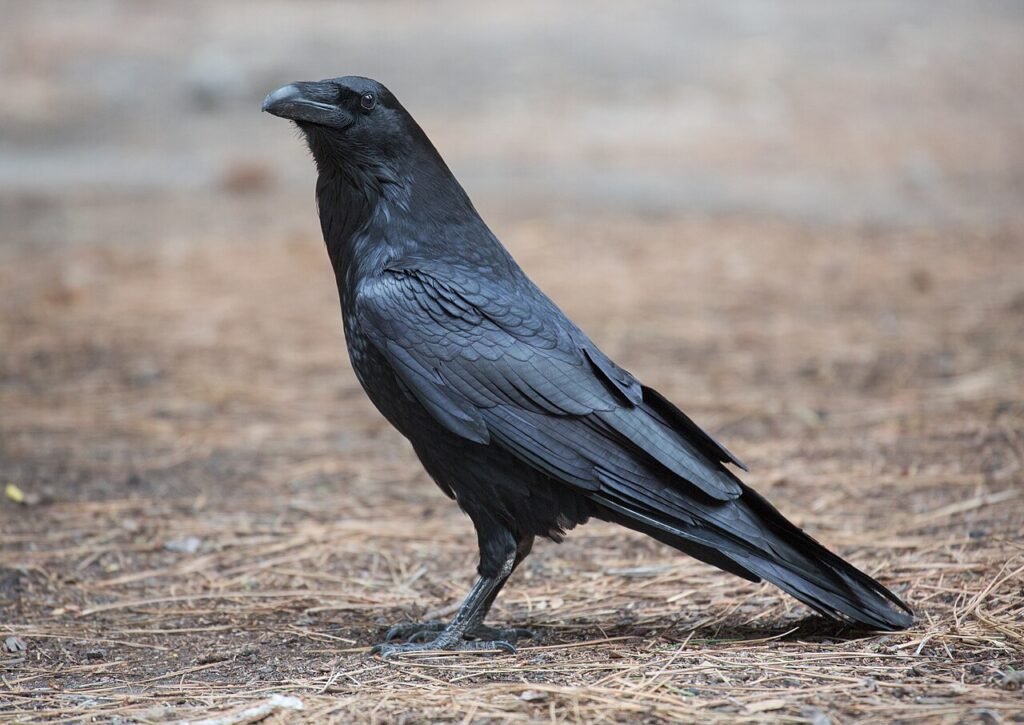
A raven is not simply any black bird. Cornell Lab identification guidance describes the Common Raven as thick-necked, heavy-billed and shaggy at the throat, with long wings and a wedge-shaped tail in flight. These traits give a tattoo its quickest identifiers.
Start with the outer contour. In a perched pose, check the forehead-to-beak line, the weight of the neck, the angle of the back and the length of the tail. In flight, check the fingered wing tips and the tail shape. If those features only become apparent after interior feather lines are added, the base drawing is not doing enough.
Species accuracy does not require a wildlife plate, but it should be intentional. A design may simplify the bird into a graphic silhouette or push the beak and throat for dramatic effect. The brief should say so. Otherwise, mixing a crow body, raven beak and generic eagle wings can produce a dark bird that has no stable identity.
Use meaning as a source note, not a label
Ravens appear in many bodies of art and story. Two documented examples show why context cannot be collapsed.
The Swedish History Museum describes Odin’s ravens Huginn and Muninn as scouts connected with thought and memory in Norse mythology. The National Museum of the American Indian presents Preston Singletary’s Raven and the Box of Daylight as a Tlingit story of Raven and the release of the stars, moon and sun. These are different traditions, stories and visual languages.
If one of them is relevant, identify the precise source and learn what the supporting elements mean within that source. Do not combine a Norse knot, a Northwest Coast formline-style raven, a skull and a random rune and call the result “ancient raven symbolism.” A client may also choose a raven for a private reason with no mythological claim at all.
The mythology tattoo ideas guide can help separate a named story from a general dark-fantasy mood. When working from a living Indigenous tradition, use materials produced by the community, its artists or an appropriate cultural institution, and do not copy a protected contemporary artwork.
Choose the amount of bird the design needs
Raven tattoo ideas usually fall into one of three visual distances.
Head and beak detail
A close head makes the beak, eye, throat hackles and sheen of the plumage the subject. It is suited to a compact field, but it can look like a crow or a generic black bird if the bill is shortened or the neck is cropped too tightly.
The eye does not need a bright white ring. A restrained reflected light or narrow open edge can be enough. Keep the nostril, mouth line and beak planes subordinate to the overall profile. Too many pale scratches across the bill turn a solid form into a diagram.
Perched or standing raven
A perched raven introduces attitude through weight distribution. A lowered body and forward head can feel alert. A tall posture with a turned head can feel watchful. Raised throat feathers add tension; a smoother outline feels quieter.
Give the feet a believable surface. A branch, stone, roof edge or object can connect the bird to the story. The support should not become a separate miniature scene unless it matters. A weak horizontal perch often divides a vertical tattoo in half, so test a diagonal or cropped support instead.
Raven in flight
Flight is best planned as a route. Decide where the bird entered the composition, where it is headed and which wing is nearer the viewer. A gliding raven can use long, calm diagonals. A banking pose shows different wing widths and turns the tail. A bird lifting away from a perch may have compressed legs and a strong upward beat.
Do not mirror the wings unless the pose is deliberately emblematic and front-facing. Natural three-quarter flight contains unequal shapes. That asymmetry gives depth and stops the bird from resembling a flat crest.
Break one black shape into useful masses
Making every feather visible is not the same as making the raven readable. Cornell’s feather anatomy material separates the outer primaries, inner secondaries, coverts and tail feathers by structure and function. A drawing can use those groups without tracing each individual feather.
Begin with four or five large value masses: head and neck, body, near wing, far wing and tail. Decide which edges must stay distinct. Then use a smaller number of feather separations to explain overlap and direction. The primary feathers at the wing tip deserve more individual treatment than the soft body contour.
Open skin can be a highlight, a gap between feathers or a narrow boundary against the background. It should follow form. Random pale lines scattered across black fill create noise and can make the bird appear scratched. Broad tonal shifts and a few selected edges usually describe volume more clearly.
The same discipline applies to the beak. Preserve a clean top line and tip. Use enough tonal separation to show the two mandibles or the turn of a three-quarter view, but do not cut the beak into many equal grey panels.
For broader planning principles, see why tattoo design readability matters. A black-and-grey tattoo planning can also help organise value range and reference priority when the raven is rendered realistically.
Keep the background on a different value plan
A black raven against a black forest, black cloud and black moonless sky has no reliable boundary. The answer is not necessarily a white outline. Change the value or texture behind the important edge.
Mist or open skin can pass behind the beak and breast. A pale moon can separate part of a wing. A lighter stone or weathered branch can hold the feet. Dark foliage may work behind a lighter belly plane but should move away from the darkest wing. Background edges can soften while the beak and leading wing edge remain firm.
Choose one area where the silhouette reads almost instantly. The rest of the bird may dissolve selectively into atmosphere. This controlled loss of edge can feel darker and more cinematic than outlining the entire animal.
If a skull, key, sword, clock or architectural element is added, decide whether the raven interacts with it. Perching, carrying, watching or flying past creates a relationship. Placing several objects around the bird without interaction turns the tattoo into an inventory of symbols.
Direction turns the raven into a story
Direction affects how a raven tattoo moves across the body. A beak aimed toward the centre of the chest or back can pull attention inward. A bird facing toward the hand or foot can extend the composition along a limb. Neither direction is universally correct; it depends on the body field and what else is present.
The head and body do not need to point the same way. A raven looking back over its shoulder creates a pause in an otherwise forward-moving design. A pair can face each other, travel together or occupy different depths. Each arrangement tells a different story before any symbolic object is added.
For an owl comparison, see owl tattoo meaning and placement. An owl is usually recognised first through its facial disc and large eyes. A raven relies more heavily on beak profile, tail, neck gesture and black-shape control.
Placement should preserve the recognisable edge
Match raven tattoo placement to the main silhouette.
- Forearm or calf: A perched bird, head-and-shoulder crop or rising diagonal can use the long field. Keep the beak and eye on a viewable face of the limb.
- Upper arm or thigh: A three-quarter bird can use the wider mass and slight wrap. Check whether a trailing wing or tail disappears around the side.
- Shoulder and chest: A raven launching across the collar or turning over the shoulder can use the body’s change of plane. Do not place the main beak break directly on the deepest fold.
- Upper back or back: The width can support open flight, a pair of birds or a larger narrative setting. More area does not require more objects.
- Ribs or side torso: A climbing or descending flight path can follow the vertical field. A wide frontal wingspan may distort as it wraps.
Test the design as a flat image and on the body. A wing that looks complete on paper may only be seen in sections around an arm. Decide whether that reveal is intentional. The bird’s most identifiable edge should still be available from the main viewing angle.
Build a reference set that protects contrast
Choose one primary bird photograph for pose and proportions. Add a side view if the beak is unclear, a flight reference if the wing is hidden and one mood reference for the background. Do not ask the artist to combine the head, both wings and tail from unrelated lighting without deciding which image controls the structure.
Black feathers are rarely one featureless black in a photograph. Look for planes created by light, overlap and sheen, then select references where those planes are visible. Avoid images in which compression or deep shadow has already merged the beak, neck and wing.
If a historical or cultural reference is part of the idea, attach the museum or community source as well as the image. State which detail matters and which parts are open to interpretation.
Prepare a raven tattoo enquiry
Before contacting Yuyi, write a concise brief with:
- raven species or intentionally stylised direction;
- close head, perched bird or flight pose;
- head and travel direction;
- cultural, literary or personal source, if any;
- one main background element;
- preferred body area and approximate size in centimetres;
- black-and-grey or colour preference;
- one primary reference and a few supporting images.
Send it through the Yuyi Tattoo contact page. The references establish priorities for discussion; they do not mean that every feather or story element will fit the chosen scale. Project scope, availability and arrangements are confirmed directly.
Sources and review date
- Cornell Lab of Ornithology: Common Raven Identification — reviewed 24 August 2026.
- Cornell Lab Bird Academy: Everything You Need to Know About Feathers — reviewed 24 August 2026.
- Swedish History Museum: Odin, Leader of the Gods — reviewed 24 August 2026.
- National Museum of the American Indian: Preston Singletary, Raven and the Box of Daylight — reviewed 24 August 2026.
Frequently asked questions
What does a raven tattoo mean?
A raven tattoo has no single universal meaning. Its reading may come from a named cultural story, literature, the bird’s observed behaviour or a personal association. Record the specific source and choose a pose that supports the intended story rather than relying on a generic symbol list.
How do you keep a raven tattoo from becoming a black shape?
Preserve the outer beak, neck, wing and tail silhouette first. Separate a few large value masses, use open skin or lighter tone at selected overlaps, and place a contrasting value behind important edges. Adding fine feather lines cannot rescue a silhouette that has already merged.
What is the difference between a raven and crow tattoo?
For a Common Raven reference, useful visual markers include a heavy beak, thick neck, shaggy throat, long wings and a wedge-shaped tail in flight. A deliberately stylised design can exaggerate these, but the reference should make the choice clear.
Where should a raven tattoo be placed?
Perched and close-up ravens can suit the forearm, calf, upper arm or thigh. Open flight and multi-element scenes need broader fields such as the chest, shoulder or back. Judge placement by whether the beak, wing edge and tail remain readable from the main viewing angle.
What should I send for a raven tattoo consultation in Singapore?
Send the preferred pose and direction, body area, approximate size, colour direction, one primary bird reference and a few supporting images. Add the exact source for any mythological or cultural element and explain which parts of the story matter to you.