
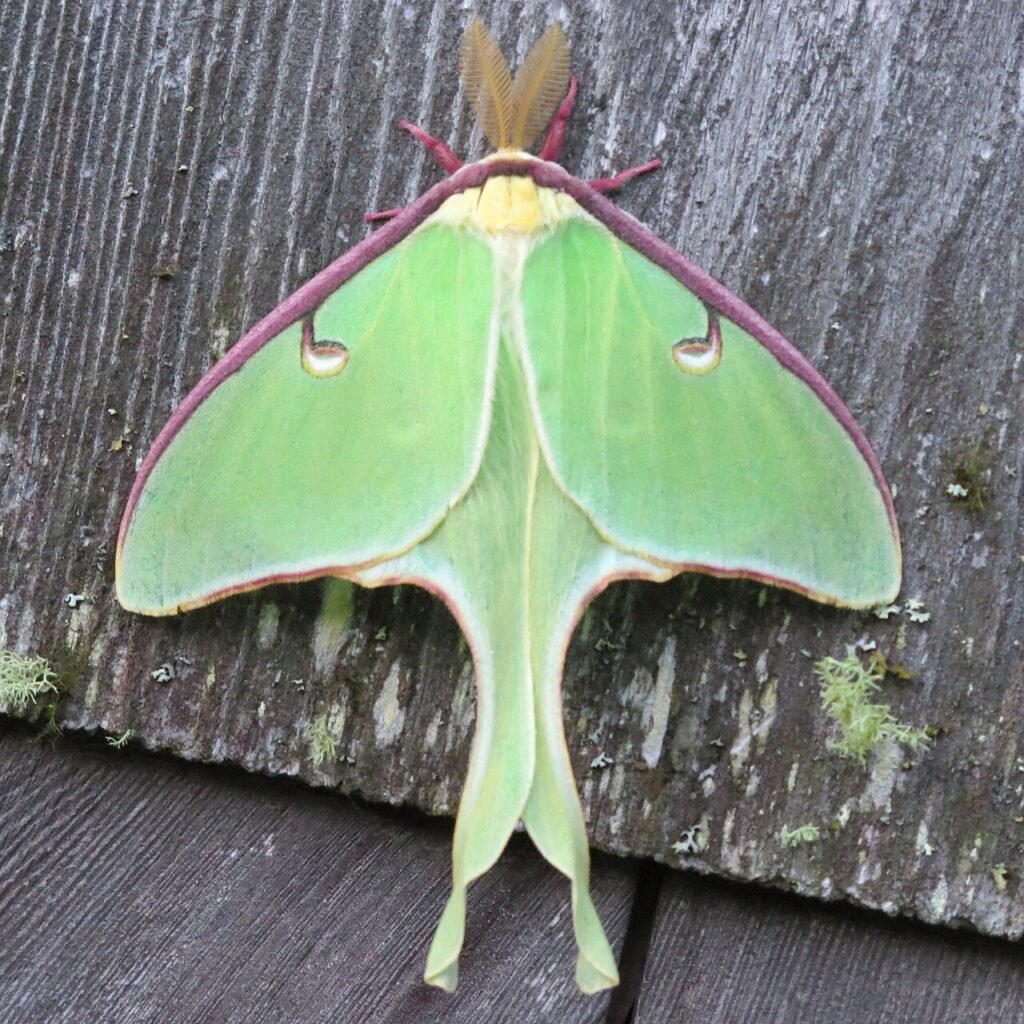
Moth tattoo meaning is not fixed. A moth may be chosen for a personal connection with night, attraction to light, concealment, a particular species or a specific literary or religious source. The wing position, body shape, antennae and surrounding objects usually communicate that idea more clearly than the word “moth” on its own.
Visually, a moth tattoo often differs from a butterfly through a heavier central body, feathery or otherwise distinctive antennae, varied resting postures and denser wing texture. These are tendencies, not universal rules. Choose a species or an intentionally invented design before deciding how the pattern and placement should work.
Do not build the design from a stereotype
Moths and butterflies both belong to Lepidoptera, and the boundary is more varied than the familiar “dull night moth versus colourful day butterfly” contrast. The Natural History Museum notes that moths can be brightly patterned and iridescent, while some are active by day. Antenna shape, resting posture, body build and wing structure can help with identification, but exceptions remain.
For a tattoo brief, that biological variety is useful. It gives several legitimate directions:
- a luna-like moth with long tails and a light, open silhouette;
- an atlas moth with broad wings, strong tips and a substantial body;
- a hawk moth with a long, streamlined shape;
- a tiger or emperor moth with bold bands or eyespots;
- a compact furry moth with folded or roof-like wings;
- an ornamental moth assembled from real anatomical cues without claiming to show a species.
Choose the reference because its outer shape and pattern fit the idea, not because a search result assigns it a convenient meaning. If the design is invented, keep the body, legs, antennae and wing attachment coherent enough that the insect still reads as intentional.
Let the body carry more visual weight
Butterfly tattoos often emphasise a narrow body between large wings. Many moth references support a thicker thorax, softer abdomen and more visible texture along the centre. That central mass can make the tattoo feel grounded, nocturnal or tactile before any moon is added.
The body should not become a black divider that disconnects the wings. Use a clear head, thorax and abdomen sequence. Antennae can rise, curve outward or follow the upper wing edge, but they need enough space to remain separate from decorative lines. Legs may be simplified, especially in a top view, yet their direction should still relate to the body rather than emerge from the wing pattern.
In a black-and-grey moth, alternate soft body texture with firmer wing edges. In a colour design, the body can remain restrained so the wing markings keep priority. If every hair, segment and leg receives the same contrast, the centre becomes busier than the silhouette.
Wing position changes the entire footprint
A moth can be shown pinned-flat, resting, angled in flight or partly folded. Each version occupies a different body field.
Open top view
An open top view displays both wings and makes the design easy to recognise from a distance. It suits a balanced placement, but it also exposes inconsistencies between the left and right patterns. Keep the major forewing and hindwing boundaries related. Small differences can make the insect feel organic; accidental changes in length or attachment can make it look damaged.
This pose works when the pattern is the main attraction. It may become too wide for a narrow forearm or calf unless the wings wrap, tilt or simplify.
Roof-like resting pose
Some moths rest with the wings drawn over the body. The result is narrower and more triangular, with less visible hindwing. It can fit a vertical field and gives the body a sheltered appearance. The artist needs a reference from the same angle because copying an open upper-wing pattern onto a folded pose can produce impossible overlaps.
Angled or flying pose
An angled moth gives one wing more area than the other and creates direction. It can move across a shoulder, wrap around an arm or approach a light source. The farther wing may show less pattern and lower contrast. That loss is useful depth, not missing detail.
Before settling on a pose, reduce the reference to a solid outline. If the design still looks like the intended moth, the pattern has a stable structure to sit on.
Pattern density must follow scale
Moth wings may contain bands, veins, speckles, scalloped margins, transparent windows and eyespots. The Natural History Museum describes eyespots as contrasting ringed markings found in both butterflies and moths. In nature they can affect predator behaviour; in a tattoo they also become strong focal points that compete with the insect’s head.
Choose a pattern hierarchy:
- outer wing shape and forewing-to-hindwing division;
- one or two large markings, such as an eyespot, window or band;
- principal veins or directional lines;
- selected small speckles, hairs or border marks.
Do not give every level equal darkness. A pair of eyespots may anchor the wings while the smaller speckle field stays quiet. A transparent-window motif can use open skin instead of a dense white border. Scalloped edges should alter the silhouette rather than be drawn as decoration inside a smooth wing.
At a smaller size, retain the markings that identify the species and remove subordinate texture. At a larger size, more pattern can remain, but the viewing order should still be clear. The tattoo design readability guide explains why scale and contrast matter more than counting tiny elements.
Symmetry can be formal without looking mechanical
An open moth invites a symmetrical layout, especially on the sternum, upper back or another centred placement. The goal is correspondence, not a perfect digital mirror. A body is not a flat sheet, and breathing, posture and muscle shape change the apparent relationship between both wings.
Keep the large landmarks aligned: upper tips, lower wing corners, major eyespots and the central body. Within that framework, texture can vary slightly. If one wing is intentionally lighter, damaged, floral or geometric, the difference should support a stated concept rather than look like an error.
An asymmetrical pose can be more natural on the shoulder, thigh or side torso. Rotate the moth, shorten the far wing and let antennae or trailing decoration continue the direction. The symmetrical versus asymmetrical tattoo design guide provides a wider method for comparing formal balance with body-led movement.
Night imagery needs a chosen relationship
Moon, stars, flame and darkness are common moth tattoo ideas, but they do not mean the same thing. Decide how the insect relates to the element.
A moth below a moon may be part of a quiet night scene without moving toward the moon. A moth circling a lamp or flame creates a directional pull and a different story. A halo behind the wings can work purely as contrast. Sparse stars can occupy open background, while a dense star field may interfere with speckles already present on the wings.
Moth-and-flame imagery also has documented cultural contexts. The Metropolitan Museum of Art records a sixteenth- or seventeenth-century Iranian lamp stand inscribed with lines from Sa’di’s “The Moth and the Candle.” The museum explains the moth drawn to the flame within a Sufi allegory of the soul and divine light. That is a specific poetic and religious reference, not the universal meaning of every moth-and-flame tattoo.
If that source matters, name it and research the poem rather than borrowing the image as generic “self-destruction.” If the design is personal, describe the intended relationship in your own words. For lunar phase and orientation choices, use the Japanese and Asian-inspired tattoo planning.
Separate the moth from its background
Dense moth patterns can disappear into leaves, smoke, lace or a dark sky. Protect the wing tips and body by changing the value behind them. Open skin can create a quiet halo. A moon can pass behind one part of the upper wings. Dark foliage can frame a pale moth, while a darker moth may need a lighter atmospheric field.
Avoid tracing the entire insect with one hard outline if the style is realistic. Use firm edges at the focal wing tips or head, and allow selected lower edges to soften. The alternation makes the wing feel layered without losing the overall footprint.
Flowers should be chosen by scale and role. One flower may support or overlap the moth; several equally detailed blooms can overpower it. If the flower carries personal or cultural meaning, keep that meaning separate from claims about the moth species unless a real ecological relationship is documented and relevant.
Moth and butterfly tattoos make different briefs
The choice is not “dark versus pretty.” A moth can be colourful, and a butterfly can be sombre. Compare the shape you want.
A moth brief may prioritise a heavier body, feathery antennae, roof-like resting wings, eyespots, powdery texture or a night setting. A butterfly brief may prioritise a slimmer central axis, clubbed antennae, a particular open or folded view and a different wing outline. The butterfly tattoo meaning and placement guide covers those butterfly-specific decisions.
When you like features from both, decide whether the final insect is a fantasy design. That is clearer than calling it a real species and changing its defining anatomy.
Match moth tattoo placement to the wing map
- Sternum: An open moth can use the centre line, but the wings must be fitted to the rib contours and checked in a natural posture.
- Upper back: A broad open-wing design has room for pattern and an optional moon or halo. Keep the insect dominant if the background expands.
- Forearm or calf: A folded, narrow or diagonally angled moth fits the long field more naturally than a very wide flat specimen.
- Upper arm or thigh: A medium-to-large open or three-quarter moth can use the width and gentle curve. Check whether the far wing wraps out of the main view.
- Shoulder or shoulder blade: An angled moth can follow movement across the joint or sit within the flatter blade. Do not split the central body across a strong change of plane without testing it.
- Ribs or side torso: A vertical moth, moon-and-moth pairing or upward flight route can use the height. Formal symmetry is harder to judge from one view on a curved side placement.
Placement photographs should show the whole body area in a relaxed stance. Include a straight view and an angle. State approximate size in centimetres rather than “small” or “medium,” because pattern survival depends directly on available space.
Prepare a moth tattoo brief
Send a concise set of decisions:
- species name, primary image or a clear note that the moth is invented;
- open, resting, folded or angled wing position;
- essential wing markings ranked by importance;
- personal, literary or cultural context, if any;
- moon, flame, flower or other secondary element, with its role stated;
- colour or black-and-grey direction;
- body area, left or right side and approximate size;
- one primary reference and a few supporting images.
Use the Yuyi Tattoo contact page to share the brief. Reference material starts the design discussion; it does not guarantee that every spot, vein or background detail can remain at the chosen size. Final scope, availability and project arrangements are confirmed directly.
Sources and review date
- Natural History Museum: Spot the Difference, Butterfly or Moth? — reviewed 24 August 2026.
- Natural History Museum: Why Do Some Butterflies and Moths Have Eyespots? — reviewed 24 August 2026.
- Smithsonian National Museum of Natural History: Insect Zoo Audio Description Tour — reviewed 24 August 2026.
- The Metropolitan Museum of Art: Engraved Lamp Stand with a Cylindrical Body — reviewed 24 August 2026.
Frequently asked questions
What does a moth tattoo mean?
A moth tattoo has no universal meaning. It can draw from a personal connection with night, a real species, literature or a named cultural source. The pose and supporting object should communicate that context rather than relying on a generic symbolism list.
How is a moth tattoo different from a butterfly tattoo?
Many moth references offer a heavier body, distinctive antennae, varied resting poses and dense wing texture, but there are exceptions. Choose an actual species or state that the insect is invented. Do not assume all moths are brown, nocturnal or shown with open wings.
Does a moth tattoo have to be symmetrical?
No. An open top view often uses formal symmetry, while a resting or flying moth can be angled and asymmetrical. On a centred placement, keep major wing landmarks related but fit them to the body rather than forcing a perfect flat mirror.
Where should a moth tattoo be placed?
Broad open moths can suit the sternum, upper back, upper arm or thigh. Narrow resting poses and angled moths often fit the forearm, calf, shoulder or side torso. The best placement preserves the central body and main wing tips from the intended viewing angle.
What should I send for a moth tattoo enquiry in Singapore?
Send a primary species or pose reference, the essential wing markings, body area, approximate size and colour direction. Add a few supporting images for antennae, pattern or background, plus the exact source for any cultural or literary theme.


