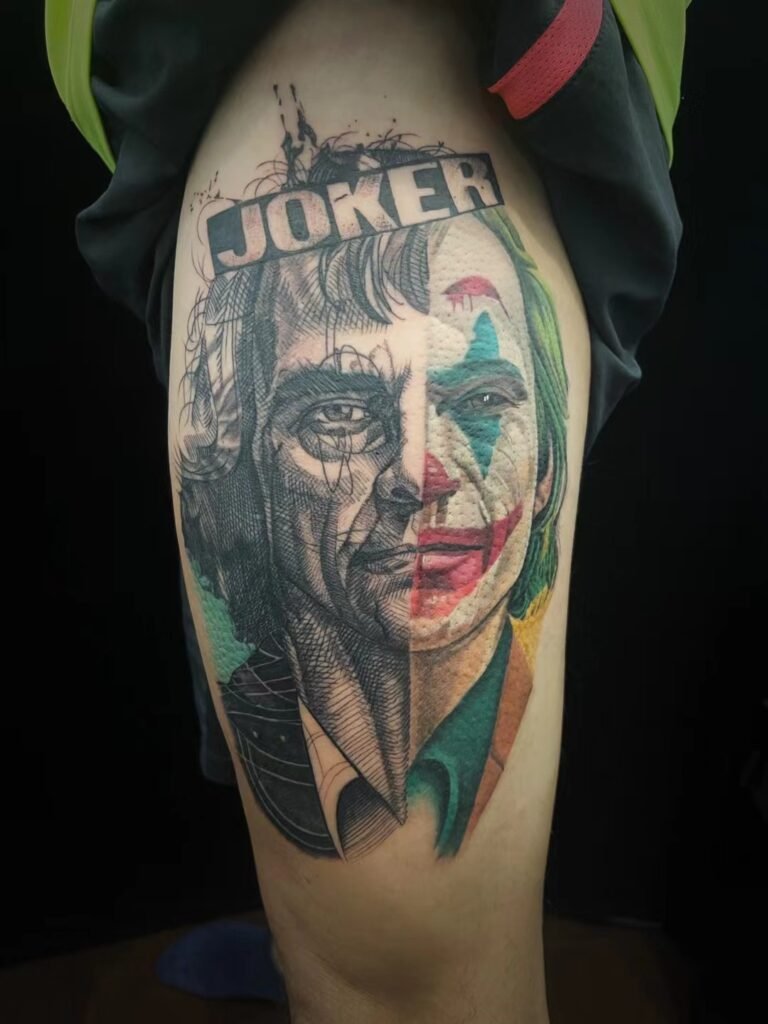
Portrait tattoo facial landmarks should be ranked by how strongly they identify the person in the chosen view. The spacing and tilt of the eyes, the route from nose to mouth, the jaw and cheek silhouette, the hairline and the expression usually matter more than pores, individual eyelashes or every strand of hair.
Likeness comes from relationships, not a checklist of isolated features. An accurately drawn eye can still feel wrong if it sits too high, too far from the nose or at the wrong angle to the mouth. Before discussing extra detail, identify the few distances, shapes and expressions that cannot change without changing who the portrait appears to be.
A proportion guide is only a starting grid
Portrait instruction often begins with average proportions. Getty Museum education material, for example, uses broad guides for the vertical positions of the eyes, nose and mouth. Those guides help establish a recognisably human head. They do not define an individual face.
The differences from the average are often where identity lives: eyes that sit closer together, a long space between nose and upper lip, an uneven brow, a narrow chin, a distinctive hairline or one side of the mouth that rises more than the other. Correcting those differences toward a standard face may make a drawing more conventionally balanced and less like the person.
Treat the reference as its own coordinate system. Mark the eye line, centre line, base of nose, mouth line and chin. Then compare widths and gaps within that photograph. Do not transfer measurements from a straight-on teaching diagram to a three-quarter or tilted head.
Getty’s research on Roman Egyptian mummy portraits makes the angle issue visible: as a head turns, the receding side compresses, the nose shifts relative to the centre and the jaw outline changes. A tattoo design has to preserve that turn. Making both sides of the face equally wide can flatten a three-quarter portrait even if each feature is carefully rendered.
Map relationships before rendering detail
Use a simple landmark map before thinking about shading. On a copy of the primary reference, identify:
- inner and outer corners of both eyes;
- highest points of the brows and their distance from the eyelids;
- bridge, tip, nostril edges and base of the nose;
- centre and corners of the mouth;
- philtrum and chin centre;
- cheekbone turns and widest jaw points;
- hairline breaks, temple shape and top of the head;
- visible ear position and the neck-to-jaw connection.
Draw a few light guide lines between them. The point is not to cover the photograph with a technical mesh. It is to reveal dependencies. Moving an eye changes its distance to the nose and brow. Widening the mouth changes its relationship to the pupils and jaw. Shortening the chin changes the lower-face proportion even when the lips remain unchanged.
Research on face recognition distinguishes individual features from configural information, meaning the spaces and relationships between those features. A review indexed by the US National Library of Medicine reports that altering the distance between the eyes can affect recognition of other unchanged features. For portrait tattoo planning, the practical lesson is clear: protect the arrangement as well as the parts.
Eye spacing includes brows and lids
“Keep the eyes” is too vague. The recognisable eye region includes spacing, size, lid shape, brow route, depth of the socket and the direction of the gaze.
Start with the line connecting both inner corners. Is it level in the image, or does the head tilt? Compare the visible width of each eye. In a three-quarter view, the far eye may look narrower. Making both eyes identical can undo the turn. Check the amount of upper lid visible, the lower-lid curve and whether the iris touches either lid.
Brows contribute more than hair texture. Their distance from the eyes, thickness, peak and asymmetry frame the expression. A raised brow, a straight low brow and a rounded brow can change the person’s apparent mood even when the eyes below are similar.
The eye highlight is a small detail, not a substitute for structure. It should follow the same light source as the rest of the face. Two oversized identical white points can make the gaze feel artificial. Preserve the pupil direction and eyelid relationships first.
The nose is a route through the face
In a frontal portrait, the nose may have few hard outlines. It is often described by the brow transition, side planes, nostrils, base shadow and highlight along the bridge or tip. Drawing a continuous dark contour down both sides can make it look pasted onto the face.
For likeness, compare:
- bridge width and where it begins near the brows;
- length from eye line to base;
- direction and projection of the tip;
- width and height of the nostrils;
- asymmetry between both alae;
- gap from the base of the nose to the upper lip.
The nose also confirms head angle. In a three-quarter view, its tip and base shift across the face, and one nostril may be more visible. In profile, the forehead-to-bridge and tip-to-upper-lip contours become major identifiers. Do not straighten a distinctive bridge or reduce a prominent tip merely to match a generic portrait template.
Mouth geometry carries expression
The mouth is more than an outline around two lips. Its corners, centre line, upper-lip peaks, lower-lip volume and relationship to the nose and chin all affect identity. Teeth, if visible, belong to the expression but should not be separated into a row of equally dark individual shapes.
Find the resting direction of the mouth line. One corner may sit higher. The centre may project or recede. A smile changes the cheeks and lower eyelids as well as the lips, so copying a smiling mouth into a neutral eye region creates conflicting signals.
OpenStax anatomy material explains that muscles of facial expression move skin around the eyes, nose and mouth. A portrait does not need anatomical labels, but it should respect the connected result. Narrowing eyes, lifting cheeks and changing the mouth corners are parts of one expression.
Jaw, cheek and chin define the outer map
Internal features receive attention because we look at eyes, nose and mouth. The external contour still matters. PubMed-indexed research finds that both internal features and external features such as hair and head outline contribute to how faces are represented and recognised.
Trace the silhouette from temple to cheek, jaw angle and chin. Note where it changes direction. A round face may depend on a continuous cheek-to-jaw curve; a narrower face may have a visible jaw corner and pointed chin. The same mouth and nose inside the wrong outline can resemble a different person.
Do not confuse a cast shadow with anatomy. Strong side lighting may hide one jaw edge or create a dark triangle under the cheekbone. Compare another authorised photograph only when it clarifies the same person’s underlying structure. The primary image should still control pose and expression.
Hairline, ears and head outline are landmarks too
Hair is often simplified in a tattoo, but the hairline should not be treated as disposable texture. A widow’s peak, recession at the temples, parting, fringe or shaved edge can contribute strongly to recognition. Preserve the large hair mass and the places where it meets the forehead before adding individual strands.
The top and back of the head establish proportion. If a reference is cropped through the hair, ask whether another image can confirm the missing outline. Do not invent a full hairstyle from a different age without stating that choice.
Ears may be secondary in a front view and decisive in a close profile. Their height, projection, piercings or relationship to the jaw can help identity, but they should not receive more internal detail than the face unless that detail has personal importance.
The portrait tattoo reference photo guide covers focus, lighting, crop and permission. This article assumes a usable primary reference and asks what must survive once the face is translated.
Expression is a landmark system
Expression should be named before features are adjusted. “Warm smile,” “reserved,” “laughing,” “determined” or “neutral” gives the artist a direction, but it must match the evidence in the photograph.
Check expression across five areas:
- brow height and tension;
- eyelid opening and the lower-lid shape;
- cheek lift or compression;
- mouth corner direction and tooth visibility;
- jaw opening and chin tension.
If the portrait is of someone personally known to you, explain which expression feels characteristic. Do not ask for an expression assembled from several unrelated photographs unless you accept that the artist must interpret missing relationships. A familiar half-smile may rely on a small asymmetry that a standardised smile would remove.
Rank what must stay, what can simplify and what can leave
Create a three-level priority note.
Must stay
List the landmarks that carry identity in the chosen reference. Examples might include close-set eyes, a high left brow, a long nose-to-mouth distance, a crooked smile, a square jaw and a deep temple hairline. Keep this list short enough to be useful.
Can simplify
Place repeated or low-priority texture here: individual hair strands, tiny skin marks, pores, minor fabric pattern, eyelashes and weak background detail. Simplifying does not mean deleting all texture. It means protecting room for the higher-value landmarks.
Can leave
Remove accidental distractions such as compression artefacts, glare, a temporary object covering the face or an irrelevant background. Do not remove a scar, mole, line or asymmetry that matters to identity without discussing it.
This hierarchy helps the design stay readable. The tattoo design readability guide explains how viewing distance, scale and contrast affect what survives. It does not establish a minimum size or guarantee how any portrait will age.
Test the landmark hierarchy before approval
Review the design in three ways. First, look at the full face without zooming. Does it read as the intended person before you inspect texture? Second, compare the landmark map with the primary photograph: eye spacing, nose route, mouth line, jaw and hairline. Third, reduce the design to the approximate size it will appear in an ordinary photograph of the body.
Avoid flipping rapidly between two images and judging only whether they feel similar. Compare one relationship at a time. If something feels wrong, describe the relationship: “the far eye looks too wide for this head turn” is more actionable than “the face is off.”
Use the broader tattoo design review checklist for spelling, orientation, crop and project scope. Design-review timing, revisions and approval arrangements depend on what the studio confirms for the project.
Prepare a facial-landmark brief
Before contacting Yuyi, prepare:
- one primary, authorised portrait reference;
- the person’s name or your private identifier for the project;
- the intended expression and head angle;
- three to six must-keep landmark relationships;
- any scar, mole, hairline feature or asymmetry that must remain;
- details that can simplify or be removed;
- intended body area and approximate size;
- one supporting image only for each clearly stated gap.
The documented Yuyi portrait realism page provides service and portfolio context. For an enquiry, use the Yuyi Tattoo contact page and send the landmark priorities with the images. Likeness cannot be promised by a photograph or landmark checklist, and not every source image can preserve every feature at every scale. Final feasibility, scope and project arrangements are confirmed after review.
Sources and review date
- J. Paul Getty Museum: Looking at Portraits, Portraits in Line — reviewed 24 August 2026.
- Getty Publications: A Study of the Relative Locations of Facial Features within Mummy Portraits — reviewed 24 August 2026.
- US National Library of Medicine: The Parts and Wholes of Face Recognition — reviewed 24 August 2026.
- PubMed: A Face Is More Than Just the Eyes, Nose, and Mouth — reviewed 24 August 2026.
- OpenStax: Axial Muscles of the Head, Neck, and Back — reviewed 24 August 2026.
Frequently asked questions
Which facial landmarks matter most in a portrait tattoo?
Priority varies by face and angle, but the relationships among the eyes, nose, mouth, jaw, cheek and hairline usually carry more identity than pores or individual hairs. Mark the distinctive departures from average proportions and protect those first.
Are the eyes always the most important feature?
Eyes often lead attention, but likeness is holistic. Eye spacing depends on the brows, nose and head angle, while the jaw and hairline contribute to the outer face. A perfect isolated eye will not preserve identity if those relationships change.
Can a portrait tattoo simplify wrinkles and hair?
Yes, when the simplification protects stronger landmarks. Keep wrinkles, hairline breaks, scars or asymmetries that identify the person or expression. Repeated strands, pores and minor texture can often be reduced, subject to the artist’s design review.
How do I explain that a portrait design does not look right?
Name a relationship rather than asking for more detail. Compare the far-eye width, brow height, nose-to-mouth gap, mouth-corner tilt, jaw angle or hairline with the primary reference. Specific observations are easier to review than a general request to make it “more realistic.”
What should I send for portrait tattoo likeness planning?
Send one primary authorised photograph, the intended expression and angle, a short list of must-keep landmarks, the proposed body area and approximate size. Add supporting images only when each one answers a defined question about a feature hidden or unclear in the main reference.