
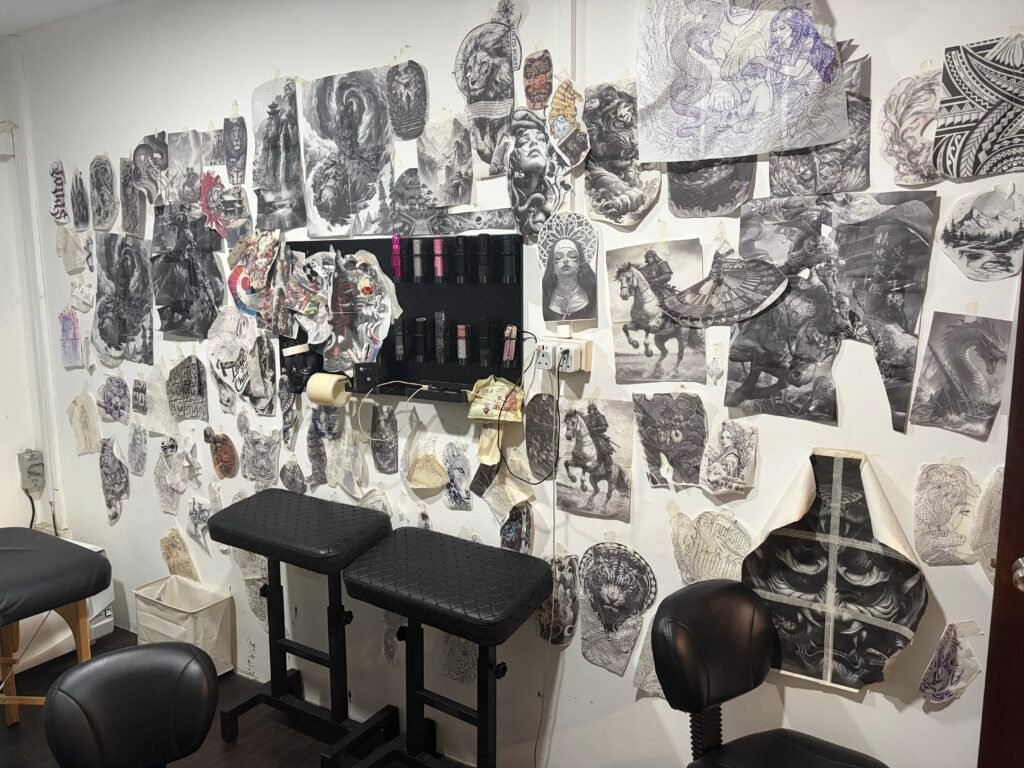
If you get a chance to review a tattoo design before the appointment, check seven things: the subject, spelling or characters, placement direction, scale, composition, reference use, and what is actually approved. Focus on decisions that become difficult or impossible to change once tattooing begins.
Do not assume every studio sends designs in advance or offers a fixed number of changes. A design may be discussed by message, adjusted at the appointment, or finalised after the artist sees the body area. Prepare clear revision questions, then ask which review process applies to your project.
First, confirm what you are reviewing
Before commenting on the design, ask what stage it is in. Is it a rough concept, a near-final drawing, a stencil layout, or a placement mock-up? Each stage deserves a different kind of feedback.
A rough concept is for subject, direction, and composition. Do not over-focus on tiny texture marks that may not be final. A stencil layout is for size, position, and line decisions. A placement mock-up is for how the design sits on the body, not necessarily for exact tone or shading.
Ask: “Which parts of this are fixed, and which parts will still be adjusted on the day?” That is a better question than “Can you change everything?” It respects the artist’s process while making sure you do not accidentally approve something important.
If the design is only discussed in person, bring your notes and use the same checks at the appointment. Ask how and when Yuyi reviews designs rather than assuming a drawing will be sent before every booking.
Check the subject against the original brief
Start with the main subject. Does the design still show the person, animal, object, flower, mask, or scene you asked for? Has anything important been removed, added, or changed?
Use plain language. “The tiger should have a closed mouth” is clearer than “It feels less calm.” “Please keep the round glasses from the photo” is clearer than “Make it more like him.” If a detail matters for recognition, name it directly.
Then check hierarchy. What reads first? In a portrait, the face should usually lead. In a Japanese composition, the main figure should not be buried by background. In a black-and-grey piece, dark areas should support the subject rather than swallow it.
If you need examples of how subject, background, and empty skin work together, view Yuyi’s tattoo work and compare the design to pieces in the same visual family. Do not compare it to every tattoo you like online. Compare it to the style you actually booked.
Check tattoo spelling, numbers, and characters slowly
Text needs a separate review. Names, dates, coordinates, roman numerals, Chinese characters, Sanskrit, Japanese kana, Arabic script, and any language you do not personally read should be checked before the appointment.
Do not rely on a screenshot, an auto-translation, or a memory of what a character means. Send the exact spelling in typed text and, if needed, a clear image of the preferred written form. Check uppercase and lowercase letters, accents, punctuation, date order, and spacing. For dates, decide whether you mean day-month-year, month-day-year, or year-month-day.
Chinese and calligraphy tattoos need extra care because the written character, calligraphic style, direction, and cultural context can all matter. If this is your plan, read the Chinese calligraphy tattoo guide before approving the design. Ask whether the artist is copying your provided text exactly or interpreting it in brush style.
Unicode’s work on visually confusable characters is a useful reminder that some characters can look similar while being different. That is not a tattoo rule, but it supports a simple habit: verify the exact character or letter from a trusted source, not only from how it looks in a font.
Check placement direction and body orientation
A design can be correct as a drawing and wrong as a tattoo if it faces the wrong direction. When reviewing the design, imagine it on the body in the posture that matters most: standing relaxed, arm hanging, arm bent, back straight, or leg forward.
Ask where the top, face, or main movement points. For an arm tattoo, does the subject face the hand or shoulder? For a calf tattoo, does it face the knee, foot, front, or side? For a back or chest piece, is it centred, offset, symmetrical, or deliberately angled?
Use body landmarks. “The mask should sit above the elbow and face toward the shoulder” is more useful than “Move it up a bit.” If the artist has not seen the area recently, send a plain photo with scale or bring that discussion to the appointment.
Do not approve a design only because it looks good on a flat screen. Ask how it will sit over curves, muscle, and joints. The artist may need to stretch, taper, or reposition parts of the composition so it works on skin.
Check scale, detail, and readability
A tattoo design should match the size you are willing to wear. Look for tiny details that may not hold at the intended scale: eyelashes, fur, small script, thin jewellery, background texture, or crowded leaves. Ask what will remain readable after the design is reduced to the placement size.
The right question is not “Can you keep all the detail?” It is “What details are essential, and what can be simplified so the tattoo reads clearly?” An artist may recommend increasing the size, reducing background, strengthening contrast, or removing secondary elements.
For black-and-grey realism, check whether there is enough contrast to separate the subject from the background. For Japanese or Asian-inspired work, check whether the main motif, background, and negative space have a clear rhythm. For script, check whether the letters have enough room between strokes.
If a design already looks crowded, do not assume tattooing will make it clearer. Ask about composition changes before ink is applied.
Check composition, crop, and negative space
Tattoo composition review is about how the eye travels. Where does the viewer look first? Where does the design breathe? Does the crop feel intentional or accidentally cut off? Is there enough open skin, or does every part compete?
For portraits, check whether the crop preserves recognisable features: eyes, brow, nose, mouth, jaw, hairline, or the specific silhouette. For animals, check whether the head, expression, and body movement are clear. For flowers, check whether the bloom, stem, and leaves support the shape of the body.
Negative space is not empty by accident. It can separate a subject from background, create movement, and keep the tattoo readable from a distance. If you are tempted to fill every gap, ask whether that would weaken the design.
If something feels off, point to a specific area. “The background is competing with the face” is useful. “I do not like the vibe” is hard to act on. Good revision notes are visible, not emotional puzzles.
Check reference use and permission
Review whether the design depends too closely on a protected image, professional photo, online artwork or another artist’s finished tattoo. IPOS explains that photographs and other artistic works can be protected by copyright, and an image found through a portal may still require permission depending on its terms and use.
An artist may be able to develop a different composition, but that does not automatically resolve copyright or personal permission questions. If a professional portrait, commercial character, brand mark or another artwork is central to the design, confirm the source and seek permission or qualified advice before approval.
Ask revision questions without demanding a revision policy
Keep revision questions narrow. Do not ask for a full redraw if the issue is placement direction. Do not ask for three alternatives if you only need the date checked. A good revision request names the problem and the desired decision.
Examples:
- “Can the face be turned slightly more toward the shoulder?”
- “Can we remove the clock so the portrait has more space?”
- “Can the background be lighter so the animal reads first?”
- “Can you confirm the Chinese characters match this typed text?”
- “Is this size large enough for the lettering to stay readable?”
- “What part of this will be adjusted when the stencil is placed?”
These are questions, not demands for a fixed number of changes. They help the artist decide what is reasonable before the appointment.
Confirm what approval means
Before the appointment, confirm what your approval covers. Does it approve the subject only? The full composition? The placement direction? The size range? The text? The reference source? The date and artist? Write down anything that remains pending.
If you have approved text, do not change it casually on the day. If you have approved a placement, do not arrive wanting a different body area without expecting the design to change. If the design depends on a reference image, do not swap the image at the last minute and expect the same appointment plan to hold.
When you are ready to discuss a design or appointment step, contact Yuyi Tattoo. For artist background, see Yuyi artist and awards. Yuyi Tattoo is in Geylang, Singapore. WhatsApp: +65 9128 0501.
Sources and review date
- IPOS AskGov — Using images from Google Images or portals — reviewed 24 August 2026.
- IPOS AskGov — Photographer copyright ownership — reviewed 24 August 2026.
- The Unicode Consortium — Unicode Technical Standard #39 — reviewed 24 August 2026.
- National Gallery Singapore — Our Collections image requests — reviewed 24 August 2026.
Frequently asked questions
Will every tattoo studio send the design before the appointment?
No. Design-sharing practices differ by studio, artist, project type, and timing. Some designs are discussed by message, some are reviewed in person, and some are adjusted after the artist sees the body area. Ask what the process is for your project instead of assuming a fixed preview.
What should I check first in a tattoo design?
Check the irreversible facts first: subject, spelling, characters, dates, placement direction, size, and reference source. Texture and tiny shading marks can often be adjusted by the artist, but the wrong name, wrong direction, or wrong body area is a bigger problem.
How do I ask for a design revision politely?
Name the specific issue and the reason. For example: “Can the flower face toward the shoulder so it reads upright when my arm hangs?” That is easier to answer than “Can you make it nicer?” Keep each request tied to the brief.
Why is tattoo spelling so important to check myself?
The client is usually the person who knows the intended name, date, phrase, or meaning best. Artists can draw beautifully and still not know whether your grandfather’s name, a date format, or a foreign-language phrase is correct. Verify from a trusted source before approving.
What if I notice a problem on the day of the appointment?
Say it before tattooing starts. A stencil can be moved or discussed before ink is applied. Once tattooing begins, many decisions become harder or impossible to change. Bring concise notes so you can check the important points calmly.

