
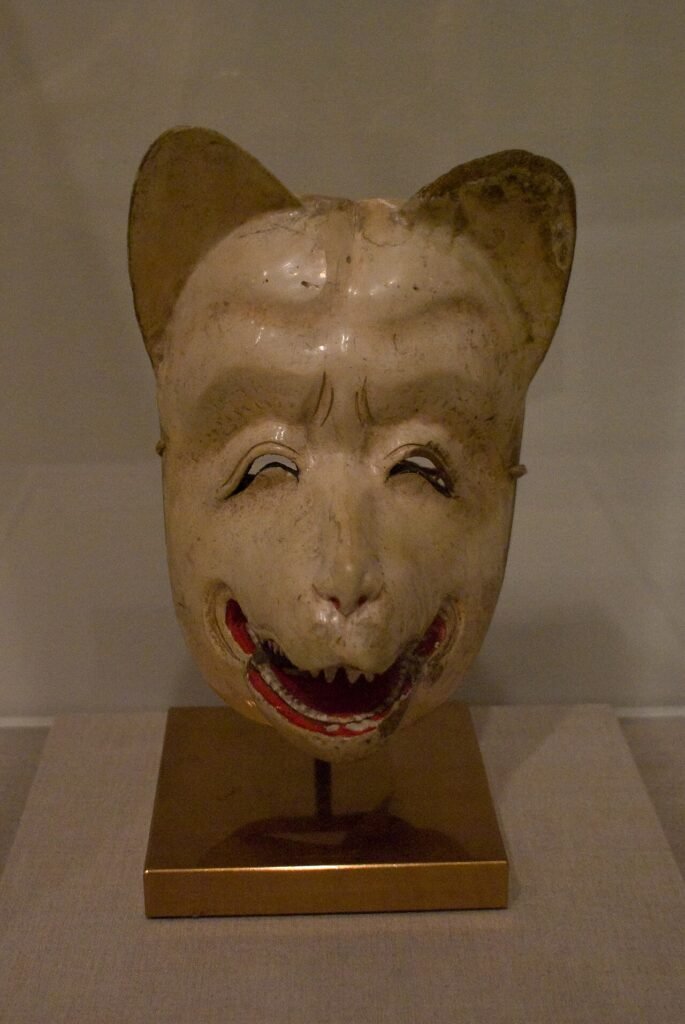
Kitsune tattoo meaning depends on which fox reference the design actually uses. A kitsune may be an Inari-associated white fox messenger, a shapeshifting trickster from a particular tale, a nine-tailed fox connected with Tamamo-no-Mae, or simply a contemporary fox-face mask. Those are related images, but they do not carry one interchangeable meaning.
Before planning the tattoo, choose one reference direction, then decide between a mask and a full fox, how many tails the composition needs, the fox’s expression and movement, and whether the background points to a documented story. Placement changes what can be drawn clearly; it does not create a traditional spiritual meaning by itself.
Start with a source, not a symbolism chart
The Japanese word kitsune means fox, so the word alone does not tell you whether an image is an ordinary animal, a revered messenger or a supernatural character. Context does that work. The object’s pose, clothing, tails, setting and source story matter more than a colour chart copied from another tattoo site.
Inari imagery is one well-documented branch. Fushimi Inari Taisha describes foxes as the messengers or kindreds of Inari Okami and calls these unseen beings byakkosan, white foxes. The shrine is equally clear that Inari Okami is not a fox. Kokugakuin University’s Encyclopedia of Shinto records a much wider history around Inari belief, including agriculture, local cults, oracular messengers and stories of foxes haunting houses. Even within that one religious setting, the fox has not remained a single, simple symbol.
Foxes also appear as deceivers, performers and beings that cross the animal-human boundary. The Metropolitan Museum of Art’s account of Hakuzōsu, the fox in the Kyogen play Tsurigitsune, follows an old fox disguised as a travelling monk. It tricks a trapper into abandoning his work, then falls for bait and is exposed. That story supports disguise, wit and comic reversal. It does not make every fox a villain or every kitsune tattoo a protective emblem.
The practical lesson is to name the branch you want. The broader guide to Japanese tattoo meanings can help you place a fox beside other motif families, but a Kitsune brief should still begin with one fox story, artwork or shrine reference.
Four workable reference directions
An Inari-associated fox
This direction suits a calm, watchful animal rather than a snarling fantasy creature. A seated or standing fox, balanced posture and clear profile can carry the reference without covering the design in shrine objects. If a torii or vermilion architecture is added, it should make the Inari setting more specific, not serve as generic proof that the fox grants luck.
White fur may recall the byakkosan described by Fushimi Inari Taisha. It still does not turn every white fox mask into a sacred image. Use the source in the brief and decide which visual cues are essential before adding flowers, weapons or flames from unrelated references.
A shapeshifting fox
A full fox paired with a human silhouette, robe, shadow or partly removed mask can show a change of identity. Hakuzōsu offers one documented route: animal and monk are visible in the same character, and the story contains both intelligence and self-defeating appetite. Other fox tales lead elsewhere, so identify the one you mean rather than asking for a general “transformation” symbol.
This is usually a two-state composition. The viewer needs to recognise both the fox and the assumed identity without mistaking them for two unrelated subjects. One face should lead, while the second state appears through a shadow, overlapping profile or limited supporting detail.
A nine-tailed fox or Tamamo-no-Mae reference
Nine tails immediately make a stronger supernatural statement than a naturalistic fox. A British Museum netsuke of Tamamo-no-Mae shows a nine-tailed fox emerging beneath her robe, giving a clear historical example of the human disguise and animal form occupying one object.
Do not treat that object as a universal chart for all fox spirits. A translated medieval account discussed by Minobe Shigekatsu in The World View of Genpei Jōsuiki describes Tamamo-no-Mae as an eight-hundred-year-old fox with two tails. The contrast matters: named stories and textual versions differ, so “one new tail every hundred years” is not a rule you can safely apply to every Kitsune image.
A contemporary fox-face mask
A Kitsune mask tattoo is a compact design format, not a complete meaning on its own. Pointed ears, a tapered muzzle and the eye shape establish the fox; painted lines, tassels and flowers are secondary. The mask can suggest a chosen guise, hidden identity or transformation when that is the wearer’s intention, but those readings should be presented as personal interpretations supported by the composition.
Do not label a decorative mask as a Noh mask without a specific theatrical source. Likewise, white ground and red markings do not automatically prove an Inari connection. If the design is primarily aesthetic, it is more accurate to say so than to invent a ritual origin.
Mask versus full fox
The choice between mask and animal changes the whole design problem. A mask is frontal, contained and expression-led. It can remain clear at a moderate size because the silhouette has only a few major landmarks. The main decisions are the tilt, eye openings, muzzle length, mouth and the balance between blank areas and decoration.
A full fox is gesture-led. The head direction, curve of the back, position of the legs and sweep of the tail must read before fur texture or background detail. It can appear alert, fleeing, stalking, seated or turning between forms. That movement asks for more length and usually more open skin around the body.
Combining both formats can work, but one must lead. A large fox with a smaller mask can imply an assumed identity. A dominant mask with a small animal below reads more like an emblem with a narrative clue. Equal-sized faces often compete, especially once flowers, cords and fire are added.
Tails are part of the story and the silhouette
Choose the tail count for a stated reason. One tail keeps the animal naturalistic unless other cues establish a supernatural setting. Nine tails can point directly towards the kyūbi no kitsune and Tamamo-no-Mae tradition. Numbers between them may suit a particular artwork, text or personal composition, but they do not come with a dependable universal ladder of age, virtue or power.
The tails must also work as shapes on skin. A fan arrangement creates a broad halo and suits a back or thigh. Parallel tails make a long, fast silhouette for a limb. A spiral can wrap a shoulder or hip, although too many crossings make the count impossible to read. If nine tails are essential, each one needs a visible root or a clearly separated path. Nine narrow ribbons squeezed behind a small mask will look like decoration rather than anatomy.
Count them in the final-size drawing, not only in an enlarged sketch. Ask whether the fox remains recognisable when the piece is viewed from several steps away. If the answer depends on tiny fur lines, the design needs a simpler tail pattern or more space.
Expression, movement and background
Expression should match the chosen reference. A calm Inari-associated fox can use level ears, a closed mouth and stable posture. A trickster can look back over its shoulder or let the human disguise slip through a shadow. A Tamamo-no-Mae scene may carry more tension, but bared teeth are a design choice, not a requirement of every version.
Foxfire is one documented background option. Hiroshige’s 1857 print Foxfires on New Year’s Eve at the Changing Tree, Oji shows small lights gathering in a dark landscape. Flame-like forms can therefore anchor a historical art reference, but their colour and number should not be turned into an invented moral code.
Moon, autumn grass, robe patterns or a sparse shrine setting can support atmosphere. Waves, clouds and wind bars have a different job: they direct the eye and connect the subject to the body’s shape. The Japanese tattoo background guide explains that structure in detail. Keep the fox as the foreground subject rather than using every familiar Japanese element at once.
Kitsune also should not absorb the identities of other folklore motifs. A long-nosed or winged mountain figure belongs to a separate Tengu reference path, while a composite dream-eating creature belongs to the Baku tradition. Mixing attributes without an intentional crossover makes the reference harder to explain and the silhouette harder to read.
Choose placement by composition, not a folklore claim
The historical and institutional sources reviewed here do not assign a sacred Kitsune meaning to the forearm, back, chest or thigh. Placement decides viewing angle, available width, visibility and whether tails can move without being compressed.
| Design direction | Space the drawing needs | Placement questions to test |
|---|---|---|
| Frontal fox mask | A contained oval or shield shape | Does the mask face forward when the arm or leg is relaxed? Are the ears crowded by the edge? |
| Full fox with one tail | Length for the spine, legs and one clean sweep | Can the animal’s gesture be read before the body turns out of view? |
| Multi-tailed fox | Width for separation between tails | Can each tail be followed at final size, and is the head still the focal point? |
| Fox and human disguise | Room for two distinct states | Which face leads, and does the overlap remain clear from normal viewing distance? |
| Kitsune within a sleeve or larger piece | A planned route for background flow | Will future motifs share the same direction, value range and edge treatment? |
A mask can fit an outer arm, calf or thigh when its key features remain open. A moving full fox often benefits from a longer panel. A nine-tailed scene usually needs a broader area or a deliberately simplified fan. These are drawing considerations, not fixed prescriptions, and the final choice should be checked on a photo of the actual placement.
Build a precise Kitsune tattoo brief
One evidenced reference and a clear composition decision are more useful than a folder of unrelated fox tattoos. Before making an enquiry, prepare:
- the named story, artwork, shrine reference or mask direction you want to use;
- mask, full fox, or fox with a human disguise;
- tail count and why that number matters to this design;
- calm, elusive, comic, threatening or another clearly described expression;
- body direction, such as seated, rising, turning or running;
- background elements that belong to the chosen reference;
- colour or black-and-grey direction, without assigning unsupported meanings to each colour;
- exact placement, approximate dimensions and whether the tattoo may later join a larger composition.
To discuss the idea with Yuyi Tattoo, use the contact page and send the reference, placement photo and rough size together. That gives the consultation a traceable cultural starting point and a practical composition direction without pretending the folklore has one official tattoo meaning.
Sources and review date
- Fushimi Inari Taisha, FAQ on Inari and fox messengers; reviewed 24 August 2026.
- Kokugakuin University, Encyclopedia of Shinto: Inari Shinkō; reviewed 24 August 2026.
- The Metropolitan Museum of Art, Fox Spirit in the Guise of a Traveling Monk (Hakuzōsu); reviewed 24 August 2026.
- Nanzan Institute for Religion and Culture, Minobe Shigekatsu: The World View of Genpei Jōsuiki; reviewed 24 August 2026.
- The British Museum, netsuke with Tamamo-no-Mae and a nine-tailed fox; reviewed 24 August 2026.
- The British Museum, Hiroshige’s Foxfires on New Year’s Eve at Oji; reviewed 24 August 2026.
Frequently asked questions
What does a Kitsune tattoo mean?
It can refer to several Japanese fox traditions rather than one fixed symbol. An Inari-associated fox points towards a messenger relationship; Hakuzōsu offers disguise and comic trickery; Tamamo-no-Mae can bring transformation, danger and a multi-tailed form. A contemporary mask may carry a personal idea about identity. The source and the visual details determine which reading is credible.
Does a Kitsune mask tattoo always represent Inari?
No. Fushimi Inari Taisha identifies foxes as Inari Okami’s messengers and explicitly says the deity is not a fox. A white fox-face mask may recall that imagery, but it may instead be a contemporary decorative mask or a shapeshifting reference. Torii, shrine context and a named source can make an Inari direction clearer; colour alone cannot.
How many tails should a Kitsune tattoo have?
Use the number required by the source or composition. Nine tails strongly evoke the nine-tailed fox tradition and appear with Tamamo-no-Mae in museum objects, yet a medieval Tamamo account also describes two tails. That variation is why exact online formulas should be treated cautiously. Whatever the number, every tail must remain separate and readable at the tattoo’s final size.
What is the difference between a Kitsune mask and a full fox tattoo?
A mask is a compact, expression-led design built around ears, eyes and muzzle. A full fox is movement-led and needs space for the back, legs and tail sweep. The mask can suggest a guise when the wearer chooses that reading; the animal can show a complete scene or transformation. Neither format is automatically more traditional.
Where does a Kitsune tattoo work best?
The best placement is the one that preserves the chosen silhouette. A frontal mask needs enough width to keep the ears and cheeks open. A running fox needs length, while a multi-tailed fox needs width and negative space between tails. Check the final-size design on the relaxed body from front, side and normal viewing distance rather than assigning folklore meaning to the body part.


