
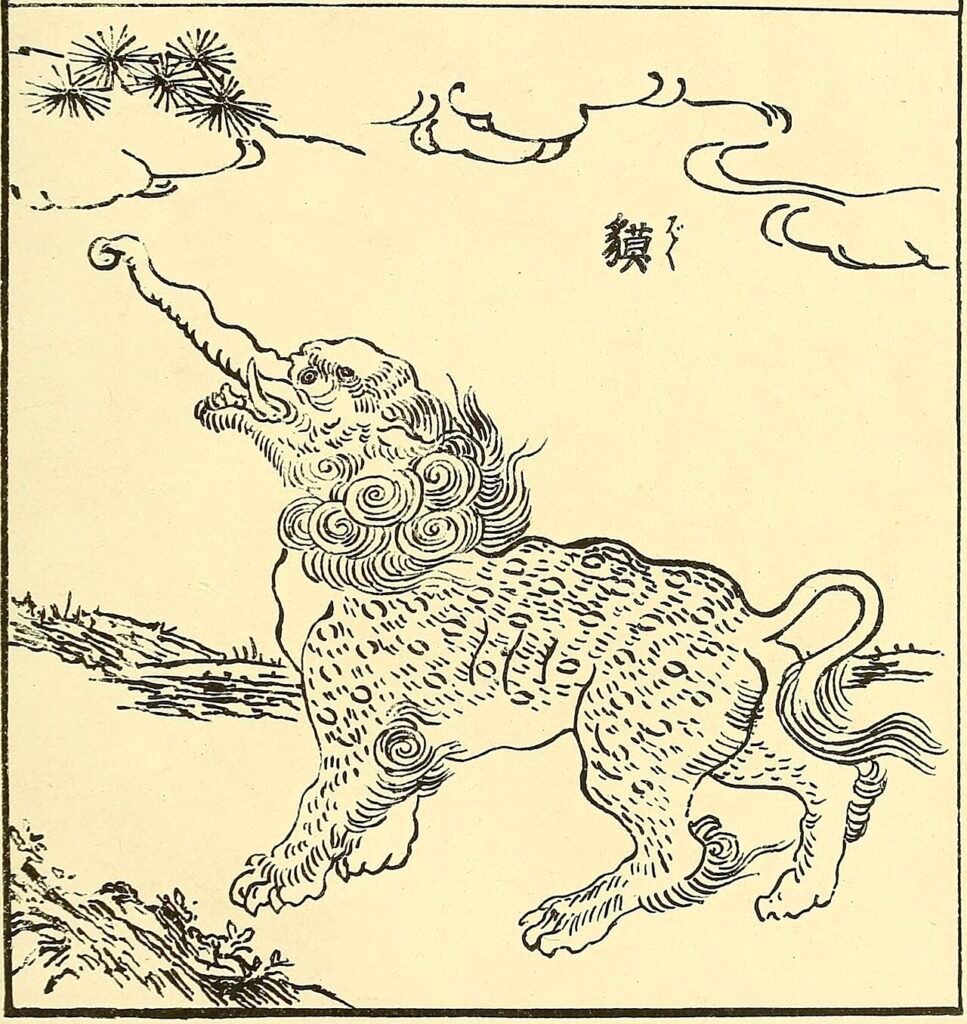
Baku tattoo meaning is usually connected with a creature that devours bad dreams, but that is only the starting point. In Japanese folklore the Baku became a protective dream-eater; in older East Asian descriptions it was a fantastic animal assembled from parts of several creatures. A tattoo can therefore suggest protection, peaceful sleep, recovery from fear, or a private relationship with dreams, without claiming that every Baku has one universal meaning.
A readable Baku tattoo depends on the reference you choose and the way its composite body is organised. The elephant-like trunk, animal paws, tail, teeth, eyes and rounded body need a clear hierarchy. Add a pillow, sleeping figure, clouds or a moon only when those elements support the subject. The strongest Baku tattoo design is not a random collection of strange-animal features; it is one calm, intentional composition that still reads from a normal viewing distance.
What the Baku is in Japanese folklore
The Baku is not the same thing as a literal tapir. The Japanese word is also used for the real mammal, which makes the two easy to confuse in modern visual culture. A folklore Baku is a supernatural creature whose role changed as stories and images moved through East Asia. The Tokyo National Museum describes Baku as a mythical creature known in East Asia, with an elephant-like trunk and a reputation for devouring nightmares. Its exhibition material also connects Baku imagery with objects used to ward off evil, including pillows and mirrors.
The Metropolitan Museum of Art records an eighteenth-century Japanese seated Baku as a mythical creature that devours dreams and nightmares. The museum’s description identifies an elephant trunk, an ox tail and tiger paws. That small netsuke is useful for tattoo research because it shows how a compact object can hold an unusual body without needing a realistic zoological explanation.
Why “dream-eating” is a careful meaning, not a promise
A Baku tattoo can represent the wish to leave a difficult dream behind, but the tattoo cannot guarantee sleep, mental health or protection from real-life events. Folklore is a language for expressing hopes and fears; it is not a medical or psychological treatment. This distinction keeps the design respectful and keeps the consultation grounded.
Start with the documented dream-eating role. Then decide how the trunk, paws, teeth and crouched body should express that role visually. Your own connection may concern rest, resilience, creativity or a private dream, but it remains personal. These readings can overlap without becoming an invented rule such as “a Baku always means success” or “every Baku tattoo wards off illness.” If a personal story is important, explain it to the artist in your own words rather than presenting it as established folklore.
Readers comparing several Japanese subjects may find the broader Japanese tattoo meanings guide useful. It treats motifs as references shaped by era, pairing and composition rather than as a fixed online dictionary. A Baku needs the same care, especially when a reference mixes Chinese, Japanese, fantasy and modern animal imagery.
The composite body: choose a reference direction first
Composite anatomy is what makes Baku tattoo ideas distinctive, but it can also make them muddy. Before sending images, decide whether you want a museum-informed historical creature, a softer contemporary guardian, or a more animal-like Baku based on the real tapir. Each direction changes the face, weight, silhouette and level of detail.
Museum-informed historical form
A historically informed direction may keep an elephant-like trunk, heavy head, animal paws and an ox-like tail. The body can be rounded and slightly awkward rather than sleek. The point is not to reproduce one museum object line for line. It is to preserve the features that make the creature recognisable as Baku instead of turning it into a generic monster.
Tapir-influenced modern form
A tapir has a useful visual relationship to Baku imagery, but a tattoo that is simply a zoologically accurate tapir may read as wildlife rather than folklore. If you want that connection, say so. The design can retain a real tapir’s compact body and nose while keeping one or two mythic cues, such as an unusual tail, paws or dream-related setting. This is a contemporary interpretation, not proof that the folklore creature was simply a tapir.
Guardian or sleeping form
A guardian direction may show the Baku alert beside a pillow, crouched over a sleeping figure or emerging from cloud forms. Those are compositional choices inspired by its dream-related role. They are not mandatory symbols. A quieter Baku with lowered eyelids may express rest; an open mouth and forward paws may express active removal of fear. Decide which emotional temperature you want before adding background.
A related Kitsune tattoo meaning comparison can help when you are choosing between different Japanese folklore creatures. Kitsune, Baku and other yōkai do not carry interchangeable visual roles. A reference should tell the artist which creature you actually want, not only that you like “Japanese mythology.”
Face, trunk and paws: where recognition lives
A Baku is often recognised first by the head. The trunk creates an immediate silhouette, but its length and curve determine whether the face feels gentle, comic, ancient or aggressive. A short, rounded trunk can keep the design approachable. A longer trunk with tusk-like forms can make the creature feel more imposing. Neither is automatically more correct; the choice should follow the source reference and the body area.
The eyes and mouth set the emotional direction. Small, half-closed eyes can support a sleeping or protective mood. A wide mouth with visible teeth can make the dream-eating action explicit, but too much detail in a small head will become visual noise. The paws need enough size to read as weight-bearing forms. If the paws are shrunk to decorative claws, the body loses its animal logic.
The body should not be drawn as a list of separate parts. Use a simple value sketch to test the head, back, belly and legs as one mass. Then decide which features deserve the sharpest edge. The trunk and eyes may be the focal points; the tail can be a secondary cue. A detailed tail cannot rescue a Baku whose face has no clear identity.
Sleeping imagery, pillows and clouds
A pillow is a direct way to connect the Baku to dreams, and museum collections document Baku-decorated sleeping objects. In a tattoo, however, a pillow can become too literal or too small. It may work as a framing shape below the creature, a background panel behind it, or a quiet object under one paw. If the pillow is only there to fill a gap, remove it.
A sleeping figure changes the subject from a creature portrait into a narrative scene. That can work on a large thigh, chest or back, but it needs careful decisions about scale and privacy. The figure does not have to be a realistic portrait. A simplified sleeping silhouette can establish the dream setting without competing with the Baku’s face.
Clouds, smoke-like forms and open skin can create a dream atmosphere without asserting a fixed traditional code. Treat them as visual transitions. Broad clouds can soften the hard edge of paws and trunk. Thin negative-space breaks can separate the Baku from its background. A crowded field of identical curls will make the composite anatomy harder to read.
For broader subject and background planning, use this mythology tattoo ideas framework. Keep the Baku section specific: the aim is not to add every creature or symbol from a mythology board, but to give one unusual figure enough room to breathe.
Placement options for a Baku tattoo
Placement controls how much of the composite form can be shown and how the creature moves with the body.
| Placement | What it can support | Main caution |
|---|---|---|
| Upper arm or shoulder | A crouched Baku with the head and trunk as the focal point | Do not place the mouth directly into the shoulder crease |
| Forearm | A compact creature in profile, with a curved trunk and tail | Keep the silhouette simple enough to read when the wrist turns |
| Thigh | Larger body, pillow or sleeping scene, and wider cloud movement | Check the design standing, not only on a flat screen |
| Chest | A frontal guardian or symmetrical sleeping composition | Respect the sternum and collarbone instead of forcing a rectangle |
| Back | Full narrative scene, large Baku and broad negative-space structure | Establish one main reading order before adding secondary symbols |
A small Baku can be charming, but a composite creature needs enough room for its essential features. If the trunk, eyes, paws and tail all need to be identified, a slightly larger design may be clearer than a miniature full-body illustration. The tattoo design readability guide explains why scale, contrast and negative space matter more than adding tiny marks.
Black and grey, colour and line direction
Black-and-grey can make a Baku feel like a carved netsuke or an old illustrated creature. Strong darks around the mouth and paws can give the body weight, while lighter grey and open skin keep the trunk from disappearing into the face. Colour can separate the creature from clouds, a pillow or a night-sky setting, but colour alone will not fix a weak silhouette.
Ask to see the design as a small thumbnail and at the intended body size. If the creature disappears when reduced, simplify the background. If the face becomes a dark oval when enlarged, separate the trunk, eye and mouth with value changes or skin breaks. These tests are more useful than asking whether one style is the “correct” Baku style.
How to brief a Baku tattoo design
Before contacting a studio, prepare a brief that distinguishes research from preference:
- Name the creature as Baku and state whether you mean a Japanese dream-eater, a historical composite animal, or a tapir-influenced contemporary version.
- Bring two or three reliable references, including at least one museum or academic reference if historical form matters.
- Mark the features you want to keep: trunk, tusks, paws, tail, eyes, mouth or rounded body.
- State the mood: asleep, calm, alert, protective, strange, humorous or intimidating.
- Give the body area, approximate size and whether the design may later connect to a sleeve, chest or back piece.
- Say whether pillow, sleeping figure, clouds, moon or open skin is essential, optional or unwanted.
Yuyi Tattoo’s documented portfolio includes Japanese and Asian-inspired compositions, large pieces and black-and-grey realism. That evidence can help you discuss visual direction, but it is not a promise that every reference or size is accepted. Send the brief through the contact page so the subject, placement and artist availability can be confirmed directly.
Sources and review date
- Tokyo National Museum — All About the Mythical Beast Baku at the Museum — reviewed 24 August 2026.
- The Metropolitan Museum of Art — Seated Baku (Mythical Creature Devouring Nightmares) — reviewed 24 August 2026.
- Los Angeles County Museum of Art — Baku: Monster that Eats Nightmares — reviewed 24 August 2026.
- Michael Dylan Foster, The Book of Yōkai — “Baku: Tapir or Dream-Eater” (University of Vienna-hosted PDF) — reviewed 24 August 2026.
Frequently asked questions
What does a Baku tattoo mean?
It commonly refers to the Baku’s role as a dream-eating or nightmare-devouring creature. A wearer may use that reference to express protection, rest, resilience or leaving fear behind. The personal meaning should be stated as personal rather than treated as a universal folklore rule.
Is a Baku a tapir?
A folklore Baku is not simply a real tapir. The two are connected in modern naming and visual comparison, and some contemporary designs borrow the tapir’s shape. Historical Baku images are composite creatures with features such as an elephant-like trunk, animal paws and a distinctive tail.
What features make a Baku tattoo recognisable?
The head and trunk usually do the most work, supported by the paws, tail and rounded composite body. A pillow or dream scene can clarify the theme, but it is optional. At small scale, keep the key features clear and avoid trying to show every animal part at equal detail.
Can a Baku tattoo include a sleeping person?
Yes, if the placement is large enough and the sleeping figure serves the composition. A simplified silhouette may establish the dream setting without competing with the Baku. Discuss privacy, scale and whether the scene should be literal or symbolic before drawing it.
Where is a Baku tattoo best placed?
An upper arm, thigh, chest or back can work, depending on whether you want a compact creature or a larger narrative scene. The right placement is the one that gives the trunk, face and paws enough room and lets the silhouette move with the body.
Should a Baku tattoo be black and grey or colour?
Either can work. Black and grey can emphasise carved form and value, while colour can separate the Baku from clouds or a night setting. Readability still depends on scale, contrast, negative space and a clear focal point.


