
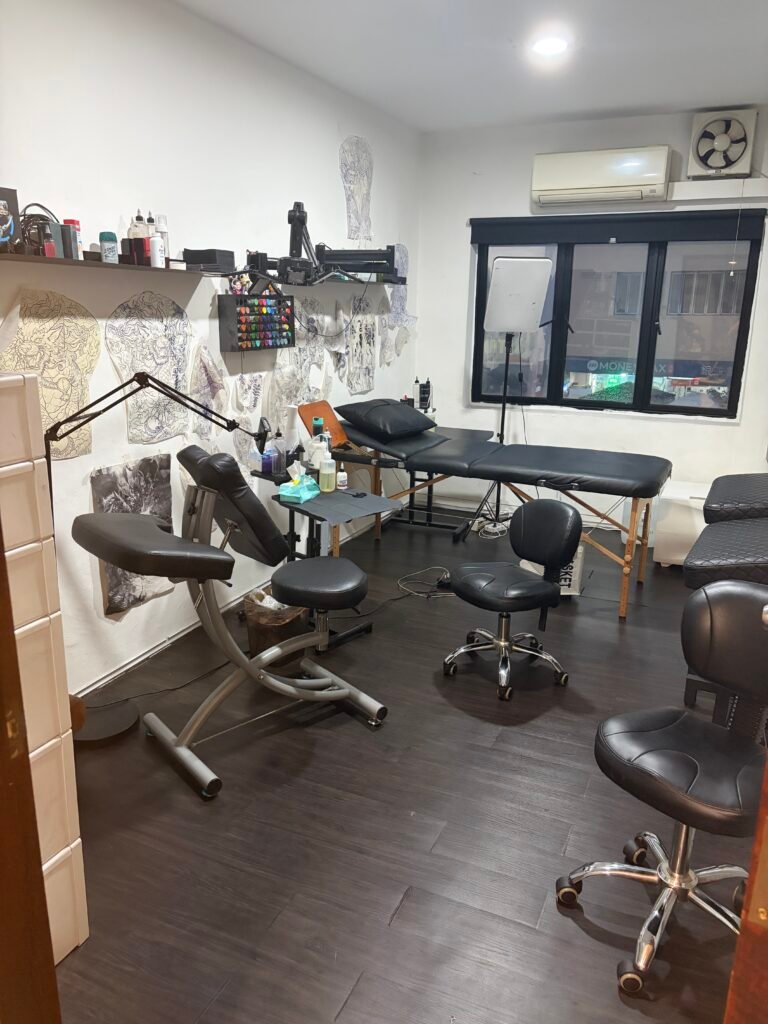
A useful first tattoo session length guide cannot give you one reliable number. The appointment may feel longer or shorter depending on the design’s size and detail, the placement, how much preparation and fitting are needed, the position you must hold, and how you communicate when you need to adjust. Ask for timing only after the studio has seen a complete brief.
Before you arrive, ask whether any timing information refers to the whole visit or only active tattooing, what position is likely for your placement, how to request a break, and what to do if you cannot stay comfortable. The studio must confirm its own process. No article can promise a duration, a break schedule, a pain level or an artist’s availability for your date.
Total appointment time is not the same as tattooing time
A tattoo appointment is not necessarily one uninterrupted block with the machine running. Depending on the project and the studio’s process, the visit may include confirming the brief, reviewing the design, checking placement, preparing the work area, fitting or adjusting a stencil, tattooing, agreed pauses and end-of-appointment instructions. Some steps may not apply to your project, and their order may differ.
That distinction is the first thing to clarify. If someone gives you a time window, ask:
- Does this describe arrival to departure, or an estimate of active tattooing?
- Which preparation or review steps are expected during the appointment?
- Is the design already settled, or could placement fitting lead to changes?
- What part of the plan remains provisional until the artist sees the body area?
These are more useful first tattoo session length questions than asking strangers how long a tattoo of the “same size” took. Their design, anatomy, position and studio process were not yours.
If you still need to settle subject, scale or direction, use the tattoo consultation questions guide before trying to organise the appointment around a clock.
What can change how one appointment feels
Duration and perceived comfort are related, but they are not interchangeable. A position that is easy at first may become distracting when held still. A short pause may feel more valuable than another estimate. Clear expectations can also make each stage easier to follow, even when the total time remains variable.
Several project details matter.
Design scale and detail
Centimetres give the artist a boundary, not a complete workload. A simple open design and a dense design can occupy a similar area while requiring different preparation and application decisions. Shading, repeated texture, small transitions, colour changes and a background can all affect the work without creating a dependable formula for minutes or hours.
Send the approximate width and height anyway. Add a reference photo and say which details are essential. The tattoo size guide explains why size, placement and detail need to be considered together. Once the artist sees those inputs, you can ask what timing information can responsibly be given.
Placement and access
The artist needs a clear view of the area and a stable surface to work on. A flat, accessible area may call for a different setup from a curved area, a joint or a place partly covered by clothing. Stencil fitting can also take a different path when a design wraps around a limb or must align with a body landmark.
Access affects the client too. Clothing has to move clear of the placement, while the rest of the body still needs reasonable coverage and support. Ask what to wear and how the area will be accessed instead of assuming a particular chair, table, screen, private room or draping method.
Position and the effort of staying still
Tattoo session positioning is easy to overlook when you have never attended an appointment. Depending on the placement, a client might be seated, reclined, lying on one side or front, or holding a limb in a supported angle. These are examples, not a prediction of Yuyi Tattoo’s setup.
General ergonomics guidance helps with one narrow principle. The U.S. Occupational Safety and Health Administration’s guidance on working positions says that even a well-arranged posture should not be held unchanged for prolonged periods. The UK Health and Safety Executive likewise identifies awkward and prolonged static postures as factors that increase physical strain. Those pages concern workstations and occupational tasks, not tattoo clients, so they do not set a tattoo break rule. They simply explain why support, position changes and early communication matter.
During tattooing, however, an unannounced movement can interrupt precise work. The practical solution is coordination: do not silently twist or pull away to fix a numb foot or tight shoulder. Tell the artist before the discomfort becomes urgent, then follow their direction on when it is safe to move.
Unresolved decisions on the day
If the placement, orientation, scale or wording is still uncertain, the appointment may include more discussion than you expected. That is not something to rush through for the sake of matching a guessed duration. The design and stencil should be understood before tattooing begins.
Ask which decisions must be final before arrival and which are normally checked in person. This keeps design review separate from comfort planning while giving both enough room.
Ask about position before you book the rest of your day
You do not need to know the studio’s furniture vocabulary. Describe what your body can and cannot do comfortably, then ask how the planned placement is usually accessed. Useful questions include:
- What position is likely for this placement?
- Will I need to lie on my front or side, sit upright, or keep an arm or leg rotated?
- Which parts of my body will be supported?
- May I make small adjustments, and how should I ask before moving?
- Is there any mobility or position constraint you need me to mention before confirming the appointment?
- How is access and coverage handled for this body area?
If you have limited joint movement, difficulty lying in a particular position or another relevant comfort constraint, state it plainly and privately. You do not need to send a full medical history in the first message. Give the minimum information needed to identify the practical issue, and ask whether the studio needs anything else. A qualified healthcare professional, not a tattoo article or casual studio message, should answer medical-clearance questions.
The Canadian Centre for Occupational Health and Safety notes in its sitting-position guidance that no single position remains comfortable for everyone over an extended period. Again, this is general ergonomics guidance. Your artist must decide which movements are compatible with the placement and the stage of work.
Ask about tattoo appointment breaks without assuming the answer
Studios and projects do not all handle pauses in the same way. Do not arrive with a break timetable copied from a forum, and do not assume you must remain silent until the artist stops. Ask for the communication process instead.
These questions are specific without demanding a promise:
- How should I signal that I need a pause?
- Should I tell you as soon as discomfort starts changing my ability to stay still?
- Are there natural points in this project when position changes can be discussed?
- What should I do if I need the toilet, water or an unexpected pause?
- If I feel a cough, sneeze or sudden movement coming, how should I warn you?
- Are any break, timing or appointment terms important for me to confirm in writing?
- What happens to the day’s plan if either of us decides it should stop earlier than hoped?
The last question does not assume a cancellation, rescheduling, payment or continuation policy. It asks the studio to explain the current terms that apply to your appointment. Keep the answer with your written confirmation.
Small adjustments and full pauses solve different problems
Sometimes the issue is a foot that needs a slightly different angle or a hand that needs support. At other times, you need to get up, use the toilet, drink water or step away from the working position. Ask the artist how to distinguish a safe small adjustment from a proper pause.
Speaking early is useful because you can still describe the problem calmly. “My shoulder is tightening; when is a safe point to adjust it?” gives the artist usable information. Waiting until you move automatically gives neither of you time to coordinate.
This is also why pain rankings from placement charts are a poor planning tool. They cannot predict your experience, how a particular position will feel or how the session will be organised. Ask about communication and support rather than requesting a promised pain level.
Send a brief that makes comfort questions answerable
A studio cannot discuss likely position or appointment structure from “I want a medium tattoo” alone. A complete first message should include:
- the subject and style direction;
- approximate width and height;
- exact body area, side and orientation;
- a clear placement photo taken in a natural posture;
- reference images with short notes;
- the date range you are considering, without assuming availability;
- any relevant limit on lying, sitting, rotating a limb or holding one position;
- your questions about total time, positioning and requesting a break.
For example:
Hi, this will be my first tattoo. I am considering a black-and-grey botanical design, roughly 12 cm high, on my outer left upper arm. I have attached a placement photo and labelled references. I find it difficult to keep my shoulder raised for long. Before I organise the day, could you tell me what position is likely, what any timing estimate includes, and how I should request a pause? Please say what still requires a consultation and whether the artist and date are available.
Use the Yuyi Tattoo contact page to send the project information. A message is an enquiry, not proof that an artist, date or duration has been confirmed.
Keep this separate from packing and multi-session planning
Food, clothing, documents and bag contents belong in the what to bring to a tattoo appointment guide. This article deals with how one appointment is structured and how to discuss comfort within it.
If design review shows that the project may span more than one date, switch to the multi-session tattoo planning guide. That is a different problem involving stages, availability and review between appointments. Do not use a single-session estimate to invent the number or spacing of future sessions.
A simple communication plan for the appointment
Before work starts, confirm four things: the position, where your body will be supported, the signal or words you will use to request a pause, and whether any part of the plan is still variable. Then speak before moving.
During the appointment, describe the issue rather than trying to diagnose it. “My fingers are tingling,” “I need to change the angle of my hip,” or “I feel unwell” is clearer than “I’m fine” while your body is telling you otherwise. The artist can address the immediate appointment and decide whether work should pause. Medical symptoms require an appropriate healthcare professional.
Your goal is not to prove how long you can endure an unfamiliar position. It is to remain communicative enough for the artist to work carefully and for you to understand each decision. That is the most useful preparation a first tattoo comfort checklist can provide.
Sources and review date
- U.S. Occupational Safety and Health Administration — Computer Workstations: Good Working Positions — reviewed 24 August 2026.
- UK Health and Safety Executive — Upper Limb Disorders Assessment: Risk Factors — reviewed 24 August 2026.
- Canadian Centre for Occupational Health and Safety — Working in a Sitting Position: Basic Requirements — reviewed 24 August 2026.
Frequently asked questions
How long does a first tattoo session take?
There is no fixed duration that applies to every first tattoo. Size, detail, placement, design readiness, fitting, setup and the position required can all affect the appointment. Send a complete brief, then ask whether any estimate covers the whole visit or only active tattooing.
Are breaks allowed during a tattoo appointment?
Ask the studio how pauses are handled for your appointment. Do not assume a frequency, duration or policy. Confirm how to signal that you need a break, when it is safe to move, and whether any timing or appointment terms apply.
What position will I be in for my first tattoo?
It depends on the exact body area, design orientation, equipment and artist’s working setup. You may be seated, reclined or lying in another position, but only the studio can confirm what is likely for your project. Ask how your limb or body will be supported.
Should I mention back, joint or mobility discomfort before the appointment?
Yes. Briefly explain any relevant constraint that could affect lying, sitting, rotating a limb or staying still. Ask whether the studio needs more information, but use a qualified healthcare professional for medical advice or clearance.
What should I do if I suddenly need to move?
Warn the artist as soon as you can and follow their direction on when to move. If you notice discomfort building, say so early rather than waiting until movement becomes automatic. The studio should confirm its preferred signal and pause process before tattooing starts.

