
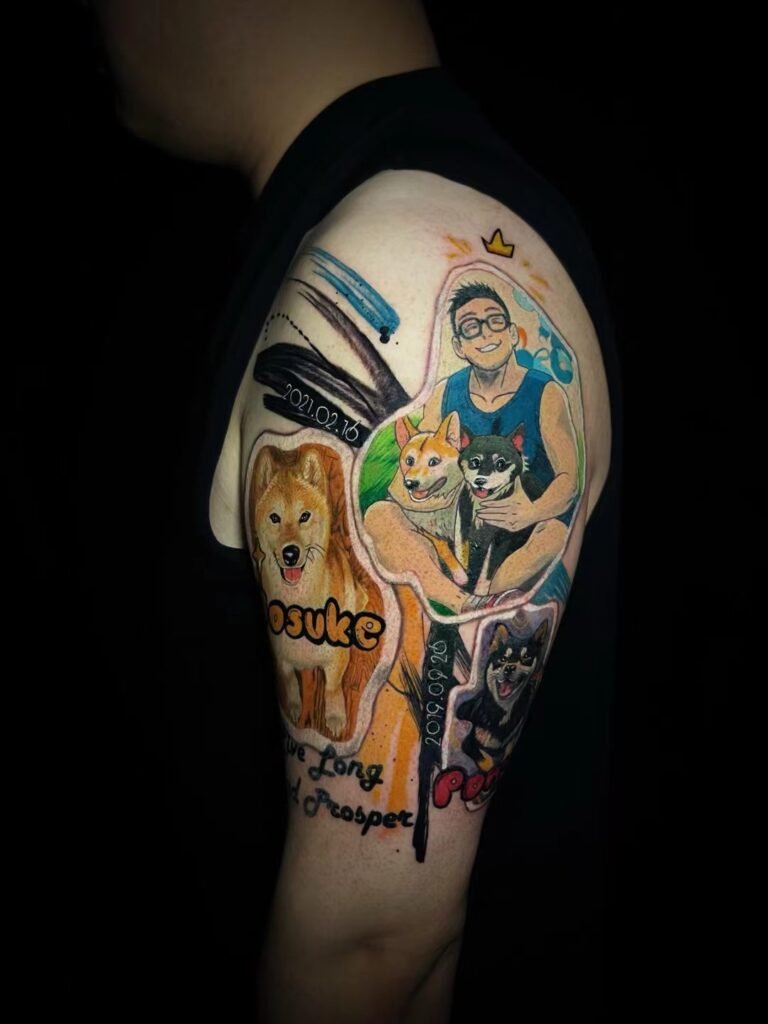
The clearest custom story tattoo ideas begin by reducing the story to one visual sentence, choosing one main subject to carry that sentence, and letting every other detail support it. The main subject might be a scene, a symbol or a portrait. If several elements all demand equal attention, the design will usually read as a list rather than one composition.
A focused brief does not make the story less meaningful. It separates what must be visible from what the artist only needs to understand. Decide what the viewer should notice first, what can be discovered second, where the design will sit, and what can stay outside the image. Those decisions give the artist room to translate the story instead of squeezing a biography into one piece.
Start with a visual sentence, not a life timeline
Begin with the words “This tattoo is about…” and finish the sentence with one idea, not a sequence of events. “The person who taught me to make things” is workable. “My childhood, my first job, three countries, my family and everything that happened after” is still a timeline.
Next, sort your information into three groups:
- Must be visible: the subject or clue without which the tattoo becomes a different story.
- Useful context for the artist: information that may guide posture, atmosphere, crop or direction, even if it never appears literally.
- Private or optional: details you want the artist to understand but do not need strangers to read.
That third group matters. A tattoo can remain personal without turning private facts into text, dates or obvious symbols. You can explain why an old tool matters while asking for the object alone. You can describe the relationship behind a portrait without adding a name banner, a quotation and a full setting.
If the first sentence still contains several separate themes, choose the one that would feel most incomplete if it disappeared. The remaining themes may become supporting clues, a later project, or context that never needs to be drawn.
Choose the carrier: scene, symbol or portrait
The best format depends on what the story needs the viewer to recognise. None is automatically more meaningful than the others.
| Format | Works well when | Main design pressure | Prepare before consultation |
|---|---|---|---|
| Scene | One action, setting or turning point carries the story | Too many characters and background objects can compete | The exact moment, main figure or object, and what happened just before and after |
| Symbol | Meaning can be held by one object, shape, plant or repeated mark | Generic symbols may need personal modification or context | Why this symbol belongs to your story and which features are essential |
| Portrait | A particular person or animal must remain recognisable | Likeness, crop and reference quality need enough space | The clearest authorised source image and the features that must be retained |
A scene shows an event. A symbol compresses the event into an object. A portrait centres the subject rather than the event. For example, a story about learning a craft could become a scene of hands working, the specific tool that was passed down, or a portrait of the person who taught it. These are generic structures, not client examples. Each tells a different version of the same broad idea.
Choose by asking what would make the story unmistakably yours. If the answer is a face, start with the portrait. If it is an action, start with the scene. If it is an object whose history you can explain in one sentence, a symbol may carry the idea with less visual weight.
Give the composition one main subject
Visual hierarchy is the order in which the eye receives information. The Getty’s principles of design describe emphasis as the area that first catches attention. The National Gallery of Art notes that compositional choices affect meaning and shows how focus can steer a viewer toward a particular person or object. The practical lesson for a story tattoo is simple: one element should lead.
Use three levels:
- Main subject: the face, figure, object or action that should register first.
- Supporting clue: one or two details that locate or deepen the story.
- Atmosphere: background, shadow, texture or movement that sets the tone without becoming another subject.
Supporting details need jobs. A window may locate the scene. A plant may connect it to a particular garden. A fabric pattern may identify a family object. Smoke, clouds or architecture may create direction or depth. If a detail only repeats what the main subject already says, it may be unnecessary.
Equal emphasis is a common source of clutter. A portrait, house, clock, landscape, vehicle, quotation and several dates cannot all be the first read. Making everything smaller does not solve the hierarchy. It only reduces the space available to separate the elements.
If you choose a scene, choose one moment
The Metropolitan Museum of Art’s guide to narrative painting asks viewers to identify the most important part of a story and consider what happened immediately before and after it. That is a useful way to select a scene. A strong moment can imply a larger sequence without showing every stage.
Look for an action with a clear subject: a hand passing an object, a figure at a threshold, two people working at the same table, or someone looking toward a recognisable place. The viewer does not need the whole timeline if the chosen moment carries its tension or direction.
Then control the frame. Getty Education notes that angle, distance, foreground and background change the story an image tells. In a tattoo brief, decide whether the viewer is close to the subject or sees more of the setting. A close crop gives the action weight. A wider view gives the location more responsibility. Neither approach is better in every case.
Describe what belongs in the foreground, what may sit behind it, and what can disappear. If the scene still needs several paragraphs to explain where to look, return to the visual sentence and narrow it again.
Make the story readable before adding clues
The first read should answer “who or what is this about?” The second may reveal action, place or relationship. Small clues come last. This order matters because a tattoo is usually seen on a body at ordinary distance, not only in a close photograph.
Test the idea as a thumbnail. Write the main subject on one line and the supporting details beneath it. If the supporting list is longer than the explanation of the subject, the composition is drifting. Another useful test is to cover each optional detail in your reference sketch. If the core story still reads, that detail is genuinely optional.
For a deeper check of scale, contrast, negative space and viewing distance, use the guide to tattoo design readability. In this planning stage, the priority is narrative order: the largest or strongest visual information should match the most important part of the story.
Let placement edit the composition
Custom story tattoo placement should be chosen with the image, not after every detail has been fixed. A broad scene may need horizontal room. A standing figure or portrait may prefer a vertical field. A design that wraps around an arm or leg cannot present every element from one viewpoint. A large back or torso concept can hold more relationships, but more area does not require more subjects.
Consider three questions:
- From which direction should the main subject be recognised?
- Should the piece be easy for other people to see, mainly visible to you, or usually private?
- Does the design need one front-facing view, or can parts reveal themselves as the body turns?
Placement also sets a boundary around future additions. If the story may expand, say so before the composition closes every edge. If this piece must stand alone, the artist can plan a more definite frame. Do not guess a fixed session count or schedule from size alone; project planning follows review of the actual subject, placement and level of detail.
Decide what to leave out
Editing is part of the custom story tattoo design process. Remove an element when it creates a new focal point without adding a new piece of meaning. Combine elements when two details perform the same job. Keep context in the written brief when it helps the artist but would weaken the image.
Use this filter for every proposed addition:
- If this detail disappears, does the main idea change?
- Does it support the main subject or compete with it?
- Can it be recognised at the planned scale without a long explanation?
- Is it something I want visible, or only something I want the artist to know?
A date may be essential, or it may duplicate a visual clue. Text may be the centre of the concept, or it may turn the image into a caption. Several portraits may be necessary for a relationship-based piece, but each additional face changes scale and composition. There is no universal rule that a story tattoo must be minimal. The rule is that every visible element must earn its place.
Build references only after setting priorities
Narrative choices should come before image collection. Otherwise, search results can start writing the story for you. Once you know the main subject and supporting role, gather references with separate purposes: identity or object accuracy, scene crop, body flow, contrast and exclusions.
Do not make five images compete for the same job. Label which file controls the subject and which only shows atmosphere or placement. The detailed guide on how to combine tattoo references explains that reference-image step. Your story brief should sit above those images and resolve conflicts between them.
Turn the idea into a focused enquiry
Your first message does not need the full history. It needs enough information to assess the composition. This generic, non-client example shows how the fields can work together:
Core sentence: This tattoo is about learning a craft from someone important to me.
Main subject: A pair of hands using one particular tool should read first.
Supporting clue: A distinctive mark identifies the tool, while a simple work surface locates the action.
Keep private or omit: Do not show names, dates or the full room.
Placement and scale: Outer upper arm, with the final size assessed from the scene and body area.
References: One clear tool photo, one hand-position reference and one body-flow reference.
Flexible points: The background and secondary objects may be cropped or simplified.
Add practical project information using the tattoo enquiry guide, but keep the narrative section short enough to scan. The consultation can explore alternatives after the priority is clear. A focused message does not reserve an appointment, settle a quote or guarantee that every proposed element will fit.
When you are ready to discuss the concept, contact Yuyi Tattoo with the core sentence, chosen format, placement and labelled references. The useful starting point is not the longest version of the story. It is the clearest decision about what the tattoo should show first.
Sources and review date
- The Metropolitan Museum of Art — Every Picture Tells a Story — reviewed 24 August 2026.
- Getty Education — Understanding Formal Analysis: Principles of Design — reviewed 24 August 2026.
- National Gallery of Art — Lesson: Community Photo Stories — reviewed 24 August 2026.
- Getty Education — Newsworthy Images — reviewed 24 August 2026.
Frequently asked questions
How much of my personal story should I tell the artist?
Tell enough to explain the main subject, the role of each supporting detail and anything that must remain private. You do not need to send a complete biography. Start with one sentence, then add only the context that changes the image, crop, atmosphere or placement.
Is a symbol better than a scene for a personal story tattoo?
It depends on what must be recognised. A symbol works when one object can carry the idea with personal context. A scene works when an action or setting is essential. Choose the format that keeps the main meaning clear without requiring several equal focal points.
Can a custom story tattoo include several people, places and dates?
It can, but each addition changes the scale and hierarchy. Decide which person, place or date must lead, then test whether the others support that subject or start separate stories. A larger placement creates room, but it does not automatically make an unfocused composition clear.
How do I choose placement for a story tattoo?
Start with the shape of the main image and how you want it viewed. Scenes often need width, while portraits and standing figures often use vertical space well. Also decide whether the story should be public, visible mainly to you, or usually covered.
How many reference images should I send?
Send only images with distinct roles. One may establish the exact subject, another the crop, another body flow, and another contrast or atmosphere. Label each role and remove duplicates. The brief should decide which reference wins if two images point in different directions.

