A useful first message is short and specific. If you are wondering what to send in a tattoo enquiry, include five details: the subject, a few reference images, the placement, an approximate size, and your timing. Those points let an artist judge whether the idea can sit on that area, at that scale, in a style they actually draw.
You do not need a finished drawing. You do need enough shape for someone to read the idea on a phone between sessions. A tattoo consultation in Singapore usually starts with that written note, not a surprise visit and a long story at the door.
If this is your first piece, read the first tattoo guide for Singapore after you draft the five fields. The guide helps you choose a design that can survive daily life. This page is only about the message itself.
How to write a subject an artist can assess
A useful subject names the main object, the view, and the one or two extras that must stay in. It also names what should stay out. “A peony, side view, two leaves, no clock and no script” is enough to start. “Floral, feminine, meaningful” is not.
Think in nouns first. Person, animal, flower, object, or scene. Then add the angle: face-on, three-quarter, full body, or a cropped detail. Then add the limit: one flower, not a bouquet; a portrait to the collarbone, not a full figure; a koi, not a full pond.
If the tattoo has to include a name, date, or small object, say so in the first line. If those extras are optional, say that too. Artists waste less time when they know which part is the centre and which part is decoration.
Meaning can wait. A short reason helps when it changes the drawing (“it is my late father’s profile, keep the nose accurate”). A long personal history does not help the first reply. Save the story for a sit-down if the project moves forward.
Cover-ups and existing tattoos belong in the subject line as facts, not as medical notes. Write that there is already a tattoo in the area and attach one clear, well-lit photo of that tattoo. Do not send clinic letters or a full health file with that photo.
A short tattoo reference images guide
Send three to six images, each with a job. One shows the subject. One shows contrast and finish. One shows how the design should travel across the body. One shows scale on a similar area. A fifth can show a hard no. A sixth is only useful if it adds a new fact.
Label them in the message, not in your own head. “Image 1 is the face I want.” “Image 2 is the soft black-and-grey shading I like.” “Image 3 is the way this sleeve sits on a shoulder.” “Image 4 is the size I mean, even though the drawing is different.” That is the whole method.
Do not send a folder of thirty screenshots. A pile forces the artist to guess which picture is the real brief. If two images fight each other, one photographic portrait and one flat cartoon, say which one wins on style and which one is only there for the subject.
Use other people’s tattoos as direction, not as a stencil. Ask for a custom reading of the idea, not a copy of someone else’s finished piece. If you send another artist’s work, write what you like in it: the crop, the darks, the empty skin, the way the tail wraps the elbow.
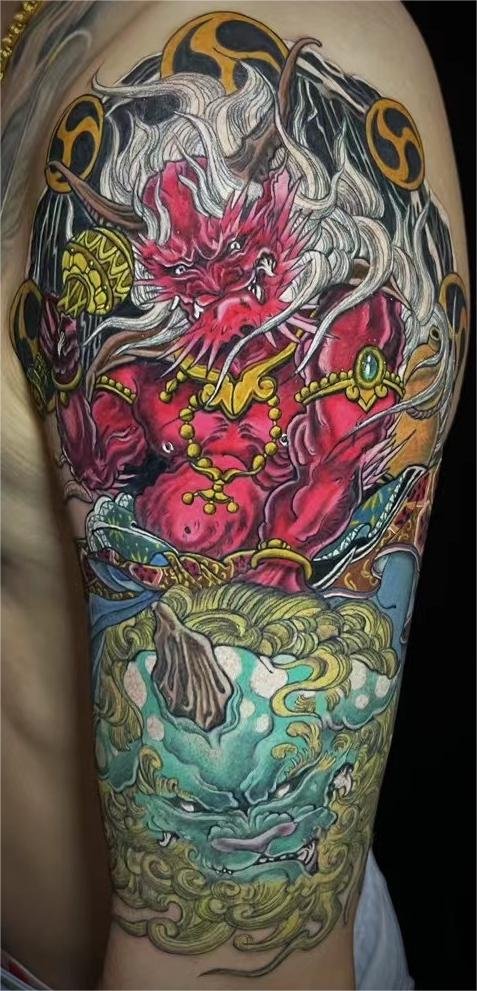
For a portrait, attach one sharp source photo of the person. Front or three-quarter light, eyes open, no heavy filter, no group shot where the face is small. Yuyi’s public portfolio includes portrait realism, so a clean face photo matters more than a mood collage.
Before you attach anything, view Yuyi’s tattoo work and drop images that sit far outside that range. A tiny colour script sample does not help a large black-and-grey back piece. A busy colour sheet does not help if you want quiet grey.
How to describe placement and measure size
Name the body area, the side, and the landmarks. “Left outer forearm, starting two finger-widths below the elbow crease, stopping above the wrist bone” is a placement. “Somewhere on the arm” is a shrug.
Add how the design should face. A head can look toward the hand or toward the shoulder. A flower can sit upright when the arm hangs, or when the arm is bent. Write the posture you care about. Most people judge a tattoo with the arm relaxed at the side.
Measure in centimetres, not in clothing sizes. Use a soft tape if you have one. If you do not, use a bank card as a scale. A standard card is about 8.5 cm by 5.4 cm. Hold it on the skin, look in a mirror, and write height and width as a range: 10 to 12 cm tall, 7 to 8 cm wide.
- Find the area in good light and stand in a normal posture.
- Mark the top and bottom with two fingers or two small bits of tape.
- Measure that span in centimetres and write a range, not a single stubborn number.
- If you send a photo of the area, keep it ordinary and clothed where you can, and place the card in the frame for scale.
Size and detail have to agree. A face with pores, hair, and a full background will not hold on a 5 cm patch. A simple emblem can. If you want a back piece or a sleeve, say “upper half of the back” or “shoulder to elbow” instead of inventing a centimetre count you cannot see.
If the area bends, say so. Inner arm, rib, ankle, and the back of the knee all change a drawing. You do not need a lecture about skin. You only need to tell the artist the tattoo has to turn a corner.
How to state a style without the exact label
Describe the finish, not the hashtag. Say whether you want it to read like a photograph, a woodblock, or a bold graphic. Say black-and-grey or colour. Say high contrast or soft transitions. Say packed with detail or plenty of open skin.
If you do not know whether a piece is “realism” or “Japanese”, compare two of your own images. “Closer to image 2 than image 5” is a style note. “Make it iconic” is not. Artists can translate contrast, crop, and flow. They cannot translate a vibe word into a stencil.
Stay inside what the artist publishes. If you want a large grey portrait, a back piece, a sleeve, or an Asian-inspired composition, say that in plain language and point at one reference. If you want a tiny colour icon in a style you never see in the portfolio, you are writing to the wrong studio.
You can leave the final call on line weight and crop to the artist. That is their job. Your job is to stop the brief from pointing at five different finishes at once.
Tattoo enquiry template
Copy the block below, delete the brackets, and attach the images in the same order you list them. This tattoo enquiry template is a brief, not a booking.
Hi Yuyi,
I would like to discuss a tattoo project.
Subject: [main object, view, must-keep details, must-leave-out details]
Placement: [side, area, landmarks, which way it should face]
Approximate size: [height x width in centimetres, or card-scale]
Timing: [dates I am in Singapore / weekday or weekend / flexible or fixed]
References: I am sending [3–6] images.
Image 1: [subject]
Image 2: [contrast / finish]
Image 3: [flow on the body]
Image 4: [scale or existing tattoo]
Image 5 (optional): [a hard no]Name: [first name]
I can come to Geylang after we confirm.
Send that once. Do not follow it with five extra paragraphs that undo the labels.
What not to send or assume
Do not send medical records, diagnosis letters, medication lists, or blood-test photos. The first message is a design brief. If a later conversation needs a simple health question, the studio can ask for that one fact. It does not need your file.
Do not send nudes or close crops you would not want stored on a phone. A clothed photo of a forearm, shoulder, or back with a card for scale is enough. If the area is private, describe the landmarks and wait for a request that is actually needed.
Do not ask the artist to copy another tattooist’s finished work line for line. Do not attach a price from another shop and ask someone to beat it. Do not dump an entire saved folder and write “anything from these.”
Do not assume a reply is a quotation, a drawing, or a reserved session. Do not assume the 24-hour listing means you can sit down the hour you arrive. Do not assume the person who opens the door is free to start a large back piece that day.
Do not pad the note with compliments, life story, or pressure about travel dates that are not real. If you fly out on a fixed night, write the date. If you live in Singapore and can wait, write that you are flexible. False urgency helps no one.
Continue planning with Yuyi Tattoo
For the next step, send Yuyi your tattoo idea.
Frequently asked questions
How many photos should I attach to a first enquiry?
Three is enough when each photo does a different job. Six is the upper end before the brief turns into a pile. If you have twenty pictures, pick the four that show subject, finish, body flow, and size. Delete the rest or keep them for a later meeting. Unlabelled extras slow the reading more than they help.
What if I only have a rough idea and no style name?
Write the object, the body area, and a size range, then attach two pictures you like and one you do not. Say what you like in each: dark shadows, open skin, a tight crop, a quiet face. That is a style note. You do not need the correct label to start a conversation.
Do I need a consultation in Singapore before I visit the studio?
A written note with the five fields is the consultation most people need first, especially if you are travelling or coming from the other side of the island. Walk in only after you confirm. The Geylang studio can be listed as open 24 hours and still have no free chair for the project you have in mind.
Can I use a family photo for a portrait tattoo?
Yes, if the face is sharp, well lit, and large in the frame. Avoid group shots, heavy filters, and photos taken from far away. Say who the person is only if it changes the drawing, such as keeping a scar or a particular smile. One good source photo beats six weak ones.
Should my first WhatsApp include my medical history?
No. Leave records, prescriptions, and clinic paperwork out of the first message. Send the design facts only. If something later affects whether a session can go ahead, wait for a direct question and answer that question. Do not volunteer a full history to a chat thread.
Does sending the template hold a date for me?
No. The template helps an artist read the project. It does not lock a clock time, a drawing, or a price. If you need to work around a flight or a short stay, put those dates in the timing field and wait for a confirmation before you plan the rest of the day around Geylang.
If the five fields are ready, message Yuyi on WhatsApp and paste them in with the labelled images. Confirm on +65 9128 0501 before you set out for 388A Geylang Road, #02.