
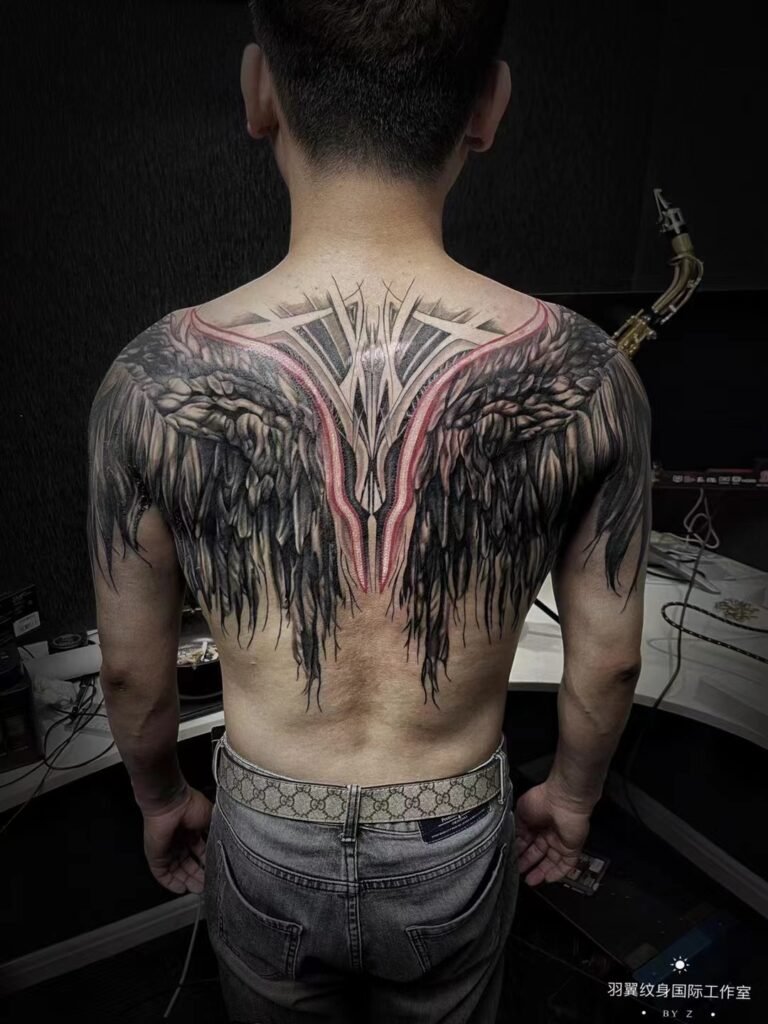
Choose a complete angel when the face, pose or named figure is the main subject. Choose wings alone when the silhouette matters more than a character, and choose one cropped wing when the placement is too narrow or curved for a convincing pair. A full figure needs room for the body and wings to read separately; wings-only designs give most of that room to feather shape.
Placement should follow the format. Broad areas such as the back, chest and thigh can hold a complete figure or paired wings. The upper arm, forearm and calf usually suit a single wing or a tightly cropped figure better. Decide the wing direction, main feather groups and degree of symmetry before adding small texture. Angel tattoo meaning is personal or tradition-specific; body placement does not create a fixed meaning by itself.
Angel and wings tattoo meaning starts with the figure
“Angel” can describe several very different pictures. A praying figure, an armoured Michael, Raphael walking beside Tobias, a cherub-like child and an anonymous winged silhouette do not carry the same source or visual story. If a particular religious identity matters, name it in the brief and keep the identifying attributes. If it does not, describe the image as a personal angelic or winged figure rather than assigning it a history it does not have.
The National Gallery’s archangels glossary distinguishes Gabriel as a messenger, Michael in relation to justice, Raphael as a healer and protector of travellers, and Uriel in relation to prophecy and wisdom. It also notes that these figures are depicted with wings and usually with an attribute. Those are named roles within a particular art tradition, not a promise that an angel tattoo will provide protection, healing or guidance.
Wings do not automatically make a figure an angel. The Metropolitan Museum of Art identifies Nike as the winged Greek personification of victory, associated with battle and athletic contests. A reference based on Nike, a mythological flight scene or a fantasy character should be briefed on its own terms. That distinction makes the design clearer and prevents a generic “angel tattoo meaning” from flattening unrelated sources into one symbol.
Full angel, paired wings or one wing?
The first practical choice is how much of the subject must be visible. When comparing angel tattoo ideas, sort the references into these three formats before discussing style. Each format spends space differently.
| Format | What carries the image | Space it needs | Main trade-off |
|---|---|---|---|
| Complete angel | Face, gesture, clothing, body and wings | A broad or long area where figure and wings can separate | A smaller size forces the face, hands or feathers to be simplified |
| Paired wings without a figure | Overall span, centre gap and two outer edges | Width for the pair, especially when the wings open sideways | Strong symmetry can look stiff if the design ignores body movement |
| One cropped wing | Root, outer contour and a clear run of long feathers | A vertical or curved panel such as an arm, calf, side torso or shoulder | The crop must look deliberate rather than like half of a missing pair |
A complete angel is the most information-heavy option. The viewer needs to find the head, understand the pose and still recognise where the wings attach. If a sword, staff, halo, robe or surrounding scene is essential, the design needs even more room. Reducing everything equally rarely helps. It is usually better to protect the face and gesture, then simplify secondary fabric, clouds or feather texture.
Wings alone remove the face and narrative gesture. That makes the silhouette immediate, but it also places more pressure on proportion. The centre gap, angle of the upper edges and length of the outer feathers become the composition. A single wing is leaner still. It works when the root and tip create a complete path across the chosen body area.
Build a full angel from the pose outward
For a complete figure, settle the action before styling the wings. Is the angel standing, kneeling, descending, turning or reaching? Where do the head and hands point? Which object identifies the figure? A calm frontal pose asks for a different wing arrangement from a twisting or airborne pose.
Start with a thumbnail silhouette. At that scale, the figure should not merge into one dark column with two feathered lumps attached. One wing can open while the other folds, or both can frame the body, but their angles must support the gesture. A three-quarter figure may need unequal visible wing widths because the torso has turned. Forcing an equal pair onto a rotated body can make the anatomy feel disconnected.
Cropping is useful when it has a clear purpose. A thigh or upper-arm composition might show the head, torso and one dominant wing while allowing the second wing to recede behind the figure. That is still a complete scene if the overlap explains what is hidden. Randomly trimming both wing tips at the boundary usually feels accidental.
Wing direction changes the composition
Wing direction changes how the eye travels, but it does not impose one universal meaning. Use words such as lifted, spread, folded, descending or wrapped to describe the shape you want. Then explain the personal mood separately.
- Lifted wings create a tall silhouette and leave room around the lower figure. They can suit a back, thigh or calf when upward movement is important.
- Side-spread wings use width. They need the back, upper chest or another broad field if the long outer feathers are meant to remain visible.
- Folded wings keep the mass close to the body. They suit a standing figure or a narrower vertical placement, though the overlapping feather layers must remain distinct.
- Curved or wrapping wings can frame a face, object or central figure. Their inner edges should lead toward that focus rather than close over it.
Art history offers useful composition references without turning them into tattoo rules. In the National Gallery’s record for Bartolomé Bermejo’s Saint Michael Triumphs over the Devil, the curved wings frame Michael’s face, contain the movement and contribute to the painting’s triangular structure. The wings have a job inside the image. They do more than identify the figure. That is a useful test for a tattoo: if the wing angle changes, what else in the composition becomes clearer or weaker?
Group feathers before drawing texture
A readable wing is built from groups, not a row of identical leaf shapes. The Cornell Lab explains that a bird wing has long primaries on the outer half, overlapping secondaries on the inner half, and coverts that smooth the area where the flight feathers attach. Angel wings are imagined forms rather than anatomical bird wings, but this hierarchy gives an artist a believable structure to edit.
In a tattoo design, the longest feathers usually establish direction. The inner flight feathers build the main plane, while shorter coverts form a transition toward the root. These groups can be separated with edge changes, value shifts and a few controlled gaps. Outlining every barb and shaft at the same strength makes the wing noisy and removes depth.
Reference choice matters here. A swan-like wing has a different mass from an eagle-like wing, and a painted Renaissance wing may use colour and decorative rhythm rather than natural anatomy. Send references for the feather character you want, but allow the arrangement to be redrawn around the body. A pasted photograph of a bird wing may be accurate to the bird and still sit badly on a human figure.
Symmetry should be checked on the body
Paired wings can be geometrically mirrored, optically balanced or deliberately unequal. These are different decisions. A centred upper-back pair often benefits from a shared root height and a consistent outer span. It does not require every feather to be copied from one side to the other. Small changes in overlap keep the pair from looking mechanically duplicated.
Optical balance matters when the body is not still. One shoulder may sit slightly higher, the scapulae move separately, and an arm position can change the visible width of the back. The design should be checked in a relaxed standing posture, then reviewed with ordinary shoulder movement. The aim is a pair that reads as intentional on the wearer, not a perfect diagram seen only on flat paper.
Asymmetry makes sense when the figure turns, one wing comes forward, or the composition crosses from shoulder to chest. In that case, repeat selected angles or feather rhythms instead of forcing equal outlines. A single wing also needs balance, but the counterweight may be the figure, an open area of skin or the direction of the body panel rather than a second wing.
Wings tattoo placement by format
The right placement for a wings tattoo is the area that preserves the chosen silhouette without unnecessary trimming.
| Placement | Formats that commonly fit | What to resolve first |
|---|---|---|
| Full back | Complete angel, broad paired wings, figure with surrounding scene | Whether the focal point is the face, torso or full wing span |
| Upper back and shoulder blades | Paired wings, cropped figure, compact framed subject | Centre gap, shoulder movement and how far the tips extend |
| Chest and sternum | Frontal figure, folded wings, mirrored compact pair | Central alignment and whether the design crosses the sternum |
| Upper arm and shoulder | One curved wing, three-quarter figure, cropped pair | Which edge wraps and which view should read first |
| Forearm or calf | Vertical single wing, narrow standing figure | Feather length, root position and a clean outer contour |
| Thigh | Full figure, folded pair or one large wing | Viewing angle when standing and the amount of width available |
Do not choose the back simply because wings are associated with backs, or the chest because the image feels personal. Those may be good reasons to explore an area, but the drawing still has to fit. A side-spread pair compressed onto a forearm loses the feature that defines it. A single wing stretched across an entire back may feel under-resolved unless its crop, root and negative space were designed for that scale.
For examples of how a large main subject, directional background and body flow can be organised together, review Yuyi Tattoo’s Japanese and Asian-inspired composition work. Use those examples to judge composition and scale, not as a source for Christian or Classical iconography.
Prepare a focused angel tattoo brief
A useful first enquiry does not need a finished drawing. It needs decisions that affect the drawing. The tattoo enquiry guide explains how to organise the initial information; for an angel or wing project, include:
- Whether you want a complete angel, paired wings or one cropped wing.
- Any named figure, tradition or artwork behind the reference.
- The pose and wing direction in plain language.
- Your body area, side and approximate height and width.
- The feather character you prefer, with one primary visual reference.
- The details that must remain, such as a face, hand, object, halo or wing tip.
- Existing tattoos nearby and whether the piece may extend later.
Send that brief through Yuyi Tattoo’s contact page for a project-specific discussion. The artist can then assess whether the figure and wings have enough separation, whether the crop suits the body area, and which details should be reduced before the design is developed.
Sources and review date
- The National Gallery, London — Archangels glossary — reviewed 24 August 2026.
- The National Gallery, London — Saint Michael Triumphs over the Devil — reviewed 24 August 2026.
- Cornell Lab Bird Academy — Everything You Need to Know About Feathers — reviewed 24 August 2026.
- The Metropolitan Museum of Art — Terracotta statuette of Nike, the personification of victory — reviewed 24 August 2026.
Frequently asked questions
What does an angel tattoo mean?
There is no single angel tattoo meaning. A named archangel can draw on a specific religious and artistic tradition, while an anonymous winged figure may be personal or fictional. Define the figure, source and attributes before assigning words such as protection, justice or guidance.
Do angel wings on the back mean protection?
Not automatically. Back placement gives paired wings useful width, but placement does not create a religious meaning or guarantee a spiritual outcome. If protection is your intended personal theme, state that in the brief and decide whether a named tradition or figure is relevant.
Is a full angel better than wings alone?
Neither is inherently better. A full angel is suitable when the face, pose or attribute matters. Wings alone are stronger when you want the span, feather shape and symmetry to carry the image. Available space often decides which version remains clearer.
Should a pair of angel wings be perfectly symmetrical?
They can be mirrored, but exact duplication is not required. A centred pair should feel balanced on the body. Feather overlap may vary, and a turning figure may need one wing to appear narrower than the other.
Can one angel wing look like a complete tattoo?
Yes. The root, outer edge and longest feathers need to create a deliberate silhouette suited to the body panel. A good crop reads as one designed wing, not as a pair that was cut in half to fit.
How much space does an angel wing tattoo need?
There is no universal minimum. Space depends on the curve of the wing, the number of feather groups, the amount of texture and the placement. Test the main contour and feather hierarchy at the intended size before committing to small detail.

