
A full sleeve budget starts with a coverage plan, not an hourly figure found online. “Sleeve” may mean a collection of separate tattoos, a continuous background or dense coverage extending into the shoulder and hand.
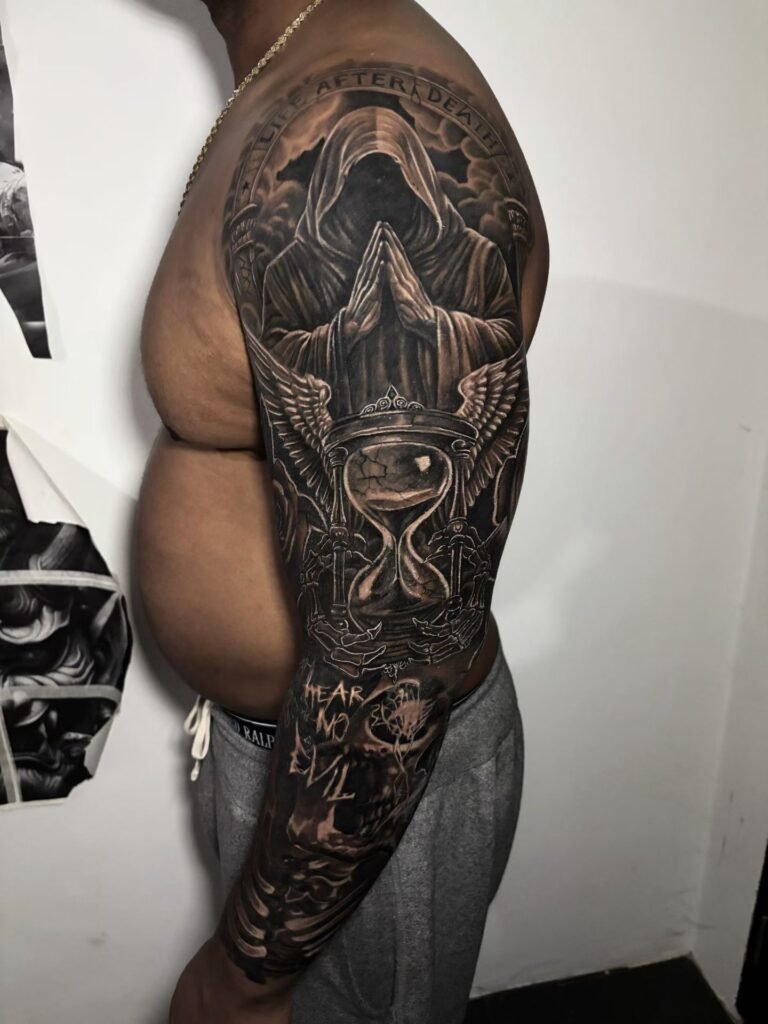
Define the boundaries first
- Where does the piece start and stop?
- Will the inner arm, elbow and gaps be included?
- Is existing ink being incorporated or covered?
- Do you want open skin, extensive shading or a colour background?
Ask the artist to separate the design proposal from the estimated tattooing schedule. Both can change if the sleeve grows after the first sitting.
Turn the estimate into a useful budget
Confirm whether you are paying per hour, per sitting or for an agreed project scope. Ask how breaks, unfinished sections, additions and rescheduling are handled. For staged payments, establish what each payment covers and whether the deposit is credited toward a particular sitting.
Leave room in your calendar as well as your budget. A series of sessions has recovery and work-clothing implications; the fastest schedule is not necessarily the most practical.
Build a budget worksheet for the actual proposal
Record the agreed starting and ending boundaries, artist, billing model and what is included in the current estimate. Under that, keep separate entries for possible additions and unresolved sections. This prevents the price of a partial outer-arm plan from being mistaken for the cost of a finished wraparound sleeve.
Ask how progress will be reviewed after each sitting. If the background changes midway, request a new scope discussion before assuming the remaining time estimate still applies. Do not book every future sitting solely from a rough first-photo estimate.
Budget for a complete stage, not an arbitrary stopping point
If you need to pause the project for several months, discuss which stage can look intentional on its own. A staged plan should make visual sense as well as spread payments. It is reasonable to delay optional background detail while retaining a clear main subject; it is less useful to add unrelated small pieces because they fit the budget that week.
Keep four numbers separate
Your budget limit, the studio’s current estimate, the payment due for the next sitting and the amount already paid are different figures. Keep them on separate lines. This makes it easier to see whether a change in scope affects the remaining project rather than only the next appointment.
If an estimate is expressed as a range of sittings, ask what assumptions produce the shorter and longer versions. Do not convert the shortest estimate into a promised completion date. A proposal that leaves unresolved inner-arm or background work should say so, even if the first visible stage looks nearly complete in a photograph.
Do not let the payment sequence design the sleeve
Choose a coherent overall direction before dividing it into appointments. Buying unrelated small motifs one at a time may be right for a deliberate patchwork plan, but it is not automatically a cost-saving route to a continuous sleeve. Connecting them later is a new design problem with its own scope.
At Yuyi Tattoo’s Singapore studio, start with the large-scale tattoo planning page and discuss the whole sleeve brief before treating one session estimate as the project total.

