
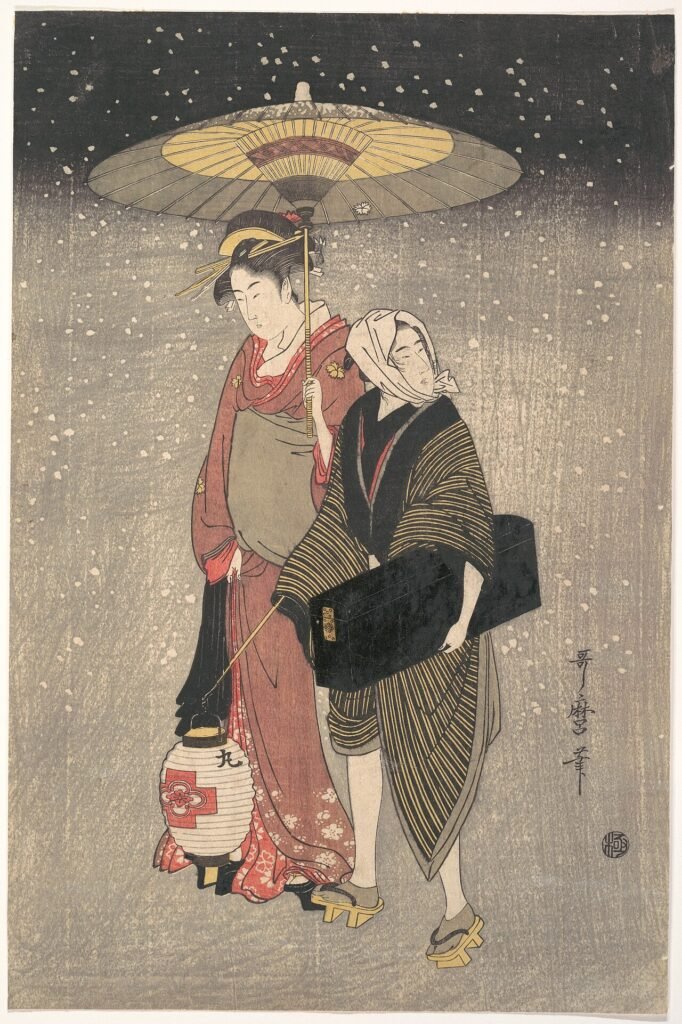
Geisha tattoo meaning should begin with the person’s documented role, not a generic idea of beauty or mystery. In Kyoto, geiko is the regional term for a geisha, while maiko are apprentices. Courtesans, actors and other kimono-clad women shown in Japanese art are not interchangeable with them.
For the tattoo, choose a dated and labelled reference, then decide what the figure is doing. Gesture, hairstyle, sleeve length, obi, instrument or fan, and facial scale should agree with that source. A respectful design does not invent an identity from costume fragments.
First identify Geisha, Geiko, Maiko or another subject
The labels answer different questions. “Geisha” is the wider term commonly used in English and in parts of Japan. Japan’s official Highlighting Japan profile explains that geiko is the Kyoto word for geisha and describes geiko as women trained to entertain through music, conversation and dance. The same source identifies maiko as trainees who progress toward becoming geiko.
Kyoto City’s official travel guide uses the distinction in present-day local context: geiko work as professional performers and entertainers in the city’s kagai districts, and maiko are young apprentice geiko. This is a professional and artistic role, not a label for any woman wearing kimono.
Historical art introduces more possible identities. The British Museum defines bijin or bijinga broadly as pictures of beautiful people, most often courtesans, geisha or ordinary townswomen. A print catalogued as bijinga is therefore not automatically a Geisha reference. The Metropolitan Museum of Art’s records for Edo-period courtesans identify brothels, ranks and named women that belong to the history of the pleasure quarters, not to the modern role of a Kyoto geiko.
Before saving an image, record:
- the museum or cultural institution;
- the exact object title;
- the date or period;
- the role named by the catalogue;
- the action, costume and setting actually visible.
If the institution calls the subject a courtesan, do not relabel her Geisha because the hair and kimono look elaborate. If it says only “woman” or bijin, keep the label open.
A reference can be accurate without being a portrait
A source image tells you how an artist represented a subject at a particular time. It does not necessarily record a neutral likeness or an everyday outfit.
Ukiyo-e prints may idealise proportions, elongate the neck, simplify the face or use costume to identify rank and fashion. Later Nihonga paintings approach the figure differently. The Met’s 1936 Elderly Geisha, for example, shows two older working women in a quiet interior. One holds a pipe; the other reviews a book of libretti beside a shamisen. The museum reads the work against the usual preference for youthful female subjects and discusses it as a more truthful depiction of working women.
Decide whether the tattoo should preserve the flat, graphic construction of a print, the softer volume of a painting, or a realism-influenced figure based on a properly licensed photograph. Do not merge the face from one period, hair from another and costume from a third while presenting the result as historical accuracy.
Use costume and hair as evidence, not decoration
Maiko and geiko dress differently, and their appearance also changes by district, career stage, season and occasion. One online checklist cannot identify every image.
Japan’s government publication on Kyoto umbrella craft gives several useful current distinctions. It states that maiko wear kimono with long furisode sleeves and arrange their own hair in elaborate styles, while geiko wear wigs. These points can guide the first check, but the selected photograph or institutional record should remain the authority for a particular outfit and occasion.
Treat each visible element separately:
| Element | Question for the source | Tattoo priority |
|---|---|---|
| Hairstyle or wig | Is the subject identified as maiko, geiko, courtesan, actor or another figure? | Preserve the large outer shape before individual hair strands |
| Hair ornaments | Are they seasonal, rank-related, theatrical or simply part of the artwork? | Keep only the pieces large enough to remain distinct |
| Kimono sleeves | Are they long furisode sleeves or a more restrained form? | Use the sleeve as a major gesture and flow line |
| Obi and ties | Where is the knot, how long is the visible section, and what does the source title identify? | Show the main mass; avoid inventing small construction details |
| Textile pattern | Does the object record identify a motif or season? | Select one or two large repeats rather than shrinking an entire fabric |
Costume can carry most of the composition, but it should still behave as cloth. Sleeves hang from shoulders, fold at elbows and react to the hand. An obi changes the torso silhouette. A trailing hem changes the stance. Pattern follows those folds rather than floating across them.
Let the gesture show the professional context
Write the figure’s action before choosing background. Dancing, tuning a shamisen, holding a fan, walking under an umbrella, reading a libretto and sitting in conversation each create a different body line.
A dance gesture can lead from the face through the shoulder and extended sleeve into the hand. The sleeve should continue the action rather than hide it. A shamisen creates a strong diagonal across the torso; both hands need a clear relationship to the instrument. A fan can open beside the face, continue a wrist angle or form a quiet countershape. An umbrella creates a long axis and a canopy that can frame the figure, but it needs enough placement width.
For a still seated pose, small asymmetry prevents the figure from becoming mannequin-like. One shoulder may settle lower, the head can turn slightly, and the hands can perform a specific task. The elderly geisha in The Met’s painting are useful because their objects and gestures suggest work and preparation without an exaggerated pose.
Avoid turning every figure into a coy glance over the shoulder. That gesture is common in modern tattoo references but does not identify the profession, period or person. Let the chosen artwork supply the posture.
Plan facial readability without claiming a likeness
This is a Japanese figure-reference problem, not a guide to reproducing a family member or celebrity. Unless the source is a named, licensed portrait and likeness is part of the brief, the face should support the artwork’s character rather than pretend to identify a real individual.
Choose front, profile or three-quarter view. A profile preserves a clear nose, lip and chin line and works well with a tall hairstyle. A three-quarter face allows both eyes to contribute while giving the head depth. A frontal face can be calm and graphic, but symmetry makes small placement errors more visible.
Set the facial size before adding hairpins or textile pattern. At small scale, keep the brow, eyes, nose shadow and mouth separated. White face makeup should not become a blank white oval; edge, eye and lip contrast still need structure. In black and grey, reserve open skin and lighter tone around the face so dark hair and collar do not close over it.
Expression should be observable: eyes lowered toward an instrument, gaze turned toward a dance hand, or a composed face directed outside the frame. Words such as mysterious, seductive or exotic do not provide a respectful or usable drawing instruction.
Give textile detail a clear hierarchy
The face and gesture should read first, the costume mass second, and textile pattern third. Reversing that order produces an impressive fabric sample with a lost person inside it.
Choose one dominant pattern zone. It may sit on the lower kimono, one sleeve or the obi. Let other fabric areas use quieter shading or partial repeats. Large motifs can bend around folds; small all-over motifs can be reduced to selected passages. The design does not need to reproduce every flower in the source to remain faithful to its visual logic.
Colour can separate skin, hair, kimono and accessories, but each bright accent should have a job. Black and grey can emphasise gesture and volume, provided the hair, face, collar and sleeve do not merge into one value. Neither palette proves cultural accuracy.
If the figure is part of a Japanese or Asian-inspired composition, study Japanese and Asian-inspired tattoo work for hierarchy and body flow. Use museum references, not another completed tattoo, to establish identity and costume.
Background should locate the figure carefully
A background may identify a performance interior, street, garden, seasonal setting or print-like empty field. Use architecture only when the source supports it. A random torii gate, pagoda and Mount Fuji do not make a figure more accurately Japanese.
Seasonal foliage can support a dated hair ornament or textile pattern, but confirm the relationship rather than adding blossoms automatically. A screen, lantern, tatami edge or instrument case can locate an interior with fewer details. Open skin may be the best background when the costume is already complex.
Courtesan and pleasure-quarter imagery requires especially careful labelling. The Met’s Takigawa of the Ōgiya Brothel identifies a high-ranking courtesan preparing to receive a customer and describes her layered garments. The record is valuable precisely because it names the role and context. It should not be used as generic “Geisha costume.”
Placement for gesture, face and costume
The thigh is well suited to a standing, seated or dance figure because it can hold a readable face and broad kimono mass. It also leaves room for a sleeve or hem to travel diagonally. Check front and outside views so the face and primary hand remain on a shared plane.
The upper arm can hold a bust or half-figure. A turning profile works with the curve of the shoulder, while a large sleeve can move down toward the elbow. A Geisha tattoo sleeve should be led by the figure’s gesture, not filled with separate fan, lantern and blossom icons.
The back supports a full figure, umbrella, dance pose or interior setting. Avoid centring every element on the spine. An off-centre figure with textile flow crossing the back may feel more natural. The calf suits a vertical standing or walking pose but may require a simpler hairstyle and fewer textile repeats.
Prepare a respectful source-led brief
Send one institutional image for identity and period, one image for gesture, and one detail reference for costume or hair. Label each role. If a photograph shows a living person, confirm that you have appropriate permission to use it; otherwise favour public-domain museum works or institutionally documented historical objects as research references.
Add placement photographs, coverage, preferred viewing side, colour direction and the one detail that must remain. The tattoo enquiry guide can help you organise those materials.
A focused message might say: “Kyoto maiko figure based on a dated institutional reference, standing three-quarter pose on the outer thigh, left sleeve leading the gesture, seasonal hair ornament retained, one large kimono pattern, no courtesan styling or generic temple background.” That is more useful than asking for “a traditional Geisha girl.”
Yuyi Tattoo’s documented portfolio includes Japanese and Asian-inspired compositions. Any specific design, schedule and project terms still need individual review. Send the labelled references through the contact page once the role, gesture and placement are clear.
Sources and review date
- Kyoto City Official Travel Guide: A Night of Culture with Kyoto’s Geiko and Maiko — reviewed 24 August 2026.
- Government of Japan, Highlighting Japan: English-speaking Geisha in Kyoto — reviewed 24 August 2026.
- Government of Japan, Highlighting Japan: Wagasa and current Geiko and Maiko dress — reviewed 24 August 2026.
- The Metropolitan Museum of Art: Elderly Geisha — reviewed 24 August 2026.
- British Museum: Bijin and Bijinga collection term — reviewed 24 August 2026.
- The Metropolitan Museum of Art: Takigawa of the Ōgiya Brothel — reviewed 24 August 2026.
Frequently asked questions
Are Geisha and Maiko the same?
No. In Kyoto, maiko are apprentices training to become geiko, the regional term for geisha. Their professional stage, dress and hair differ, so choose the label supported by the reference.
Is every kimono-clad woman in an old print a Geisha?
No. Museum catalogues distinguish geisha, courtesans, actors, ordinary townswomen and broader bijinga subjects. Use the object title and catalogue description rather than identifying the role from clothing alone.
What gesture works well in a Geisha tattoo design?
A source-led action works best: dancing, playing shamisen, holding a fan, walking with an umbrella, reading or sitting in conversation. The hands, sleeves and gaze should all support the same action.
How much costume detail should be included?
Enough to identify the role and preserve the intended visual character, but not so much that the face and gesture disappear. Keep the outer hairstyle, sleeve and obi masses clear, then choose one dominant pattern area.
Can a Geisha figure work in black and grey?
Yes. Black and grey can show fabric weight, face, hair and gesture clearly when values are separated. Reserve lighter space around the face and avoid giving hair, collar and background the same dark tone.


