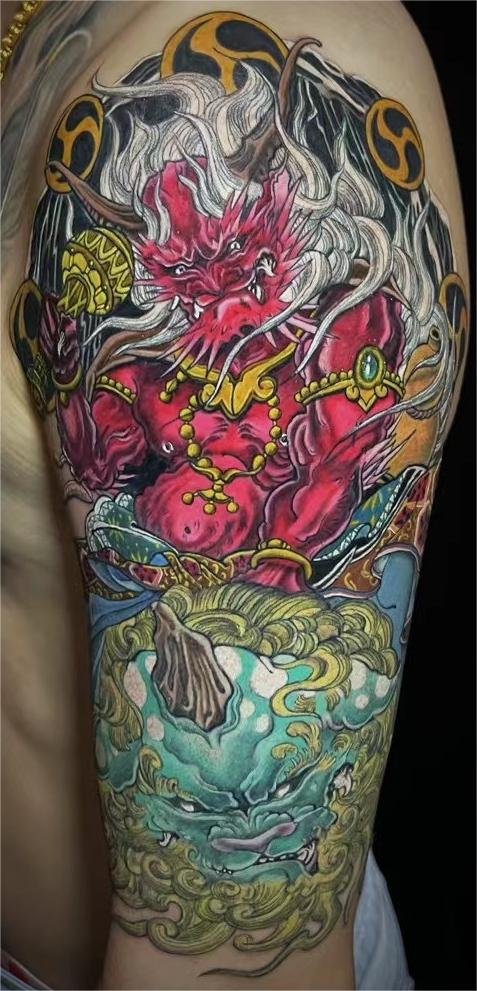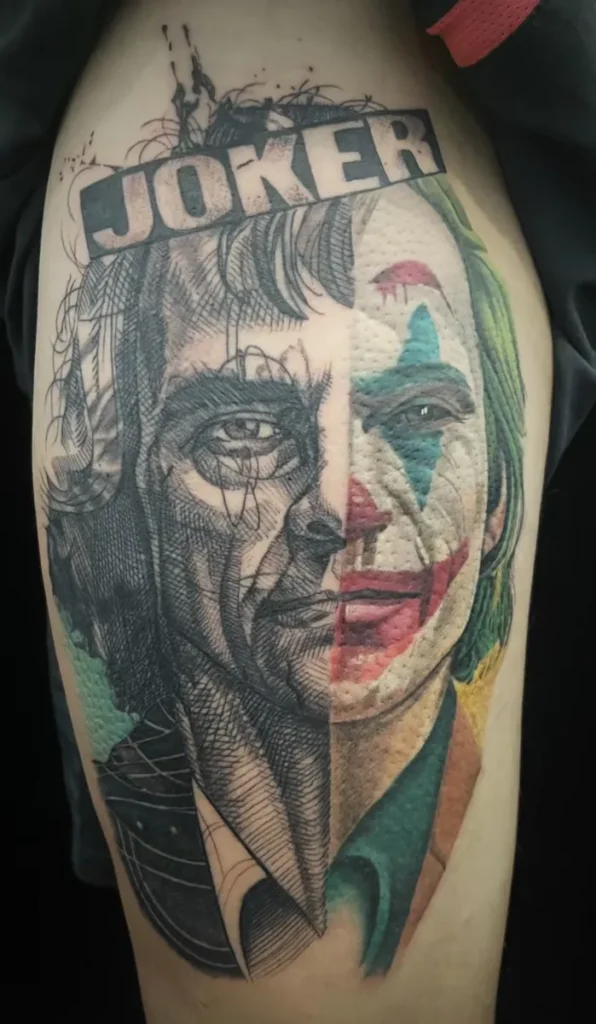
Healed tattoo photos are useful because they show the tattoo after the first shine, swelling and surface darkness have settled. Read them for contrast, edges, scale, body placement and ordinary-light visibility. A healed photograph can support your decision, but it cannot guarantee how a different design will heal on your skin.
Fresh tattoo photos still matter. They show the artist’s immediate drawing, packing and line control. But if you are deciding whether to book, healed work answers a sharper question: does the image still read after the skin has closed and the surface is no longer glossy? That is the evidence to ask for, especially for black-and-grey realism, portraits, Japanese backgrounds and large pieces.
First, check whether the photo is actually healed
Do not assume a portfolio image is healed unless it is labelled, dated or confirmed by the artist. A fresh tattoo is usually darker, shinier and more swollen. The skin may reflect a ring light. The blacks can look deeper because surface ink and moisture are still present. A healed tattoo usually looks drier, less reflective and closer to normal skin texture.
Ask a simple question: “Is this fresh or healed, and how long after the appointment was the photo taken?” If the artist cannot say, treat the image as a finished tattoo photo rather than healed proof.
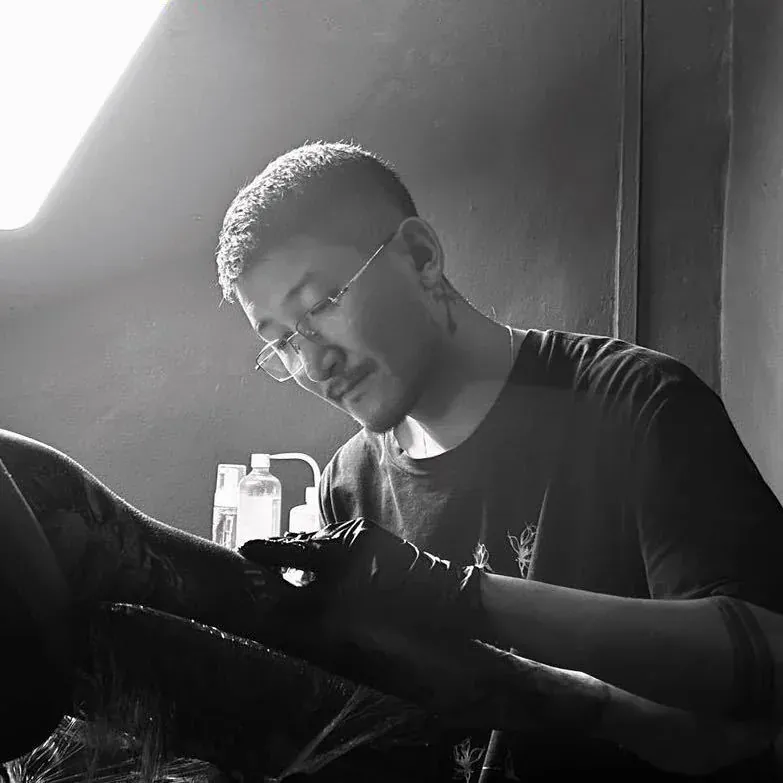
Yuyi Tattoo’s public portfolio includes black-and-grey realism, portrait realism, large-scale back pieces and Japanese or Asian-inspired compositions. The site does not label every image as fresh or healed. When you browse Yuyi Tattoo portfolio work, read the images as portfolio evidence, then ask which examples are healed if that distinction will affect your booking decision.
What healed tattoo photos can show
A healed image is not magic. It is still a photograph, and photography can flatter or hide. Used carefully, though, it can show several things that fresh work cannot show as clearly.
Contrast that survives normal skin texture
Contrast is the first test. Squint at the image or step back from the screen. Can you still tell the main subject from the background? In a portrait, do the eyes, nose, mouth and jaw remain separate? In a dragon, warrior or flower composition, can you read the main motif before you inspect the detail?
Good contrast does not always mean the tattoo is very dark. It means the darks, mid-tones, light skin breaks and negative space are arranged so the design still reads. A black-and-grey tattoo with nothing but mid-grey can look soft when fresh and flat when healed. A piece with every shadow pushed to black can lose form. The strongest healed work usually has a planned value range.
If you are considering black and grey, compare the healed image with the kind of work shown on the black-and-grey tattoo page. Look for skin breaks, clean dark placement and faces that remain readable without needing a caption.
Edges that stay intentional
Edges tell you whether the tattoo was designed with control. Hard edges should still look deliberate: the line of an eyelid, a blade, a mask, a scale pattern, a letter. Soft edges should fade because the form turns, not because the tattoo blurred into the background.
Zoom in, but do not obsess over microscope-level detail. Skin is not paper. A useful healed photo should show whether outlines wobble, whether small shapes merged, and whether shaded edges still describe the subject. For portraits, check the eyelids, nostrils, lips and hairline. For Japanese or Asian-inspired work, check the border between the main figure and the background. For lettering, check spacing and letter counters.
A slightly softened edge is normal. A collapsed edge is different. The difference is whether the tattoo still communicates the intended form at the size it was given.
Scale that matches the detail
Healed tattoo photos are especially useful for judging scale. Some designs look impressive as drawings because the page does not move, stretch or heal. On skin, small details need enough room to remain separate.
Look at the body part, not only the subject. A five-centimetre face with tiny eyelashes asks for a different margin of safety from a shoulder-size face. A sleeve can hold more background movement than a wrist. A full back can carry a large central figure with supporting texture; a small rib tattoo cannot carry the same amount of narrative without becoming crowded.
If a healed tattoo has held well, ask why. Was the design large enough? Were the details simplified? Did the artist leave skin breaks? Did the darkest areas anchor the image? Those answers matter more than the fact that one photo looks clean.
Body flow in real positions
The best healed photos show the tattoo on the body, not only as a flat close-up. Arms rotate. Shoulders roll forward. Ribs stretch when someone breathes. A healed photo taken from one flattering angle may hide how the design turns.
Ask for a straight-on photo and one or two angle photos for large work. For sleeves and back pieces, check whether the design still has a main line of movement when the person is standing normally. A tattoo can be technically clean and still feel awkward if the composition fights the body.
This is where the artist page is useful context. Yuyi’s artist profile explains the studio’s documented direction and awards without claiming that one result guarantees another. Use that context, then return to the images.
What healed tattoo photos cannot prove
A healed photo can support trust. It cannot remove uncertainty.
It cannot prove that the same result will happen on a different person. Skin tone, scar tissue, sun exposure, immune response, placement, aftercare, session length and design density all affect how a tattoo settles. It also cannot prove the artist’s whole portfolio. One well-healed photograph is one data point. Three or four healed examples in the same style are stronger.
It cannot prove hygiene by itself. A clean healed tattoo suggests the result did not obviously fail in that case, but it does not show whether needles were opened from sealed packages, whether ink was single-use, or whether gloves were changed properly. Ask those questions separately before you sit down.
It cannot prove touch-up policy or cost. A healed photo may show a piece after a touch-up, before a touch-up, or with no touch-up needed. Unless the caption explains the sequence, do not infer the studio’s rule.
And it cannot prove the artist will accept your design. A portfolio shows what has been done. A consultation decides whether your reference, body area, size and timing make sense.
Fresh vs healed tattoo photos: how to compare the pair
When an artist can show both fresh and healed photos of the same tattoo, compare them in order.
Start with the fresh image. Check whether the drawing is clean, whether the main subject is readable and whether the tattoo was placed with the body rather than pasted onto it. Then move to the healed image and ask what changed.
Some changes are expected. The surface shine disappears. Blacks can soften. Grey tones settle. Colours may look less wet and more integrated with the skin. Fine lines may relax slightly. The question is not whether the healed tattoo looks identical to the fresh photo. It will not. The question is whether the important parts still work.
Use this short comparison:
| Check | Fresh photo | Healed photo |
|---|---|---|
| Contrast | May look extra dark because the skin is fresh and glossy | Shows whether the value range still reads |
| Edges | Shows immediate line and shading control | Shows whether important edges stayed clear |
| Scale | Shows how much detail was attempted | Shows whether that detail had enough room |
| Skin texture | Often swollen or reflective | Closer to everyday viewing conditions |
| Reliability | Good for technique on the day | Better for judging settled readability |
If the healed photo loses a small amount of sharpness but keeps structure, that can be a strong result. If the whole image becomes a grey patch, scale or contrast was probably pushed too far.
Lighting, filters and photo quality
A healed tattoo photo is only as honest as the conditions around it. Look for ordinary room light, daylight or a clear studio shot without heavy smoothing. A photo taken under strong side lighting can make texture look sharper. A photo taken under a ring light can make blacks look richer. A filter can hide redness, dry skin or low contrast.
Useful photos show enough surrounding skin to understand placement and scale. Cropped details are fine as a second image, but not as the only proof. For large work, a close-up of armour, fur or flower petals does not tell you whether the whole back or sleeve works.
Ask for one wider shot if the image is cropped. Ask whether the photo was taken after healing, after a recent touch-up, or immediately after a session. A calm artist will answer plainly. The answer may be “this one is fresh” or “we do not have a healed photo of that piece yet.” That is more useful than a vague caption.
A practical checklist before you book
Use this checklist for any healed tattoo portfolio:
- Is the photo clearly labelled as healed, or did the artist confirm it?
- Is the design similar to yours in style, size and placement?
- Does the main subject still read when you step back?
- Are the key edges intentional rather than blurred or patched?
- Does the tattoo show enough surrounding body to judge scale?
- Are there several healed examples, not only one standout image?
- Have you separated healed-result evidence from hygiene, price and policy questions?
If the answers are mostly yes, the healed portfolio supports a consultation. If several answers are missing, ask for clarification before you book. You can contact Yuyi Tattoo with your idea, placement, size and references. The studio is in Geylang, Singapore, and the public phone or WhatsApp number is +65 9128 0501. A 24-hour listing does not promise walk-in availability or that Yuyi is free at that moment, so confirm before arriving.
Sources and review date
- U.S. FDA — Tattoos and permanent makeup fact sheet — reviewed 24 August 2026.
- American Academy of Dermatology — Tattoos: 7 unexpected skin reactions and what to do about them — reviewed 24 August 2026.
- PMC / Journal of Experimental Medicine — Unveiling skin macrophage dynamics explains both tattoo persistence and strenuous removal — reviewed 24 August 2026.
Frequently asked questions
Are healed tattoo photos always better than fresh photos?
They answer a different question. Fresh photos show the tattoo on the day it was made. Healed tattoo photos show whether contrast, edges and scale still work after the surface settles. For booking decisions, healed examples are stronger evidence, but a fresh photo can still show drawing control and placement.
How many healed photos should I ask to see?
Ask for several examples in the same style and scale as your project. One healed image is useful, but it does not prove portfolio consistency. Three or more comparable healed examples give you a better read on repeatable decisions.
What if an artist has strong work but few labelled healed photos?
Ask directly which images are healed. If the artist has no healed examples in your style, treat that as missing evidence rather than a failure. You can still consult, but you should make a slower decision and look harder at scale, contrast and comparable finished work.
Can a healed photo prove that my tattoo will not fade?
No. A photo shows one tattoo at one point in time. Sun exposure, placement, skin response, design density and aftercare all affect how a tattoo ages. Use healed photos to judge settled readability, not to demand a permanent result guarantee.
Should I compare healed photos across different skin tones?
Yes, when possible. Contrast and colour behave differently across skin tones and undertones. A useful portfolio shows how the artist plans enough value separation for the skin in front of them. If you do not see a close match, ask how the design would be adjusted.