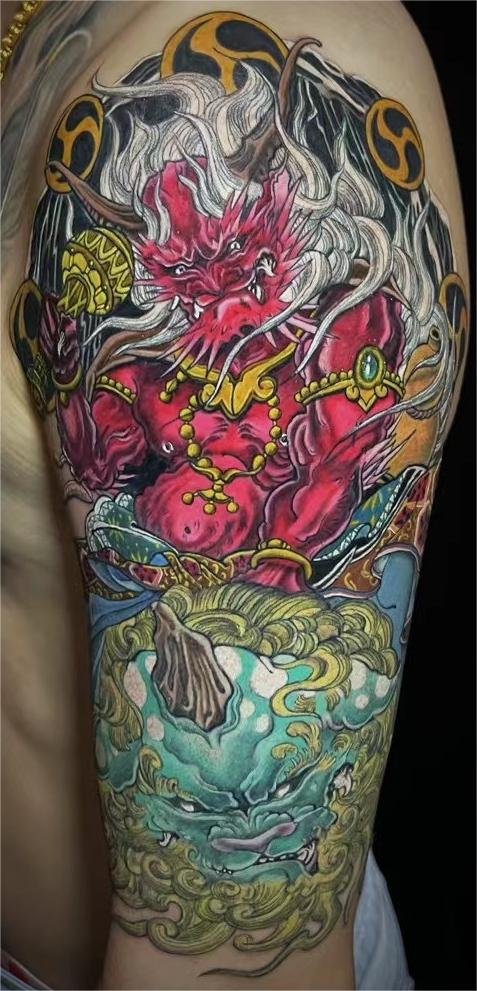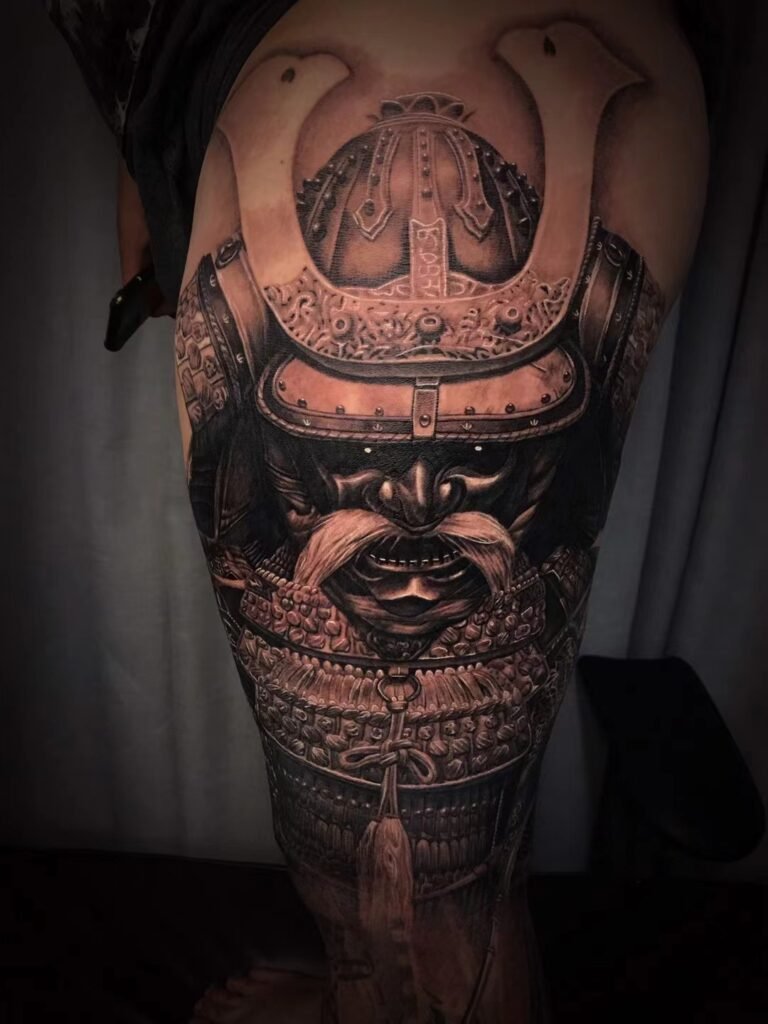
Katana tattoo meaning is personal rather than fixed by the weapon alone. In a larger tattoo composition, a katana is most useful as a long directional line: the blade, scabbard or hilt can lead toward the main subject, separate two areas or carry movement through a narrow body zone. A kabuto works differently, adding a compact armour silhouette, a crest line and layered edges.
Decide which subject remains primary before placing either object. The katana or kabuto should support that hierarchy rather than imply a complete Samurai figure by accident. This guide covers weapon and helmet form, orientation, cropping and supporting roles. Ninja imagery, faces, hands, full-body poses and warrior narratives are outside its scope.
Separate object research from symbolic meaning
Search results frequently assign honour, loyalty, discipline or protection to every katana and kabuto tattoo. A wearer can choose those themes, but they are not properties that can be read reliably from any sword or helmet. The visible object has its own construction and history; the personal meaning belongs in the client’s brief.
Write the intent in two lines:
- Object statement: the exact katana mounting or kabuto reference and the parts that must remain recognisable.
- Personal statement: the private idea, mood or relationship that makes the object relevant.
Keeping those statements separate prevents a visual detail from being promoted into a historical fact. A sheathed sword may feel restrained in one design, while another client may choose it simply because the scabbard creates a stronger line. A helmet may feel protective, but its crest may refer to a specific deity, family or commission that requires source checking.
A katana is more than one curved blade
The British Museum’s katana record separates the long blade from its saya or scabbard, tsuka or hilt and tsuba or guard. The blade dates to 1520 while the documented mounting is later, which is a useful reminder that a museum object can contain parts with different dates and makers. The record also describes this type of mounting as worn through the belt with the cutting edge uppermost.
For tattoo planning, the identifying structure is a relationship between parts:
- the blade establishes length and curvature;
- the point finishes the direction;
- the guard creates a compact cross-shape or disc between blade and hilt;
- the wrapped hilt adds a short area of texture;
- the scabbard makes a broader, darker companion line.
Choose which parts will actually appear. A full sword needs enough length for the hilt and guard to remain proportional. A cropped hilt and guard can identify the object in a tighter area, but the context must make clear that the missing blade is outside the frame rather than broken unintentionally.
Use orientation to support the main subject
A katana can create a vertical, diagonal or shallow crossing line. The correct choice depends on what it supports.
Vertical or near-vertical
A near-vertical sword can stabilise a narrow forearm, calf or side panel. Behind a broader subject, it acts as an axis. Keep enough separation between the blade and the subject’s outside edge so the two silhouettes do not merge into one line.
Diagonal
A diagonal introduces movement and can connect a shoulder to an upper arm, cross a thigh panel or guide the eye through a back composition. The point should lead somewhere intentional: toward the focal subject, into open space or out of the frame. A random diagonal that cuts through a face or important contour weakens both elements.
Horizontal or shallow angle
A shallow angle can divide upper and lower areas or create a quiet base beneath the main subject. It needs width, so it is better suited to the back, chest or thigh than to a narrow limb. Check that the body curve does not make the sword appear kinked.
Orientation does not supply a universal meaning. It supplies energy, stability or division within this particular drawing.
Sheathed, partly drawn or exposed
Katana tattoo ideas often begin with the state of the sword. Treat this as a compositional decision before treating it as a metaphor.
| Sword state | Shape created | Supporting use | Main risk |
|---|---|---|---|
| Fully sheathed | One substantial line with hilt and guard | Stable axis, boundary or quiet counterweight | Scabbard detail becoming busier than the main subject |
| Partly drawn | Two close lines separating near the guard | Controlled tension or a widening route into the composition | Blade and scabbard merging at small scale |
| Fully exposed | One thinner reflective line | Direction, light break or sharp diagonal | A long blade cutting through important features |
| Cropped hilt | Compact guard and wrap texture | Small identifier near a larger subject | Looking like an unrelated handle with no structural context |
| Blade and scabbard apart | V-shape or crossing pair | Broader framework on back, chest or thigh | Becoming the primary subject through size alone |
If the object is secondary, do not spend the highest contrast on every fitting. Preserve the point, curve, guard and hilt relationship first. Pattern on the scabbard or guard should remain quieter unless the specific museum object is the focus of the project.
Cropping a katana without making it look accidental
Cropping can make a long weapon usable inside a larger composition. The crop should occur where the viewer can understand continuation. A blade leaving the outer frame is usually clear. A scabbard passing behind the main subject can also be understood if it reappears or if the hilt establishes its route.
Avoid ending the blade in an empty area without a visible point. That can suggest a broken sword even when none was intended. Avoid hiding the entire guard beneath another motif, because the transition from hilt to blade is one of the most recognisable parts. If only the hilt is visible, include enough guard and scabbard mouth to explain what it belongs to.
Overlap establishes depth. The sword can pass behind a mask, animal, flower mass or architectural edge, but the primary subject should keep its cleanest contour. It can pass in front when the weapon is deliberately the nearest layer, although that stronger overlap may give it more visual importance.
Kabuto form begins with the bowl and crest
Kabuto were not one standard horned helmet. The British Museum’s early sixteenth-century kabuto has a ridged bowl constructed from vertical plates, an articulated shikoro neck protector and a crossed hawk-feather clan crest. Those parts create three separate reads: the bowl, the descending layered guard and the upward crest.
The Metropolitan Museum of Art’s Zukinnari Kabuto has a very different silhouette. It takes the form of a square cloth cap, and its front crest depicts Fudō Myō-ō in flames. The example shows why a dramatic crest cannot be borrowed as anonymous decoration. Its subject is part of the object’s identity.
For a kabuto tattoo design, simplify in this order:
- preserve the bowl profile;
- keep the crest’s outer direction;
- show enough neck-guard layers to separate helmet from background;
- add cords, plate texture and small fittings only if the scale permits.
If the reference cannot be identified, describe it as an unsourced modern or fantasy helmet rather than presenting it as a documented historical kabuto.
Use a kabuto as a secondary mass
A kabuto is broader than a sword, so it supports a composition by adding weight rather than a long direction. It can sit behind the primary subject as a partial armour silhouette, occupy a lower corner as a foreground object or balance a large circular form on the opposite side.
A three-quarter kabuto often works better than a frontal one in a supporting role. It shows bowl depth and lets the far side become quieter. A fully frontal helmet with a wide crest is naturally assertive and can compete with the main focal point. Reduce contrast, crop one side or choose a less expansive reference if the helmet is meant to remain secondary.
Do not add an invented face simply because the opening feels empty. Once eyes, expression, hands, torso armour or a named warrior become essential, the project is a complete Samurai figure composition. That requires a different reference set and a different scale. Here, the negative opening beneath the bowl can remain dark, open or partly obscured by the primary motif.
Katana and kabuto can support each other
A sheathed katana can run behind a cropped three-quarter kabuto, giving the helmet an axis. Alternatively, a long sword can lead while a small helmet profile adds weight near the guard.
Choose one object to do the stronger job:
| Composition need | Better lead support | Quieter second object |
|---|---|---|
| Long direction through a limb or torso | Katana or scabbard | Small kabuto profile near one end |
| Broad weight beside a primary subject | Kabuto | Cropped hilt or short scabbard segment |
| Foreground-to-background depth | Cropped kabuto in front | Sword line receding behind |
| Separation between two visual zones | Sheathed katana | Crest silhouette contained within one zone |
Avoid crossed weapons, a full helmet, a face guard, banners and equal background detail all competing in the same small area. Supporting motifs work by clarifying hierarchy, not by cataloguing equipment.
Fit the objects to a moving body area
On a forearm or calf, a katana can follow the long axis, but the guard and hilt should stay on the preferred viewing surface. A blade that wraps around the limb may look bent or shortened. A small kabuto profile can sit near the wider end of the area, where the crest and neck guard have more room.
The outer upper arm supports a diagonal hilt, partial scabbard or three-quarter kabuto. Check the arm hanging naturally; a frontal helmet placed across the shoulder turn can lose half its crest. The thigh provides more width for a full helmet and a crossing sword line. The back or chest can use a shallow diagonal, but the weapon should not cut through the central subject by accident.
Test the composition as a silhouette before approving the fittings. From normal viewing distance, the primary subject should read first, the sword direction second and the helmet form third. If the order reverses, reduce the contrast or size of the supporting object.
Check museum details without copying a whole display
Museum records help identify an object’s parts, date, materials and associations. They do not require the tattoo to reproduce a display exactly. The Met’s Art of the Samurai collection guide shows how widely sword blades, mountings, kabuto shapes and crests can vary. Use one compatible reference family rather than selecting the most dramatic feature from every object.
Record the museum name, object title and URL. Mark which detail matters: blade curve, scabbard treatment, bowl profile, crest or neck guard. If a family crest, religious figure or inscription appears, verify it separately and decide whether it belongs in the personal project. Omitting an unverified detail is more accurate than assigning it a convenient meaning.
Prepare a warrior-object enquiry
Send the following information:
- primary subject of the overall tattoo;
- supporting object: katana, scabbard, kabuto or a controlled combination;
- exact museum or institutional reference;
- sword state and orientation, or helmet view and crop;
- which object details are essential and which may be simplified;
- placement side, approximate boundaries and relaxed body photographs;
- colour or black-and-grey direction;
- a clear note that no complete warrior figure is intended, if that is the boundary.
Review Yuyi’s Japanese and Asian-inspired tattoo work to consider hierarchy and body flow. The tattoo enquiry guide explains how to label references and placement images. Once the primary subject and supporting object are defined, send the brief through the Yuyi Tattoo contact page. Project scope and availability can then be assessed without guessing from the motif alone.
Sources and review date
- British Museum: Katana with saya, tsuka and tsuba — reviewed 24 August 2026.
- British Museum: Early sixteenth-century kabuto — reviewed 24 August 2026.
- The Metropolitan Museum of Art: Helmet, Zukinnari Kabuto — reviewed 24 August 2026.
- The Metropolitan Museum of Art: Art of the Samurai, Japanese Arms and Armor, 1156–1868 — reviewed 24 August 2026.
Frequently asked questions
What does a katana tattoo mean?
A wearer may connect a katana with discipline, resolve, protection, craft or another personal idea, but no meaning is automatic. The sword’s state and orientation shape the visual mood. State the personal context separately from the historical object reference.
Can a katana support a tattoo without showing a Samurai figure?
Yes. A blade or scabbard can provide a vertical axis, diagonal movement, a boundary between areas or a cropped foreground line. Keep the guard, hilt and curve coherent so the object remains identifiable without a hand or complete figure.
What should I check in a kabuto reference?
Identify the bowl form, front or side crest, neck guard and source. Check whether the crest represents a family, deity or named commission. Do not assume every horned or masked fantasy helmet is a documented historical kabuto.
Should a katana be sheathed or drawn in the design?
Choose by composition first. A sheathed sword gives one substantial line, a partly drawn sword creates two separating lines, and an exposed blade gives a thinner direction. Any personal interpretation should be supplied by the wearer rather than treated as a universal rule.
Can I add a clan crest to a kabuto tattoo?
Only after identifying and verifying it. A crest can belong to a specific family or object history, so it should not be selected as generic decoration. If lineage is not part of the brief, use the sourced helmet as shown or omit the unverified crest.
What should I send for a katana or kabuto tattoo enquiry?
Send the overall primary subject, one institutional object reference, the intended crop and orientation, placement photographs, approximate boundaries and a list of essential details. State whether the object is meant to stay secondary within a larger composition.