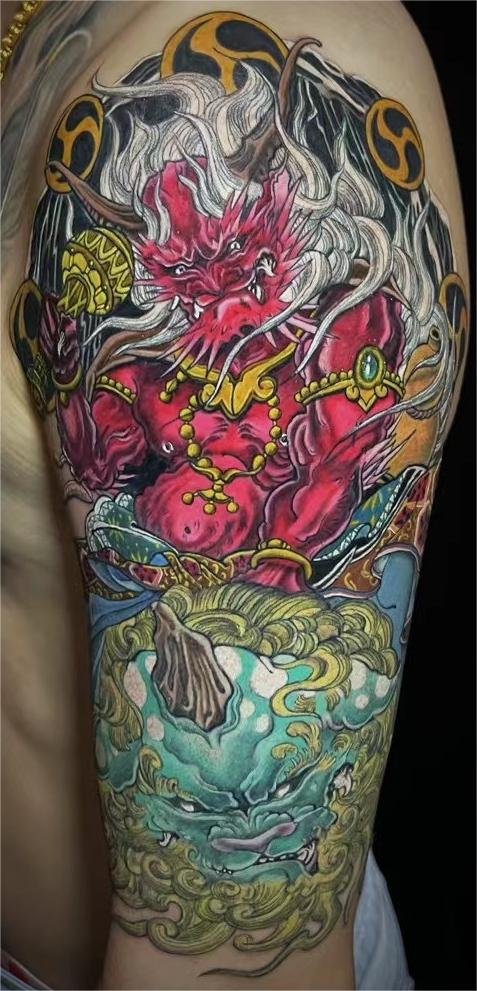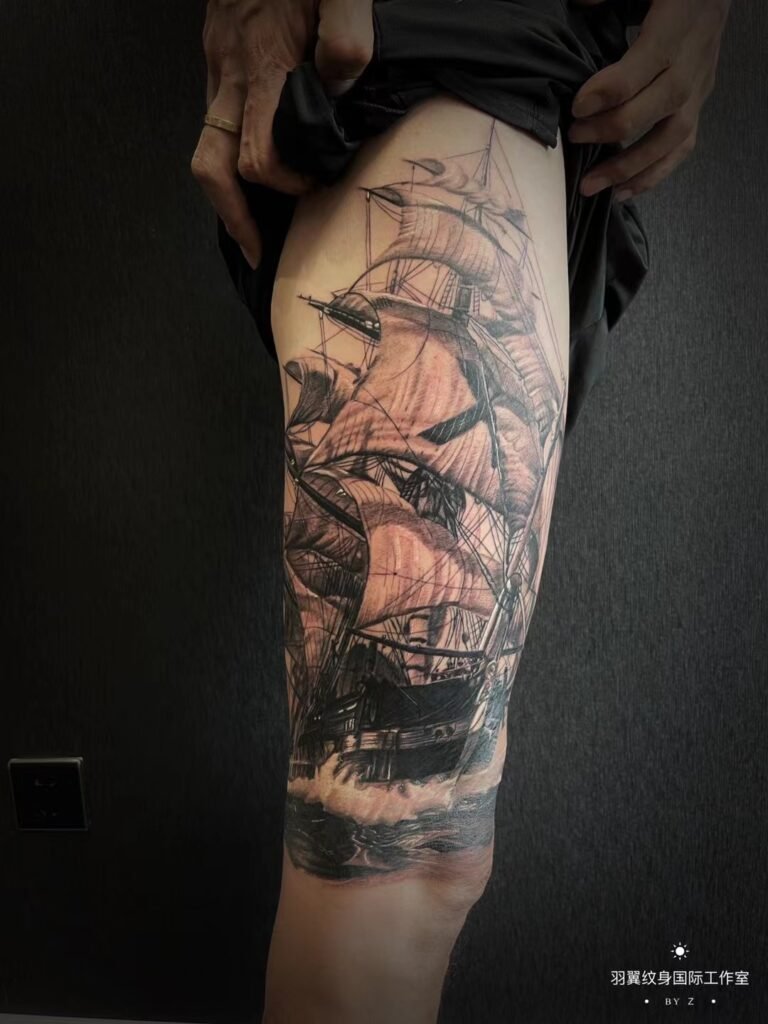
Leg sleeve tattoo planning is different from arm sleeve planning because the leg is read while standing, walking, sitting and turning. A good leg sleeve uses panels, flow and negative space so the thigh, knee, calf and lower leg feel connected without forcing every area to carry the same amount of detail.
The safest way to start is not to ask how many sessions, how much it hurts or what a full leg tattoo costs. Start by deciding what each viewing angle should show, where the main subject belongs, and how the design moves from thigh to calf without crowding the knee.
The leg is not just a larger arm
A leg gives more surface area than an arm, but the surface behaves differently. The thigh is broad and can carry a strong subject. The knee interrupts the design with a mobile joint. The calf has a curved back plane that people often see from behind. The shin is flatter from the front but visually narrow. The ankle and foot area taper quickly and should not be treated as an unlimited extension.
This means a leg sleeve composition usually needs panels. A panel is not a separate tattoo; it is a readable area within the whole. The thigh can be one panel, the outer calf another, the back of the leg a third, and the lower front a fourth. The background, direction and value plan decide whether those panels feel connected.
For larger coverage, use the large-scale tattoo planning page as the hub. It explains why body layout, reference preparation and responsible scope matter before any project is priced or scheduled.
Map the main viewing angles first
A leg sleeve is seen from more everyday angles than people expect. A front photo only shows part of the truth. Before the design is drawn, decide what should happen in each view.
Front view
The front view includes the thigh, knee, shin and ankle line. It often carries a strong vertical read. A subject placed here should be simple enough to remain clear when the person walks, because the knee and ankle alter the line with movement. If the front is too busy, the whole leg can feel heavy.
Outer side view
The outer thigh and outer calf are strong public-facing areas. When someone stands naturally, these surfaces are often visible from a slight angle. This is a good route for directional forms: an animal body, fabric, smoke, waves, flowers, armour, clouds or black-and-grey background moving from upper leg to lower leg.
Back view
The back of the thigh and calf can carry large shapes, but the knee crease creates a visual break. A full leg tattoo does not need the back view to mirror the front. It needs its own rhythm. The calf can hold a secondary focal point, while background or negative space can keep the knee area from becoming cramped.
Seated view
Leg tattoos are also seen when sitting. The top of the thigh, knee and lower leg change relationship when the hip and knee bend. This does not mean the design must look identical in every position. It means the main subject should not depend on one locked posture to make sense.
Choose a main subject and supporting panels
The main subject should occupy the surface that gives it enough room. A portrait-like figure, guardian, animal, warrior or large floral form may need the thigh. A long dragon, snake, koi, cloth form or wave structure may move across several panels. A black-and-grey realism direction may rely on value hierarchy rather than outline, so the light and dark structure must be planned before detail.
Supporting panels should not compete with the main subject. If the thigh carries the strongest image, the calf can carry echoing forms, background, smaller symbols or a secondary subject with lower contrast. If the calf is meant to be the public-facing focus, the thigh can become the origin of the movement rather than a separate headline.
The Japanese and Asian-inspired tattoo page is useful when the project uses waves, flowers, guardians, dragons, koi or other Asian-inspired material. Those subjects often need rhythm and background more than a simple collection of motifs.
The knee is a transition, not a storage area
The knee is a hinge-like region and one of the main interruptions in leg sleeve composition. It should be treated as a transition point, not as spare space for the most delicate detail. The NCBI Bookshelf anatomy summary describes the knee primarily as a hinge joint, with flexion and extension as its main movement. For tattoo planning, the design consequence is simple: the area changes shape as the leg bends.
A leg sleeve can handle the knee in several ways. It can keep the kneecap light and let background move around it. It can place a bold, simple form over it if the style supports that. It can use negative space so the panels above and below breathe. What usually fails is a small, detailed subject squeezed across the kneecap and crease because there was nowhere else to put it.
The back of the knee also needs care. The fold is visually different from the front of the knee and can make dense work feel heavy. A design can pass through the area, but the line of travel should be deliberate.
Thigh to calf tattoo flow
Thigh to calf tattoo flow is the path that makes the leg feel like one project. It can move vertically, spiral around the leg, or travel diagonally from outer thigh to inner calf. The choice depends on the subject and how much coverage you want.
Vertical flow is direct and strong. It suits long figures, columns of smoke, fabric, botanical stems and compositions that should read from hip to ankle. Spiral flow feels more dynamic and can suit dragons, koi, snakes, waves or wind. Diagonal flow is useful when the design has to avoid existing tattoos or when the main subject begins on one side and resolves on another.
Flow should not be confused with filling every gap. Empty skin can be the thing that lets the flow remain readable. If the thigh, knee, shin and calf are all packed at equal density, the leg becomes one dark block. Good leg sleeve tattoo planning chooses where the eye lands, where it travels, and where it rests.
Existing tattoos and future extension
Many leg sleeves begin with an existing thigh piece, calf piece or small ankle tattoo. Those pieces become fixed landmarks. The artist has to decide whether the new design works around them, connects them with shared background, or leaves them separate inside a broader collection.
If you might extend from a thigh tattoo into a full leg tattoo later, leave the lower edge open. If you might extend a calf tattoo upward, do not close the upper edge with a hard border unless you are sure it will stay separate. Sleeve extension planning matters on the leg just as much as on the arm.
You can view Yuyi Tattoo’s portfolio to study scale, value and large-surface composition. Use those examples to discuss direction and density, not to copy an existing work.
What to send for a leg sleeve consultation
A useful leg sleeve brief should show the whole canvas, not only the intended focal area. Send:
- Front, outer side, inner side and back photos of the leg, standing naturally.
- A seated photo if the design crosses the thigh and knee.
- Close photos of existing tattoos, scars or areas the artist should know about.
- The coverage goal: thigh only, calf only, knee included, lower leg, or full leg tattoo.
- The main subject and any supporting motifs.
- Whether you want black and grey, colour, Japanese-inspired, realism-influenced or undecided style.
- Visibility notes: shorts, work clothing, sports gear or areas you want to keep open.
When the brief is ready, contact Yuyi Tattoo with the photos and coverage goal. The studio is in Geylang, Singapore, and WhatsApp enquiries can be sent to +65 9128 0501.
Sources and review date
- NCBI Bookshelf — Anatomy, Bony Pelvis and Lower Limb, Hip Joint — reviewed 24 August 2026.
- NCBI Bookshelf — Anatomy, Bony Pelvis and Lower Limb, Knee — reviewed 24 August 2026.
- NCBI Bookshelf — Anatomy, Bony Pelvis and Lower Limb: Ankle Joint — reviewed 24 August 2026.
Frequently asked questions
Is a leg sleeve planned the same way as an arm sleeve?
No. The leg has different viewing angles, larger panels and different transition points. The thigh, knee, calf and ankle each need their own role. A design copied from arm sleeve logic can look disconnected on the leg.
Should the knee be included in a leg sleeve?
It depends on the design. The knee can be included if the composition uses bold forms, background or controlled negative space. It should not be treated as leftover room for delicate detail. Decide whether the knee is a bridge, a break or a feature before the design is drawn.
Can I start with a thigh tattoo and extend to a full leg later?
Yes, if the first design leaves an open route. The lower edge of a thigh piece should not close off the future calf connection unless you are sure it will stay separate. Tell the artist early if extension is possible.
Does a full leg tattoo need one continuous subject?
No. It needs one clear visual logic. Several panels can belong together through shared background, direction, value or spacing. One continuous subject is only one route; a panel-based composition can also work if it is planned deliberately.
What is the most useful photo for planning?
There is no single most useful photo. Send front, back, inner and outer views of the whole leg, plus close photos of existing tattoos. A leg sleeve is a wraparound project, so the artist needs to see what happens outside the main focal view.