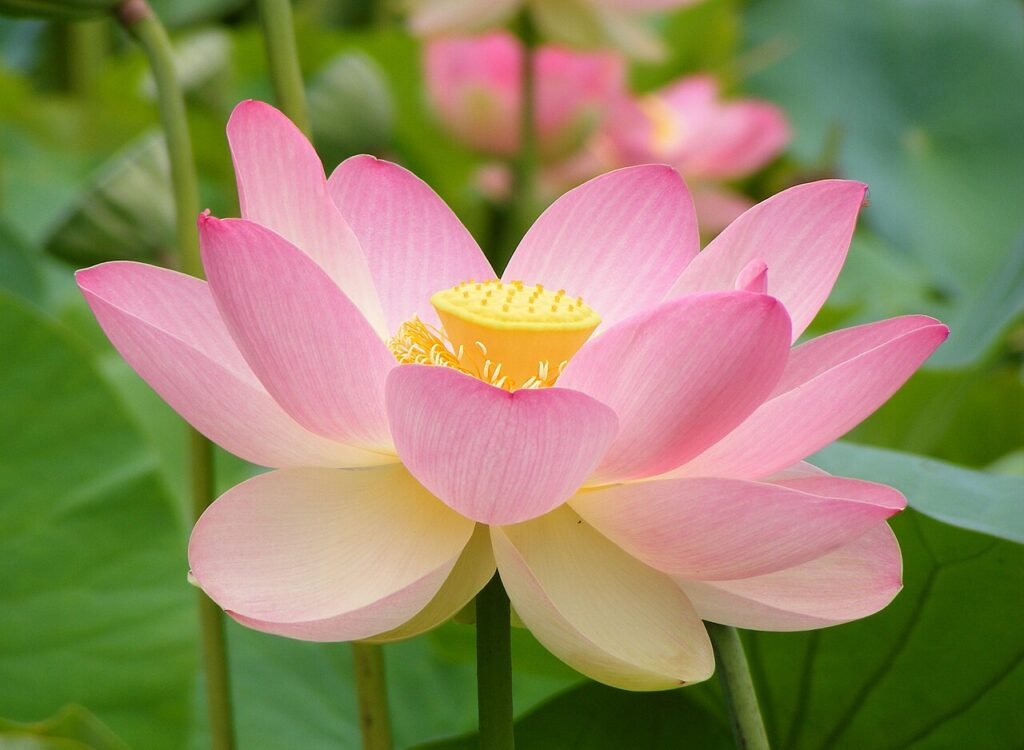
Lotus tattoo meaning depends on the tradition and image being referenced. Purity, awakening and spiritual development recur in Buddhist interpretations because the flower rises clean from muddy water, but a lotus can also signal beauty or divinity in Hindu art, integrity and auspicious wordplay in Chinese art, or a specific Pure Land and sutra context in Japanese Buddhism. It is not one pan-Asian symbol with a single translation.
Plan the tattoo by choosing the cultural context and visual form first. A natural flower on water, a radial ornamental bloom, a lotus pedestal beneath a sacred figure and a flower paired with text are not interchangeable designs. Their scale, placement and level of reference checking should follow what the lotus is meant to do.
Why the source tradition comes first
The flower supplies a strong contrast: roots and stems occupy muddy water while the bloom opens above the surface. Museums use that image to explain religious art, but each object adds context. The lotus may be auspicious on an early Buddhist monument, a Hindu deity’s seat or attribute, part of a Chinese rebus, or a Japanese devotional pedestal.
A search result that says “the lotus means rebirth” is therefore incomplete. Rebirth may fit a particular Pure Land image or a wearer’s story, yet it does not explain every ornament. Resilience is also a reasonable modern reading of growth through difficulty, not one ancient meaning held identically across Asia.
A more accurate brief names both source and intention: “a naturalistic lotus inspired by Chinese ink painting, representing integrity to me” is clearer than “an Asian lotus for strength.”
South Asian religious art: shared flower, specific figure
South Asian religious art provides an early and influential lotus context, while the flower also developed meanings elsewhere in Asia. A Metropolitan Museum of Art teaching resource calls it an Indian sign of spiritual perfection and explains that Hindu and Buddhist beings may stand or sit on stylised lotus petals. Yet the surrounding figure, pose, gesture and attributes identify a particular deity or bodhisattva.
An early Buddhist example makes the connection more specific. The Met’s pair of carved lotuses from the Bharhut Stupa, dated to around the first century BCE, describes the flower as an auspicious symbol alluding to the Buddha’s enlightenment. That record supports an enlightenment reading for that Buddhist object. It does not prove that every later decorative lotus, or every modern lotus tattoo, depicts the Buddha’s awakening.
Hindu images use the lotus in their own iconographic settings. The Smithsonian’s page on a painting of Krishna says South Asian lotuses can signify purity, beauty and divinity; Krishna stands on a bloom and wears other lotus references. Another deity may sit on or hold the flower in a different work. For a tattoo of a named deity, identify the complete scene instead of applying a generic “Eastern spirituality” label.
Chinese meanings: Buddhist purity, integrity and wordplay
Chinese lotus imagery can be religious, literary or auspicious. A Ming-dynasty silk tapestry in the Smithsonian collection is described through several layers: the lotus rising unsoiled from mud signifies purity, integrity and Buddhist spiritual transcendence, while the pronunciation he also allows a visual pun on a different character meaning peace.
Other Chinese objects use seed pods, paired flowers or accompanying animals to create different rebuses. Those readings depend on language and the exact set of motifs. They should not be detached from their objects and turned into a universal rule such as “three seeds always mean family.” If a wordplay meaning matters to your tattoo, bring a museum record or a checked Chinese source for that precise combination.
Chinese painting also makes room for the lotus as an observed plant: bent stems, broad leaves, seed heads and weathered petals can form a botanical scene without being a formal devotional emblem. A botanical scene and a Buddhist pedestal may share a flower while asking for very different treatment on skin.
Japanese Buddhist contexts: pedestal, Pure Land and sutra
In Japanese Buddhist art, lotus forms frequently support Buddhas and bodhisattvas or appear in visions of a Pure Land. The Kyoto National Museum’s account of a decorated Lotus Sutra explains why each written character in the copy rests on a painted lotus pedestal: every character is treated like a Buddha or bodhisattva. The museum also connects lotus ponds with imagery of the Buddha’s Pure Land.
This reference gives two cautions. A lotus throne is part of the iconography, not a flower placed beneath a portrait for balance; its petals, figure and other attributes should share one source. The Lotus Sutra is also a particular scripture. Its title, a passage or decorative script requires accurate text and tradition-specific checking. A flower alone is not a quotation from it.
Japanese-inspired tattoo compositions can also use a natural lotus with water, leaves and another main subject. That may echo Buddhist visual culture, but the religious weight depends on the whole image. Do not assume that every lotus beside a koi is devotional, or that adding a Buddha automatically makes a loosely assembled flower accurate.
Do lotus colours have fixed meanings?
Online guides often provide a neat chart assigning one meaning to white, pink, blue, red and purple lotuses. Such charts can mix sources from different Buddhist traditions with modern colour psychology. Treat them as inspiration only unless your chosen religious or artistic source documents the colour in that context.
The Kyoto National Museum’s decorated sutra uses red, green, blue, gold and silver lotus pedestals in a visual pattern. Those colours serve that manuscript, not a general tattoo legend. Works from different regions and schools likewise cannot be decoded through one universal list.
For a non-devotional tattoo, choose colour for the actual flower, the source artwork, contrast with surrounding elements and your personal intention. For a sacred figure or text, check the iconography before changing colours for aesthetics. Black and grey can emphasise petal structure, water and light, but it should not be described as spiritually neutral if the composition still contains recognisable religious imagery.
Choose the form before the placement
A lotus changes character when viewed from above, from the side or as a pedestal. Start with the view that supports your idea.
| Lotus form | What the viewer sees first | Space it needs |
|---|---|---|
| Open bloom from above | Radial petal order and centre | A reasonably flat area where the outer petals can stay even |
| Side-view flower and stem | Rise, bend and relationship to water | A longer vertical or diagonal path |
| Flower, leaf and seed pod | A botanical cycle rather than one perfect bloom | Enough width to separate several silhouettes |
| Lotus pedestal | The sacred figure and its base as one unit | Large enough to preserve the figure, petal rows and attributes |
| Repeating ornamental lotus | Rhythm and symmetry | A placement whose centre line and edges can be mapped accurately |
An open lotus is sometimes labelled a mandala merely because it is radial. The Smithsonian National Museum of Asian Art defines a mandala in Buddhist art as a schematic rendering of the Buddhist cosmos and complex Buddhist beliefs. It is not a synonym for any symmetrical flower. If you want a lotus-inspired ornamental rosette, call it that unless the design genuinely follows an attributed mandala reference.
Lotus tattoo placement and readable scale
Placement does not create a guaranteed meaning. It determines the viewing angle, the amount of petal information available and how the flower changes when the body moves.
- Forearm or calf: a side-view bloom with stem and water can use the long axis. A compact top-view flower needs enough width so inner and outer petals do not merge.
- Upper arm or shoulder: a rounded bloom can follow the volume, but the centre and outer petals must be checked from the front and side rather than designed as a flat circle.
- Thigh or shoulder blade: broader space can hold leaves, a seed pod, water or a more layered ornamental flower while keeping each silhouette distinct.
- Chest or back: these areas can support a lotus pedestal, sacred figure or larger symmetrical composition. The figure and flower should be planned together from an identified source.
- Narrow or very small areas: simplify the number of petal layers. Enlarging the idea or removing secondary ornament is more honest than preserving every tiny line from the reference.
There is no single placement rule shared by every Buddhist, Hindu or Asian community. A standalone botanical lotus and an image containing a Buddha, deity, mantra or scripture may be viewed differently. If your design is devotional, ask a knowledgeable practitioner from the relevant tradition about placement concerns rather than relying on a generic “never below the waist” statement from a tattoo blog.
Pairings that change the design brief
A paired element can narrow the lotus context, so name it early.
- A Buddha, bodhisattva or Hindu deity requires an attributed iconographic reference and more scale than a flower alone.
- Water, broad leaves and seed pods create a natural scene and can show several stages of the plant without forcing a religious narrative.
- A koi or other Japanese main subject makes current direction and background flow part of the composition; the lotus should not block the animal’s face or movement.
- Chinese characters, Sanskrit, Siddham or another script must be checked for exact wording, script and orientation. Decorative resemblance is not sufficient.
- Geometric ornament should be identified honestly. A lotus-inspired pattern is valid without being called a traditional mandala.
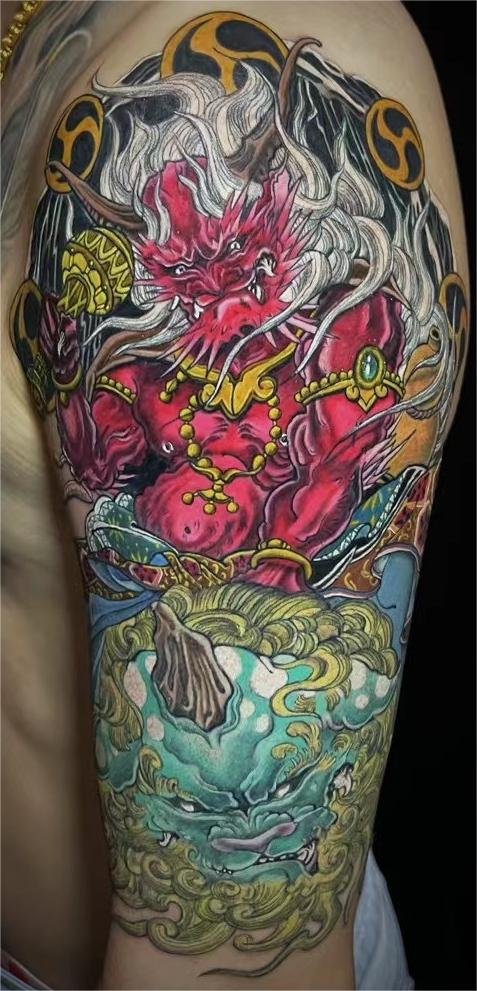
To compare how larger subjects, water and floral support can share one body area, review Japanese and Asian-inspired tattoo work. Use the examples to judge scale and hierarchy, not as designs to copy.
Build a clear lotus tattoo enquiry
Your first message should identify the tradition or source, the lotus form, the body area and approximate coverage. Include whether the design is botanical, personal or devotional; whether it contains a figure or text; the preferred colour direction; and which elements are essential. One museum reference plus a few visual references usually communicates more than a folder of unrelated lotus tattoos.
The tattoo enquiry guide shows how to prepare placement photos and organise references. Once the cultural reference and composition are clear, contact Yuyi Tattoo to discuss whether the intended scale can hold the petals, supporting imagery and any sacred details without crowding.
Sources and review date
- The Metropolitan Museum of Art: The Art of South and Southeast Asia, a Resource for Educators (reviewed 24 August 2026).
- The Metropolitan Museum of Art: Two Lotuses from the Bharhut Stupa (reviewed 24 August 2026).
- Smithsonian National Museum of Asian Art: Krishna Fluting (reviewed 24 August 2026).
- Smithsonian National Museum of Asian Art: Dragonfly and lotus plants (reviewed 24 August 2026).
- Smithsonian National Museum of Asian Art: Mandala glossary entry (reviewed 24 August 2026).
- Kyoto National Museum: The Lotus Pedestal Character Lotus Sutra (reviewed 24 August 2026).
Frequently asked questions
What does a lotus tattoo mean in Buddhism?
It often draws on purity, awakening or spiritual development, using the flower’s emergence from muddy water as the central image. The exact reading changes with the Buddhist tradition and accompanying figure, text or Pure Land scene, so “Buddhist lotus” is a starting context rather than a complete meaning.
Is a lotus tattoo Hindu or Buddhist?
It can reference either, and it also appears in Jain, Chinese literary, Korean decorative and other Asian contexts. In Hindu and Buddhist art, the deity, bodhisattva, gesture, attribute and pedestal identify the scene. A standalone natural flower does not automatically belong to only one religion.
Does every lotus colour have a traditional meaning?
No single colour chart applies across Asia. Particular schools, scriptures and artworks use colour in specific ways, while modern tattoo guides often combine those systems. Choose from an attributed reference if religious accuracy matters; otherwise describe the palette as a personal or visual choice.
What is the best placement for a lotus tattoo?
The best placement fits the chosen view. A side-view flower suits a longer vertical area, an open radial bloom needs width, and a sacred figure on a lotus pedestal needs a much larger field. Placement should preserve the petal structure and any iconographic details rather than follow a symbolic body chart.
Can I combine a lotus with a koi or Guanyin?
Yes, but the pairings have different demands. A koi and lotus composition needs coherent water flow and clear hierarchy. A Guanyin or other sacred figure needs a reliable art-historical or devotional reference, accurate attributes and enough scale for the face, hands and lotus base.
Is a symmetrical lotus automatically a mandala?
No. Radial symmetry alone does not make a flower a mandala. In Buddhist art, a mandala is a structured rendering of the cosmos and complex beliefs. If the design is simply inspired by lotus geometry, “ornamental lotus” or “radial lotus” is a more accurate description.