
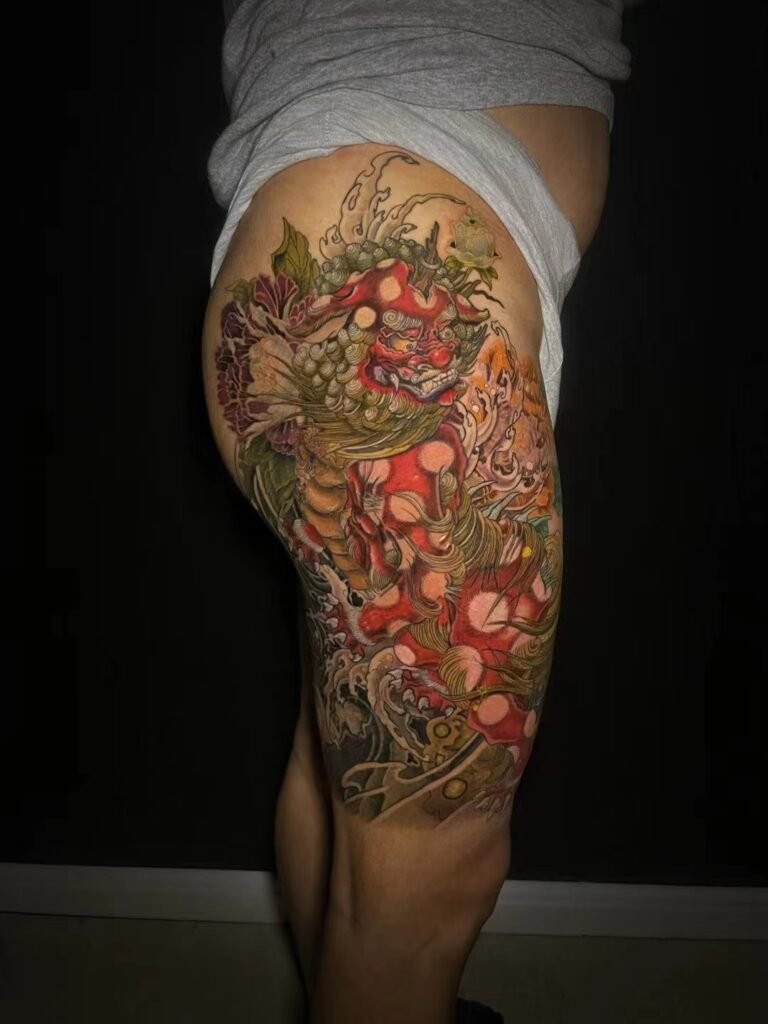
An Oni mask tattoo does not have one universal meaning. Oni appear across Japanese religion, folklore, art and regional performance as many kinds of beings, sometimes threatening and sometimes protective. For a useful tattoo brief, identify the source first, then decide which expression and facial features your design should retain.
Oni and Hannya are also not interchangeable. Oni is a broad category of demon-like beings, while Hannya is a specific mask used for a female serpent-demon in Noh theatre. Both may have horns and fangs, but the reference, face and emotional register are different. Scale determines whether those differences remain visible on skin.
What the word Oni tells you, and what it does not
The safest answer to “what does an Oni mask tattoo mean?” is that the meaning depends on the Oni being referenced. Kokugakuin University’s Encyclopedia of Shinto describes Oni as ambivalent beings associated with both disaster and blessing. Its overview separates several historical ideas, including harmful spirits, outsiders represented as demons, and Oni that act as benevolent or protective figures. That range rules out a single definition such as evil, revenge or protection for every design.
The visual record is just as varied. A late eighteenth-century carving in the British Museum’s collection has horns, fangs and clawed limbs, yet the museum discusses the figure as mischievous rather than simply evil. A 2026 Niigata University museum exhibition focused on regional differences among masks used in Sado’s Oni Daiko traditions. These examples belong to different settings and periods, so neither should be treated as a template for all Oni.
For a tattoo, “Oni” is therefore the beginning of the research, not the finished concept. Ask what kind of image attracted you. Was it a full-bodied ogre in an Edo-period print, a carved netsuke, a festival mask, a theatre image, or a modern tattoo interpretation? Save the original source and date where possible. A clear origin gives the artist more useful information than a folder of unrelated red demon faces.
Oni mask or Hannya: how to separate the brief
Confusion usually starts because search results group horned Japanese masks together. The overlap is visual, but the labels describe different things.
The Victoria and Albert Museum’s Hannya record identifies Hannya as a female serpent-demon mask worn by the main actor in the second acts of several Noh plays. It belongs to a named theatrical role and a documented mask tradition. Oni is broader. Kokugakuin University traces the term across religious rites, folklore, outsiders, spirits and Noh, while the British Museum uses it as a generic term for a Japanese demon.
| Question | Oni-led brief | Hannya-led brief |
|---|---|---|
| What is the source? | A named tale, artwork, carving, rite, festival mask or chosen Oni type | A Noh mask and the female demon roles associated with it |
| What should the face communicate? | Brute force, mischief, alarm, menace or another source-led mood | A recognisable theatrical mixture of demonic rage and human anguish |
| Which features carry identity? | Often a broad facial mass, pronounced brow, horns, fangs and a forceful mouth | Long horns, metallic eyes, sharp cheek structure and the particular Hannya mouth |
| What needs checking? | Whether the reference is actually Oni rather than Tengu, Namahage, a guardian or an invented mask | Whether the reference preserves Hannya rather than becoming a generic horned face |
These are working distinctions, not a rule that every historical object follows. The University of Oregon’s Oni research page shows recurring features such as horns, sharp teeth, muscular bodies and fierce expressions, but it also presents variation within the category. A source image always outranks a generic checklist.
If your main interest is the Noh character, use a Hannya-led brief rather than asking for “an Oni that looks like Hannya.” If you want an ogre-like face with a heavy jaw and forceful expression, keep the brief Oni-led and do not add Hannya features merely because they are familiar online.
Build the face before choosing extra symbols
An Oni mask tattoo design is read first as a face. Its silhouette and internal landmarks have to work before smoke, flowers, weapons or background bars are introduced.
Start with the outside contour. Decide whether the skull is compact and round, wide through the temples, or tall and tapered. Then place the horns. Short horns keep the outline dense; longer horns add height and can steer the eye into the surrounding composition. Unequal, damaged or curved horns can add character, but they should come from the chosen drawing rather than being treated as historical facts.
Next establish the brow, eyes, nose and mouth. A low brow and small eye openings can create concentrated pressure. Larger eyes make the expression more startled or theatrical. A broad nose gives the centre of the face weight. The mouth changes the mood most sharply: closed lips with visible tusks feel controlled, a clenched row of teeth feels tense, and a wide open jaw introduces sound and aggression.
This is why references should be judged in grayscale as well as colour. If the face stops reading when its red or blue fill is removed, it may rely too heavily on colour separation. Strong shadow around the brow, nose and mouth should preserve the expression. You can review the range of Japanese and Asian-inspired tattoo composition before deciding how much background your mask needs.
Describe the expression with observable choices
Words such as fierce and powerful are too broad to direct a drawing. Describe what the face is doing.
For controlled menace, request a closed or partly closed jaw, steady eye direction and a compact brow. For an explosive expression, the jaw can open, the nostrils flare and the upper eyelids lift. A mischievous Oni may use asymmetry: one raised brow, an off-centre grin or eyes directed toward a second figure. A defeated or constrained Oni needs different evidence in the composition, such as posture, rope or an opposing character. The face alone should not be expected to tell an entire story.
Choose the viewing angle at the same time. A frontal mask is immediate and symmetrical. It fits a broad panel but can look rigid if every horn, eye and fang mirrors the other side. A three-quarter view gives the nose and cheek more depth and lets one horn overlap the other. A steep upward or downward angle can feel dramatic, although it demands more room because foreshortening compresses facial landmarks.
Include one clear expression sentence in your enquiry: “broad Oni face, three-quarter view, clenched teeth, eyes looking down” is usable. “Scary Japanese demon with deep meaning” is not.
How scale changes an Oni mask tattoo
Small and large Oni masks solve different design problems. A compact piece needs a simple contour, one dominant expression and generous gaps between teeth, eyes and wrinkles. Fine cracks, multiple rows of teeth and elaborate forehead texture can merge when they are compressed. Removing secondary marks is usually better than shrinking the whole drawing unchanged.
Medium scale allows a full face, horns and a restrained frame. An upper arm, calf or outer forearm may hold the mask clearly, but the design must be checked on the curved body rather than approved only as a flat rectangle. One eye can disappear around the side of a limb if the face is too wide. A three-quarter view may fit that curve more naturally than a front-on mask.
Large placements can show a fuller narrative. A thigh panel can hold a broad jaw and longer horns without wrapping the key features out of sight. A back or torso composition has space for an opposing figure, environment and stronger depth. In an Oni mask tattoo sleeve, the mask should have one primary viewing angle. Background may travel around the arm, but the eyes, nose and mouth should not be divided across unrelated surfaces.
Before asking for exact dimensions, photograph the placement from the front and both sides with your arm or leg relaxed. State whether the piece must be readable mainly from the front, from outside the limb, or as the body turns. The tattoo enquiry guide explains how to send placement and reference information in a form that can be assessed.
Pairings that keep the Oni as the main subject
Supporting elements should identify a scene or improve the layout. They should not be added because a search result calls them mandatory.
Shōki, the Demon Queller, creates a clear relationship when the source calls for a captured or confronted Oni. The British Museum holds an Edo-period netsuke of Shōki with an Oni, which documents the pairing in Japanese decorative art. It does not mean every Oni design represents defeat or requires Shōki.
An iron club and tiger-skin garment recur in Oni iconography documented by the University of Oregon. Either can identify a full figure, but a face-only mask may not have room to show them convincingly. Clouds, smoke, fire shapes or wind can frame the horns and carry movement without pretending to assign a new traditional meaning. Their job is compositional unless your chosen source gives them a narrative role.
Paired masks can work when the contrast is intentional. One might be still while the other shouts, or one might face forward while the other turns away. Do not label the second mask Hannya merely to create a male-versus-female formula. Confirm what each reference actually depicts first.
Limit the first brief to one main mask and, at most, two supporting ideas. An Oni, Hannya, dragon, snake, peony, temple gate and full cloud background in one narrow panel leave no clear subject. Hierarchy matters more than the number of recognisable motifs.
A focused Oni tattoo enquiry
Gather one source image for identity and up to two images for mood or composition. Note which parts of each reference you want to retain. Add the exact placement, approximate coverage, preferred viewing angle, colour direction and whether the design may later expand. State that you are seeking a custom interpretation rather than a copy.
Your brief might read: “Oni-led outer-thigh piece, based on an Edo-period horned figure; broad jaw, controlled expression and three-quarter view; black and grey with a simple smoke frame; no Hannya features.” That gives the artist a subject, source, mood, structure and boundary.
Yuyi Tattoo’s documented portfolio includes Japanese and Asian-inspired compositions, but each proposed subject and layout still needs to be reviewed as its own project. When your source and placement are ready, use the contact page to send a focused enquiry. Availability, timing and project terms should be confirmed directly rather than assumed from an article.
Sources and review date
- Kokugakuin University Digital Museum, Encyclopedia of Shinto: Oni — reviewed 24 August 2026.
- British Museum: reclining Oni netsuke, late eighteenth century — reviewed 24 August 2026.
- Victoria and Albert Museum: Hannya mask — reviewed 24 August 2026.
- University of Oregon, Yōkai Senjafuda: Oni — reviewed 24 August 2026.
- Niigata University Asahimachi Museum: craft and heritage of Oni masks — reviewed 24 August 2026.
- British Museum: Shōki and an Oni netsuke — reviewed 24 August 2026.
Frequently asked questions
Is an Oni mask the same as a Hannya mask?
No. Oni is a broad term used for varied demon-like beings in Japanese traditions. Hannya is a specific Noh mask for a female serpent-demon. The two can share horns and fangs, so identify the source rather than relying on those features alone.
Does an Oni mask tattoo always mean evil?
No. Kokugakuin University documents harmful, ambivalent and benevolent Oni traditions. A tattoo should not claim one meaning for all of them. Its reading should be tied to the chosen story, object, performance tradition or personal intention.
Which features make an Oni mask readable?
The outside silhouette, horns, brow, eyes, nose, jaw and fang spacing do most of the work. Colour can support them, but the face should remain identifiable in grayscale. At a smaller scale, fewer wrinkles and wider gaps usually improve clarity.
Where can an Oni mask fit in a sleeve?
The upper arm can hold a broad mask, while a narrower forearm may suit a three-quarter view or a more compact face. Choose one main viewing angle and keep the eyes, nose and mouth together instead of wrapping them across several surfaces.
Can an Oni and Hannya appear in one tattoo?
They can, provided each mask is correctly identified and the pairing has a clear purpose. Decide which is dominant, how their expressions contrast and whether the available placement is large enough to keep both faces distinct.

