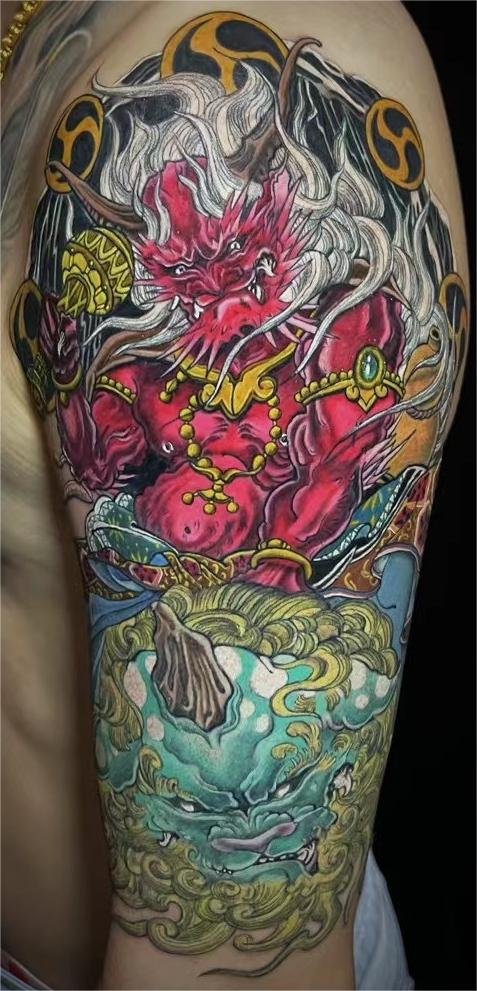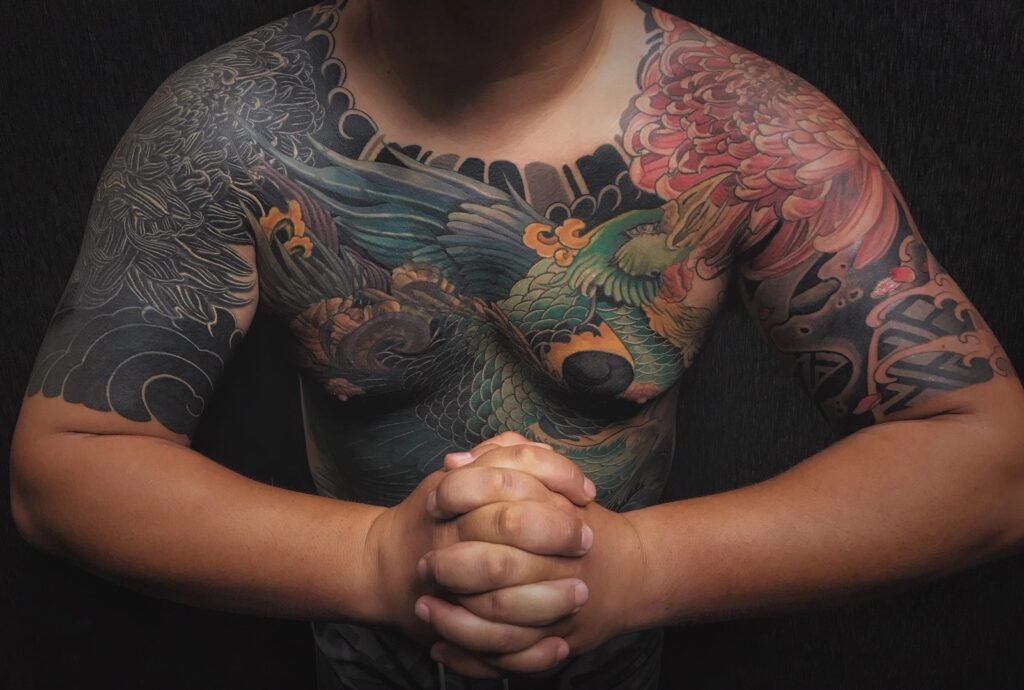
An Asian phoenix tattoo should not begin with a generic rebirth claim. The fire-and-ashes story belongs to the classical and later Western phoenix tradition. Chinese fenghuang is a distinct mythical bird, and Japanese hō-ō developed from Chinese imagery within Japanese art. Choose which bird you mean before choosing flames, clouds or a dragon.
That choice changes the drawing. A classical phoenix may be built around fire and emergence, while fenghuang and hō-ō references often emphasise a crested head, layered wings and long ornamental tail feathers. Direction, wing spread and tail space then determine whether the bird remains readable on the body.
Why “phoenix” is an imprecise search term
English-language catalogues often use phoenix as a convenient translation for several mythical birds. The translation helps people find an object, but it can conceal important differences.
The Metropolitan Museum of Art is explicit about this in its record for an eighteenth-century Chinese panel with five fenghuang. The museum says that although the bird is usually translated as phoenix, the fenghuang is a distinct mythical species with different associations. The record connects its appearance with peace and prosperity in the context of an imperial workshop object.
The familiar bird that burns and returns from its ashes belongs elsewhere. The Getty’s discussion of a medieval phoenix in a bestiary describes the fire cycle and explains how medieval Christian art used the phoenix for death and resurrection. Classical accounts vary, but that rebirth tradition is well established in the Mediterranean and European history of the bird.
Research published through Harvard’s Scholar site makes the distinction direct: its discussion of the Chinese fenghuang states that the bird does not share the ashes-and-rebirth legend attached to the Western phoenix. This is why a fenghuang tattoo meaning should not be reduced to “reborn from fire” unless the client deliberately asks for a modern hybrid.
The Japanese hō-ō is closely related to the Chinese bird, yet Japanese objects have their own dates, materials and settings. The Smithsonian’s National Museum of American History describes a Japanese hō-ō motif as derived from the Chinese fenghuang. A nineteenth-century Japanese sword guard in The Met’s collection places a hō-ō among auspicious clouds and associates its rare appearance with the start of a new era or the birth of a virtuous ruler.
These are related traditions, not three spellings for one fixed story.
Choose one source lane before collecting tattoo images
The fastest way to improve a brief is to label the source lane of every saved image.
| Source lane | Useful identifying clues | Documented context to research | What not to assume |
|---|---|---|---|
| Classical or later Western phoenix | One dominant bird, fire, pyre, sun rays, emergence from ashes | Classical, medieval, Christian or later European versions | That the same fire cycle belongs to fenghuang or hō-ō |
| Chinese fenghuang | Crested head, elaborate layered plumage, very long tail, courtly or auspicious setting | Peace, prosperity, imperial use, femininity or paired royal imagery in the particular period and object | That every fenghuang is an empress symbol or a rebirth bird |
| Japanese hō-ō | Related long-tailed bird adapted in Japanese painting, textiles, metalwork and architecture | Auspicious appearance, new era, virtuous rule, immortality or other object-specific readings | That every Japanese “phoenix” must rise through flames |
| Modern hybrid | Features deliberately borrowed from more than one lane | The client’s stated combination | That the blend is a traditional formula |
Do not decide from colour alone. Red and gold appear in many modern tattoo references, while historical objects use different materials and palettes. Look at the head crest, wing construction, tail, setting, object date and museum label.
If you like one bird’s body and another image’s setting, say so openly. A custom hybrid can be coherent when its sources are named. Problems arise when a modern mash-up is presented as a timeless Asian tradition.
Build the bird around a line from beak to tail
Large mythical birds can become a loose collection of feathers. Prevent that by establishing one structural line before drawing ornament.
Begin at the beak, pass through the neck and chest, follow the body, and continue into the dominant tail feather. This path should be readable even when the wings and secondary tail plumes are hidden. A lifted chest with the beak aimed upward feels like ascent. A horizontal body with wings extended feels like flight across the placement. A descending bird needs the head and chest to lead; otherwise it can look as if it is falling backward.
The neck should connect cleanly to the body. Fenghuang and hō-ō references may combine traits from several real birds, but the tattoo still needs believable joints. The breast carries volume, the wings attach behind it, and the tail begins from the body rather than from a decorative knot. Museum references are especially useful because the entire silhouette can be studied without copying another tattoo.
Decide the tail’s job. One central plume can continue the main direction. Several ribbon-like feathers can wrap a limb or frame the body. A broad fan can anchor a back or thigh composition. Long feathers should vary in length and interval; perfectly parallel ribbons make the design mechanical.
Direction is composition, not a universal code
There is no single museum-backed rule that an ascending Asian phoenix means success while a descending bird means failure. Direction changes the energy and body flow, but its cultural meaning must come from the chosen source rather than a general chart.
An ascending bird works well when the placement offers vertical space. On an arm, the chest may sit near the upper arm while the tail travels toward the forearm. On a leg, the bird can climb from calf toward thigh, provided the head remains visible from a natural standing angle. The tail should narrow as the limb narrows.
A bird crossing the body horizontally can occupy the upper back, chest-to-shoulder area or thigh. One wing may approach the viewer while the other recedes. This avoids a flat heraldic silhouette unless symmetry is deliberately required by the reference.
A perched or settled hō-ō creates a different composition. The bird can interact with paulownia, pine or an architectural form, and the long tail can descend without requiring the wings to fill the whole area. The Ashmolean Museum documents a Japanese textile showing two hō-ō by a paulownia tree over waves. That object supports the pairing in a specific Japanese artwork; it does not make paulownia compulsory for every hō-ō.
Wings need a hierarchy, not equal detail everywhere
The near wing should usually carry the clearest structure. Establish its shoulder, leading edge and main feather groups. The far wing can be narrower, softer or partly hidden. If both wings are the same size and face the viewer equally, the bird may read as an emblem rather than a creature moving through space.
Group feathers into large masses before adding barbs or surface pattern. From a distance, a wing should read as three or four strong sections, not dozens of separate leaves. Dark gaps between major groups create depth. Small internal marks can be reduced on a forearm or calf and expanded on a back or thigh.
Tail and wing should not compete for the same space. If the wing opens across the shoulder blade, send the tail along a different diagonal. On a sleeve, the tail can carry the wrap while the wing remains the focal panel. On a thigh, a folded wing can preserve more room for a broad tail fan.
Photograph the intended placement from several angles and sketch the large feather masses over those photographs. The Japanese and Asian-inspired tattoo page can help you compare how large subjects and background are given different visual weights.
Placement choices for a large bird composition
The back gives the clearest room for both wings, but a full span is not the only option. A three-quarter bird can cross from one shoulder blade toward the opposite lower back, leaving space for tail movement. If the bird is paired with a dragon, choose which head is the primary focal point. This article keeps the bird dominant; the dragon should support the source tradition and the overall curve rather than create a second unrelated centre.
An upper arm and shoulder can hold the chest, head and one open wing. The tail then travels down the arm or turns toward the chest or back. A full sleeve can work, though the bird should not be divided into a head, separate wing and separate tail that only connect through background. The underlying body line must survive the wrap.
The thigh suits a large profile bird, folded wing and long tail. It also allows a circular composition in which tail feathers return toward the chest. The calf is narrower, so a rising profile, one visible wing and fewer tail plumes are usually clearer than a full frontal spread.
Chest and side-body placements favour a diagonal. The head can sit near the upper chest while the wing and tail follow the ribs. Because the torso changes with posture and breathing, the complete design should be assessed on the body rather than approved solely as a flat image.
Fire, cloud, paulownia and dragon pairings
Supporting elements should reveal which source lane is being used.
Flames and ashes are direct choices for a classical or later Western phoenix. They can also appear in a declared modern hybrid. They should not be added to a fenghuang or hō-ō solely because the English label says phoenix.
Clouds fit the Japanese hō-ō sword guard documented by The Met and many East Asian auspicious compositions. Their practical role is to separate wing and tail layers. Paulownia is documented with hō-ō in Japanese objects, including the Ashmolean textile, and can give the bird a perch or a vertical counterline. Use the specific artwork to decide leaf and flower form rather than drawing generic foliage.
Dragon and fenghuang pairings occur in Chinese court and textile art, but their role changes by dynasty, object and audience. Avoid a fixed “male dragon, female phoenix” explanation unless a reliable source for the selected object supports it. In a tattoo, choose one dominant creature. A large bird and large dragon of equal contrast can overwhelm even a back piece.
Colour should follow the reference and the need for separation. Multiple colours can distinguish crest, wing groups and tail eyes, but too many equal accents break the silhouette. Black and grey can work when open skin, dark feather bases and clear edges preserve the different layers. Neither palette supplies cultural accuracy on its own.
Prepare a source-led enquiry
Send one museum or institutional reference that establishes the bird, one image for wing posture and one for tail movement. Label them “identity,” “pose” and “flow.” State whether you want a classical phoenix, Chinese fenghuang, Japanese hō-ō or an intentional hybrid.
Add the placement, coverage and main viewing angle. List no more than two required supporting elements. Note whether the piece should remain contained or may later extend. The tattoo enquiry guide gives a practical format for sending those details.
A focused request could say: “Japanese hō-ō based on a nineteenth-century metalwork reference, rising three-quarter pose on the outer thigh, one open wing, long tail turning toward the hip, cloud and paulownia support, no flames.” This provides source, direction, anatomy, placement and exclusions.
Yuyi Tattoo’s documented portfolio includes Japanese and Asian-inspired compositions, but a particular design, schedule and project terms require individual review. Send the source packet through the contact page when the bird tradition and placement are clear.
Sources and review date
- The Metropolitan Museum of Art: Panel with Five Phoenixes in a Garden — reviewed 24 August 2026.
- Harvard Scholar: Junjie Jiang on Xu Bing’s Phoenix and the fenghuang translation — reviewed 24 August 2026.
- The J. Paul Getty Museum: A Birdwatcher’s Eye View, classical and medieval phoenix — reviewed 24 August 2026.
- The Metropolitan Museum of Art: Japanese Sword Guard with Phoenix Motif — reviewed 24 August 2026.
- Smithsonian National Museum of American History: Meissen dish and Japanese hō-ō source — reviewed 24 August 2026.
- Ashmolean Museum: Two hō-ō by a paulownia tree over waves — reviewed 24 August 2026.
Frequently asked questions
Is fenghuang the same as a phoenix that rises from ashes?
No. Phoenix is often used as an English translation, but The Met describes fenghuang as a distinct mythical species, and the Harvard source states that it does not share the ashes-and-rebirth legend of the Western phoenix.
What is a Japanese phoenix called?
It is commonly called hō-ō. Japanese hō-ō imagery developed from the Chinese fenghuang and appears in Japanese metalwork, textiles, painting and architecture. Its meaning should be checked against the period and object being referenced.
Must a phoenix or fenghuang tattoo face upward?
No universal rule requires it. Upward, horizontal, descending and perched poses create different movement. Choose the direction that fits the source, body area and intended focal point.
Can a fenghuang tattoo include fire?
It can as an intentional modern hybrid, but fire and rebirth should not be presented as automatic fenghuang tradition. If flames matter to the concept, state that you are combining visual languages.
How much space do the wings and tail need?
Enough for the near wing, body line and dominant tail feathers to remain separate at normal viewing distance. A back or thigh can carry broader spreads; a sleeve or calf usually benefits from one leading wing and a narrower tail path.