
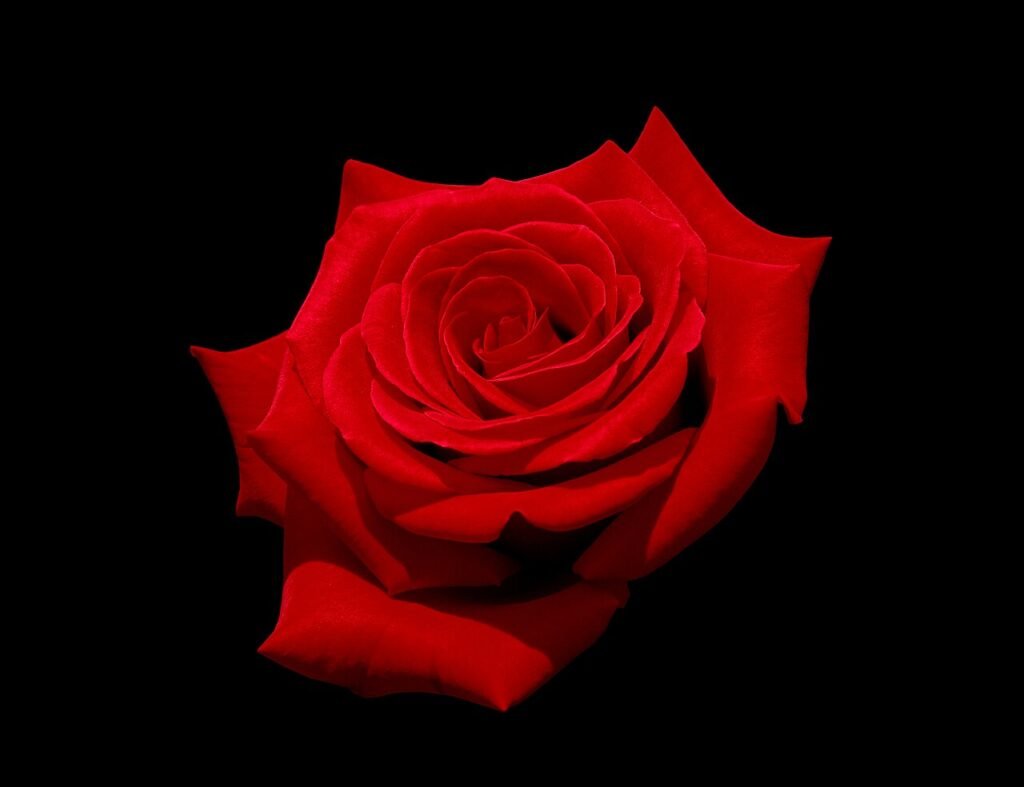
Rose tattoo meaning is not fixed by one colour chart. Love, remembrance, beauty, devotion, grief and protection are familiar personal readings, but their relevance depends on the wearer and cultural context. The visible design is shaped more directly by bloom angle, opening stage, stem direction, leaves, thorns, scale and the body area.
Choose the rose as a three-dimensional form before adding a symbolic label. A front-facing bloom makes a broad circular focal point. A three-quarter rose shows layered depth and a clear direction. A profile, half-open flower or bud creates a narrower silhouette that can travel along a limb. Those decisions make the reference usable for a custom composition.
Why a rose does not have one permanent meaning
Roses have accumulated associations through religion, mythology, literature, heraldry, horticulture and modern gift culture. These systems overlap but are not interchangeable. A red rose in one image may relate to romantic love; in another it may be devotional, political, memorial or simply the strongest colour choice in the composition.
The Metropolitan Museum of Art’s account of rose floriography explains that flower meanings were assembled from several sources and combined or adjusted through pairings. That history supports a more careful approach than treating an online list as a universal code. If a colour or number matters to you, state the connection in the brief instead of expecting the flower to announce it to everyone.
A useful first note is: “This rose represents ___ to me, and I want it to feel ___.” The first blank holds the private meaning. The second provides a design direction such as open, restrained, weathered, formal, soft or severe. Neither requires the artist to invent a customer story.
Look at rose structure before choosing style
The genus Rosa includes many species and cultivated forms. Kew Gardens notes that rose flowers vary in size and shape, while its scientific profile for the genus Rosa records the five-petal basic botanical structure and the usual presence of prickles or thorns on stems and branches. Cultivated double roses can show many more visible petals, so identify the actual flower you want rather than asking for a generic perfect rose.
The main structural choices are:
- the outer silhouette of the bloom;
- where the centre faces;
- how tightly the inner petals are packed;
- which outer petals turn, fold or overlap;
- whether sepals, stem, leaves and thorns are visible;
- where the darkest folds and lightest openings sit.
Style comes after this framework. Traditional, illustrative, botanical, black-and-grey and painterly roses can all begin from the same reference, but they distribute line, colour and shadow differently.
Bloom angle controls the focal point
Front-facing bloom
A front view places the flower’s centre near the middle of a rounded silhouette. It is immediately recognisable and can work as a self-contained focal point on the shoulder, chest, elbow-adjacent upper arm, thigh or knee-adjacent leg. The risk is mechanical symmetry. Natural petals vary in size and overlap, so the design needs rhythm rather than a set of identical rings.
A front-facing rose also competes strongly with any nearby face, clock, animal or text because it behaves like a visual target. Decide whether the rose is the main subject or a supporting shape. Two equally detailed circular focal points can split the composition.
Three-quarter bloom
A three-quarter view shows the centre at an angle and lets one side of the flower appear fuller than the other. This creates depth, direction and a useful diagonal edge. It often fits the outer forearm, upper arm, shoulder, thigh and calf because the bloom can turn with the body instead of sitting like a flat badge.
The reference must show which petals are in front. Mixing a front-view centre with side-view outer petals can create an impossible flower. Use one primary photograph for perspective, then let secondary images guide colour or texture only.
Profile, half-open rose or bud
A side view reveals the cup of the bloom, underside sepals and connection to the stem. A half-open rose or bud is narrower and can lead a vertical composition along the forearm, ribs, spine-side area or calf. It can also show a sequence of stages when combined with a more open flower.
Opening stage may carry a private meaning, but it does not have a universal translation. A bud is not automatically youth, and a fully open rose is not automatically maturity. Treat those readings as client context, then select the form for its actual silhouette.
Stem direction turns a bloom into a composition
A rose head alone creates a compact motif. Adding a stem creates a route for the eye and gives the tattoo a top, bottom and direction of travel. A straight stem can suit a narrow forearm or calf. A gentle S-curve can follow the ribs, shoulder-to-arm transition or side of the thigh. A wrapping stem can connect several surfaces, but the flower must still have a preferred viewing angle.
Map the stem in one clean line before deciding where every leaf and thorn goes. If the curve changes direction repeatedly, the tattoo can look tangled. If it is perfectly straight across a rounded limb, it may appear bent from the main view. Placement photographs help the artist see where the line disappears around the body; the placement-description guide shows which views to send.
Stem length also changes the balance. A long stem with a small bloom feels linear and quiet. A short stem under a large bloom concentrates weight at the top. A cut stem, broken stem or root is an additional narrative choice, not a neutral filler detail.
Leaves and thorns need specific jobs
Leaves can widen a narrow stem, cover an awkward transition and point back toward the bloom. Their serrated edges and central veins identify the plant, but every leaflet does not need the same detail. Use one or two larger leaf groups to balance the flower and keep secondary leaves quieter.
The sharp structures on rose stems are commonly called thorns; botanically, many familiar roses bear prickles. In tattoo planning, the terminology matters less than their placement and visual weight. A few visible points can create tension against soft petals. A dense sequence of equal spikes can overpower the stem and turn into a saw-tooth border.
Do not assume that visible thorns automatically mean pain, defence or hardship. They may carry that personal meaning, but they also belong to the observed plant. If thorns are essential to the story, show them clearly and state why. If they are only botanical detail, keep them subordinate to the bloom.
Colour choice is not a universal code
Red, pink, white, yellow, orange, purple and near-black roses circulate with many popular interpretations. These associations vary by place, period and occasion. Some colours also come from cultivated varieties, lighting or artistic invention rather than a message.
Choose colour for three reasons: personal relevance, reference accuracy and contrast on the selected body area. Rank them. A particular family member’s favourite yellow may matter more than botanical realism. A deep red bloom may need lighter petal breaks so its folds remain distinct. A pale rose may need a stronger outline or dark leaves to avoid losing its outer shape.
Black-and-grey rose tattoos depend on value rather than named colour. The centre, petal folds and cast shadows must be organised so the bloom does not become one mid-grey spiral. The tattoo readability guide explains why major light and dark masses should work before small texture is added.
Pair the rose by shape and hierarchy
Rose tattoo ideas often include daggers, skulls, portraits, animals, script, clocks or other flowers. Pairings change meaning only when the wearer or a documented visual tradition supplies that context. They also create practical composition problems.
A rose can soften a hard angular object, fill space beside a portrait or create a circular counterweight to a long blade. It can also overwhelm a smaller symbol because layered petals attract attention. Decide which element is primary and let the other support it through scale and contrast.
Text should not cross the busiest petal folds unless reduced legibility is intentional. A date or name may sit on a banner, beside the stem or in a quieter field. Check spelling and number order separately from the drawing. For a portrait pairing, keep the rose far enough from the eyes and mouth that both subjects retain their own value structure.
This page is about the general rose form. The Japanese flower tattoo guide deals with peony, chrysanthemum and cherry blossom in seasonal Japanese composition, which is a different planning system. The sunflower tattoo guide covers a flatter radial flower with a large seed head rather than the rose’s layered cup.
Rose placement by composition type
| Placement | Composition that often fits | Main planning question |
|---|---|---|
| Outer upper arm or shoulder | Front or three-quarter bloom with short stem | Does the bloom turn cleanly around the shoulder cap? |
| Forearm | Three-quarter bloom, bud or vertical stem | Which elements remain in the main view? |
| Chest | Broad bloom, pair or rose with portrait/text | How does the shape relate to collarbone and sternum? |
| Ribs or side torso | Profile bloom with flowing stem | Does the line follow the body without excessive bends? |
| Thigh | Large bloom, cluster or paired motif | Which flower is the primary focal point? |
| Calf | Vertical stem, bud or three-quarter rose | Can the outer petals stay clear on the taper? |
| Back | Large cluster, portrait pairing or directional arrangement | Where does the viewer enter the composition? |
A body area is not just a blank rectangle. Take one straight-on photograph, one three-quarter view and, for an arm or leg, a second view after natural rotation. Mark approximate boundaries rather than tracing an exact petal outline before the design exists.
Prepare a rose reference that can be drawn
Use a clear botanical or photographic reference with visible petal overlaps. The Met’s rose design plate by Émile-Allain Séguy is an example of natural forms studied for decorative application: bloom, buds and branches are observed, then organised for design. Your reference process can follow the same separation between accurate observation and deliberate composition without copying an existing tattoo.
Send these items in the brief:
- One sentence for personal context and desired mood.
- Front, three-quarter or profile bloom angle.
- Bud, half-open or fully open stage.
- One primary flower reference and any supporting colour reference.
- Whether stem, leaves and thorns are essential.
- Colour or black-and-grey direction.
- Placement side, approximate boundaries and body photographs.
- Any paired object or text, ranked as primary or secondary.
When those choices are ready, use the Yuyi Tattoo contact page to send the reference set and placement photographs. Project suitability, design scope, timing and availability are confirmed from the individual enquiry rather than assumed from the flower motif.
Sources and review date
- Royal Botanic Gardens, Kew: Roses — reviewed 24 August 2026.
- Kew Science Plants of the World Online: Rosa L. — reviewed 24 August 2026.
- The Metropolitan Museum of Art: A Rose by Any Other Name — reviewed 24 August 2026.
- The Metropolitan Museum of Art: Roses, plate 4 by Émile-Allain Séguy — reviewed 24 August 2026.
Frequently asked questions
What does a rose tattoo mean?
A rose tattoo can carry love, remembrance, devotion, grief, beauty, protection or another personal reading, but none is compulsory. Cultural associations vary. State your own context and use bloom angle, colour, thorns and pairings to support it.
Does rose colour have a fixed tattoo meaning?
No. Popular colour associations come from different cultural and commercial traditions. Choose colour according to personal relevance, the reference flower and the contrast needed for the design, rather than treating an online chart as a rule.
Should a rose tattoo face up or down?
There is no universal correct direction. Decide where the bloom centre should look from the main viewing angle and how the stem should travel on the relaxed body. A placement photograph is the clearest way to confirm orientation.
Do thorns always mean pain or protection?
No. They may support those personal ideas, but they are also part of the plant’s observed form. If the thorns carry meaning, make them intentional in the brief. If not, they can remain a quiet structural detail.
Is a bud or an open rose better for a small placement?
A bud or profile bloom is narrower and may fit a slim placement more naturally. A front-facing open rose needs width and enough room to separate petal layers. The best option depends on style, contrast and body curvature, not only centimetres.
What should I send for a rose tattoo enquiry in Singapore?
Send one main rose reference, the bloom angle and opening stage, colour direction, placement photographs, approximate boundaries and a list of essential supporting elements. If text is included, provide the exact checked wording.


