
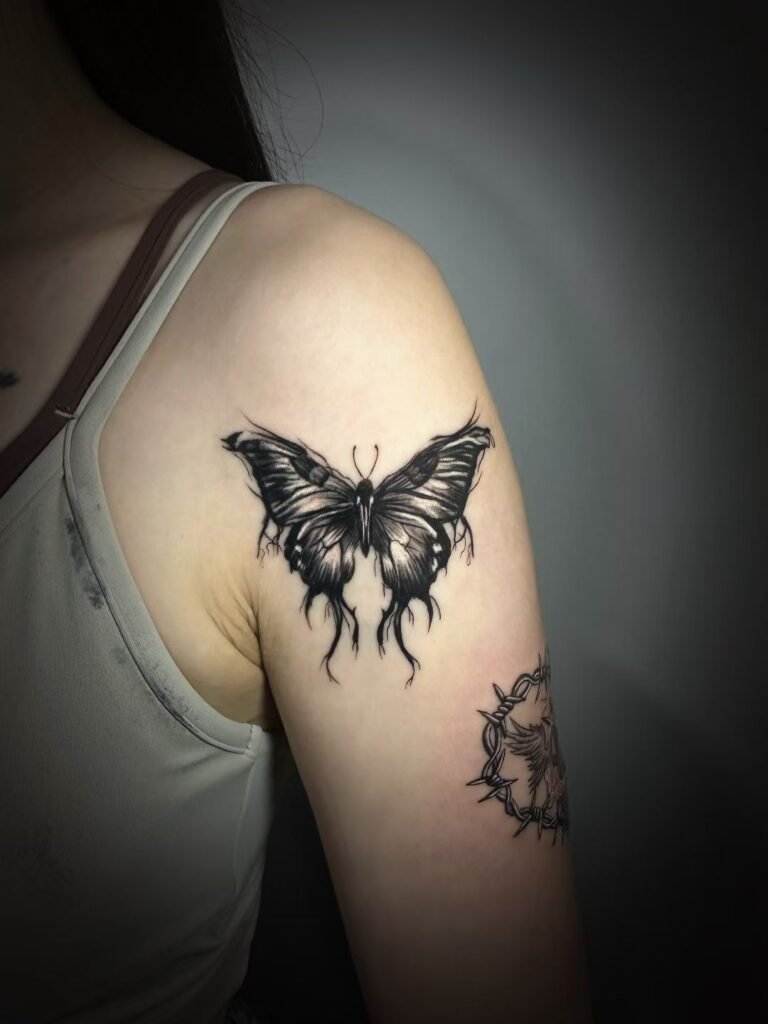
Butterfly tattoo meaning is personal and culturally variable. Transformation is a familiar modern interpretation because butterflies undergo metamorphosis, but it is not a compulsory message attached to every butterfly image. A tattoo can instead mark a person, a place, a period of life, an interest in a particular species or simply an appreciation of the insect’s form.
For design planning, choose the wing position before choosing decorative detail. An open butterfly creates a broad, nearly symmetrical shape. Folded wings make a narrower side view. Angled wings suggest flight and work well on a curved or off-centre placement. Species, scale and body area then decide how much of the natural pattern can remain readable.
Meaning needs a named context
Butterfly imagery has carried different associations in different places and periods, so a colour chart cannot settle what your tattoo says. A Mexica butterfly stamp in The Metropolitan Museum of Art is documented within a visual tradition where butterflies could relate to varied themes, including fertility, fire, death, rebirth and particular deities. That range alone shows why “butterfly equals transformation” is too narrow as a universal claim.
If transformation is your reason, say what kind of change matters to you and whether the message needs to be obvious to anyone else. If the butterfly represents a person, decide whether identity comes from a species, colour, date or pairing. If there is no symbolic story, that is also a complete answer. The artist still needs a visual brief, not an invented explanation.
Keep the private reason separate from the design mechanics. “A blue butterfly for a new chapter” identifies context, but it does not yet specify open or folded wings, top or side view, realistic or simplified markings, placement, size or orientation. Those choices determine what appears on skin.
Open, folded and angled wings make different silhouettes
Butterflies have bilateral body plans, with corresponding structures on the left and right. The Smithsonian National Museum of Natural History uses a butterfly to explain bilateral symmetry and describes the visible relationship between body, forewings, hind wings and vein networks. A tattoo may preserve that structure or deliberately rotate it, but it should not lose track of which forms belong together.
Open wings
An open-wing view shows the upper surfaces and gives the most room for a recognisable pattern. It naturally creates a horizontal diamond or triangular mass around a narrow body. This can sit across the sternum, upper back, shoulder blade or thigh, or be scaled down into a simpler wrist or ankle emblem.
Open wings invite close comparison between left and right. Minor differences are natural on a moving body, but the main wing tips, eyespots and border bands need a planned relationship. Dense patterns that look balanced on a screen may become too crowded once the design is reduced.
Folded wings
A butterfly at rest may hold its wings together above the body, presenting a side view. This format is narrower, more vertical and usually asymmetrical to the viewer because only one side is dominant. It can follow a forearm, calf, rib line or the side of the neck without forcing a broad shape onto a narrow area.
Folded wings also reveal different markings from an open dorsal view. Do not combine the top-side pattern from one photograph with the resting silhouette from another unless the change is intentional. A species reference should show the wing surface you actually want tattooed.
Angled or partly open wings
An angled view sits between the two. One wing may appear larger because it is closer to the viewer, and part of the body may be visible in perspective. This makes the butterfly feel airborne or recently landed. It suits shoulder caps, hips, outer thighs and diagonal rib placements where perfect mirror symmetry would fight the curve.
Perspective needs restraint. If the far wing is reduced too aggressively, the insect can look damaged rather than foreshortened. A clear reference showing the same angle is more useful than asking an artist to guess the pose from a flat open-wing specimen.
Start with a species or a deliberate invented pattern
“Butterfly” covers a huge range of outlines. Swallowtails have extended hind-wing tails. Some species have broad rounded wings; others are narrow, scalloped or almost leaf-like at rest. Choosing a species gives the artist a coherent relationship between edge shape, veins, colour bands and spots.
A good reference set contains one primary photograph showing the desired pose and, if needed, a second clear specimen image for markings. Label which source controls shape and which one is only colour inspiration. Avoid building a supposedly realistic butterfly from five unrelated species unless the goal is openly decorative.
An invented butterfly can work well when the pattern is designed for tattoo readability. Keep the major vein structure plausible, then simplify the internal fields. Decorative flowers, dots or ornamental lines can replace natural markings, but the forewings, hind wings, thorax and abdomen should still form one organised insect rather than four decorative panels around a line.
Pattern density has to match scale
Butterfly colour can come from pigments and from microscopic structures in wing scales. The Smithsonian’s overview of butterfly colours and biomimicry explains the distinction and shows why iridescent natural colour is more complex than a flat printed swatch. A tattoo can interpret that appearance through colour relationships and contrast, but it cannot reproduce the physical optics of a wing scale for scale.
Prioritise the outer edge, the major dark and light fields, the principal veins and one or two identifying marks. Secondary speckles can be reduced when the tattoo is small. A monarch-inspired design, for example, needs its main black network and border rhythm more than a literal count of every pale spot.
Scale should be decided from pattern density, not from the label “small butterfly.” The tattoo size guide explains why centimetres, body curvature and detail must be assessed together. If the body area cannot hold the veins and open spaces without crowding, choose a bolder interpretation, reduce the pattern or allow more room. Tiny detail should never be promised to remain equally sharp at every size.
Symmetry belongs to the body, not to a flat stencil
A perfectly mirrored drawing can appear uneven when it wraps over ribs, crosses the sternum, sits near a shoulder blade or moves with a joint. The solution is not always to force the tattoo back onto a centreline. It may be better to rotate the butterfly, change its wing position or choose a placement with a more stable front view.
Centreline placements such as the upper sternum, upper back or spine make symmetry a conspicuous part of the design. Measure from anatomical landmarks, but remember that human bodies have ordinary left-right differences. Off-centre placements allow more movement. A butterfly on the shoulder can appear to turn with the arm; one on the thigh can sit at a three-quarter angle and remain readable from the front.
The guide to symmetrical and asymmetrical tattoo design compares these approaches in more detail. For a butterfly, the choice is not “accurate versus inaccurate.” It is whether mirrored structure or a sense of flight should lead.
Placement choices by wing position
| Placement | Wing position that often fits | What to check in a placement photo |
|---|---|---|
| Sternum or upper back centre | Open and balanced | How the centreline divides the body and wing tips |
| Shoulder blade | Open or partly angled | Whether one wing runs into the arm crease |
| Shoulder cap | Angled or lifting | How the silhouette changes when the arm rises |
| Forearm | Folded, vertical or simplified open | Whether broad wings wrap out of the main view |
| Rib or side torso | Folded or diagonal | How breathing and posture change the long axis |
| Thigh | Open, angled or a small group | Which view should read first while standing |
| Calf or ankle | Folded or simplified open | Whether veins and border marks have enough room |
Take one straight-on and one three-quarter placement photograph while standing naturally. For a joint-adjacent area, add a view with the joint moving. Draw rough wing-tip boundaries on a copy rather than sending an extreme close-up of bare skin with no anatomical reference.
Colour, black and grey and open skin
Colour can identify a species or create a personal palette. Black and grey can emphasise vein rhythm, shape and shadow. Neither choice determines the meaning. What matters is a clear value structure: the body must separate from the wings, important bands must separate from secondary pattern and the outer edge must remain legible against the placement.
Leave open skin or quieter fields between dense marks. Filling every wing cell with texture can flatten the insect into a dark badge. In black and grey, vary the weight of the main veins and pattern borders rather than outlining every natural scale. In colour, decide which hue leads and use dark structure to keep the wing shape organised.
Distinguish butterflies from moths and dragonflies
Butterflies, moths and dragonflies should not share one generic insect template. Moths often have different resting postures, bodies and antenna forms. The moth tattoo planning guide looks at that broader body mass and night-oriented visual language. Dragonflies use two long wing pairs around an elongated abdomen, creating a different cross-shaped structure; the dragonfly tattoo guide addresses that geometry.
If you are combining insects, vary scale and direction while keeping one focal point. Three identical butterflies placed at equal distances can look like stamps. A larger open butterfly with one smaller angled companion creates hierarchy, but any personal family or memorial reading should come from your brief rather than a fixed numerical code.
What to send with a butterfly enquiry
Prepare the following before you contact the studio:
- Your personal context, or a clear note that the choice is mainly visual.
- Open, folded or angled wing position.
- Species name or one primary reference with a visible source.
- Natural, simplified or invented pattern direction.
- Colour or black-and-grey preference.
- Left or right body side, desired orientation and approximate boundaries.
- Straight-on and three-quarter placement photographs.
- Any essential flower, text or second insect, ranked by importance.
Send that brief through the Yuyi Tattoo contact page. The initial review can then focus on whether the selected wing position, pattern and scale suit the body area. Availability, final scope and other project details are confirmed from the individual enquiry.
Sources and review date
- Smithsonian National Museum of Natural History: Insect Zoo audio description tour — reviewed 24 August 2026.
- Smithsonian National Museum of Natural History: Butterfly Colors and Biomimicry — reviewed 24 August 2026.
- The Metropolitan Museum of Art: Mexica butterfly stamp — reviewed 24 August 2026.
Frequently asked questions
What does a butterfly tattoo mean?
It means what the wearer assigns to it within a particular cultural and personal context. Transformation is common, but it is not universal. A butterfly can also represent a person, species, place, memory or simply a preferred natural form.
Are open or folded wings better for a butterfly tattoo?
Open wings suit broad areas and make symmetry prominent. Folded wings create a narrower side view for forearms, calves and ribs. Angled wings can feel more active and often fit curved, off-centre placements.
Does a butterfly tattoo have to be perfectly symmetrical?
No. The insect has a bilateral structure, but a tattoo sits on a body that curves and moves. A centred open-wing design may use close visual balance, while an angled flying pose can use intentional asymmetry and perspective.
Should I choose a real butterfly species?
A real species gives the design a coherent wing outline and pattern. It is not compulsory. An invented pattern can work if the major anatomy remains organised and the decorative detail is designed for the chosen scale.
Can a very small butterfly keep detailed wing patterns?
Not every pattern can be reduced without losing separation. The workable detail depends on line weight, contrast, placement and wing shape. For a small tattoo, prioritise silhouette, principal veins and major light-dark fields.
What should I send for a butterfly tattoo enquiry in Singapore?
Send the desired wing position, one main reference, species or pattern direction, placement photographs, approximate boundaries and colour preference. Mark any essential pairing so it can be assessed with the butterfly rather than added later.

