A tattoo size guide helps you understand how physical dimensions interact with design detail, body curvature, and visual clarity over time. While clients often request a specific measurement in centimetres, skin is an elastic, three-dimensional surface where complexity dictates the minimum workable scale. A realistic portrait, an intricate geometric motif, and a bold calligraphy script each require vastly different physical dimensions to age well on the body.
Relying purely on a ruler often creates unrealistic expectations regarding what can fit into a compact space. In professional tattooing, size is treated as a functional boundary rather than a fixed menu option. Understanding how anatomical curves and visual density alter a design will help you plan an enduring piece.
Why centimetres alone do not define a tattoo
Measuring a design by width and height provides an initial reference, but flat measurements do not reflect how ink sits on living tissue. A stencil that measures eight centimetres across a flat sheet of paper will distort once wrapped around a forearm or ribcage. The human body contains natural contours, muscle flow, and joint movement that constantly shift how artwork appears in daily life.
Viewing distance is another critical factor in determining appropriate dimensions. Large-scale compositions, such as back pieces and full sleeves, are designed to be legible from across a room before revealing finer textural nuances up close. Smaller pieces must balance immediate proximity with long-term ink diffusion, ensuring lines do not bleed into one another over years of natural skin regeneration.
Evaluating a concept requires looking beyond linear numbers to assess how the subject moves with your anatomy. When planning a project, visual weight and anatomical harmony carry far more influence than numerical height or width alone.
Detail density and workable scale
Every artistic style possesses an absolute minimum scale below which physical detail collapses. Tattoo needles deposit pigment into the dermis, and natural cellular turnover causes microscopic line spreading across decades. If an artist attempts to compress high-density realism or complex micro-lettering into too small an area, the negative space vanishes and the image gradually turns into an unreadable dark patch.
Anatomical realism, animal fur, multi-layered shading, and complex floral arrangements require sufficient surface area for distinct tonal transitions. For example, a realistic human eye requires several millimetres of clean skin between the pupil, iris fibres, and surrounding eyelids to retain its expression. Compressing those elements into a two-centimetre medallion eliminates the light values needed for depth.
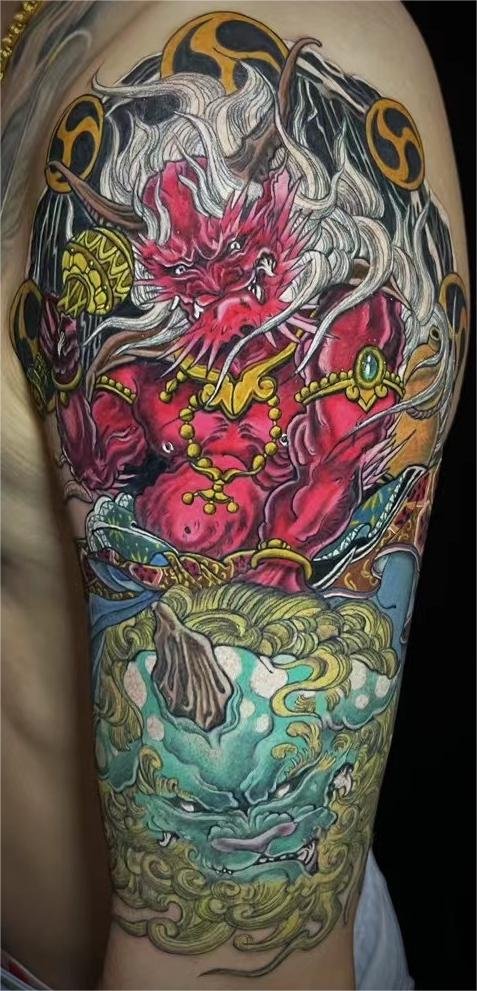
Before committing to a specific boundary, it is vital to adjust your expectations based on design complexity. You can view Yuyi’s tattoo work to observe how large-scale realism and Asian-inspired motifs use expansive skin coverage to maintain visual depth and distinct subject separation.
Comparing flat and curved body placements
The same centimetre measurement behaves differently depending on where it sits on the body. Flat, stable anatomical planes allow stencils to lay evenly with minimal distortion, whereas cylindrical limbs and flexible joint areas wrap the artwork around multiple visual angles.
The following table demonstrates how a standardised measurement translates across distinct anatomical zones.
| Placement Area | Surface Type | Distortion Risk | Recommended Design Approach |
|---|---|---|---|
| Inner Forearm | Mostly flat, slight taper | Low | Well-suited for vertical compositions, text, and single-point illustrative subjects. |
| Outer Bicep / Shoulder | Cylindrical curve | Moderate | Needs anatomical flow so outer edges wrap naturally without severing main focal points. |
| Ribcage / Side Torso | Dynamic contour | Moderate to High | Expands with breathing; requires organic alignment along the natural arch of the ribs. |
| Upper Back / Shoulder Blade | Broad, relatively flat | Low | Excellent for wide focal pieces, high-contrast portraits, and detailed compositional work. |
| Calf / Shin | Tapered curve | Moderate | Vertical orientation works best; horizontal elements wrap around the leg and lose symmetry. |
| Wrist / Ankle | Highly mobile cylinder | High | Fine micro-details blur faster due to constant joint articulation and friction; bold simplicity is essential. |
Selecting placement requires balancing personal preference with structural realities. Placing a wide, square composition onto a narrow, tapering forearm forces the artist to shrink the design significantly, sacrificing essential internal elements.
Line weight, contrast and negative space
A successful tattoo relies on the relationship between bold structural lines, soft gradients, and bare skin. Negative space—the un-inked skin left between shaded zones—acts as the primary source of light and visual breathing room. When a tattoo is sized too small, negative space is the first element lost.
Fine needles allow for delicate textures, but structural integrity depends on deliberate contrast. Without adequate dark tones anchoring the piece and sufficient open skin balancing them, the tattoo appears flat and indistinct from a short distance. As the skin ages and experiences sun exposure, high-contrast compositions retain their readability far better than cramped, low-contrast designs.
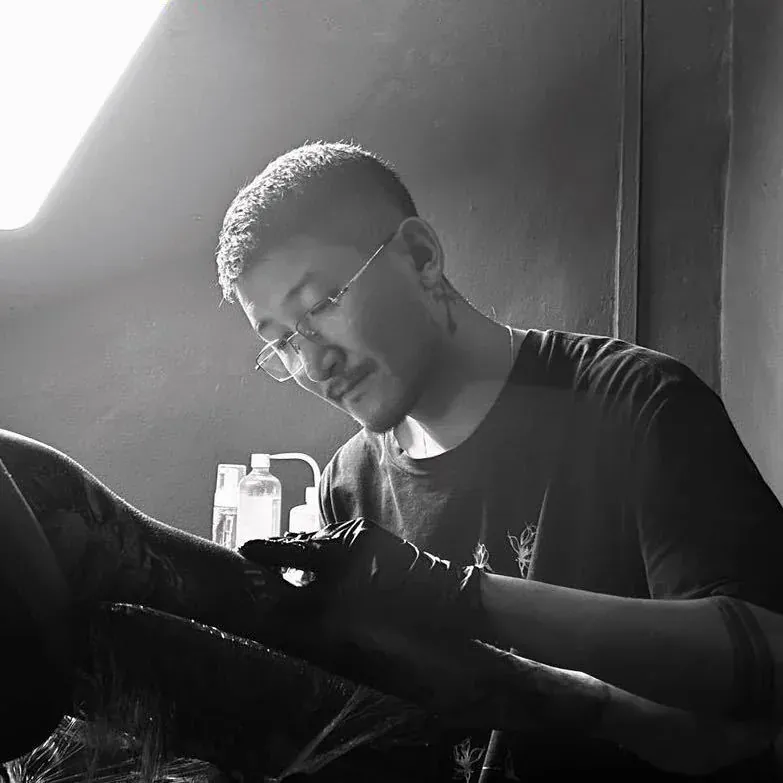
A painterly approach rooted in classical fine arts helps determine how light falls across body contours. Yuyi, who received formal academic fine arts training at the LuXun Academy of Fine Arts and has been tattooing since 2010, structures large-scale black-and-grey realism by prioritising tonal hierarchy over unnecessary micro-clutter.
Connecting dimensions to sessions and quotes
Clients frequently ask about a fixed tattoo price by size, assuming that a ten-centimetre tattoo carries a universal cost regardless of subject matter. In practice, physical dimensions represent only one component of a technical quote. A simple ten-centimetre geometric outline can be executed much faster than a ten-centimetre realistic eye with layered skin textures and hyper-fine tonal gradients.
Session length and project pricing depend on several technical variables:
- Total visual complexity, including the number of individual focal elements and background textures.
- The selected body placement, as sensitive or difficult-to-stretch skin areas require slower, more meticulous needle passes.
- Skin elasticity, hydration, and natural undertones, which influence how pigment settles into the dermal layer.
- Compositional preparation time needed to map custom reference artwork to your specific anatomical curves.
To budget effectively for custom body art, it helps to understand tattoo prices in Singapore as a reflection of artist experience, artistic style, and technical execution rather than flat square-centimetre calculations.
How to photograph and measure your placement area
Providing accurate placement references allows an artist to assess visual scale before your in-person consultation. Sending a blurry close-up of a patch of skin does not show the surrounding anatomical landmarks needed to design a balanced layout.
Follow these practical steps to document your intended tattoo zone:
- Stand naturally in a neutral posture with relaxed muscles, avoiding twisting or tensing the limb.
- Have a friend take a clear, well-lit photograph from approximately one to two metres away, capturing the entire body segment (such as the full arm or back).
- Place a standard flexible ruler or a common household reference item flat against the skin adjacent to the target area for scale.
- Take one straight-on photograph and one secondary photograph showing the natural three-quarter profile curve.
- Note any existing tattoos, birthmarks, or scar tissue in the surrounding area that the new piece must flow around.
These contextual images allow the artist to digitally superimpose rough concepts onto your body contours, ensuring initial scale discussions are grounded in your actual proportions.
Size consultation checklist
Arriving prepared for a design discussion speeds up the planning phase and ensures your ideas align with long-term execution standards. Review this checklist before submitting your inquiry:
- Realistic size flexibility: Are you open to adjusting your target centimetre range if your design concept requires more breathing room?
- Primary reference imagery: Have you gathered two to four visual examples showing the specific rendering style, contrast balance, and mood you prefer?
- Placement boundaries: Have you decided whether the piece must stay completely hidden under specific work clothing or if it can extend naturally across the muscle?
- Long-term expansion plans: If you intend to build a full sleeve or back piece later, have you noted this so the initial borders leave room for seamless integration?
- Clear reference photos: Have you taken wide-angle photographs of your relaxed placement area with an approximate measurement included?
When you have these materials organised, you can send Yuyi your tattoo idea along with your references to begin discussing structural composition and workable scale.
Frequently asked questions
Can any design be scaled down to a small tattoo size in cm?
No, not every design can be compressed into a compact dimension. Highly detailed compositions containing realistic portraits, dense foliage, or layered architecture require physical surface area to maintain separation between needle lines. Shrinking complex imagery below its minimum workable scale causes adjacent lines to bleed together as the skin naturally regenerates over time, resulting in a dark, indistinct shape rather than a clear image.
How does body movement affect a small vs medium tattoo size?
Body movement causes skin to stretch, compress, and twist across joints and muscle groups. A small design placed over a highly active joint, such as the inner wrist or ankle, undergoes constant distortion and accelerated friction. Scaling up to a medium placement across a broader, more stable plane—such as the forearm or outer bicep—allows the artwork to retain its structural proportions without warping during everyday physical motion.
Why do two tattoos of the same centimetre measurement cost different amounts?
Two tattoos sharing identical linear dimensions can require vastly different technical application times. A minimalist outline with open skin space involves straightforward execution, whereas a high-realism piece of the same height requires complex multi-tonal shading, varied needle configurations, and precise contrast management. Project quotes reflect the total artistic labour, technical difficulty, and design preparation involved rather than physical square centimetres alone.
What is the best way to determine the correct size for a portrait tattoo?
Determining portrait scale requires assessing the subject’s key facial features, lighting contrast, and hair texture. A portrait generally needs enough vertical height to ensure the eyes, nose bridge, and mouth have sufficient un-inked skin between shaded zones. Scheduling an in-person stencil fitting allows the artist to align the facial angle with your muscle contours, confirming that the scale looks natural from both near and far viewing distances.
Plan your tattoo placement with Yuyi Tattoo
If you have a tattoo concept and want an expert assessment on appropriate dimensions, placement flow, and design detail, reach out with your project ideas. While Yuyi Tattoo operates from a private studio located at 388A Geylang Road, #02, Singapore 389387, booking an advance consultation ensures focused time to evaluate your anatomy and reference imagery.
To discuss your design, send your placement photos, approximate measurements, and reference artwork directly via WhatsApp message to Yuyi before scheduling your studio appointment.