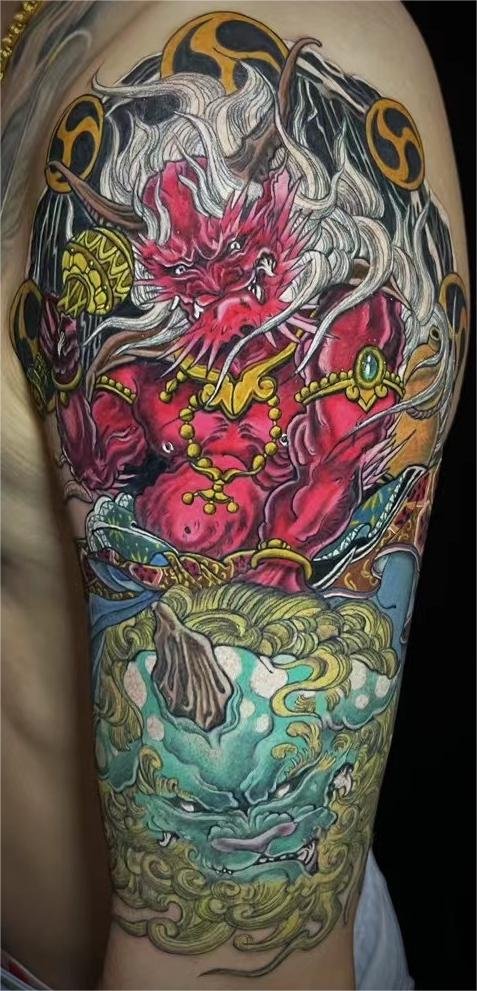
Japanese tattoo meanings rarely come from one fixed dictionary definition. What a dragon, koi or hannya mask suggests depends on which historical tradition it draws from, which motifs sit beside it, and where it sits on the body. This guide treats Japanese tattoo designs as a connected system of motifs rather than a checklist of symbols with a single correct answer.
Why Japanese Tattoo Meaning Depends on Source, Era and Pairing
Japanese tattoo meaning shifts depending on whether a motif comes from Buddhist temple art, Noh theatre, Edo-period woodblock prints or present-day tattoo practice, and it shifts again once that motif sits next to another one. Treating any single image as having one locked meaning misreads how these visual traditions developed.
Tattooing in Japan did not start as decoration. The Pitt Rivers Museum at the University of Oxford notes that full-body tattooing, irezumi, carried religious and status significance as an art form, but by the 17th century tattoos were also used as a codified punishment marking criminals and outcasts, before former convicts began reclaiming and embellishing those marks (Pitt Rivers Museum, University of Oxford). The revival that shaped today’s imagery came through woodblock printing: the Museum of Fine Arts, Boston notes that many recognisable tattoo motifs trace back to early 19th-century Edo, when tattooers drew on ukiyo-e prints, particularly Utagawa Kuniyoshi’s series on the heroes of the Water Margin, or Suikoden, and that the Meiji government later banned tattooing as part of its modernisation drive, a ban lasting until the mid-20th century that pushed the practice underground for decades (Museum of Fine Arts, Boston).
That layered history means a “traditional” meaning is often several meanings stacked together: a religious symbol, a piece of theatre iconography, a print artist’s invention, and a personal statement chosen today. A dragon drawn by Kuniyoshi for a fictional bandit is not making the same statement as a dragon carved centuries earlier for a temple gate. Both are legitimate references; neither is the only correct one. Readers who want to see these references combined into full compositions can explore Japanese and Asian-inspired tattoos before settling on a single motif.
The Major Motif Families
Most Japanese tattoo designs draw from a manageable number of recurring subject groups, each carrying documented history alongside looser contemporary interpretations that vary by artist and wearer.
Dragons
The Museum of Fine Arts, Boston’s survey of tattoo prints describes Kuniyoshi adorning his Suikoden heroes with dragons of various kinds alongside lions and coiling snakes to signal supernatural strength (MFA Boston). Contemporary tattoo culture often extends this into ideas of protection and untamed power, though that reading is a modern gloss rather than one documented rule.
Koi
The koi’s association with transformation ties to the “ascending dragon gate” legend, tōryūmon. The British Museum’s catalogue note on a Hokusai print of carp leaping a waterfall explains that carp gathering below the rapids known as Dragon Gate and managing to climb them are said to become dragons, with the phrase denoting a gateway to success in life (British Museum). That documented legend underlies koi being read as a marker of perseverance, though wearers apply it to very different personal circumstances.
Masks
Hannya and other Noh masks are among the most recognisable Japanese tattoo motifs, and their documented meaning comes from theatre. The Victoria and Albert Museum describes the hannya as a female serpent-demon “filled with malicious jealousy and hatred,” worn by the lead performer in plays such as Aoi no Ue and Dōjōji (Victoria and Albert Museum). In tattoo practice this is often reinterpreted more loosely as emotional intensity or protection, but that broader reading sits on top of the theatrical original rather than replacing it.
Animals
Tigers, snakes, cranes and phoenix-like ho-o birds recur across Japanese decorative art and tattoo design, drawn from the same pool of imagery used in painting, ceramics and textiles. Their tattoo meanings are usually read in relation to what surrounds them, which is one reason a single-animal reference list can mislead on its own.
Warriors
Suikoden warriors are a direct legacy of Kuniyoshi’s prints. The Pitt Rivers Museum notes that many kabuki plays centred on masterless samurai, gamblers and outlaws known as Suikoden, and that prints showing them with elaborate tattoos helped popularise large-scale body art among ordinary urban classes in Edo (Pitt Rivers Museum, University of Oxford). Warrior figures generally reference courage, loyalty or defiance drawn from the source stories rather than a single fixed code.
Flowers
Flowers carry symbolic weight and set the season of a composition. The Pitt Rivers Museum notes that cherry blossom tattoos were often associated with the way of the samurai, since the blossom’s beauty is as fleeting as a samurai’s readiness to face death. The Metropolitan Museum of Art’s essay on seasonal imagery traces this same sense of transience through Buddhist and Shinto visual culture more broadly (The Metropolitan Museum of Art). Peonies, chrysanthemums and maple leaves carry their own seasonal associations, covered below.
Foreground, Background, Season and Movement
A Japanese tattoo composition is built from layers, and reading it correctly means separating the main subject from what supports it. The foreground carries the primary figure, whether that is a dragon, koi, mask or warrior, while the background carries connective elements such as waves, clouds, wind bars or rock formations, traditionally used as filler linking separate figures into one continuous design.
Season is usually set by the flowers or foliage in the background rather than the main subject itself. The Met’s essay on seasonal imagery explains how Japanese art repeatedly returns to the passage of the seasons to express broader ideas about impermanence, with cherry blossoms marking spring and chrysanthemums or bare branches marking autumn and winter (The Metropolitan Museum of Art). Movement is carried through the direction of water, wind and cloud lines, which typically flow diagonally across a limb or torso to unify separate motifs into one scene.
How Motif Pairings Support One Composition
Pairing motifs is less about matching fixed meanings and more about deciding what a figure needs around it to read as a complete scene. The table below outlines common Japanese tattoo motif pairing choices and what each tends to emphasise, without claiming any pairing has a single correct meaning.
| Main subject | Common supporting motifs | What the pairing tends to emphasise | Design consideration |
|---|---|---|---|
| Dragon | Clouds, wind bars, waves | Movement and elemental scale | Needs generous space to show the body’s full length |
| Koi | Water, maple leaves, lotus | Direction of travel and season | Upward koi reads differently to downward koi |
| Hannya mask | Peonies, spiderweb, fire | Contrast between softness and tension | Works well as a contained foreground piece |
| Tiger | Bamboo, snow, wind | Season and setting | Snow suggests winter; bamboo suggests forest |
| Suikoden warrior | Weapon, deity figure, pine | Narrative and stability | Often anchors a larger back piece |
| Phoenix (hō-ō) | Paulownia, clouds | Renewal and elevation | Pairs poorly with heavy dark backgrounds |
None of these pairings are compulsory. They reflect how these motifs are conventionally composed together in Japanese decorative art and tattoo practice, and a good composition can depart from them when it serves the wearer’s own concept.
Placement and Scale Change What Can Be Read
Placement and scale determine how much of a layered composition a tattoo can hold, so the same motif choices read differently on a full back than on a forearm. A large back piece or full sleeve has room for a foreground figure, a supporting background, a clear season and a sense of directional movement, all in one continuous design.
A smaller placement, such as a forearm panel, calf piece or wrist tattoo, usually cannot carry all four layers without becoming cluttered, and the motif reads more like a standalone icon than a scene. That is not a lesser choice, but it needs planning from the start. Sleeve work sits between these extremes: it uses continuous background elements such as water or clouds to link separate motifs placed along the arm, so the composition still reads as one piece when the arm moves. It is worth taking time to view Yuyi’s tattoo work across different placements and scales before deciding on your own.
Example Concept Combinations
These are starting points for a conversation with your artist, not fixed formulas with one correct meaning attached.
- A rising koi moving toward a wave crest suggesting the dragon gate, with maple leaves marking autumn behind it. Often discussed as upward movement paired with a change in season, though the personal reading is left to the wearer.
- A hannya mask as the central figure, surrounded by peonies and a fine spiderweb pattern, commonly used to contrast an intense central figure against a softer, decorative surround.
- A Suikoden-style warrior anchoring a large back piece, supported by pine trees and banked clouds. This layout favours scale, since the narrative detail in the warrior’s pose needs room to read clearly.
- A tiger moving through bamboo with light snow behind it, an alternative seasonal setting to the more common cherry blossom or maple pairings.
A Motif-Selection Worksheet
Before a first consultation, rough answers to the questions below are more useful than a single reference image pulled from a search engine. None of these answers are binding; they give an artist a starting point to work from.
- Main subject: which single figure should carry the most visual weight?
- Supporting motifs: what background elements (water, clouds, flowers, foliage) do you picture around it?
- Season or setting: does the piece feel like spring, autumn, winter, or no season at all?
- Direction of movement: should the composition flow upward, downward, or stay static?
- Placement: which part of the body, and how much of it are you willing to commit?
- Scale: is this a contained piece, a sleeve, or a larger back or torso project?
- Personal versus traditional weight: closer to documented historical iconography, or a personal reinterpretation of it?
Bringing rough answers to these seven points to a consultation is more useful than arriving with a single symbol and asking what it “means,” since a workable composition is built from how the pieces relate, not from one motif in isolation.
Planning a Composition With Yuyi
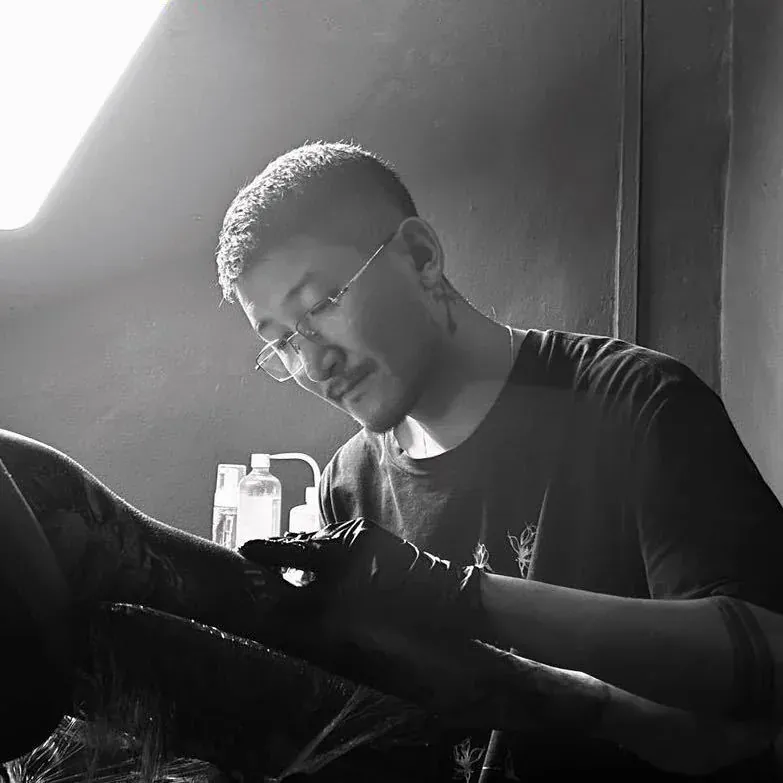
Yuyi trained in fine art at the LuXun Academy of Fine Arts before moving into tattooing in 2010, and his studio work spans black-and-grey realism, portrait realism, large-scale back pieces and sleeves, and Japanese and Asian-inspired compositions. That combination of formal training and large-scale composition experience matters, since a Japanese-motif tattoo is closer to composing a painting across a body than picking a symbol from a list. You can meet Yuyi, a Singapore tattoo artist on the studio site.
The studio is at 388A Geylang Road, #02, Singapore 389387. It lists 24-hour opening, but that does not guarantee a specific artist or a same-day slot, so it is worth messaging ahead of any visit to confirm timing.
Ready to Plan Your Composition
If you have a rough sense of your main subject, the supporting motifs you like, your preferred placement and the scale you are considering, send those details over WhatsApp to start composition planning. Message Yuyi on WhatsApp with the main subject, supporting motifs, placement and scale you have in mind, and the conversation can go from there.
Sources and review date
- Pitt Rivers Museum — Japanese irezumi — reviewed 20 August 2026.
- Museum of Fine Arts Boston — Tattoos in Japanese Prints — reviewed 20 August 2026.
- The Met — Seasonal imagery in Japanese art — reviewed 20 August 2026.
Frequently asked questions
What does a Japanese dragon tattoo mean?
There is no single fixed meaning. Documented history links dragons to elemental and guardian imagery in Japanese art, and to dramatic strength in Edo-period tattoo prints. Many wearers today read dragons as protective figures, but that is a contemporary interpretation layered on top of the documented sources, not a replacement for them.
Is a koi tattoo always positive?
Koi are widely associated with perseverance through the dragon-gate legend documented by the British Museum, where a carp climbing the rapids becomes a dragon. This is generally read as a positive theme of effort and transformation, though the specific meaning still depends on the wearer and the composition around it.
Can I combine koi and dragon in one tattoo?
Yes, and this pairing has documented roots in the dragon-gate legend, since koi and dragons are already connected in that story. The two can appear together, or a koi can be shown at different stages of transformation, depending on placement and available space.
What does a hannya mask tattoo mean?
In Noh theatre, documented by the V\&A, the hannya represents a female demon transformed by jealousy and rage. Tattoo culture often reinterprets this more broadly as emotional intensity or protection, but that is a contemporary addition rather than the original theatrical meaning.
How much of my body do I need for a full Japanese tattoo design?
It depends on how many compositional layers you want. A single foreground motif can work on a smaller area, but adding background, season and clear movement typically needs a sleeve, half-sleeve, or back piece to read properly without feeling cramped.
Do Japanese tattoo motifs have to follow traditional rules?
No. Traditional composition conventions are a useful reference, not a requirement. Wearers and artists often depart from them deliberately to fit a personal concept, as long as that departure is a considered choice discussed with the artist rather than an accident of poor planning.