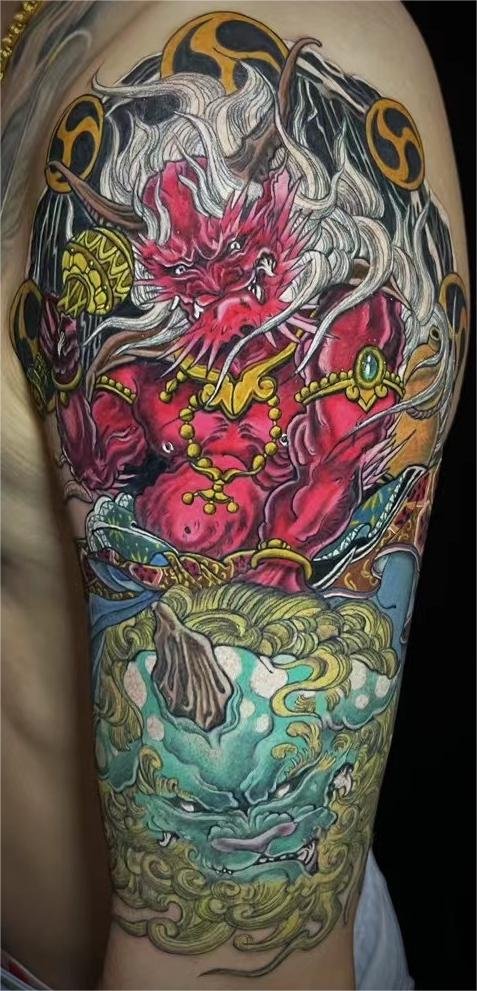
Dragon tattoo meaning depends on which tradition the design draws from. In Chinese art the dragon reads as a symbol of authority, water and good fortune; in Japanese irezumi it reads as a benevolent, wise creature linked to clouds and protection. The meaning you end up with is shaped less by folklore and more by how the dragon is drawn, placed and paired on the body.
Most people who ask for a dragon tattoo are not asking for a lecture on mythology. They want a design that fits their arm, their back or their chest, and they want to know why the dragon curls the way it does. This piece separates the two main dragon traditions, then works through the practical decisions: direction, pairings, placement and scale.
Chinese Dragon Meaning and Context
The Chinese dragon, or long, is a composite creature built from parts of several animals rather than a single beast copied from nature. According to the Fitzwilliam Museum’s collection notes, the Chinese dragon combines antlers like a stag, the head of a crocodile, a snake-like neck, carp scales, tiger paws and hawk claws, a mix meant to signal that the creature holds power over many domains at once.
That same source notes the dragon’s long-standing tie to water and weather, which made it sacred to farmers who depended on rain, and explains why five-clawed dragons were historically reserved for the emperor while four-clawed versions were used by the wider population. The Metropolitan Museum of Art’s 2024 exhibition on the Year of the Dragon frames the creature in a similar way: a symbol of imperial authority, a force believed to dispel evil influences, and a benevolent deity associated with bringing rain to sustain life. None of this means a Chinese dragon tattoo today carries an imperial message. It means the visual language, scales, claws, mane and the way the body coils through clouds, has centuries of established form behind it, which is partly why it still reads clearly on skin.
Japanese Dragon Meaning and Context
Japanese dragon tattoos sit inside a different history, one tied directly to the development of tattooing itself rather than to court ceremony. The Seattle Art Museum’s programming on this subject points out that Japanese dragon tattoos grew alongside Edo-period (1615 to 1868) print culture and were closely associated with outsider identities in Japanese society. When tattooing became illegal for Japanese citizens in the late nineteenth century, tattoo artists continued working on visiting foreigners, many of whom chose dragon designs specifically as souvenirs of Japan, a pattern that continued with American servicemen stationed in Asia after the Second World War.
Within Japanese tattoo culture, the ryu (dragon) is generally treated as a wise and protective figure rather than a destructive one. Material connected to master tattooer Horiyoshi III’s archive of irezumi imagery describes Japanese dragons as benevolent, linked to water, clouds and sky, and associated with wisdom, courage and the control of natural forces, a contrast to fire-breathing dragons in some Western folklore. In irezumi practice, the dragon is usually one of the motifs built into a large, flowing composition that runs across the back or the full arm rather than sitting as an isolated image. If you’re drawn to this style specifically, it helps to explore Japanese and Asian-inspired tattoos before settling on a single motif, since the dragon rarely stands alone in traditional Japanese layouts.
Shared Traits, Different Readings
Both traditions treat the dragon as powerful and connected to water, but they diverge on tone. A Chinese dragon tends to carry associations with rulership, order and prosperity. A Japanese dragon tends to carry associations with wisdom, protection and the taming of natural forces. Neither association is fixed once the design becomes a tattoo; a lot of what a dragon “means” on someone’s body comes down to the story the wearer attaches to it, not a universal rulebook.
This is why the same dragon body, coiled with a long serpentine spine, whiskers, a mane and clawed limbs, can end up meaning very different things to different clients. Some people want it as a family or heritage reference. Others want it purely for the composition: a dragon fills a sleeve or a back panel in a way few other single subjects can, because its body can bend, stretch and wrap around muscle without losing its shape.
Direction and Movement, Without the Myths
There is no fixed rule that a dragon facing “up” or “down” the body carries one universal meaning; that idea circulates online but isn’t supported by the museum and academic sources referenced here, so it’s treated as design preference rather than fact. What direction actually does is control how the eye travels across the piece and how the dragon interacts with the body’s own movement.
A dragon that climbs from wrist to shoulder on a sleeve reads as ascending and active, following the arm’s natural line when raised. A dragon coiled around the torso on a back piece moves in a circular or diagonal path instead, since the back doesn’t hinge like a limb. Movement direction is usually decided by the shape of the body part and the placement of supporting elements such as clouds or waves, not by a symbolic code that has to be followed. A skilled artist will map direction against the muscle groups and the client’s stance, because a design that looks strong standing still can look static once the arm bends.
Pairings That Change the Reading
A dragon rarely appears alone in either tradition, and the elements around it do a lot of the storytelling.
- Clouds: the most common companion in both Chinese and Japanese work, since dragons are consistently tied to sky and weather across the sources above. Clouds also fill negative space efficiently on large pieces.
- Waves: reinforce the dragon’s connection to water and are common in Japanese full-back and sleeve compositions, often layered behind the dragon’s body to suggest movement through the sea.
- Flowers, particularly peonies: peonies paired with dragons and other auspicious creatures appear in Chinese decorative art as symbols of wealth and rank, a pairing documented in museum collections on Chinese auspicious motifs.
- Tigers: in East Asian art, the dragon and tiger are frequently set as a contrasting pair, one linked to sky and water, the other to land and strength, which is why some clients ask for both in a single large-scale piece.
These pairings aren’t decorative filler. They change the composition’s balance and can shift the story from “power” to “protection” to “prosperity” depending on what’s included.
Sleeve, Back or Chest: How Placement Changes the Brief
The same dragon design behaves differently depending on where it sits, because each area has a different shape, visible surface and healing consideration.
| Placement | Body shape | What it suits | Practical note |
|---|---|---|---|
| Sleeve (arm) | Long, cylindrical, bends at elbow | A dragon that appears to travel or climb; easy to keep partially hidden under clothing | Design must account for the arm’s bend so the dragon doesn’t distort when flexed |
| Back | Wide, flat, largest continuous canvas | Full-body dragons with clouds, waves or a paired tiger; strongest option for detail and scale | Longest sessions and healing area; usually built in stages |
| Chest | Curved, includes collarbone and pectoral shape | A dragon head or partial body as a focal piece, often extending toward the shoulder | More sensitive skin area; placement near the sternum needs careful planning around movement |
None of these is inherently “better.” The choice usually comes down to how much of the design a client wants visible day to day, and how much surface area the concept genuinely needs. If you’re deciding between these, it’s worth thinking about long-term coverage goals before the first session, since a dragon that starts on the shoulder often gets extended into a sleeve or back piece later.
Scale, Negative Space and Background
Scale is not just about how big the tattoo is; it’s about how much of the design is dragon versus how much is supporting background. A dragon confined to a small area, such as a forearm panel, usually has to simplify its scales, claws and mane to remain legible once healed. A dragon given a full back or full sleeve can carry finer detail because there’s room for it.
Negative space, the untattooed skin left around the design, is what keeps a large dragon piece readable rather than cluttered. Clouds and waves are often used specifically to manage this: dense in some areas to frame the dragon’s body, sparse elsewhere to give the eye somewhere to rest. Clients who want maximum detail sometimes ask for very little negative space, which can look striking fresh but tends to blur together at a distance once the piece is a few years old. If you’re weighing this trade-off, it’s a good idea to plan a large-scale tattoo project with reference images that show both dense and open backgrounds, so the artist can explain how each will age on your specific skin tone and area.
Questions to Bring to Your Consultation
Coming to a consultation with clear answers to these questions makes the first meeting far more productive:
- Which tradition are you drawn to, Chinese dragon or Japanese ryu, or a blend of both?
- Where on the body is the dragon going, and is it meant to stay contained there or expand later into a larger piece?
- What supporting elements do you want, clouds, waves, peonies, a tiger, or none?
- Do you want the dragon facing a particular direction, and why, is it about following the arm’s movement or about balancing a specific composition?
- How much negative space do you want left in the background?
- Do you have reference images of dragon tattoos, paintings or prints that show the exact style and level of detail you like?
Bringing photos, even rough ones, saves time. It’s also worth taking a look through examples of finished work before your consultation; you can view Yuyi’s tattoo work to see how different dragon compositions have been handled at different scales.
Continue planning with Yuyi Tattoo
Continue with explore Japanese and Asian-inspired tattoos, plan a large-scale tattoo project, and view Yuyi’s tattoo work.
Sources and review date
- Fitzwilliam Museum — Chinese dragon jar — reviewed 20 August 2026.
- Seattle Art Museum — Why get a Japanese dragon tattoo — reviewed 20 August 2026.
- Museum of Fine Arts Boston — Tattoos in Japanese Prints — reviewed 20 August 2026.
Frequently asked questions
Does a dragon tattoo have to be Chinese or Japanese style, or can it combine both?
Most tattoo artists treat Chinese and Japanese dragon styles as distinct visual languages rather than interchangeable options, since the body shape, scale pattern and supporting elements differ between them. Some clients do request a blended approach, but it works best when discussed openly in the design stage rather than assumed.
Is there a correct direction for a dragon tattoo to face?
There is no verified rule from museum or academic sources dictating a fixed meaning for a dragon facing up or down the body. Direction is generally decided by how the design fits the body part and how it should move when the muscle flexes, not by a fixed symbolic code.
How long does a full back or sleeve dragon tattoo take to complete?
This depends on the size, detail level and the client’s availability for sessions, and it isn’t something that can be stated as a fixed number in advance. It’s best discussed directly during a consultation once the design and placement are settled.
Can a dragon tattoo be added to later, like extending it into a sleeve?
Extending a dragon design over time is common, particularly when a piece starts smaller and grows into a full sleeve or back piece. It’s easier to plan for this from the start, so mentioning future extension plans during the first consultation helps the artist design accordingly.
What should I bring to a consultation for a dragon tattoo?
Reference images showing the style, direction and level of detail you like are the most useful thing to bring. Photos of the specific body area, along with any preferences on supporting elements like clouds or waves, help the artist prepare a design that fits your body and goals.
If you have a dragon design in mind, message Yuyi Tattoo on WhatsApp with the dragon form, movement, placement and any supporting imagery you’re considering, and the studio will follow up from there.