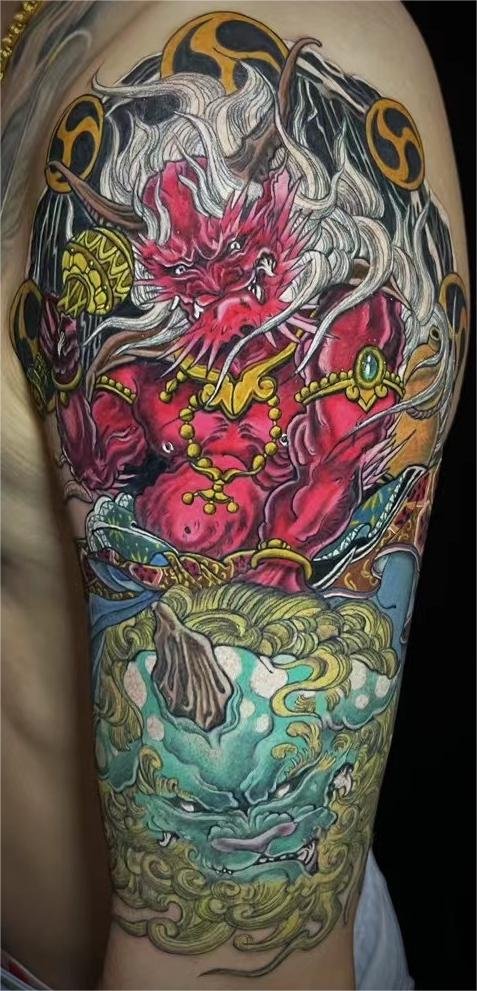
A koi fish tattoo meaning usually points back to one story: a carp that fights its way up a waterfall and becomes a dragon. That single legend explains most of what people associate with koi, including perseverance and transformation, but it does not fix one meaning to every colour or every swimming direction. The rest depends on how the fish is drawn, where it sits on the body, and what the wearer is actually trying to say.
The Story Behind Koi and Transformation
The core koi story comes from a Chinese legend about a carp swimming upstream, forcing its way past a waterfall known as the Dragon Gate, and being transformed into a dragon once it succeeds. The San Diego Zoo Wildlife Alliance describes this directly: koi symbolism largely arises from the legend of the Dragon Gate, where the determined koi swam upstream, conquering waterfalls and other obstacles, until it was transformed into a dragon, a positive force in Chinese culture.
This is not a Japanese invention. It travelled into Japan alongside broader Chinese cultural influence and was later absorbed into Japanese visual art, where it took on its own life. What makes koi different from a lot of tattoo motifs is that the transformation story is doing real work. The fish is not just decorative. It stands for the idea that struggle against resistance is what produces change, which is why koi keep showing up in contexts about effort, patience and outcomes that were not guaranteed.
It is worth being honest about one thing here: the legend describes a single fish overcoming a specific obstacle. It does not describe a colour code, a fixed swimming angle, or a rulebook for tattoo placement. Those additions came later, mostly through decorative art and, eventually, through tattoo culture itself.
Where the Meaning Actually Comes From
The koi and dragon imagery that ends up on skin today is inherited more directly from Edo-period woodblock prints than from folk legend alone. The Museum of Fine Arts, Boston, traces this lineage in its exhibition “Tattoos in Japanese Prints,” noting that some of the world’s most popular tattoo motifs go back to early 19th-century Edo, where tattoo artists took inspiration from colour woodblock prints known as ukiyo-e. Koi, dragons, warriors and seasonal flowers were established as a shared visual vocabulary in print before they became a shared vocabulary on skin.
This distinction matters for anyone reading meaning into a design. The prints set the visual grammar: how a koi’s body curves against a current, how scales are shaded, how water is broken into waves and foam. The meanings attached to koi in modern tattoo culture, including detailed colour charts and rigid direction rules, are a newer, more commercial layer built on top of that older visual tradition. Some of it lines up with older symbolism. A lot of it is modern shorthand that got repeated online until it looked like established fact.
Academic surveys of irezumi are more careful about this gap. The University of Oxford’s Pitt Rivers Museum notes that Japanese full-body tattooing, known as irezumi, is believed to date back several thousand years and was regarded as an art form carrying both status and religious significance, without reducing individual motifs to single fixed meanings. Writing for Nippon.com, cultural anthropologist Yamamoto Yoshimi surveys irezumi’s shifting status across Japanese history, from an emblem of Edo-period urban cool to a practice pushed underground during the Meiji era. None of that history supports the idea that a koi tattoo has one correct interpretation. It supports the opposite: meaning has always been shaped by period, context and the person wearing it.
If you’re deciding between koi and other traditional subjects, it helps to explore Japanese and Asian-inspired tattoos as a category before locking in one motif, since koi is usually one part of a larger visual conversation rather than a standalone symbol.
Swimming Upstream or Downstream, Discussed Carefully
Swimming direction gets treated online as a fixed switch: upstream for struggle, downstream for having already succeeded. That framing is a simplification of the original legend, not a rule with any single authoritative source behind it. The Dragon Gate story is about a fish pushing against a waterfall’s current, which is naturally read as upstream movement, and the transformation happens after that struggle.
Beyond that one narrative beat, there isn’t a documented, universal code stating that every downstream koi means something specific and fixed. Direction in a tattoo composition is often driven by the shape of the body part being tattooed, not just symbolism. On a forearm, a koi angled toward the wrist or the elbow changes how the whole piece flows when the arm moves. On a thigh or calf, direction interacts with how the leg is usually seen, standing or in motion.
A reasonable way to use direction is to treat it as a personal framing choice layered on top of the transformation story, rather than as an absolute label. If someone wants a koi that speaks to something they’re still pushing through, an upstream orientation echoes the legend most literally. If someone wants to mark something already behind them, a calmer downstream composition can carry that intent just as well, but it’s an interpretation the wearer is choosing, not a fixed dictionary entry.
Koi and Dragon Relationships
A koi and dragon tattoo meaning is essentially the transformation legend shown as two stages of the same figure. The tattoohistoryatlas project’s overview of Japanese irezumi describes horimono composition as typically built around a main subject, or shudai, commonly a dragon, tiger, koi or phoenix, with the koi ascending the Dragon Gate read specifically as a symbol of perseverance. Pairing koi and dragon in one piece makes that link explicit: the koi is what you were, the dragon is what the struggle produces.
Not every koi and dragon composition needs to show a literal transformation mid-motion. Some designs place a dragon and koi separately within the same larger piece, using them as two related but distinct figures rather than one fish becoming one dragon. Both approaches are legitimate uses of the source material. What matters is that the composition communicates a relationship, rather than the two figures being included just because they’re both popular.
This is also where scale becomes a real consideration. A dragon rendered with any presence needs room to read clearly, and a koi needs enough space around it for the water and movement to make sense. If you’re weighing a koi and dragon combination, it’s worth looking at how larger pieces are actually structured before committing, which is one reason to view Yuyi’s tattoo work across different body placements.
Colour, Without a Rigid Chart
Colour choice in a koi tattoo is a real design decision with some cultural grounding, but it isn’t governed by one fixed universal chart. Traditional Japanese references do attach some general associations, such as black koi (magoi) linked to endurance and fatherhood, and red-and-white pairing read as an auspicious, celebratory combination. Gold is broadly associated with prosperity in more modern usage. These associations show up consistently enough in cultural writing to be worth knowing, but they are general tendencies drawn from folk and decorative tradition, not a strict, universally agreed code where every shade has one locked meaning.
In practice, colour in a tattoo also has to work as colour: how it ages, how it sits against skin tone, how it reads from a distance versus close up, and how it interacts with the water, waves and flowers around it. A koi rendered mostly in black-and-grey with selective colour accents can carry just as much intent as a fully saturated piece. Treating colour as a purely symbolic checklist tends to produce designs that feel assembled from a list rather than composed as one image.
If a specific colour matters to you personally, whether that’s a birth colour, a colour tied to a memory, or simply one you find visually strongest, that reasoning is a better starting point than trying to match an internet chart. A good artist can tell you honestly how a particular palette will hold up over time on your skin, which is a more useful conversation than debating whether gold “means” wealth.
Water, Flowers, Season and Body Flow
Everything surrounding the koi carries as much weight as the fish itself. In traditional horimono composition, seasonal and floral elements, known as keshoubori, are used deliberately to set atmosphere and season around a main subject like a koi or dragon. Cherry blossoms suggest spring and impermanence, peonies suggest a fuller, more established bloom, and chrysanthemums often point toward autumn. None of these have to be literal; they’re mood-setting, similar to how a background score works in a film.
Water treatment is arguably more technically demanding than the fish itself. Waves, foam, and the transition between calm water and turbulent water around a waterfall all have to move convincingly with the koi’s body, especially once the tattoo wraps around a limb or torso. This is where the Edo-period print tradition still shows its influence directly: the graphic, almost sculptural way water is broken into whitecaps in old ukiyo-e prints is the same visual language many tattooers still draw from today.
Body flow is the part people underestimate most. A koi that looks balanced as a flat drawing can look completely wrong once it follows the curve of a shoulder, wraps around an elbow, or sits across a ribcage that moves with breathing. This is one reason experienced Japanese-style work is planned directly on the body rather than as an isolated flat sketch.
Sleeve and Back-Piece Planning Questions
A koi rarely stays small once someone commits to it seriously. It tends to grow into a sleeve or a back piece because the water, flowers and negative space all need room to breathe. Before committing to that scale, a few honest questions are worth working through with your artist.
- Do you want one koi as the clear focal point, or multiple koi as a school moving together?
- Should the piece eventually connect into a full sleeve, a back piece, or stay contained to one section such as a forearm or thigh?
- Is a dragon part of the plan now, or is that a future addition the composition should leave room for?
- Which season or flower motif fits the tone you want, calm and established versus restless and unresolved?
- How much negative space (open skin) do you want left between elements, since this affects how the piece ages and reads from a distance?
Answering these before the first session makes a much bigger difference to the final result than any decision about colour or direction on its own. If a full sleeve or back piece is realistically where this is heading, it helps to plan a large-scale tattoo project from the start rather than trying to retrofit a small koi into something bigger later.
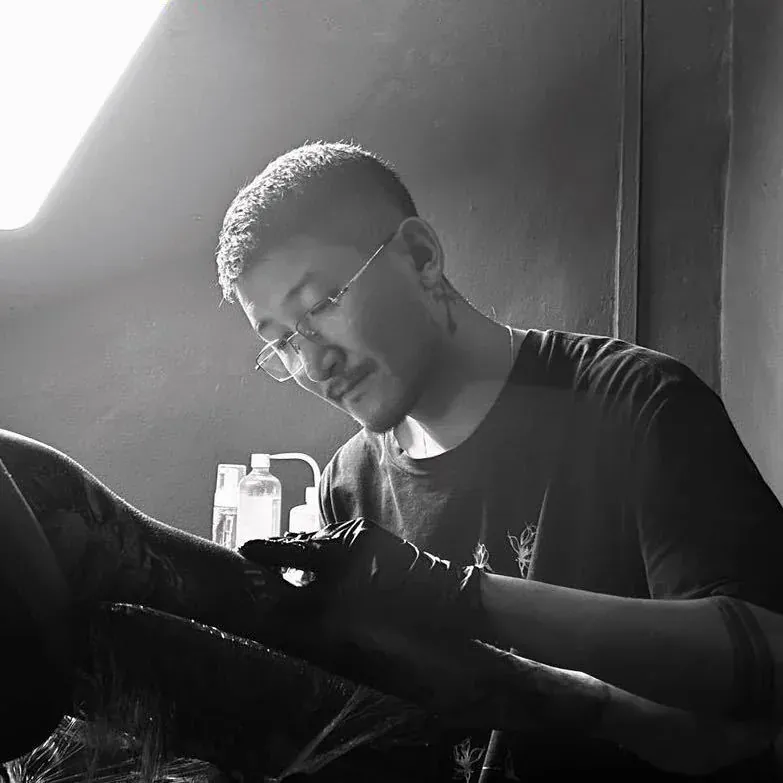
Yuyi trained in fine art at the LuXun Academy of Fine Arts and has worked as a tattoo artist since 2010, with black-and-grey realism, portrait realism and large-scale Japanese and Asian-inspired backs and sleeves among the areas most represented in the studio’s work. That background matters for koi pieces specifically, because getting scales, water motion and body flow right on a large scale is closer to drawing than to filling in a stencil.
Sources and review date
- San Diego Zoo Wildlife Alliance — The koi story — reviewed 20 August 2026.
- Museum of Fine Arts Boston — Tattoos in Japanese Prints — reviewed 20 August 2026.
- Pitt Rivers Museum — Japanese irezumi — reviewed 20 August 2026.
Frequently Asked Questions
Does a koi swimming upstream always mean struggle and downstream always mean success?
No. The Dragon Gate legend involves a fish pushing upstream before transforming, so upstream naturally echoes that struggle. But there is no single authoritative rule fixing downstream to one meaning; direction is often shaped by body placement and personal intent as much as symbolism.
Is a koi and dragon tattoo just two separate lucky symbols?
Not quite. In traditional composition, the koi ascending the Dragon Gate is specifically read as perseverance, with the dragon representing the transformation that follows. Pairing them usually implies a before-and-after relationship rather than two unrelated lucky charms.
Does koi colour have a fixed meaning I should follow strictly?
Some general associations exist in Japanese folk tradition, such as black koi linked to endurance, but these are tendencies rather than a strict universal chart. Personal reasoning about a colour usually produces a more meaningful result than following an online colour list exactly.
Can a koi tattoo be small, or does it need to be a sleeve?
A koi can work as a smaller, contained piece, but the water, waves and floral elements that usually surround it need enough space to read clearly. Many koi designs grow into sleeves or back pieces once the surrounding composition is planned properly.
How is a koi tattoo different from a general Japanese-style tattoo?
Koi is one motif within the broader Japanese horimono tradition, which also includes dragons, tigers, phoenixes and seasonal flowers. A koi piece can stand alone, but it’s often planned as part of a larger Japanese or Asian-inspired composition rather than in isolation.
If you’re working through direction, colour, placement or specific motifs you want included in a koi design, send Yuyi a message on WhatsApp with those details so the composition can be planned around what you actually want, rather than a generic template.