
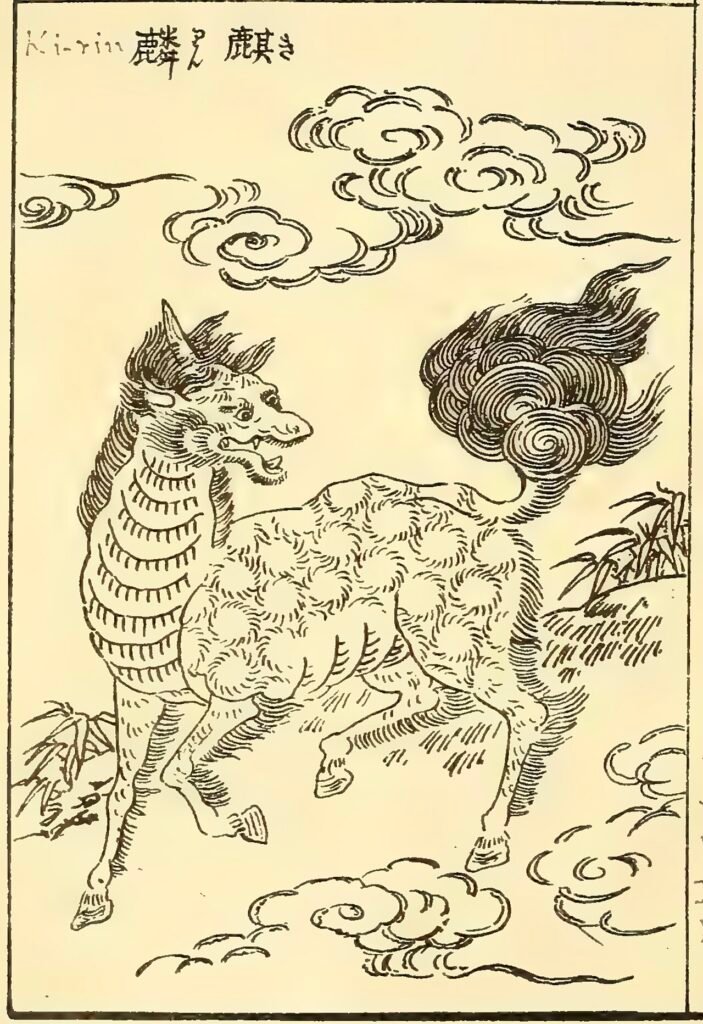
Kirin tattoo meaning is not a single symbol-definition lookup. The word can point to related but regionally varied creatures: the Chinese qilin, written 麒麟, and the Japanese kirin that developed through East Asian visual exchange. Museum records show the animal changing in body plan, surface pattern and symbolism across periods. For a tattoo, the first question is therefore not “which meaning is correct?” but “which visual and cultural reference am I asking the artist to draw?”
A recognisable kirin usually needs a deliberate combination of features rather than a generic horse with one horn. Depending on the source, it may have a dragon-like head, a horn, a deer-like body, horse-like legs or hooves, a lion-like tail, scales and flame-shaped markings. The posture, cloud or rock setting and amount of open skin then determine whether the creature reads as a calm auspicious beast, a dynamic guardian-like figure or an invented fantasy hybrid. State the source direction before treating the design as a finished concept.
What the word kirin refers to
“Kirin” is the Japanese reading commonly used for the creature often called qilin or kylin in English-language museum catalogues. The British Museum’s controlled vocabulary groups “kirin,” “kylin” and “qilin” under an Asian mythical figure. That cataloguing choice is useful for research, but it does not erase regional differences. A Japanese reference, a Ming rank badge and a contemporary fantasy illustration may share a name while presenting different heads, bodies, surfaces and settings.
The Metropolitan Museum of Art’s study of the qilin explains that traditional Chinese sources did not leave one precise, universally fixed image of the creature. The museum discusses how a giraffe presented to the Ming court in 1414 was celebrated as a qilin, showing that historical identification and visual representation could shift with context. That history is a reason to avoid declaring one tattoo silhouette the only authentic form.
The documented body plan: build from parts, not a shortcut
The Metropolitan Museum’s survey of Japanese netsuke describes a kirin with a dragon’s head, a horn lying back against the head, a deer’s body, legs and hooves similar to a horse, and a lion’s tail. It also notes scales or protuberances and flame-like forms at the chest or shoulders. These details are not a universal checklist for every time and place; they are a strong source for recognising one Japanese art tradition.
The Louvre’s collection description of a Chinese qilin similarly records a body assembled from several animals: deer body, wolf-like head enlarged with a horn, ox tail and horse hooves. Its catalogue also says the appearance varies by period. For a kirin tattoo design, choose which parts carry the identity:
- Head: a dragon- or wolf-like head establishes a mythic creature rather than an ordinary stag.
- Horn: one or more horns can alter the silhouette; specify the source instead of treating horn count as a fixed law.
- Body: deer-like lightness creates a different mood from a heavy scaled body.
- Legs and hooves: horse-like legs give the animal a readable stride or raised-leg pose.
- Tail: a lion, ox or another source-specific tail changes the rear silhouette.
- Surface: scales, patterned fur and flame-like marks add texture but should not hide the body structure.
Do not compress every version into one crowded creature. A clear source direction usually makes a stronger tattoo than a collage of every remembered detail.
Kirin tattoo meaning: auspicious, virtuous and personal layers
Museum records support several broad associations, but they do not force one universal tattoo meaning. The Metropolitan Museum describes the qilin as an auspicious mythological beast associated with the reign of a virtuous ruler; its collection record on a Qing scroll cover also notes the creature’s connection with auspicious rule and Ming noble rank badges. The Museum of Fine Arts, Houston describes qilins in Chinese art, poetry and mythology as benevolent creatures associated with good fortune, prosperity, devotion to family and the desire for male heirs.
Those associations belong to particular historical and social contexts. A wearer may instead choose the kirin for its composite anatomy, quiet movement, family reference, interest in Chinese or Japanese art, or a personal idea of protection and good fortune. It is better to describe that personal layer honestly than to claim that every kirin tattoo has one ancient meaning.
Use three levels when discussing your idea:
- Source meaning: what the museum, object record or scholarly text says about the chosen image.
- Visual meaning: what the posture, gaze, hooves, scales and surrounding space make a viewer feel.
- Personal meaning: why you want the animal and what you want the tattoo to remember.
This keeps a contemporary tattoo respectful without pretending that a private interpretation is a historical rule. For broader context on how Japanese motifs shift with source and pairing, compare the Japanese tattoo meanings guide.
Posture changes the reading
A kirin is often imagined as rare, benevolent or auspicious, so a tattoo does not need an aggressive battle pose to feel powerful. Posture can carry more character than extra ornament.
Standing or walking kirin
A standing kirin lets the head, neck, horn and composite legs be studied clearly. A measured walking pose can suggest care, restraint or quiet presence. It suits a thigh, upper arm, calf or a vertical side-body placement. Keep the legs separated enough that they do not merge into a single column of dark ink.
Leaping or rising kirin
A raised foreleg or lifted body creates movement and makes clouds useful as a visual support. The diagonal can travel across a shoulder, back or thigh. A leaping pose needs a clear landing direction; otherwise the creature appears to float. The tail and mane should reinforce the direction rather than point against it without purpose.
Coiling or turning kirin
A turning body shows the head and torso at different angles and can wrap around a limb. It is useful for a sleeve or a design that must follow a curved body area. The artist needs enough scale to keep the horn, eye and muzzle readable when the skin turns.
Calm seated or lowered kirin
A lowered pose can emphasise the head, chest flames and patterned body. It may suit a contained chest, shoulder or upper-arm composition. Do not add a dramatic background simply to fill the space; calm posture works when the negative space remains intentional.
Clouds, flames, rocks and open skin
Clouds are a common way to place a mythic creature in an active environment. In a tattoo, they also provide a practical transition between body parts, especially across a shoulder or elbow. Use broad cloud masses to indicate elevation and movement, not a wall of identical curls. If every cloud receives the same outline and shading, the kirin loses hierarchy.
Flame-like forms require care. The Met netsuke reference describes “fire markings” as a design element associated with mythological beasts, with shapes flaring around the chest or shoulders. In a tattoo, these marks can frame the front of the body and separate it from the background. They should follow the creature’s anatomy rather than look like random flames pasted onto a horse.
Rocks and waves can ground a standing kirin. A cloud-and-rock composition gives the viewer a vertical world: air above, creature in the centre, weight below. Open skin is equally important. It can represent mist or distance and gives the horn, muzzle and hooves room to read. A full background is not automatically more traditional or more meaningful.
Scale: the design decision that protects recognition
Small kirin tattoo ideas often begin with a beautiful reference image and end with too many tiny features. A small piece cannot show a dragon head, horn, scales, flame markings, cloud curls and detailed hooves at the same level. Choose one primary reading: a head study, a compact walking creature, or a simplified full-body silhouette.
At larger scale, the artist can separate the components and use value to establish hierarchy. The eye and muzzle may carry the darkest accents; the horn and chest markings can stay cleaner; scales can be grouped rather than individually outlined. The tail should remain visible as a tail, not dissolve into background texture.
Ask to see the proposed design at the distance at which people will normally view it. A kirin on a forearm is read while the arm moves. A back piece may be seen in a mirror or photograph. Readability is not a rejection of detail; it is the order in which detail is allowed to arrive.
Kirin tattoo placement choices
| Placement | What it supports | Main design question |
|---|---|---|
| Upper arm or shoulder | Head, chest flames and a turning body | Will the horn remain clear when the arm rotates? |
| Forearm | Walking or vertical kirin with restrained clouds | Can the legs and tail stay separate in a narrow field? |
| Thigh | Larger composite anatomy and rock/cloud setting | Does the pose read while standing and walking? |
| Back | Leaping or full-scene composition with broad movement | Where is the focal head, and how does the eye travel? |
| Chest or side body | Calm, framed animal with intentional open skin | Does the design follow the sternum, ribs or pectoral curve? |
| Calf | Upright or lowered figure with a compact background | Will the ankle and knee transitions distort the legs? |
Placement should be chosen with the body in motion, not only as a flat rectangle. If you are considering a larger Japanese or Asian composition, review the Japanese tattoo background guide and compare the way background, scale and body flow are handled. A motif-specific plan is more useful than asking an artist to “fit a kirin anywhere.”
Colour, black and grey and reference discipline
Bring references with captions. Mark which image supplies the head, which supplies the body, and which supplies the cloud or flame treatment. If an image comes from a museum, note the object record. If it is a modern artwork, say so. Avoid asking for a direct copy of a living artist’s tattoo. The goal is an original composition informed by identified sources.
A reference board should name the tradition, essential body plan, pose, background and size needed for a readable face and anatomy.
For another example of why regional labels and source choices matter, compare the guardian lion and foo dog design guide, then send the focused kirin brief through the contact page. The discussion should stay with the desired scale, anatomy and reference direction; this article does not claim that Yuyi has completed a specific kirin example.
A respectful way to describe your brief
A strong message might say: “I am researching a Japanese kirin based on the Metropolitan Museum netsuke description. I want a walking pose on the outer thigh, a dragon-like head, deer-like body, horse-like hooves, restrained chest flames and open space rather than dense clouds. I prefer black and grey. Please advise whether this size can keep the horn, eye and tail readable.”
That wording makes the source and the design priorities visible. It leaves room for the artist to adjust anatomy, flow and scale rather than promising that every historical detail can fit. The final tattoo can be personal and contemporary while remaining clear about which reference tradition informed it.
Sources and review date
- The Metropolitan Museum of Art: Netsuke: Small Sculptures of Japan (Bulletin); reviewed 24 August 2026.
- The Metropolitan Museum of Art: Scroll Cover with Mythical Creature; reviewed 24 August 2026.
- The Metropolitan Museum of Art: The Giraffe as the Mythical Qilin in Chinese Art; reviewed 24 August 2026.
- British Museum: Kirin / Kylin / Qilin collection term; reviewed 24 August 2026.
- Musée du Louvre: Box in the form of a qilin; reviewed 24 August 2026.
- Museum of Fine Arts, Houston: Table Screen with Scholars and Qilin; reviewed 24 August 2026.
Frequently asked questions
What does a kirin tattoo mean?
It can draw on auspiciousness, virtue, benevolence, prosperity or family-related associations documented in Chinese art, while also carrying the wearer’s own meaning. The reference period, region, pose and pairing matter; there is no single universal definition.
Is a kirin the same as a Western unicorn?
They share a horned-animal shorthand in some English descriptions, but a kirin or qilin is a composite East Asian mythical creature with regionally varied forms. A dragon-like head, deer-like body, hooves, scales, tail and flame-like markings can make the reference more specific than a horse with one horn.
Should I choose a Chinese qilin or Japanese kirin?
Choose the visual tradition you want to research. Chinese and Japanese sources overlap but do not present one identical body plan. Name the source object or period in your brief so the artist does not have to guess.
What are good kirin tattoo ideas for a sleeve?
A walking or turning kirin with broad clouds, restrained flame-like markings and deliberate open skin can follow a sleeve’s movement. The head, horn, legs and tail need enough scale to remain separate around the elbow and wrist.
Where should a kirin tattoo be placed?
Upper arm, thigh, back, chest, side body, calf and forearm can all work, depending on the pose and size. Choose the area by asking where the head will face, how the body will travel and which joints may distort the anatomy.
Can a kirin tattoo include clouds and flames?
Yes, if those elements come from the chosen reference direction and support the composition. Broad clouds can create movement and transitions; flame-like marks can frame the chest. They should not bury the creature’s anatomy or be presented as mandatory symbols.


