
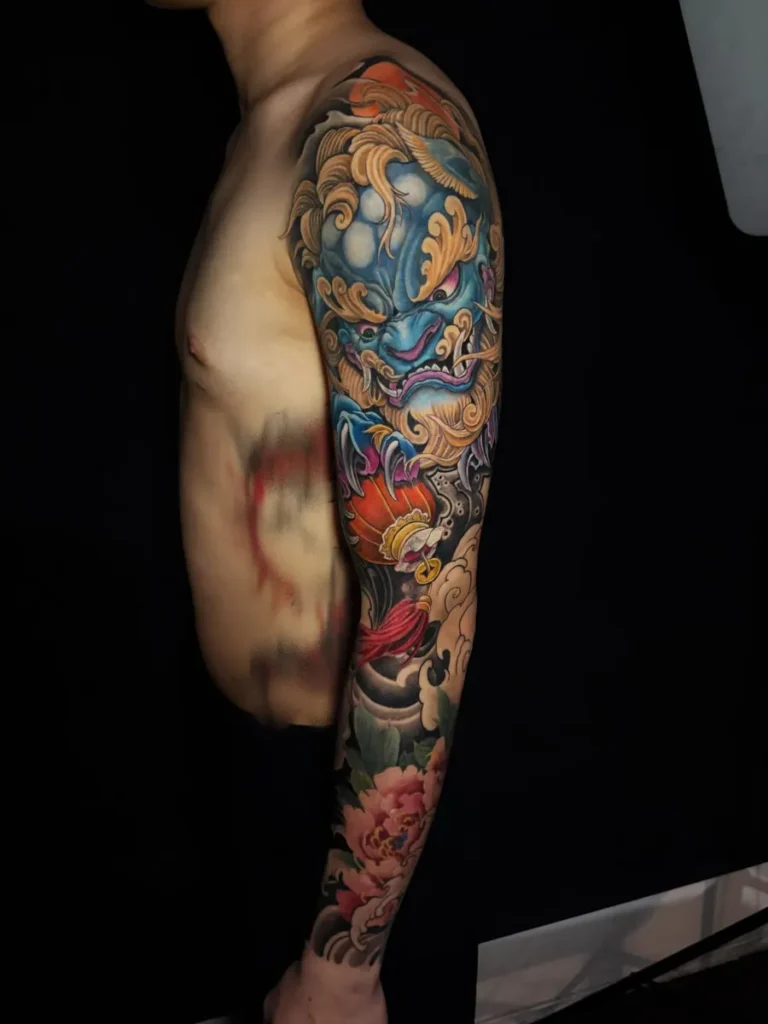
Foo dog tattoo meaning usually points to protection, threshold energy and a strong guardian presence, but the phrase itself is modern English shorthand rather than a precise historical name. In Chinese contexts the image is better understood as a guardian lion, stone lion or shishi; in Japanese contexts related figures include shishi and komainu. The tattoo design should start by asking which visual tradition you are referencing, then decide how the lion moves across the body.
A strong guardian lion tattoo is not just a fierce face with a mane. It needs stance, weight, claws, mouth shape, background and placement that make the figure feel as if it is guarding an edge, turning around a limb or pushing through clouds and flowers. Peonies, waves, smoke, wind bars and architectural framing can all work, but only when they support the lion rather than compete with it.
Why the name “foo dog” needs care
Many clients search for “foo dog tattoo meaning” because that is the English phrase they have seen online. It is useful as a search term, but it can flatten several related traditions into one label. Museum descriptions more often use “guardian lion,” “Buddhist lion,” “shishi,” or “komainu,” depending on the object and culture.
The Metropolitan Museum of Art describes an early Chinese guardian lion as a fierce crouching figure with bared fangs and splayed claws. Its note also places paired stone lions at Han-dynasty tombs and later Buddhist cave temples in northern China. That matters for tattoo planning because the figure begins as an architectural and ritual guardian, not as a simple lucky animal.
In Japan, komainu are commonly translated as lion-dogs. The Met’s Japanese guardian lion-dogs are a useful comparison: they have leonine heads, canine bodies and the familiar open-mouth and closed-mouth pairing found at shrine entrances. The Asian Art Museum also distinguishes a lion from an imaginary lion-dog within a Japanese pair. A tattoo can borrow from either direction, but it should not pretend that Chinese guardian lions and Japanese komainu are exactly the same image.
Chinese guardian lion, shishi or Japanese komainu?
Before choosing a reference, decide what kind of guardian you want the design to read as.
Chinese guardian lion
A Chinese guardian lion usually feels architectural, frontal and weighty. It may be seated, crouched or pawing at a ball or cub in older sculpture. For a tattoo, this direction suits a strong central face, heavy paws, curled mane, carved-looking eyes and a sense of pressure toward the viewer. It can work well on the upper arm, thigh, chest or back because those placements give the head enough room.
Shishi or karajishi
Shishi and karajishi often appear in Japanese and East Asian art as highly stylised lions. They can look more animated than a gate sculpture, with curling fur, open mouth, lifted paws and a rolling body. This direction is helpful for an Asian guardian lion sleeve because the form can turn around the shoulder and elbow without becoming a stiff emblem.
Komainu
Komainu are usually thought of as paired guardians at Japanese shrines. The open and closed mouths are part of the visual language. If you want a pair of figures, a chest panel, shoulder pair or back composition may carry that idea better than squeezing both into a small forearm. If you only want one figure, the artist can still reference the komainu style, but the design should not claim the full paired shrine symbolism.
Meaning comes from role, not a rigid symbol chart
It is tempting to assign one fixed meaning to every detail: one paw means power, one colour means luck, one direction means protection. That approach is too neat. Historical objects show repeated roles and visual patterns, but they do not turn every detail into a universal tattoo rule.
Separate the idea into three layers before choosing references:
- Cultural role: guardian figures protect thresholds, sacred spaces and important buildings.
- Visual reading: crouching, bared teeth, claws and open mouths create alertness and force.
- Personal meaning: the wearer may connect the figure with protection, courage, family, discipline or a particular memory.
A tattoo can hold all three layers, but the personal layer should not be presented as ancient fact. If your reason is private, say it clearly in the consultation. If your reference is cultural, bring the source image and name it accurately.
Movement: how the lion should travel on skin
The best guardian lion tattoos have a clear line of action. Even a seated lion needs movement in the mane, shoulder and paws. On skin, that movement matters more than adding extra symbols.
For a sleeve, the face often sits near the outer upper arm or shoulder, where it can be read at distance. The body, mane and background then move down toward the elbow and forearm. The forearm should not become a dumping ground for leftover curls. It needs a second focal point, a paw, a peony or a turning cloud, so the design still works when the arm is bent.
On a thigh, the lion can be larger and more sculptural. The head can face forward or slightly across the body, while the mane and peony forms wrap toward the side of the leg. On the chest, a guardian lion needs to respect the collarbone and sternum; a square face placed too high can look trapped under the neck. On the back, the design can become more architectural, with the lion occupying a gate-like central role.
Foo dog and peony tattoo pairings
A foo dog and peony tattoo works because the two forms solve each other’s design problems. The guardian lion provides face, claws, teeth and tension. The peony provides broad petals, soft curves and places to rest the eye.
In tattoo composition, peonies are often paired with bold animals because their rounded petals provide a contrasting shape. That is a design choice, not a rule that every peony carries one fixed meaning. In this pairing, the peony mainly does three practical things:
- It gives the composition rounded mass around the lion’s head.
- It softens hard claws, teeth and brow shapes.
- It creates a seasonal or decorative layer without stealing the main role.
If the lion is very detailed, keep the peony shapes broad. If the peony is too small and busy, it becomes filler. If the peony is as visually loud as the lion’s face, the sleeve can lose hierarchy.
Background choices: clouds, waves, wind or architecture
Background should explain the lion’s movement. Clouds can make the figure feel elevated or spiritual. Waves can give weight and rolling force, especially in Japanese-influenced compositions. Wind bars can connect separate parts of a sleeve and keep the design from floating. Architectural lines, such as a gate edge or carved base, can make the guardian role more explicit, but they need enough scale to avoid looking like scenery.
For clients exploring broader Japanese and Asian-inspired work, it helps to compare how backgrounds are handled on the Japanese and Asian-inspired tattoo page. The question is not “which background is luckier?” The question is “which background gives the guardian a believable place to move?”
Placement options for a guardian lion tattoo
| Placement | What it suits | Design caution |
|---|---|---|
| Upper arm and shoulder | Strong face, mane and peony wrapping into sleeve flow | Avoid putting the entire lion face across the elbow bend |
| Full sleeve | Asian guardian lion sleeve with peonies, wind, cloud or wave structure | Plan the elbow and wrist early so the subject does not break apart |
| Thigh | Larger crouching figure, big paws, open mouth and floral support | Keep the face readable when standing and walking |
| Chest | Protective, frontal, threshold-like image | Follow collarbone and sternum rather than forcing a square badge |
| Back | Architectural guardian composition or paired guardians | Needs clear hierarchy so it does not become a wall of detail |
Large guardian designs need enough room for the face, mane and paws to age clearly. If the idea is heading toward a full sleeve or back piece, use the large-scale tattoo planning guide before treating the design as a small single image.
Colour, black and grey and contrast
Guardian lion tattoos can work in colour or black and grey. Colour can separate the mane, mouth, peony and background, especially when blues, reds or warm petals are used with restraint. Black and grey can make the figure feel more sculptural and serious. Neither option is automatically more authentic.
What matters is contrast. The eyes and mouth need the darkest accents. The mane needs rhythm, not identical curls everywhere. The petals or clouds need lighter areas so the lion’s silhouette does not vanish. Ask to see how the design reads from a few metres away, not only as a close-up stencil.
What to send before a consultation
A useful guardian lion brief includes:
- one or two references marked as Chinese guardian lion, shishi or komainu if you know the difference;
- the body area and approximate size in centimetres;
- whether you want one guardian or a pair;
- whether peony, cloud, wave or wind background is essential;
- colour or black-and-grey preference;
- any personal meaning you want kept private or visible.
Yuyi Tattoo’s portfolio includes Japanese and Asian-inspired compositions, large sleeves and large back pieces. Browse the Yuyi Tattoo portfolio first, then send a focused brief rather than a folder of unrelated lion images.
Discuss the composition with Yuyi
If you are planning a guardian lion, shishi or foo dog composition, send your references, placement and approximate size through the contact page. A clear first message makes it easier to discuss whether the design should be Chinese guardian lion, Japanese komainu-inspired, or a contemporary Asian guardian composition.
Sources and review date
Reviewed 24 August 2026.
- The Metropolitan Museum of Art — Guardian Lion, China, Northern Qi dynasty
- The Metropolitan Museum of Art — Guardian Lion-Dogs, Japan, Kamakura period
- Asian Art Museum — Guardian lion (shishi), one of a set of two
Frequently asked questions
Is “foo dog” the correct name for this tattoo?
It is a common English search term, but it is not the most precise cultural name. Depending on the reference, “guardian lion,” “shishi,” “karajishi” or “komainu” may be more accurate. Use “foo dog” to explain what you mean, then bring source images so the design can be named and drawn carefully.
What does a foo dog tattoo mean?
Most clients use it to express protection, strength or guardianship. Historically related figures often guarded tombs, temples, shrines or important entrances. The tattoo meaning still depends on the reference tradition, the pose, the pairing and the wearer’s own reason.
Can I get only one guardian lion, or does it need to be a pair?
One guardian can work well as a sleeve, thigh or chest piece. A pair makes more sense when the placement has enough room, such as the chest, back or paired shoulders. Do not force two figures into a small area if one strong figure would read better.
What pairs well with a guardian lion tattoo?
Peonies, clouds, wind bars, waves and architectural framing are common options. The best pairing is the one that improves movement and hierarchy. If the lion already has a complex mane and face, the supporting elements should stay broader and quieter.
Is a guardian lion tattoo Japanese or Chinese?
It can be either, or a contemporary composition influenced by both, but the source should be stated clearly. Chinese guardian lions and Japanese komainu share related guardian functions, yet they come with different visual conventions and settings.

