
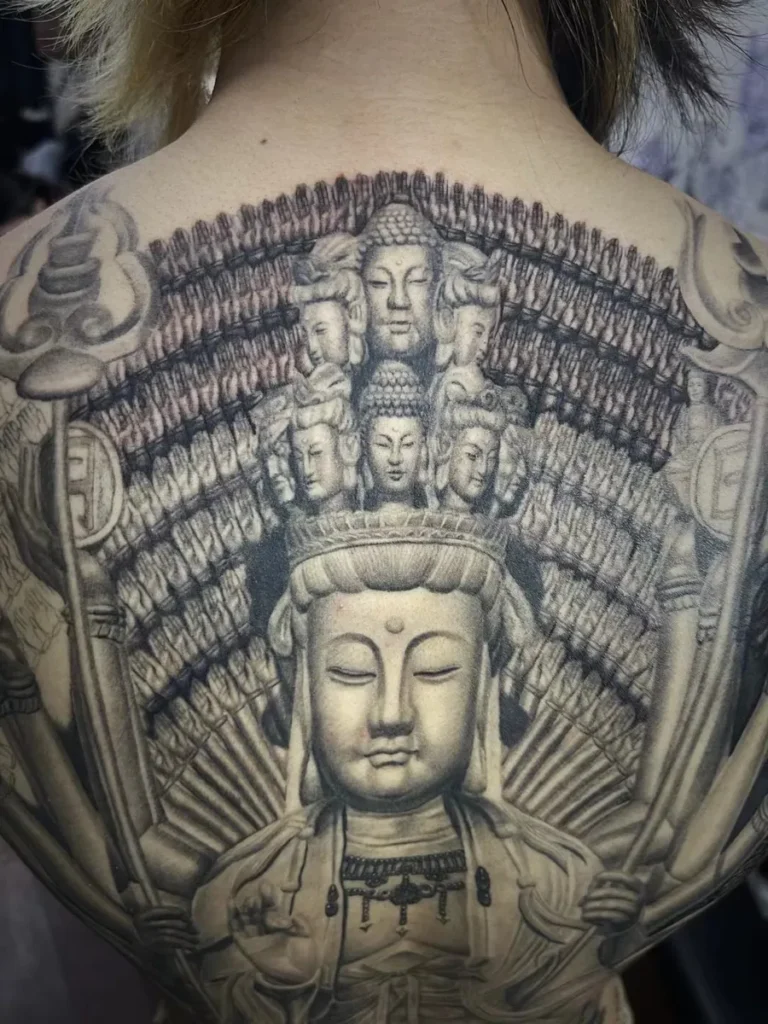
A Guanyin tattoo design should be planned from a specific Buddhist reference, not from a generic image of a peaceful goddess. Guanyin is the Chinese form of Avalokiteshvara, the bodhisattva of compassion, and the figure has appeared in many visual forms across East Asian Buddhist art. The design question is therefore not only “what does Guanyin mean?” but “which form, gesture and level of detail can be carried respectfully on this part of the body?”
For tattoo planning, the safest starting point is scale. A single standing or seated Guanyin can work as a large upper-arm, thigh, chest or back design. A thousand arm Guanyin tattoo usually needs the back or another large field because the face, hands, halo and repeated arms need room to breathe. Small versions often lose the very gestures that make the reference recognisable.
Guanyin meaning in context
The Metropolitan Museum of Art describes Guanyin as the Chinese translation of Avalokiteshvara, the bodhisattva of compassion. The same source notes that Avalokiteshvara could be male, gender-neutral or appear in many forms, while Guanyin became increasingly established as a female figure in imperial China. That history is important because a tattoo should not reduce Guanyin to one fixed gendered stereotype or one internet phrase.
In devotional and artistic contexts, Guanyin is associated with compassion, mercy and the ability to respond to suffering. Some sources describe the bodhisattva as one who hears the cries of the world. In tattoo design, however, the meaning should be handled with care. A client may connect Guanyin with family, protection, calm, gratitude or Buddhist devotion, but those personal readings should not be presented as the only religious meaning.
A respectful Guanyin tattoo begins with three questions:
- Which form of Guanyin are you referencing?
- Which details must remain accurate for that form?
- Where on the body can the image stay legible and dignified as it moves with skin?
Choose a reference before choosing a style
“Guanyin tattoo” can refer to very different images. A seated Water-Moon Guanyin has a different mood from a standing white-robed figure. A thousand-armed and thousand-eyed Avalokiteshvara has a different design problem from a single bust portrait. A black-and-grey realism approach has different priorities from a flat decorative outline.
The reference should come before the tattoo style. Bring a museum image, temple image, scripture-based iconography reference or other reliable source. Avoid sending a heavily edited social-media image with no origin, because it may already be a mix of unrelated Buddhist, fantasy and commercial elements.
If the tattoo will be black and grey, the artist still needs to know which details are essential. The face, hand gesture, lotus, halo, robes, vase, willow branch or multiple arms cannot all be treated as generic decoration. If you want a realistic face but a traditional halo, say that early.
Gesture, hands and facial expression
Guanyin tattoos succeed or fail in the face and hands. The expression should be calm without becoming blank. The eyes need softness, but also enough structure to hold up after healing. The mouth should be restrained; an exaggerated smile can make the design feel sentimental rather than devotional.
Hands matter even more. In Buddhist imagery, gestures and attributes are not random. A hand may hold a lotus, a vase, a willow branch, beads or another object depending on the form. In a thousand-armed design, the Smithsonian National Museum of Asian Art describes the fullest form as having many arms and hands, with an eye in each palm perceiving suffering. The Asian Art Museum’s seated thousand-armed Guanyin object also notes eleven faces and many arms as signs of vast power and perception.
For tattooing, this means the hands cannot be drawn as tiny repeated marks. If they are too small, they heal as noise. A large back piece allows the central face and hands to stay clear while the outer arms become rhythmic structure. A smaller design should choose fewer hands and better clarity.
Planning a thousand arm Guanyin tattoo
A thousand arm Guanyin tattoo is a full composition, not a portrait with decoration behind it. The central figure needs a stable vertical axis. The main face, crown or halo usually anchors the upper section. The primary hands or arms create the first layer. Secondary arms then radiate outward as a repeated frame.
The back is the most natural placement because the spine gives a central line and the shoulder blades allow the outer arms to spread. The design still has to work with anatomy. If the arms are placed too evenly, the tattoo may look like a fan pasted onto skin. If every hand is rendered with equal detail, the eye has nowhere to rest. A good plan separates primary hands from supporting rhythm.
Large Guanyin projects also need patience in the brief. Yuyi Tattoo’s portfolio includes large-scale back pieces and Asian-inspired compositions, but a fixed session count or completion time cannot be set before the design, placement and schedule are assessed. Use the large-scale tattoo planning page to frame the first conversation around scope rather than guesses.
Placement and respect
A religious tattoo raises practical and personal questions. Some clients want the image placed where it can be seen and honoured; others want a private devotional piece. Some avoid areas that they feel would be disrespectful. Those choices depend on personal belief, community context and how the image will be lived with.
From a design perspective, the safest placements are those that keep the face and hands intact:
| Placement | Suitable for | Design note |
|---|---|---|
| Full back | Thousand-arm Guanyin, seated Guanyin, large halo composition | Best room for symmetry, repeated hands and robes |
| Upper arm or shoulder | Single bust, half figure, lotus and halo | Keep the face on a flatter outer plane |
| Thigh | Larger seated or standing figure | Allows robe flow and lotus base without crowding |
| Chest | Frontal devotional image | Must work carefully around sternum and collarbone |
| Forearm | Smaller single figure or hand/lotus detail | Avoid overloading with tiny facial detail |
If you are unsure whether a placement is appropriate, raise that concern directly. It is better to adjust the design before drawing than to compromise a sacred image later.
Black-and-grey design choices
Guanyin tattoos often work well in black and grey because the style can hold robes, soft light and sculptural volume. But black and grey is not automatically solemn. It needs a hierarchy of values: deepest darks in the hair, crown, robe folds and shadow; middle tones for skin and cloth; open skin or soft grey for light around the face.
A large Guanyin piece can easily become too grey if every fold and ornament receives the same attention. The face should remain the point of stillness. The hands and halo should frame it. Robes and clouds should support the figure rather than compete for first place. If you are considering this direction, compare relevant black-and-grey tattoo work and look for smooth value transitions, not just dark shading.
Buddhist reference and Chinese characters
If the design includes Chinese characters, a sutra title, mantra reference or name, accuracy matters. Do not rely on machine translation or a decorative font. Decide whether the text should be traditional Chinese, simplified Chinese, Sanskrit transliteration, Siddham-style seed syllables or no text at all. Each choice changes the cultural and visual register.
For many Guanyin tattoos, no text is cleaner. The face, gesture and lotus already say enough. If text is used, it should be placed as part of the composition, not squeezed beside the figure like a caption. A vertical line of characters may balance a robe or frame the side of a back piece; a random short phrase may weaken the design.
What to send to Yuyi Tattoo
For a Guanyin brief, send:
- the exact reference image or source link;
- whether you want Guanyin, Avalokiteshvara, thousand-arm Guanyin or another specific form;
- the body area and approximate size;
- black-and-grey or colour preference;
- any required hand gesture, lotus, halo, vase, willow branch or text;
- any placement concerns related to respect or religious meaning.
Browse the Yuyi Tattoo portfolio before writing your brief. You can also read about Yuyi as a Singapore tattoo artist to understand his visual focus before asking for a large religious composition.
Discuss the reference and placement with Yuyi
If you are planning a Guanyin tattoo, start with the reference, placement and scale. Send those details with any religious or personal boundaries you want respected, then discuss whether the design should be a single figure, a black-and-grey portrait composition, or a larger back piece.
Sources and review date
Reviewed 24 August 2026.
- The Metropolitan Museum of Art — Compassion, Mercy, and Love: Guanyin and the Virgin Mary
- Smithsonian National Museum of Asian Art — Thousand-armed, thousand-eyed bodhisattva Avalokiteshvara
- Asian Art Museum — Seated thousand-armed bodhisattva Avalokiteshvara (Guanyin)
- Honolulu Museum of Art — HoMA Selects: Guanyin
Frequently asked questions
What does a Guanyin tattoo mean?
A Guanyin tattoo often refers to compassion, mercy and attentive care, because Guanyin is the Chinese form of Avalokiteshvara, the bodhisattva of compassion. The exact meaning still depends on the chosen form, the wearer’s beliefs and the way the image is placed and drawn.
Is a thousand arm Guanyin tattoo possible on an arm?
A full thousand-arm composition is usually better suited to the back or another large placement. An arm can carry a simplified Guanyin figure or a partial radiating-hand idea, but too many small hands will lose clarity as a tattoo.
Should a Guanyin tattoo be black and grey or colour?
Both can work. Black and grey is strong for sculptural robes, soft light and calm expression. Colour can support lotus, halo and decorative details. The right choice depends on the reference, skin tone, scale and how much detail the design must hold.
What references should I bring?
Bring museum, temple, cultural institution or clearly attributed Buddhist art references. Avoid using another tattoo as the main authority. If a modern artwork is part of your visual taste, pair it with a reliable cultural source so the iconography can be checked.
Can I include Chinese characters with Guanyin?
Yes, but only after confirming the exact wording, script and placement. Text should support the composition. It should not be added as an afterthought or translated automatically without review.
For help planning your own tattoo, contact Yuyi Tattoo.

