
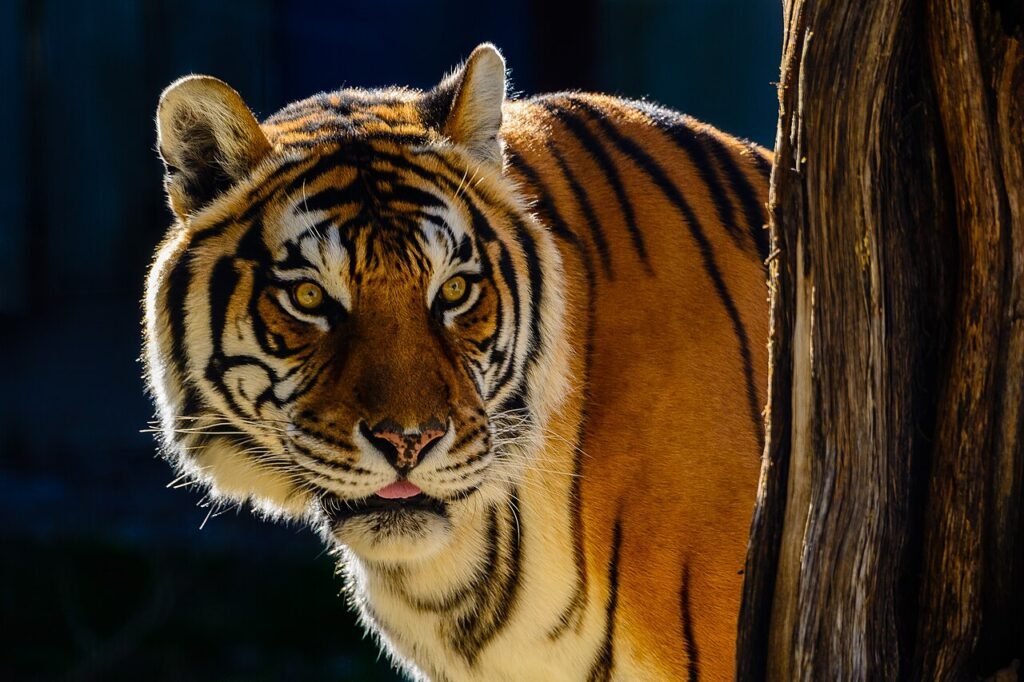
A Japanese tiger tattoo design should begin with the animal’s structure: head, shoulders, spine, paws, tail and the line of action through the body. Tiger tattoo meaning is often linked with strength, courage and protective force, but the design becomes convincing through posture and movement, not by following fixed direction or colour rules.
In Japanese art, tigers often appear with bamboo, wind, rocks, waves or dragons. Those pairings give the animal setting and rhythm. For a tattoo, the question is practical: where does the tiger look, how does the back curve, what happens at the elbow or knee, and which background keeps the figure readable from a distance?
Japanese tiger context without forcing folklore
Tigers are not native to Japan, yet tiger images became important in Japanese painting through East Asian cultural exchange. The Minneapolis Institute of Art notes that Japanese painters often relied on Chinese paintings as a major source for the animal because no tigers lived in Japan. The Metropolitan Museum of Art also describes tiger and dragon paintings as part of a broader East Asian exchange, with Japanese tiger paintings frequently setting the animal in bamboo forests.
This history matters for tattoo design because a Japanese tiger is often a stylised creature, not a zoological study. The paws may be large, the expression dramatic, the fur patterned for rhythm, and the body arranged for movement. A naturalistic tiger can be beautiful, but it is a different brief from a Japanese tiger sleeve.
A careful brief should separate:
- the cultural image of the tiger in Japanese and East Asian art;
- the visual anatomy that makes the tiger believable;
- the wearer’s personal reading of strength, protection or resilience.
That avoids turning a rich image into a narrow symbol chart.
Start with the line of action
Every tiger tattoo needs a line of action. Imagine a single curve running from the nose, through the shoulder, down the back and into the tail. If that curve is strong, the tiger feels alive before any stripes are added. If it is weak, even perfect fur texture will not save the design.
A crouching tiger compresses energy. It works well on the upper arm, shoulder, thigh or back because those areas can hold a coiled body and heavy paws. A leaping tiger opens the body into a diagonal and suits a larger sleeve, rib or back placement. A walking tiger gives a horizontal rhythm, useful for thigh and side-body layouts. A face-only tiger can be powerful, but it should still include mane-like fur, whisker movement or background to avoid looking like a flat emblem.
When clients ask whether the tiger should face up, down, inward or outward, the first answer should be anatomical. On an arm, the head may need to face toward the hand for movement, or toward the shoulder for a more protective feeling. On a leg, the head may work better across the thigh than straight down the shin. Direction is a design decision before it is a meaning decision.
Tiger and bamboo tattoo design
A tiger and bamboo tattoo is one of the most natural pairings because the two forms contrast well. The tiger is heavy, curved and muscular. Bamboo is vertical, segmented and flexible. In Japanese painting, bamboo often gives the tiger a forest setting and suggests wind moving through the scene.
For tattooing, bamboo can do several useful things:
- It creates long verticals that balance the tiger’s curved body.
- It gives a narrow sleeve or calf a background without filling every space with smoke.
- It can frame the face and shoulders while leaving open skin for readability.
- It suggests movement through leaves and stalks rather than through extra symbols.
Bamboo should not become a fence. If every stalk is parallel and evenly spaced, the tattoo can look static. Better bamboo bends, overlaps and disappears behind the tiger. Leaves can point toward the face, paws or direction of travel. The tiger should feel as if it moves through bamboo, not sits in front of wallpaper.
Tiger and dragon pairings
Tiger and dragon pairings are common across East Asian art. The Met discusses the larger exchange of tiger and dragon painting traditions. In tattoo terms, the pairing often creates a contrast between land and sky, body and atmosphere, grounded force and rising movement.
This does not mean every tiger must be paired with a dragon. A tiger and dragon sleeve or back piece needs enough room for both subjects to remain readable. If both heads fight for the same focal area, the composition becomes noisy. If the dragon coils too close to the tiger’s stripes, the forms merge. A good paired design chooses one dominant figure and one counterforce, then uses cloud, wind or wave background to connect them.
If you are considering this kind of Japanese or Asian-inspired composition, start with the Japanese and Asian-inspired tattoo page and decide whether the tiger is the main subject or part of a larger system.
Background: wind, cloud, wave or rock
A tiger needs ground or atmosphere. Bamboo gives vertical motion. Wind bars give speed and connect empty areas. Clouds can make the design feel more mythic, especially if the tiger is paired with a dragon. Rocks create weight and help the paws feel planted. Waves can work in some Japanese compositions, but they must make sense with the tiger’s body. If the tiger is meant to feel grounded, too much water may weaken the image.
The background should answer three questions:
- Where is the tiger moving?
- What is the strongest dark shape behind it?
- Which open areas keep the head, shoulder and paws readable?
A sleeve with a tiger, bamboo, peonies and waves may sound rich, but it can become crowded. Choose the elements that support movement. Leave out the rest.
Placement for a Japanese tiger sleeve or large piece
| Placement | Strong design options | Caution |
|---|---|---|
| Upper arm and shoulder | Crouching tiger head, shoulder and forepaw, bamboo or wind around the deltoid | Do not flatten the face across the bicep without considering side view |
| Full sleeve | Tiger wrapping from shoulder to forearm with bamboo, wind or cloud background | Plan the elbow as a transition, not a hole in the design |
| Thigh | Large walking or crouching tiger, strong paw and tail movement | Keep the head visible when standing naturally |
| Calf | Vertical tiger with bamboo or wind | Avoid making the body too narrow and stiff |
| Back | Tiger and dragon, full-body tiger, landscape setting | Needs clear hierarchy and enough negative space |
A Japanese tiger sleeve should not be planned as separate stickers: face, paw, flower, bamboo. The sleeve needs a path. The viewer should know where to look first and where the eye travels next. Large projects benefit from early layout planning, so review the large-scale tattoo guide before treating the tiger as a small isolated image.
Stripes, fur and readability
Tiger stripes are not decoration. They describe form. Stripes should wrap around the shoulder, ribcage and leg, changing direction as the body turns. If the stripes all run the same way, the tiger becomes flat. If there are too many thin stripes, the body becomes busy and loses its large shape.
The face needs special care. Eyes, nose, mouth and whisker pads form the emotional centre. The darkest darks often sit around the eyes, nose and mouth. The body can carry softer shading. The paws and claws need enough contrast to show weight. The tail should guide the eye rather than trail off as an afterthought.
From a distance, the viewer should see tiger first, then posture, then background, then smaller details. If the viewer sees only stripes and leaves, the hierarchy has failed.
Colour or black and grey?
Colour can bring warmth to the tiger and separate the bamboo, flowers or background. Black and grey can make the tiger more graphic and serious. Neither choice is a cultural requirement. The design should be chosen according to skin tone, reference, scale and the amount of contrast needed.
For a colour tiger, restraint matters. Too much orange, green, red and blue can make every part equally loud. For black and grey, the risk is the opposite: tiger, bamboo and background can collapse into one grey mass. Ask how the design will separate the animal from the setting after healing.
What to send before consultation
A useful tiger brief includes:
- whether you want a Japanese tiger, realistic tiger or hybrid approach;
- one to three reference images, preferably with clear posture;
- the placement and approximate size;
- whether bamboo, dragon, peony, wind, cloud or wave background is essential;
- colour or black-and-grey preference;
- whether the tiger should feel crouching, leaping, walking or frontal.
Browse Yuyi Tattoo works to compare composition and scale before sending your brief. Then use the contact page with enough detail for a focused reply.
Sources and review date
Reviewed 24 August 2026.
- The Metropolitan Museum of Art — East Asian Cultural Exchange in Tiger and Dragon Paintings
- British Museum — Seated tiger by Maruyama Ōkyo
- Minneapolis Institute of Art — Japanese Tiger and Dragon
- Museum of Fine Arts, Boston — Tattoos in Japanese Prints
Frequently asked questions
What does a tiger tattoo mean?
A tiger tattoo often suggests strength, courage, protection or controlled aggression. In Japanese and East Asian art, the meaning also depends on setting and pairing. Bamboo, dragon, rock, wind or cloud can change the reading.
Does a Japanese tiger tattoo need bamboo?
No. Bamboo is a strong pairing because it gives vertical rhythm and a traditional visual setting, but a tiger can also work with wind, cloud, rock, peony or a simpler background. The choice should support the body flow.
Which direction should the tiger face?
There is no universal rule. Direction should follow the body area, the tiger’s posture and the intended movement. A tiger that looks powerful on a flat image may feel awkward if forced against the curve of an arm or thigh.
Can a tiger and dragon fit in one sleeve?
Sometimes, but it depends on scale. Both figures need enough space to remain readable. A full sleeve, back or chest-and-arm project usually works better than a small narrow placement for a tiger and dragon pairing.
Is black and grey suitable for a Japanese tiger tattoo?
Yes. Black and grey can work well if the stripes, face, paws and background have clear value separation. The design should still preserve the tiger’s large silhouette rather than relying only on small fur detail.


