
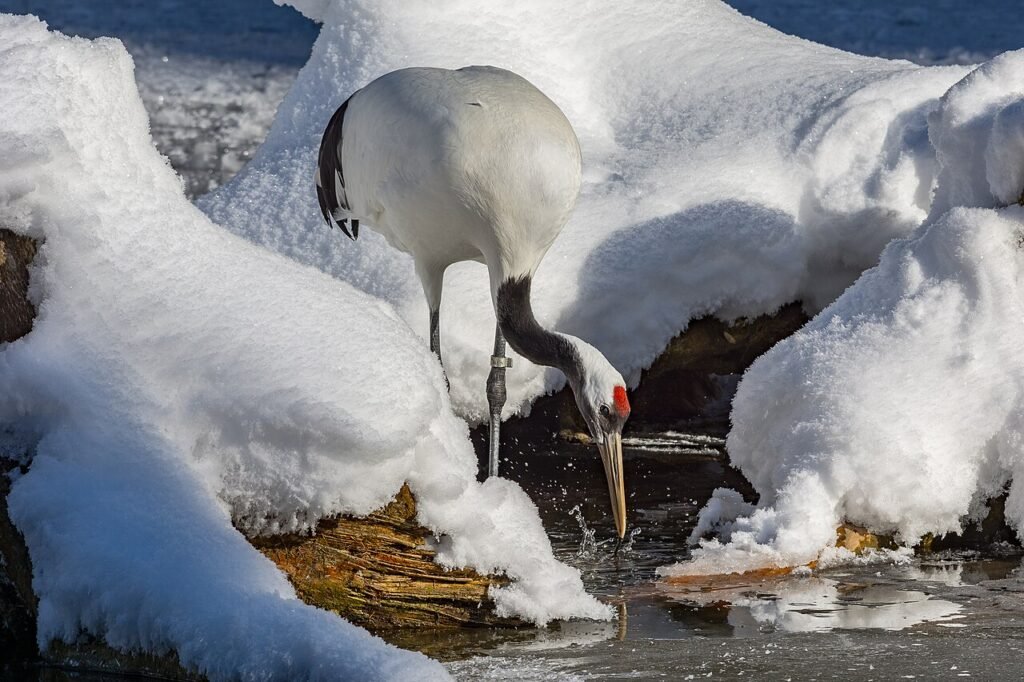
Crane tattoo meaning is often connected with longevity, good fortune, harmony and refined beauty in East Asian and Japanese art, especially when the crane appears with pine, sun, tortoise or other auspicious imagery. That is a useful starting point, not a complete design brief. A tattoo becomes meaningful through the crane’s posture, the landscape around it and the way the long neck, wings and legs fit the body.
For tattoo planning, a Japanese crane tattoo should be treated as a composition problem. A standing crane feels quiet and vertical. A flying crane creates a long diagonal. A pair of cranes changes the reading toward relationship or balance. A crane and pine tattoo can feel ceremonial and enduring, while a crane with water, cloud or moonlight may feel more spacious and lyrical.
Cultural context without turning it into a symbol dictionary
Museum collections repeatedly connect cranes with auspicious themes. The Smithsonian National Museum of Asian Art’s “Crane and pine” object notes crane and pine among immediately recognisable symbols of longevity. The Museum of Fine Arts, Boston has a print titled “Objects Suggesting Longevity” that groups pine trees, crane and turtle. The Met’s “Pines and Cranes of Longevity” makes the same association clear in its title.
Those sources support the broad context, but they do not mean every crane tattoo must mean exactly the same thing. In Japanese and East Asian art, meaning often comes through pairing, season, occasion and composition. A crane on a pine branch reads differently from a crane flying through open sky. A single crane with a moon feels different from a pair standing beside an ancient pine.
For a tattoo, ask which layer matters most:
- auspicious meaning such as longevity or good fortune;
- visual elegance through wings, neck and negative space;
- a personal association with calm, travel, family or memory;
- a Japanese-inspired composition that fits a sleeve or back piece.
Posture is the first design decision
A crane has a very different silhouette from a dragon, koi, tiger or guardian lion. It is narrow, long and often quiet. That makes posture the most important decision.
Standing crane
A standing crane suits the forearm, calf, thigh or side body. The neck creates a vertical line, the beak gives direction, and the legs can extend into grass, water or shadow. This is the clearest option for a calm crane tattoo. It needs restraint. If the background is too dense, the elegance disappears.
Flying crane
A flying crane is all wing and direction. It works well across the upper arm, shoulder blade, ribs, thigh or back. The wings can follow the shoulder or wrap slightly around the arm. The danger is making the wings too symmetrical and flat. A strong flying crane usually has one wing lifted, one wing receding or a slight turn through the body.
Paired cranes
A pair of cranes can suggest harmony or companionship, especially in contexts where cranes are linked with long life and good fortune. The design still needs hierarchy. If both birds are identical and mirrored, the tattoo may look decorative but lifeless. Give one crane the leading gesture and the other a supporting posture.
Crane head or detail
A crane head, feather study or small standing crane can work, but it should not be asked to carry the same complexity as a full landscape. Small crane tattoos need clean shapes and limited detail.
Crane and pine tattoo composition
A crane and pine tattoo is a strong pairing because both forms are visually useful. The crane is slender and light. The pine is rooted, dark and irregular. Together they create vertical strength and open space.
The pine should not become a generic tree. In Japanese and East Asian painting, old pines often twist, lean and show age through gnarled branches. That roughness gives the crane a place to rest. If the crane is standing under the pine, the branch can frame the upper body. If the crane is flying past it, the pine can anchor the lower or side portion of the tattoo.
A crane and pine design works best when the pine carries some dark weight. The crane can remain lighter, with careful black accents in the eye, beak, wing tips and legs. If both crane and pine receive the same tone and detail, the composition becomes grey and flat.
Landscape: sun, moon, water, cloud and open skin
Crane tattoos often need less background than clients expect. The bird’s long white body, wings and legs already create enough information. Too much cloud, flower, wave and sun can overwhelm the subject.
A rising sun can make the design feel ceremonial or graphic. A moon can soften the mood and make the crane feel quiet. Water gives the legs a natural base and can connect the bird to a sleeve. Clouds create air and movement, but they should be broad and restrained. Open skin is especially important: it can stand in for mist, sky or light without adding ink.
In a Japanese crane tattoo, negative space is not empty. It is the air the bird needs to breathe. If every gap is filled, the crane loses its grace.
Sleeve composition and body flow
A crane sleeve has a different rhythm from a tiger or dragon sleeve. It should not be built from aggressive spirals. The main line is usually vertical or diagonal: beak to neck, neck to back, back to wing, wing to feathers.
On an upper arm, a flying crane can place the body near the deltoid and let one wing move toward the chest or back. On a forearm, a standing crane can use the wrist-to-elbow line naturally. On a full sleeve, a crane can pair with pine, water and light cloud, but the elbow needs careful planning. A wing placed directly across the elbow can distort; a cloud or branch may work better as the transition.
For larger projects, the large-scale tattoo planning page is helpful because crane designs rely on placement and empty space as much as detail. If the piece is part of a broader Japanese or Asian-inspired direction, compare related composition principles on the Japanese and Asian-inspired tattoo page.
Colour or black and grey?
Crane tattoos can be elegant in black and grey because the bird’s body is naturally light. The challenge is to keep enough contrast in the beak, crown, legs, wing tips and background. A red crown can be a small colour accent if the design supports it, but it is not required.
Colour may help with pine, sun, water or seasonal elements. Use it sparingly. A crane surrounded by too many bright colours can lose its quiet presence. If the tattoo is mainly black and grey, the artist must protect light skin areas so the crane remains white and readable after healing.
Placement options
| Placement | Works well for | Design caution |
|---|---|---|
| Forearm | Standing crane, long neck, water or reed base | Keep small feathers simple |
| Upper arm | Flying crane, wing wrap, moon or cloud | Avoid flattening both wings across the arm |
| Thigh | Crane and pine, larger standing or flying crane | Keep the body readable when walking |
| Calf | Vertical standing crane with pine or water | Do not overfill the narrow space |
| Back | Pair of cranes, crane and pine landscape, large sky composition | Needs strong asymmetry and open skin |
Before asking for a quote, browse Yuyi Tattoo works and decide whether your crane should be a quiet standalone image or part of a larger composition.
What to send before consultation
A useful crane brief includes:
- standing, flying, paired or crane-and-pine direction;
- any cultural layer you want retained, such as longevity or good fortune;
- the body area and approximate size;
- whether the design should be Japanese-inspired, black-and-grey, colour or minimal;
- references from museum collections, paintings or natural crane photos;
- any background elements you want included or avoided.
Use the contact page with a focused brief. A crane design benefits from clarity. If every auspicious element is added at once, the tattoo can lose the quiet strength that made the crane appealing in the first place.
Sources and review date
Reviewed 24 August 2026.
- Smithsonian National Museum of Asian Art — Crane and pine
- The Metropolitan Museum of Art — Pines and Cranes of Longevity
- Museum of Fine Arts, Boston — Objects Suggesting Longevity
- British Museum — Cranes and pine tree; crane and plum-blossom
- Seattle Art Museum — Old Pine
Frequently asked questions
What does a crane tattoo mean?
A crane tattoo often refers to longevity, good fortune, harmony or grace in East Asian and Japanese art contexts. The exact reading depends on posture, pairing and personal reason. A crane with pine feels different from a crane flying alone.
What does a crane and pine tattoo mean?
Crane and pine are often associated with longevity and auspicious wishes. In design terms, the crane gives lightness and line, while the pine gives rooted weight and dark structure. The pairing works because it is visually balanced as well as culturally recognisable.
Is a crane tattoo suitable for a sleeve?
Yes, but it needs careful planning. A crane sleeve should use long lines, open skin and restrained background. The elbow and wrist transitions matter because the bird’s wings and legs can distort if placed without considering movement.
Should a crane tattoo be in colour?
It can be colour or black and grey. Colour can support a red crown, pine, sun or water. Black and grey can be elegant if the artist preserves enough light space for the crane’s body and wings.
Can I combine a crane with other Japanese motifs?
Yes, but choose carefully. Pine, water, cloud, moon, sun and restrained flowers can work. Too many symbols will make the design feel like a list rather than a composition.


