
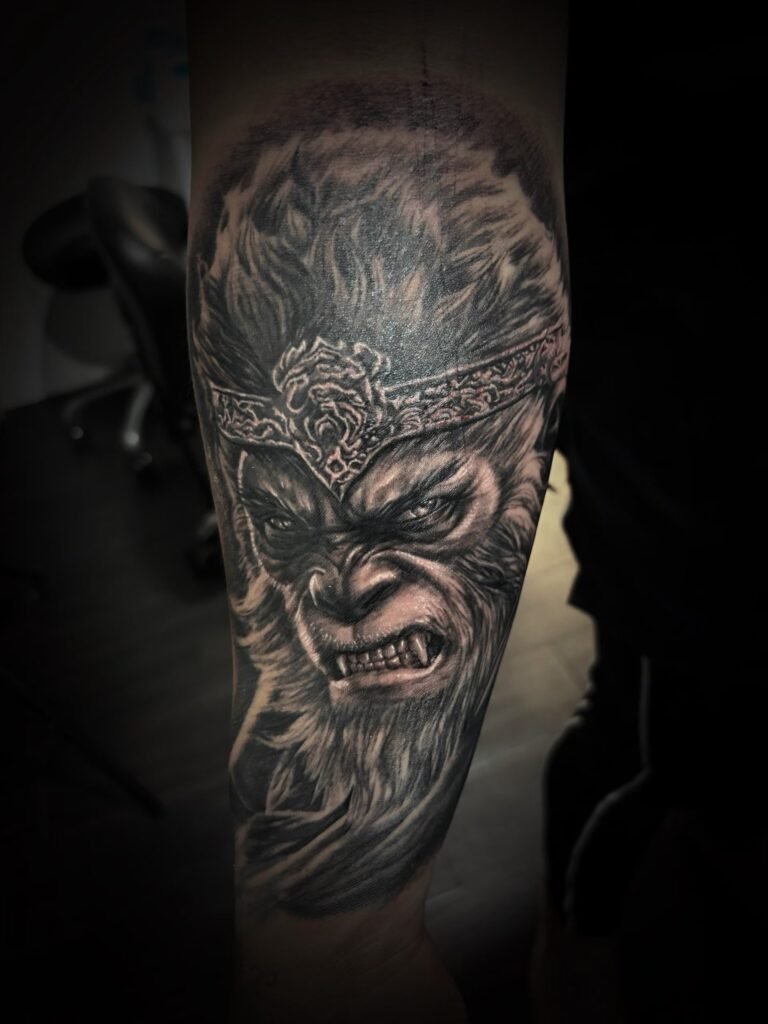
A monkey king tattoo design should be built around motion. Sun Wukong is not a still emblem: in Journey to the West he is a rebellious, quick-witted, supernatural figure whose staff, cloud movement, crouching posture and alert expression do much of the visual work. The meaning of a Monkey King tattoo can include courage, mischief, discipline, transformation and protection, but the design needs a clear literary reference before it becomes a tattoo.
For tattoo planning, the staff, clouds and pose matter first. A small face-only Monkey King can work, but a larger design can show the character twisting, leaping, gripping the staff or looking through smoke and cloud. If Chinese characters are added, they should be checked for wording and placed as part of the composition, not used as decoration after the figure is finished.
Literary reference: Sun Wukong in Journey to the West
The Chinese novel Journey to the West, commonly attributed to Wu Cheng’en and published in the Ming period, is the main literary source behind Sun Wukong’s modern image. The Chinese Text Project hosts the Chinese text, and Princeton’s Cotsen Children’s Library describes Monkey as a rebel-turned disciple and escort of the fictionalised Xuanzang on the pilgrimage. The British Museum identifies Sun Wukong as the immortal monkey who accompanied Tripitaka, another common name for Xuanzang in the story tradition.
For tattoo design, this means Sun Wukong should not be treated as a random “warrior monkey.” He belongs to a specific literary world: pilgrimage, Buddhist and Daoist themes, celestial conflict, discipline, transformation and comic force. You do not need to include the whole story, but you should know which version of the character you want: rebellious Great Sage, disciplined protector, battle-ready pilgrim, or a contemporary interpretation based on the classic.
The Met’s Edo-period print of Songokū, the Japanese name for Sun Wukong, is also useful because it shows how the Chinese novel travelled visually into Japanese print culture. A tattoo can reference Chinese or Japanese visual traditions, but the source should be stated clearly.
Staff as the main composition line
Sun Wukong’s staff is one of the strongest tools in a tattoo composition. It can be a diagonal slash, a vertical anchor, a circular motion cue or a barrier between foreground and background. If the staff is planned well, the whole design feels active before clouds or flames are added.
A vertical staff can suit a forearm, calf or side body. It gives the figure a stable axis. A diagonal staff works well across the upper arm, thigh, chest or back, especially if Wukong is leaping or twisting. A horizontal staff can be dramatic across the back or chest, but it may fight the natural body lines if forced onto a narrow limb.
The staff should not simply be placed behind the character. It should explain the pose. If Wukong is crouching, the staff can brace the body. If he is leaping, it can point the direction of travel. If he is facing forward, it can frame the figure or create a protective gate-like line.
Clouds and speed
Clouds in a Monkey King tattoo are not just filler. They can suggest supernatural travel, sudden movement and the character’s ability to appear almost mid-action. The cloud shapes should follow the body rather than swirl randomly.
For a sleeve, clouds can move from shoulder to forearm, carrying the staff and figure around the arm. For a back piece, clouds can create large open fields behind the character, allowing the staff and limbs to stay readable. For a thigh, clouds can wrap around the outer leg and give the figure room to leap.
Do not make every cloud equally detailed. Large clouds and open skin give speed. Tiny smoke curls everywhere create noise. The strongest Monkey King tattoos usually use background to amplify the pose, not to prove how many details can fit.
Pose: crouch, leap, twist or portrait
Sun Wukong has a body language problem that many tattoo ideas ignore. He should look agile. A rigid standing pose can work if it is ceremonial, but it will not carry the same energy as a crouch, leap or twist.
Crouching pose
A crouching Monkey King feels coiled and alert. It suits upper arm, thigh and calf placements. The knees, elbows and staff can form a compact triangle. This is a good option when the available space is not large enough for a full flying pose.
Leaping pose
A leaping pose suits the back, ribs, thigh or full sleeve. The limbs can extend, the staff can cut through the composition, and clouds can trail behind. The risk is overextension: if the arms and legs are too spread out, the figure loses facial clarity.
Twisting pose
A twisting pose works well on the shoulder and upper arm because the body naturally turns around the deltoid. The staff can wrap partly around the arm. This is a strong choice for clients who want a dynamic piece but not a full back.
Portrait or bust
A portrait-style Sun Wukong can focus on the face, crown, headband, armour and expression. It needs strong eyes and mouth control. A flat angry face can look generic; a better expression shows intelligence, mischief and focus.
Armour, crown and facial expression
Sun Wukong designs often include a headband, crown, armour plates, belt, boots or flowing cloth. These details help identify the character, but they can also crowd the tattoo. Choose the elements that serve the pose.
The face should carry personality. Wukong is not only fierce. He can be cunning, playful, defiant or intensely focused. The brow, eyes and mouth should match the story version you want. If the design is too monstrous, it may drift away from Sun Wukong into a generic demon monkey. If it is too cute, it may lose the force that makes the Monkey King compelling.
For a tattoo, the eyes and mouth need clear contrast. Hair and fur should frame the face, not cover it. Armour should support the torso and movement rather than become a catalogue of tiny plates.
Chinese character tattoo composition
If you include Chinese characters with a Monkey King tattoo, decide what they are doing. Are they naming the character, 孙悟空 or 孫悟空? Are they using the title 齊天大聖 or 齐天大圣, “Great Sage Equal to Heaven”? Are they quoting a line from the novel? Each choice needs checking.
Traditional and simplified Chinese should not be mixed casually. A vertical inscription should align with the figure or staff. A title can be placed along the staff, beside a cloud column or in a separate seal-like block. Do not squeeze characters into leftover space. Poor placement makes the design look like a label rather than a composition.
If you are not fluent in Chinese, confirm the exact wording with someone qualified before tattooing it. The artist can then focus on calligraphic weight, spacing and how the characters balance the figure. For many designs, the strongest choice is no text at all; the staff, crown and pose can identify Sun Wukong clearly.
Placement and scale
| Placement | Strong options | Caution |
|---|---|---|
| Upper arm | Crouching or twisting Wukong, staff diagonal, cloud wrap | Keep the face on a readable plane |
| Full sleeve | Leaping figure, staff and clouds moving down the arm | Plan elbow and wrist transitions early |
| Thigh | Dynamic pose with staff and cloud base | Avoid losing the face when the leg turns |
| Back | Full dramatic Wukong, long staff, cloud field, optional text | Needs clear hierarchy so clouds do not swallow the figure |
| Calf | Vertical staff, compact crouch, smaller portrait | Avoid too many armour details |
A Monkey King idea can expand quickly. Staff, cloud, armour, flames, mountains, characters and enemies cannot all have equal priority. If the project is large, use the large-scale tattoo planning guide to settle the dominant figure, placement and supporting elements.
For a placement-specific example, compare Yuyi’s Monkey King forearm tattoo with your own scale and composition.
What to send before consultation
A useful Monkey King brief includes:
- whether you want Chinese Sun Wukong, Japanese Songokū or a contemporary version;
- the story moment or mood: rebel, protector, pilgrim, battle-ready or playful;
- the body area and approximate size;
- whether the staff must be vertical, diagonal or action-based;
- cloud, flame, mountain or text preferences;
- exact Chinese characters, if any, with preferred traditional or simplified form.
Before sending the enquiry, browse Yuyi Tattoo works and read about Yuyi as a Singapore tattoo artist. Yuyi’s work includes black-and-grey realism, large-scale back pieces and sleeves, and Japanese or Asian-inspired compositions. Use those examples to describe the visual direction you want, then send a specific brief for your own design.
Discuss a Sun Wukong composition with Yuyi
If you are planning a Sun Wukong tattoo, send the reference version, placement, scale and any Chinese characters through the contact page. A clear brief helps decide whether the design should be a compact portrait, a sleeve with staff and clouds, or a full large-scale Monkey King composition.
Sources and review date
Reviewed 24 August 2026.
- Chinese Text Project — 西遊記 / Journey to the West
- Princeton University Cotsen Children’s Library — Journey to the West tag archive
- The Metropolitan Museum of Art — The Monkey King Songokū, from Journey to the West
- British Museum — Sun Wukong 孫悟空
- Smithsonian National Museum of Asian Art — The Monkey King Sun Wukong
Frequently asked questions
What does a Monkey King tattoo mean?
A Monkey King tattoo can suggest rebellion, wit, courage, transformation, protection and disciplined power. The strongest meaning comes from which Sun Wukong you choose: rebellious Great Sage, loyal pilgrim, fierce protector or a more playful interpretation.
Is Sun Wukong Chinese or Japanese?
Sun Wukong is a Chinese literary character from Journey to the West. The character also appears in Japanese visual culture as Songokū. A tattoo can reference either visual route, but the brief should state which one you want.
Should a Monkey King tattoo include the staff?
Not always, but the staff is one of the clearest ways to identify the character and create movement. If you omit it, the face, crown, headband, armour or Chinese characters need to carry more of the identification.
Can I add Chinese characters to a Sun Wukong tattoo?
Yes, but confirm the exact wording first. Decide between simplified and traditional characters, then place the text as part of the design. Characters added into leftover space often weaken the composition.
What placement works best for a dynamic Monkey King tattoo?
Upper arm, thigh, sleeve and back are strong options. The best placement depends on the pose. A crouch needs compact space, a leap needs diagonal room, and a full staff-and-cloud scene usually needs a larger field.

