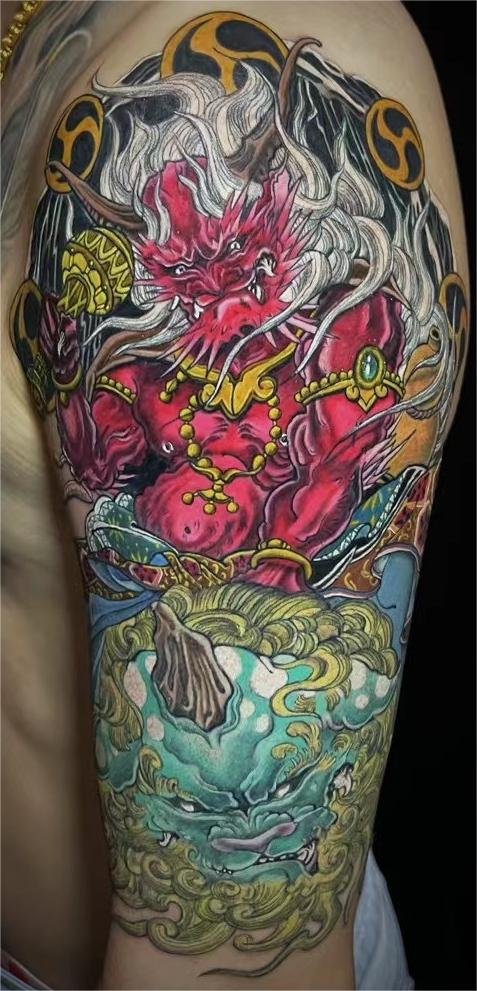
A half sleeve is usually the better starting point when you want a complete arm segment, more control over visibility, or the option to extend later without committing the whole arm now. A full sleeve is the stronger choice when you already want one continuous composition from shoulder to wrist and are ready to let the whole arm be planned as one field.
The practical difference is not only how much skin is covered. It is how the design ends. A half sleeve must either finish cleanly or leave an intentional exit for future work; a full sleeve must connect shoulder, elbow, forearm and wrist without looking like several unrelated tattoos joined in a hurry. Good half sleeve tattoo planning starts with that future question before the first line is drawn.
The real choice: finished segment or whole-arm map
Many people ask for a half sleeve because it feels safer than a full sleeve. That can be true, but only if the half sleeve is designed as a strong segment rather than a cropped full sleeve. A cropped design often has a hard lower edge, crowded filler near the elbow, and no visual route for extension. It may look finished on day one, but it gives the next project nowhere to go.
A full sleeve has the opposite problem. It gives the artist more room for movement and hierarchy, but it also requires a wider commitment. The main subject, background rhythm, empty skin and final edge all have to be considered together. If the plan is weak, every later stage inherits the weakness. If the plan is clear, the arm can read from a distance before a viewer notices small details.
This is why the question is not “which is better?” It is “which amount of arm should be treated as the design unit?” If the unit is the upper arm, build a half sleeve with a deliberate boundary. If the unit is the whole arm, use a full sleeve plan from the start.
Coverage levels in plain language
Sleeve terms are useful, but they are not rulers. Arm length, shoulder shape, elbow position, clothing lines and existing tattoos all change where a sleeve feels complete. Use the terms below as a conversation starter, not as a fixed measurement.
| Coverage choice | Common design unit | What it gives you | Main planning risk |
|---|---|---|---|
| Upper-arm half sleeve | Shoulder cap to around the elbow | A broad canvas, easier shirt coverage, strong place for one main subject | Closing the design too hard above the elbow |
| Lower-arm half sleeve | Around the elbow to wrist | High visibility and a clear forearm read | Running out of space near the wrist or inner elbow |
| Three-quarter sleeve | Shoulder to mid-forearm | More flow than a half sleeve while keeping some wrist space open | An awkward stopping point if the edge is not designed |
| Full sleeve | Shoulder to wrist | One complete arm composition with maximum continuity | Committing to a whole-arm plan before the hierarchy is clear |
If you already know you may want a full sleeve tattoo in Singapore later, tell the artist before a half sleeve is mapped. It changes where background should remain open, where the strongest subject should sit, and how much negative space should be kept near the future join.
When a half sleeve makes sense
A half sleeve works well when the idea has one strong subject and enough surrounding space to finish cleanly. A guardian figure on the upper arm, a black-and-grey portrait-like subject with smoke or fabric, or a Japanese-inspired motif with flowers and wind can all sit well as a half sleeve if the shape is controlled.
Upper-arm half sleeve
The upper arm gives more width than the forearm and usually allows a larger focal subject. It also connects naturally to the shoulder cap, which means the top edge can be rounded into the body rather than cut off like a band. This is useful when the design needs presence but does not need to be visible all the time.
The difficult part is the lower edge. If the lower border stops in a straight line above the elbow, the tattoo can feel like a sleeve cuff. That may be intentional, but it should be a choice. If future extension is possible, the lower edge should usually be broken with background, smoke, petals, water, fabric or other forms that can continue later.
Lower-arm half sleeve
The forearm is more visible and tapers toward the wrist. A lower-arm half sleeve can look sharp because people see it when the arm is relaxed, but the taper means detail must be edited harder. A design that looked spacious on a rectangle can become crowded when wrapped around the wrist and inner forearm.
For lower-arm work, the artist has to decide what appears on the outer forearm, what turns to the inner side, and what becomes supporting texture. If you want to extend upward later, the upper edge near the elbow should stay usable. Do not let the first project consume every transition point just because the immediate drawing looks full.
When a full sleeve makes sense
A full sleeve makes sense when you want the whole arm to read as one object. The subject can be Japanese and Asian-inspired, black-and-grey realism, illustrative, or a hybrid direction, but the logic is the same: one arm, one hierarchy, one controlled rhythm.
The shoulder normally carries the largest read. The elbow is treated as a turning point rather than a place for fragile detail. The forearm gives the clearest everyday view. The wrist finishes the composition and needs a clean exit so the sleeve does not look as if it simply ran out of room. Because the shoulder is one of the body’s most mobile regions, a sleeve also has to be checked with the arm relaxed, slightly lifted and turned, not only from a straight front photo.
For broad planning principles, the large-scale tattoo planning page is the better hub than any single sleeve article. It keeps the conversation on layout, body movement, references and responsible quoting rather than guessing sessions or cost too early.
Sleeve extension planning: how to avoid trapping the next stage
The strongest reason to think about half sleeve vs full sleeve tattoo planning early is extension. A half sleeve can grow beautifully, but only if the first stage leaves structure for the second. The artist needs somewhere to connect background, a reason for the eye to move past the old edge, and enough contrast left for the new area to hold its own.
Three decisions matter most.
First, decide whether the half sleeve is visually closed or open. A closed design has a finished border and is not pretending to become something else. An open design has broken edges, directional background and empty skin reserved for a future join. Neither is better, but mixing the two creates trouble.
Second, protect transition zones. The shoulder, elbow and wrist are not just spare skin. They are where the sleeve changes direction. If a future full sleeve is likely, avoid placing the densest, darkest material exactly where the next stage must connect.
Third, keep style and value consistent. A soft grey upper-arm half sleeve can be extended with black-and-grey background more easily than with a sudden saturated colour block. A bold Japanese composition can extend well when wind, waves, clouds or flowers are planned as continuing forms. The Japanese and Asian-inspired tattoo page shows why background and supporting motifs matter when a design has to move around the body.
Working with existing tattoos
Existing tattoos do not automatically prevent a sleeve, but they do set fixed points. A small piece near the shoulder may become part of the background. A dark forearm piece may force the new design to become heavier around it. A tattoo near the elbow may limit where the flow can turn. Clear photos are more useful than descriptions because the artist needs to see size, value, placement and healed edges.
If you have several existing tattoos and still want one whole-arm read, decide whether you want a unified sleeve or a connected collection. That choice changes how much old work should be absorbed, framed or left separate, and it should be stated before the new coverage is planned.
You can view Yuyi Tattoo’s portfolio to compare how large subjects, black-and-grey value and Asian-inspired forms sit on different body areas. Use the portfolio to identify the kind of scale you want, not to request a direct copy of a finished design.
What to send before deciding
Before asking for a half sleeve or a full sleeve, send enough information for the artist to see the real arm. A short brief should include:
- Four arm photos: front, back, inner side and outer side, with the arm relaxed.
- Close photos of any existing tattoos on or near the planned area.
- Whether you want upper-arm half, lower-arm half, three-quarter or full coverage.
- Whether future sleeve extension is possible, likely or not wanted.
- Two or three references for subject, mood and density.
- A note on visibility: work clothing, daily sun exposure and whether the wrist must stay open.
When you are ready, contact Yuyi Tattoo with the photos and coverage goal. Yuyi Tattoo is in Geylang, Singapore, and WhatsApp enquiries can be sent to +65 9128 0501.
Sources and review date
- NCBI Bookshelf — Anatomy, Shoulder and Upper Limb, Shoulder — reviewed 24 August 2026.
- American Academy of Dermatology — Caring for tattooed skin — reviewed 24 August 2026.
Frequently asked questions
Is a half sleeve easier to extend than a full sleeve is to start?
It can be, but only if the half sleeve was planned with an open edge. A closed half sleeve can be difficult to extend because the new work has to break through a finished border. If extension is even a possibility, mention it before the design is drawn.
Should I start with the upper arm or the forearm?
Start with the area that best suits the main subject and your visibility needs. The upper arm gives more width and is easier to cover with clothing. The forearm is more visible and tapers toward the wrist, so it needs stricter editing. Neither choice is automatically better.
Can a half sleeve look complete on its own?
Yes. A half sleeve should not look unfinished just because it may extend later. The goal is a complete segment with controlled exits, not a half-drawn full sleeve. A good design can stand alone now and still leave room for the next stage.
Does a full sleeve have to be one theme?
No, but it does need one visual logic. Different subjects can share an arm if scale, value, background and spacing are controlled. If every piece has a different density and direction, the arm can feel scattered even when each tattoo is strong by itself.
How do I avoid regretting the sleeve boundary?
Decide the stopping point before choosing small details. Look at the arm from several angles, check where clothing cuts across it, and ask whether the edge should be closed or open. Boundary planning is what protects future options.