
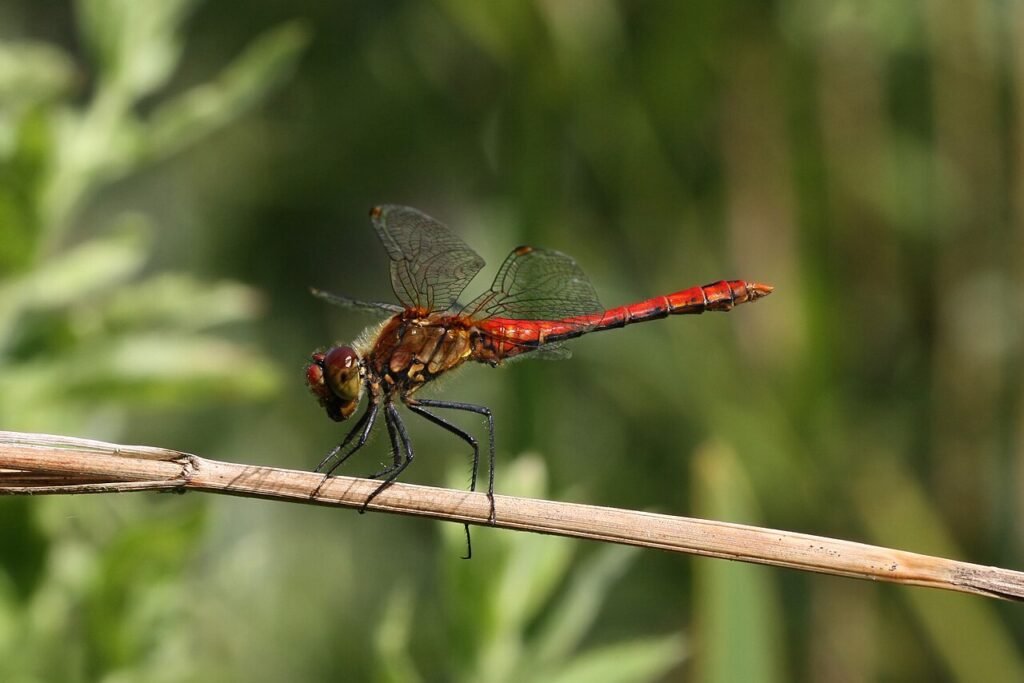
Dragonfly tattoo meaning is not universal. In a specific Japanese art context, the insect may be linked with samurai imagery or the idea of victory, while another client may choose it for movement, water, a remembered place or simply its form. Name the source of the meaning instead of presenting one association as a rule across cultures.
For the design to remain recognisably dragonfly-like, protect its long abdomen, two distinct pairs of wings and clear head-thorax-body structure. Decide whether it is hovering, turning or perched, then choose a scale and placement that give the paired wings enough separation. A tiny generic insect silhouette cannot carry every vein, plant and symbolic layer at once.
Begin with the source of the meaning
“Transformation,” “freedom,” “courage” and “resilience” appear frequently in online motif lists, but a repeated caption is not evidence of one shared tradition. Meaning can come from a museum object, a story, a seasonal association, a family memory, a scientific interest or a private event. Those sources are not interchangeable.
The Tokyo National Museum’s 2025 exhibition on insect motifs states that dragonflies are closely associated with samurai in Japanese art. A British Museum record for an eighteenth- or nineteenth-century sword guard describes dragonflies as kachimushi, translated there as “winning insect,” and connects that label to continual forward progress in the object’s cultural context. These are named institutional records tied to Japanese decorative and arms material. They do not prove that every dragonfly everywhere means victory.
Art Platform Japan records Hokusai’s nineteenth-century print Dragonfly and Bellflower in the Tokyo National Museum collection. That record is useful because it demonstrates a historical dragonfly-and-plant composition without inventing a single message for the pairing. A client can reference the print’s lightness, spacing or subject relationship while separately explaining what the motif means personally.
When you bring a cultural association, bring the source with it. “I am referring to this museum object and its samurai context” is precise. “Dragonflies always mean warriors” is not.
The anatomy creates a distinctive silhouette
The Natural History Museum describes adult dragonflies as having three main body sections: head, thorax and abdomen. It also notes that they have two pairs of wings, that most species show transparent wings with a network of veins at rest, and that the abdomen has ten segments. For tattoo planning, these facts explain why a dragonfly cannot be reduced to a butterfly body with narrow wings.
The head is compact and eye-dominant. The thorax is the structural hub from which the legs and four wings emerge. The abdomen is long and segmented, producing the straight or gently curved tail that makes the insect immediately recognisable.
Preserve those proportions before adding ornament. If the abdomen becomes too short, the form can look like a generic fly. If all four wings merge into two leaf shapes, the specific wing arrangement disappears. If the thorax is hidden under a flower or jewel, the attachment of the wings may no longer make visual sense.
Accuracy does not require an entomology plate. It requires enough structure that stylisation feels deliberate. A graphic design can simplify veins, enlarge the head or bend the abdomen while still preserving the relationships between the main parts.
Choose a top view or an angled view
A top-down dragonfly shows the four-wing plan most clearly. It can feel still, emblematic and balanced. This view suits a design where paired wings, central axis or decorative pattern matters more than dramatic perspective.
An angled dragonfly creates movement. One wing pair may appear shorter because it turns away, and the abdomen may cross the body area diagonally. This can fit a calf, forearm, shoulder blade or rib area more naturally than a strict horizontal spread. The trade-off is that the artist has to preserve enough wing separation for the insect to remain clear.
A side view emphasises the long abdomen, legs and perched posture, but it may hide the four-wing structure. Use it when the story involves a reed, stem or moment of rest. Add another reference to show the wing anatomy if the primary photo overlaps the wings.
Do not choose the viewpoint from the insect alone. Place a simple silhouette over a photograph of the intended body area. A top view may fit a broad surface, while an angled view may follow a long muscle or the diagonal between two landmarks.
Transparent-looking wings need restraint
Most dragonfly wings appear transparent at rest, with visible venation. In a tattoo, “transparent” is a visual effect rather than actual transparency. Open skin, selective light shading and a controlled vein pattern can let the wing feel lighter than the body.
Trying to copy every cell in a high-resolution macro photograph can make the wings busier than the insect. Choose which structural veins describe the fan and where smaller divisions can disappear. Keep the body and leading wing edges strong enough to establish the form before fine interior marks are added.
Background affects the illusion. A wing crossing a dark water shape may need a different boundary from a wing over open skin. If a flower, moon or geometric field sits behind the insect, decide whether the wing visually interrupts that field or appears to float across it. Too many equal lines in both wing and background can remove the separation.
Scale should follow the information you want to keep. The tattoo size guide explains why centimetres alone do not determine readable detail. For a dragonfly, count the essential information: four wings, their main veins, the head, thorax, segmented abdomen and any plant or water pairing. Reduce the information before forcing it into a fixed small box.
Symmetry can be accurate without looking mechanical
A resting top-view dragonfly naturally suggests bilateral balance. That does not require a perfectly mirrored tattoo. Wing angle, small damage, light direction, plant overlap or a turn in the abdomen can introduce controlled difference.
Exact symmetry creates an emblem or jewel-like effect. It suits a centred placement and decorative intention. Slight asymmetry creates life and directional movement. A raised wing, curved abdomen or off-centre perch can prevent the design from looking stamped onto the body.
The symmetrical versus asymmetrical tattoo design guide helps compare those choices across body areas. For this motif, decide what remains paired and what is allowed to vary. The two wing pairs should still read as an organised structure even when perspective makes one side shorter.
Movement begins with wing angle and body direction
The Natural History Museum notes that dragonflies can control the angle and speed of each wing independently, allowing agile flight, directional changes and hovering. A tattoo cannot animate, but it can imply one of those states.
For hovering, keep the body relatively steady and let the wing angles create vibration or lift. For forward flight, use a clear nose-to-tail route and a slight diagonal. For a turn, curve the abdomen and stagger the wings so the composition changes direction. For a perched dragonfly, place the legs convincingly on a stem and let the wings settle into a readable rest position.
Body placement can reinforce the motion. A dragonfly aimed along the forearm or calf has a clear travel route. One crossing the shoulder blade diagonally can seem to turn across the upper back. A rib placement may use a rising or descending line. There is no universal rule that the head must point upward, inward or toward the heart. Choose a direction that supports both the personal idea and the resting view of the body.
Water and plants can add context without becoming filler
Dragonfly nymphs are aquatic, and adult dragonflies are often seen near water and plants. This natural-history relationship makes reeds, ripples, pond plants or an open water line coherent design partners. The pairing can describe habitat without being assigned a spiritual meaning.
A plant can also solve composition. A vertical stem supports a side-view dragonfly. Bellflowers can create a historical art reference when Hokusai’s print is the chosen source. Reeds can extend a narrow calf or forearm layout. A broad water shape can counterbalance wings across a larger placement.
Keep one element dominant. If the insect carries the meaning, do not let a dense bouquet reduce it to an accessory. If the plant is a memorial or identity anchor, the dragonfly may be the moving secondary form. State the hierarchy before choosing detail.
Avoid combining every common association in one scene. A lotus, moon, clock, compass, quote and several dragonflies may each have a story, but together they can erase the insect’s light structure. One setting and one supporting idea are often enough.
Placement should protect the body-to-wing ratio
Long placements such as the forearm and calf can follow the abdomen while allowing wings to cross the wider part of the surface. A thigh or upper back offers more room for an open four-wing view and supporting plants. A shoulder blade can support a diagonal flight path, but the insect should be checked with the arm relaxed and raised because the surface changes with shoulder movement.
On a wrist, ankle or other compact area, the decision is usually between keeping a clean silhouette and keeping interior wing information. Reducing every line equally is rarely the best solution. Enlarge the essential shape or remove secondary veins, texture and background.
Curved placements need a primary viewing angle. If the body sits on the outer arm while a wing wraps toward the inner surface, decide which wing pair must be visible from the main view. A complete stencil check on the body is more informative than judging a flat drawing alone.
Keep it distinct from butterfly and moth planning
Butterflies usually present a broader wing mass around a shorter body, while moth references may emphasise heavy wings, antennae or a nocturnal setting. Dragonflies depend more strongly on a long abdomen, four narrow wings and a direct flight axis. Reusing a butterfly layout can make the dragonfly’s structure feel compressed.
Use the butterfly tattoo meaning and placement guide or moth tattoo meaning and placement guide when those insects are the actual subject. If you are choosing among them, compare the silhouette and movement you want before comparing symbolic lists.
Prepare a useful dragonfly brief
Send one clear species or anatomy reference, one viewpoint reference and one image for the intended visual finish. If meaning comes from a museum object, artwork or cultural source, include its title and link. Add placement photographs, an approximate size range and the direction the head should face in a relaxed posture.
State which parts matter most. For example: “Keep the long blue abdomen and four separated wings. I prefer a slight turn rather than perfect symmetry. Use reeds only as a light vertical support. The Japanese sword-guard association is my cultural reference; please do not add other samurai imagery.”
When the idea is clear, contact Yuyi Tattoo with the labelled references and placement views. Yuyi Tattoo can assess the proposed composition against the documented portfolio direction, but the first message does not confirm a design, price, appointment, artist availability or result.
Sources and review date
- Natural History Museum: Dragonflies, the Ultimate Hunters | reviewed 24 August 2026.
- Tokyo National Museum: Traditional Motifs in Japanese Art, Insects | reviewed 24 August 2026.
- British Museum: Tsuba with Two Dragonflies | reviewed 24 August 2026.
- Art Platform Japan: Dragonfly and Bellflower by Katsushika Hokusai | reviewed 24 August 2026.
Frequently asked questions
What does a dragonfly tattoo mean?
It depends on the source and the wearer. Specific Japanese museum records connect dragonflies with samurai imagery or victory in particular object contexts. Other tattoos may refer to water, movement, a species, a place or a personal memory. Name the source rather than claiming one universal meaning.
How many wings should a dragonfly tattoo show?
Adult dragonflies have two pairs, for a total of four wings. Perspective may overlap or shorten them, but the design should retain enough separation to communicate that structure. A top view shows it most clearly; an angled view trades some clarity for movement.
How can dragonfly wings look transparent in a tattoo?
Use open skin, selective shading and a simplified network of structural veins so the wings remain lighter than the body. The exact solution depends on scale, background and contrast. Copying every cell from a macro photo can make the wing too dense.
What placement suits a dragonfly tattoo?
Choose a surface that supports the long body and intended wing spread. Forearms and calves can carry a lengthwise route, while thighs and the upper back allow a broader wing plan. The shoulder blade can suit diagonal movement if the design is checked in relaxed and raised-arm views.
Can I pair a dragonfly with flowers or water?
Yes, when the pairing has a clear role. Water and reeds can describe habitat; a named flower can add a personal or documented art reference. Decide whether the insect or the supporting element leads, and avoid assigning the combination a cultural meaning without a reliable source.


