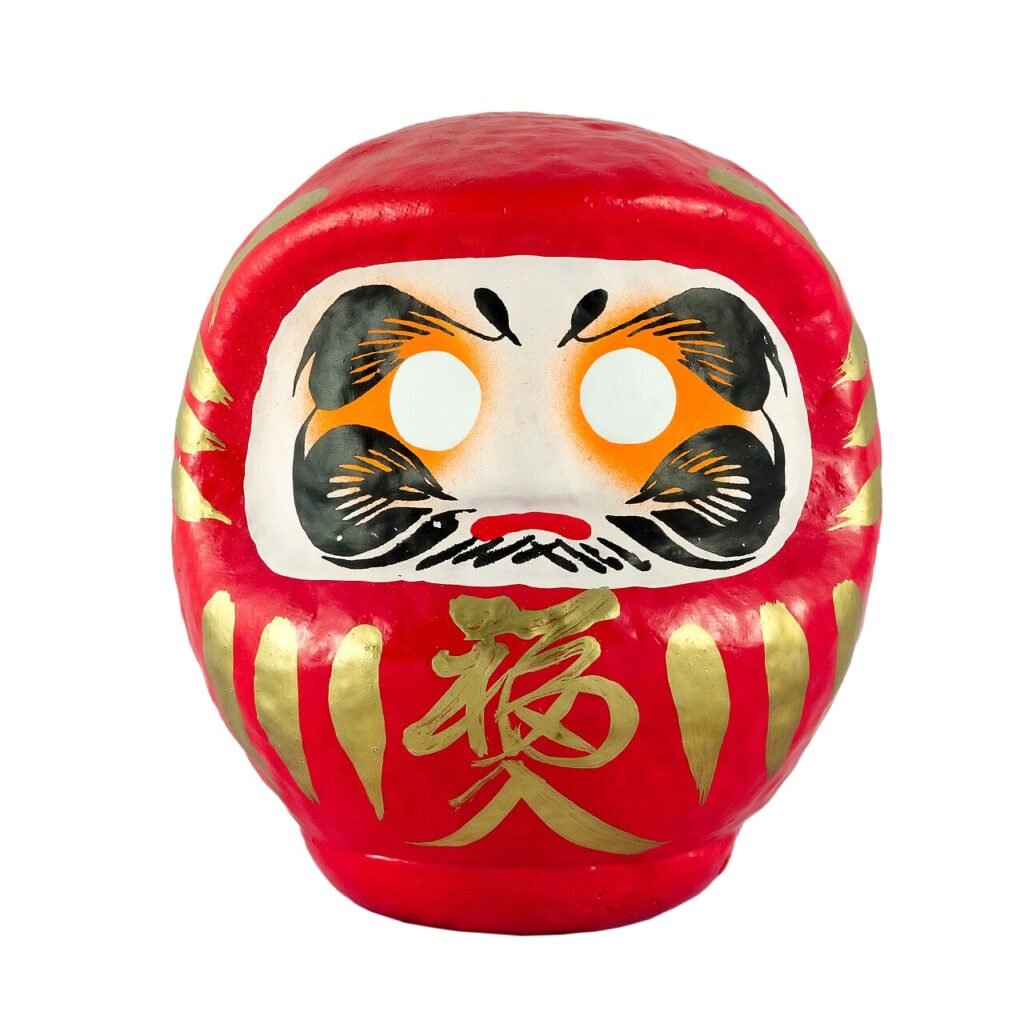
Daruma tattoo meaning is most securely connected to perseverance and the practice of keeping a wish or goal in view. The familiar round doll represents Daruma, the Japanese name for Bodhidharma, and its weighted form returns upright after being pushed over. Its blank, single-filled or completed eyes can place the design at a different point in a goal ritual.
For a tattoo, the first decisions should be which form of Daruma you mean, what state the eyes will show, and how much facial detail the placement can hold. A compact Daruma works best when the round silhouette, eyes and brow read before the beard, lettering or background. Adding every available symbol usually weakens the motif rather than deepening it.
The religious figure and the folk doll are related, but not identical
Daruma appears in Japanese art as both a human religious figure and a rounded folk object. Japan’s national e-Museum catalogues a fourteenth-century hanging scroll titled Daruma (Bodhidharma) under a pine tree. Its description identifies Daruma as the founder of the Zen, or Chan, school and recounts the tradition that he travelled to China from the West and meditated facing a wall for nine years. The work shows a robed figure, not the later tumbler doll (National Institutes for Cultural Heritage e-Museum).
The doll compresses that figure into a recognisable object. The SFO Museum describes hollow papier-mache Daruma weighted at the bottom so they return upright when pushed over. That physical behaviour is the strongest basis for modern readings of persistence and recovery after setbacks (SFO Museum).
Choose between these forms before collecting references. A Bodhidharma portrait needs room for a human face, robe and contemplative posture. A Daruma doll tattoo depends on the compact body, stylised beard and large eyes. Mixing them is possible as a contemporary interpretation, but the brief should state that choice rather than treating every Daruma image as interchangeable.
Decide what the eyes say before the sketch begins
The eyes are not minor decoration. Web Japan explains that many Daruma are sold with both eyes blank. In the convention it describes, the owner fills the doll’s left eye while making a wish, then completes the other when the wish is fulfilled (Web Japan). This gives a Daruma tattoo three clear visual states:
- Both eyes blank: closest to a new doll before its goal ritual begins.
- One eye filled: commonly read as a wish or goal still being carried.
- Both eyes filled: commonly read as completion and gratitude.
Do not turn the side of the first pupil into a universal rule. The Japan Creative Centre at the Embassy of Japan in Singapore states that there is no single correct order, even while noting the familiar left-eye-first practice (Japan Creative Centre). Regional practice, the reference object and the viewpoint can differ. A photograph may also be mirrored.
Record the eye choice in plain language, such as “the doll’s left eye filled, which appears on the viewer’s right.” That removes ambiguity between reference, drawing and body placement. A permanent one-eyed Daruma should also look intentional as a finished image. It is safer to plan the composition you want now than to assume a later alteration will fit automatically.
Give the design a strict visual hierarchy
A useful Daruma tattoo design has three levels of information. The first is the outer silhouette: a broad head and rounded base that can be recognised without seeing the face. The second is the expression, led by the eye sockets, pupils and heavy brows. The third contains beard strokes, moustache, painted marks and any supporting texture.
When all three levels receive equal contrast, the face becomes crowded. The eye ritual then disappears inside decoration. Keep the pupils and eye openings distinct, give the moustache a few larger directions, and let some open skin separate the brow from the beard. Tiny repeated hairs can be reduced without losing the identity of the doll.
The same editing applies to written characters. If a reference includes kanji, identify exactly what it says and why it belongs in your design. Do not copy decorative writing from a cropped product photo or rely on an unverified automatic translation. A word that cannot be read clearly at the chosen scale should not be made structurally essential.
Choose one of three scale strategies
Scale should follow the amount of information you want to preserve.
A compact emblem
This version uses the complete round silhouette, large eyes and simplified facial marks. It suits a contained placement where the shape can sit alone. Background, dense beard texture and small lettering should be limited. The design succeeds through recognition, not through miniature ornament.
An expressive Daruma face
A larger head-led design can emphasise an intense gaze, asymmetrical brows and painted texture. The lower body may be cropped, but enough of the curved outline should remain to separate Daruma from a generic bearded mask. This direction gives the eyes more visual weight and allows black-and-grey shading or restrained colour without packing the entire doll into the frame.
A sleeve or panel anchor
In a larger composition, Daruma can act as one focal object rather than occupy every available surface. Surrounding movement should lead toward the face, and quieter gaps should protect the eyes. Before committing to a full background, compare how a single focal subject is handled in Japanese and Asian-inspired tattoo compositions. A sleeve needs a coverage plan, but this motif page stays focused on the Daruma itself.
Match the round form to the placement
Daruma is compact, front-facing and visually top-heavy. Placement should support that geometry rather than stretch it into an unrelated shape.
| Placement | What it can support | Main design check |
|---|---|---|
| Outer upper arm | Full doll or large face with a curved frame | Keep both eyes readable when the arm rests naturally |
| Forearm | A slightly vertical doll or cropped portrait | Check the taper so the base does not become pinched |
| Calf | Full silhouette with room above and below | View it from the front and side before fixing orientation |
| Thigh | More facial texture and one supporting element | Preserve a strong outer shape at normal viewing distance |
| Chest, back or sleeve | Daruma as an anchor within a wider composition | Give the face clear priority over background detail |
A perfectly circular drawing can look different on a curved limb. Ask for the design to be viewed on the body, with the arm or leg both relaxed and gently turned. The eyes should not split around an edge, and the rounded base should not vanish into a joint. These checks matter more than forcing the design into a preset size.
Use colour and pairings with restraint
Red is the most familiar Daruma colour, but colour alone does not need to carry the tattoo’s meaning. A red body with black facial marks creates immediate recognition. Black and grey can shift attention toward the gaze and brush-like texture. Either direction still needs open areas around the eyes.
Treat internet charts that assign a fixed promise to every modern colour with care. Daruma are produced in many colours and contemporary patterns, and sources do not present one universal chart. If a colour is personal, describe it as personal. If it comes from a specific object, bring that object as the reference.
One supporting element is often enough. A broad cloud, a restrained floral shape or a simple painted-texture frame can provide movement without burying the doll. Multiple flowers, waves, flames, lettering and geometric fills may each be attractive separately, yet together they compete with the eyes. Decide which element explains the setting and remove the rest.
Build a brief around decisions, not a collage
A focused first message should answer:
- Do you want the round folk doll or a human Bodhidharma portrait?
- Will the eyes be blank, single-filled or complete?
- Which eye is filled from the doll’s own viewpoint?
- Is the priority the silhouette, the expression or a larger scene?
- Where on the body should it sit, and may the project expand later?
- Do you prefer red and black, black and grey, or another reference-led palette?
- Which single supporting element, if any, is essential?
Attach one clear cultural or museum reference and a small number of visual references marked with what you like in each. The tattoo enquiry guide can help organise placement photographs, approximate coverage and reference notes without turning the message into a large mood-board dump.
Yuyi Tattoo’s documented portfolio includes Japanese and Asian-inspired compositions. To discuss a Daruma concept, use the contact page and send the eye state, placement, coverage and preferred visual direction. Project timing, quotation and artist availability are confirmed only after the specific brief is reviewed.
Sources and review date
- National Institutes for Cultural Heritage e-Museum, Daruma (Bodhidharma) under a pine tree, reviewed 24 August 2026.
- Web Japan, Have You Ever Heard of a Lucky Daruma?, reviewed 24 August 2026.
- Japan Creative Centre, Embassy of Japan in Singapore, Daruma: Gunma’s Good Luck Charm, reviewed 24 August 2026.
- SFO Museum, Mingei: Traditional Japanese Arts, reviewed 24 August 2026.
Frequently asked questions
What does a Daruma tattoo mean?
The best-supported readings are perseverance, returning after setbacks and keeping a goal in view. Those ideas come from the doll’s self-righting form and eye ritual. A wearer may add a personal meaning, but it should be described as personal rather than presented as a fixed ancient rule.
Should a Daruma tattoo have one eye or two?
Either can be intentional. One filled eye commonly places the image in the middle of a wish or goal, while two completed eyes can refer to fulfilment and gratitude. Blank eyes refer more closely to a new doll. Choose the state that makes sense as a complete tattoo now.
Which Daruma eye should be filled first?
There is no single order accepted everywhere. Web Japan describes filling the doll’s left eye first, while the Japan Creative Centre notes that no order is universally correct. Use a named reference and specify the doll’s viewpoint so a mirrored image does not reverse your choice accidentally.
Can a Daruma tattoo be small?
A compact Daruma can work when the silhouette, eyes and major beard shapes are simplified. Small lettering, dense hair strokes and several background motifs compete for the same space. If those details are essential, more scale or a more selective composition is needed.
What placement suits a Daruma tattoo?
The outer upper arm, forearm, calf and thigh can all support its rounded shape. The best location depends on whether you want a complete doll, an expressive face or a larger panel. Check the design on the moving body so both eyes and the curved base remain clear.