
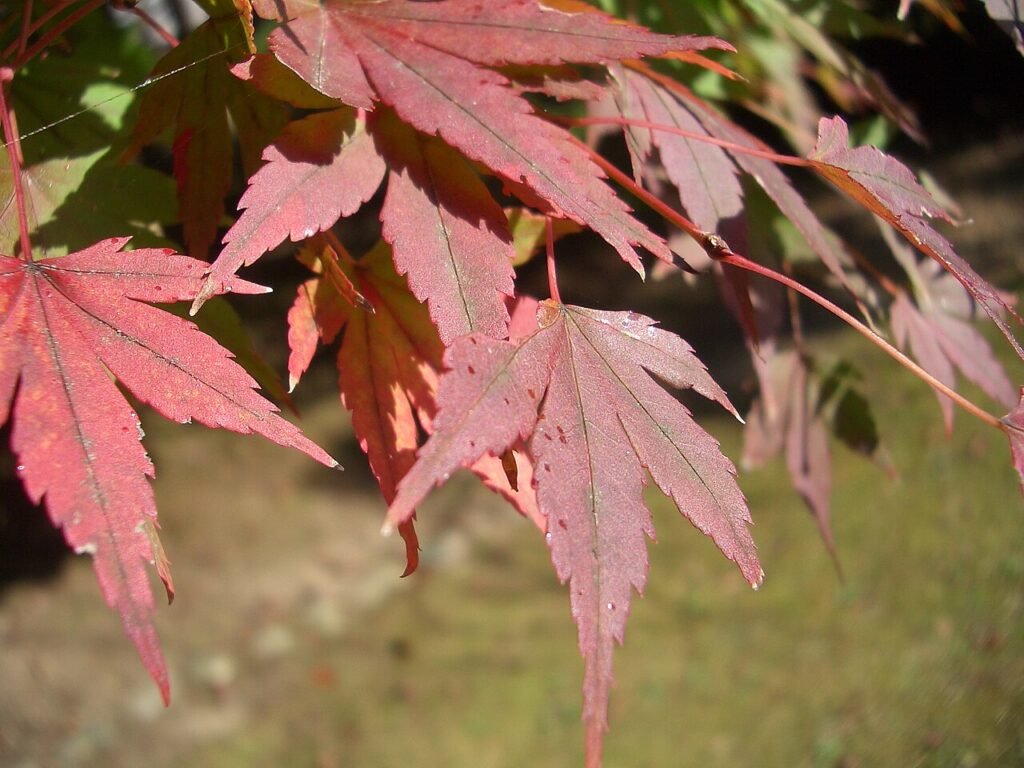
The most reliable Japanese maple leaf tattoo meaning is autumn. Red momiji leaves have long marked the autumn season in Japanese art, clothing and poetry, where they can suggest changing weather, close attention to nature and the passage from one season to the next. They do not carry one compulsory message such as loss, rebirth or courage; those are possible personal readings, not a universal Japanese code.
For a tattoo that works on skin, decide what the leaves are doing before deciding how many to add. A still branch, leaves blown across open skin and fallen leaves travelling on water create different moods and different lines of movement. You also need to choose whether momiji is the subject, a seasonal clue or a background element supporting a larger figure.
What “momiji” identifies in a design
The Japanese dictionary Kanjipedia gives momiji two related senses: leaves turning red or yellow late in autumn, and another name for maple or its leaf. English-language museum and cultural descriptions commonly use the word for Japanese maple and its red autumn foliage. The term alone is therefore not a complete art brief. A clear reference image is more useful than asking for “momiji” and assuming everyone pictures the same leaf, colour and season.
The red maple is a well-established autumn marker. A Government of Japan feature on traditional kimono names momiji and chrysanthemum among typical autumn plant motifs. The same account also distinguishes fresh green ao-momiji, used from late spring into summer, from red leaves and the autumnal Tatsutagawa pattern. That distinction matters for tattoo planning: a green branch can feel fresh and growing, while detached red leaves usually place the scene later in the year.
Historical objects show that the maple did more than stand for an abstract idea. The National Institutes for Cultural Heritage’s record for Kanō Hideyori’s sixteenth-century Maple-Viewing screen describes people eating and drinking beneath brilliant maples beside Kyoto’s Kiyotaki River. The work is predominantly autumnal, yet its atmosphere is restrained and calm. This is a useful corrective to online lists that label every falling leaf as sadness or death. Momiji can represent the experience and beauty of a season without turning it into a tragedy.
Season is documented; personal meaning is chosen
An autumn leaf visibly records change, which is why modern wearers may connect it with transition, maturity, memory or accepting that a period has ended. Those meanings make intuitive sense, but they should be presented as the wearer’s interpretation. Japanese artworks do not provide one official emotional definition for every maple leaf.
The source scene changes the tone. A canopy of red leaves can feel abundant and celebratory. One crisp leaf held still can feel observant and quiet. Several leaves carried downstream can imply time moving beyond the viewer’s control. A branch with green, orange and red leaves can make gradual change visible. None of these arrangements needs a slogan attached to it; the composition can carry the idea.
Before collecting tattoo references, finish this sentence in your own words: “I want autumn to feel like…” Calm, energetic, reflective and severe will each produce a different leaf pattern. That answer is more useful than copying a meaning from a symbol chart.
The Tatsuta River pairing: maple leaves on moving water
Maple leaves and water have a documented relationship in Japanese decorative art. The Government of Japan’s kimono feature traces the Tatsutagawa pattern to a waka poem associated with the Tatsuta River, its water pictured as coloured red by scattered maple leaves. A British Museum triptych from the early nineteenth century likewise shows women boating on the Tatsuta River while autumn leaves cover the water.
This gives a water-and-momiji tattoo an evidenced visual reference without making it a mandatory rule. The leaves can sit on broad currents, collect in a quiet eddy or break apart near foam. Their orientation should agree with the water. If every leaf points in a different direction while the current flows cleanly one way, they stop supporting the scene and begin to look sprinkled on afterward.
The pairing also helps with transitions. Water supplies a continuous path around an arm or leg; the leaves mark pauses along that path. In a larger piece, a few leaves near the main subject can establish autumn while smaller, more widely spaced leaves lead the eye toward the edge.
Four ways to use maple leaves without turning them into filler
Momiji can take very different levels of visual importance. Choosing one of these roles early prevents the leaf count from growing without a purpose.
A single botanical subject
One leaf or a short branch puts the silhouette first. The pointed lobes need clear separation, and the stem should visibly belong to the leaf rather than disappear into shading. This approach suits a contained composition where the client wants autumnal identity without a full Japanese background.
A moving cluster
A small group of leaves can show a gust or a falling arc. Vary rotation and distance, but keep one dominant direction. Identical leaves copied at equal intervals look like a pattern; differences in angle and scale make them feel caught in the same weather.
A seasonal bridge
Leaves can connect two larger subjects across a joint or an area of open skin. They should remain subordinate. If every gap receives another leaf, the bridge becomes visual noise and the focal figures lose separation.
Part of a landscape
A branch, riverbank, rock and stream create a place rather than a loose symbol. This needs more room because the viewer must distinguish foreground foliage from distant water or cloud. The Smithsonian’s Rinpa Screens presentation of Ikeda Kōson’s Maple Leaves on a Stream shows how clusters of red foliage and a dark flowing stream can animate a large folded surface. On the body, the same broad idea has to be redrawn for curves and movement rather than copied from the screen.
Pairing momiji with a main Japanese motif
The leaf should establish season or movement without assigning a new fixed meaning to the main subject.
- Koi and water: fallen leaves can make the current visible and set an autumn atmosphere. The koi’s direction should be chosen for the composition, not from a claim that every upward or downward fish has one prescribed meaning.
- Dragons and wind: leaves can trace a diagonal gust around coils and clouds. Keep them away from the face and claws if those details carry the focal expression.
- Tigers, warriors and masks: momiji can locate the figure in a particular season while leaving the figure’s own story intact. A leaf does not automatically turn a warrior scene into a meditation on mortality.
- Chrysanthemums: both can support an autumn setting, but the flower and leaf have competing outlines. Make one clearly larger or more important instead of distributing equal detail everywhere.
- Rocks and streams: this is a quieter option when the season itself is the subject. It can favour atmosphere over a heroic central figure.
For examples of how foreground subjects and supporting elements share space, browse Japanese and Asian-inspired tattoo work before deciding which part of your idea deserves the strongest contrast.
Red, green or black and grey?
Red, orange and russet make autumn immediately legible, but they are not separate entries in a universal colour dictionary. The palette should describe the stage of the season and the mood of the whole piece. A mostly red cluster feels different from leaves moving through yellow, orange and brown. Green ao-momiji shifts the seasonal read toward fresh foliage and should not be labelled autumn simply because the silhouette is a maple.
Black and grey can still communicate momiji through the pointed outline, curled edges, value changes and surrounding context. Without red, the design may need stronger evidence of season, such as a bare branch, flowing water or a mix of intact and fallen leaves. Enough open skin between lobes and between separate leaves keeps the pattern recognisable from normal viewing distance.
Do not force every leaf to show all its veins. In a large close-up leaf, veins can contribute to structure. In a group of smaller leaves, the outer shape and angle matter more. Reserving detail for the nearest or largest leaves also creates depth.
Placement should follow the path of the leaves
Instead of choosing a body area from a placement-meaning chart, match the format to the movement you want.
| Design direction | Placements to consider | Planning priority |
|---|---|---|
| One leaf or compact branch | Forearm, upper arm, calf or shoulder blade | Preserve a distinct silhouette and stem |
| Falling diagonal cluster | Shoulder to upper arm, thigh or side torso | Keep a clear start, path and endpoint |
| Leaves on a stream | Arm or leg panel, sleeve section or larger torso work | Make water and leaves travel together around curves |
| Branch and landscape | Thigh, back or broad torso area | Separate near leaves, distant elements and open atmosphere |
| Background around a figure | Sleeve, back or large panel | Keep leaf contrast below the main subject |
Check the arrangement with the body relaxed and moving. A leaf placed across a bend can distort in a way that is lively, while a detailed cluster packed into the same bend may become difficult to read. Photos of the full placement from more than one angle will help an artist plan the route.
Turn the idea into a useful enquiry
A focused brief can be one paragraph. State whether you want red autumn momiji or green foliage, whether the leaves are the main subject or background, what carries them, the intended body area, approximate coverage and colour direction. Add one historical artwork or natural leaf reference and a small number of tattoo references for visual preferences, rather than asking to duplicate another tattoo.
The tattoo enquiry guide explains what placement photos and reference details make an initial message easier to assess. When your season, motion and coverage are clear, contact Yuyi Tattoo with the brief so the leaf scale and surrounding composition can be discussed for your body area.
Sources and review date
- Kanjipedia: Momiji (reviewed 24 August 2026).
- Government of Japan, Highlighting Japan: Kimono with Autumn Leaf Patterns (reviewed 24 August 2026).
- National Institutes for Cultural Heritage, e-Museum: Maple-Viewing screen (reviewed 24 August 2026).
- British Museum: A Brocade Picture of Maples on the Tatsuta River (reviewed 24 August 2026).
- Smithsonian National Museum of Asian Art: Rinpa Screens (reviewed 24 August 2026).
Frequently asked questions
What does a Japanese maple leaf tattoo mean?
Its clearest documented role is to signal autumn. A wearer may also connect the changing or falling leaf with transition, memory, maturity or impermanence, but those are personal readings rather than one fixed rule shared by all Japanese art or tattoo traditions.
Is momiji different from an ordinary maple leaf?
Momiji commonly refers to Japanese maple or its coloured autumn foliage in English-language cultural sources. For design purposes, use an attributed artwork or botanical image that shows the slender, pointed leaf you want. The reference prevents the finished silhouette from becoming a generic maple emblem.
Do Japanese maple leaves have to be red?
No. Red momiji gives the most immediate autumn signal, while green ao-momiji suggests fresh foliage and a different stage of the year. Black-and-grey leaves can also work when their shape, movement and surrounding elements make the intended season clear.
Can maple leaves be paired with koi?
Yes. Leaves on moving water have strong precedents in Japanese art, so they can sit naturally in a koi composition. Plan the current, fish and leaves as one flow. The pairing creates an autumn setting, but it does not impose one mandatory personal meaning on the koi.
How many maple leaves should a tattoo include?
There is no prescribed number. One leaf makes the silhouette the subject; a small cluster shows movement; repeated leaves can carry season through a sleeve or larger scene. Use only enough to establish the path and atmosphere, leaving clear space around the main figure.


