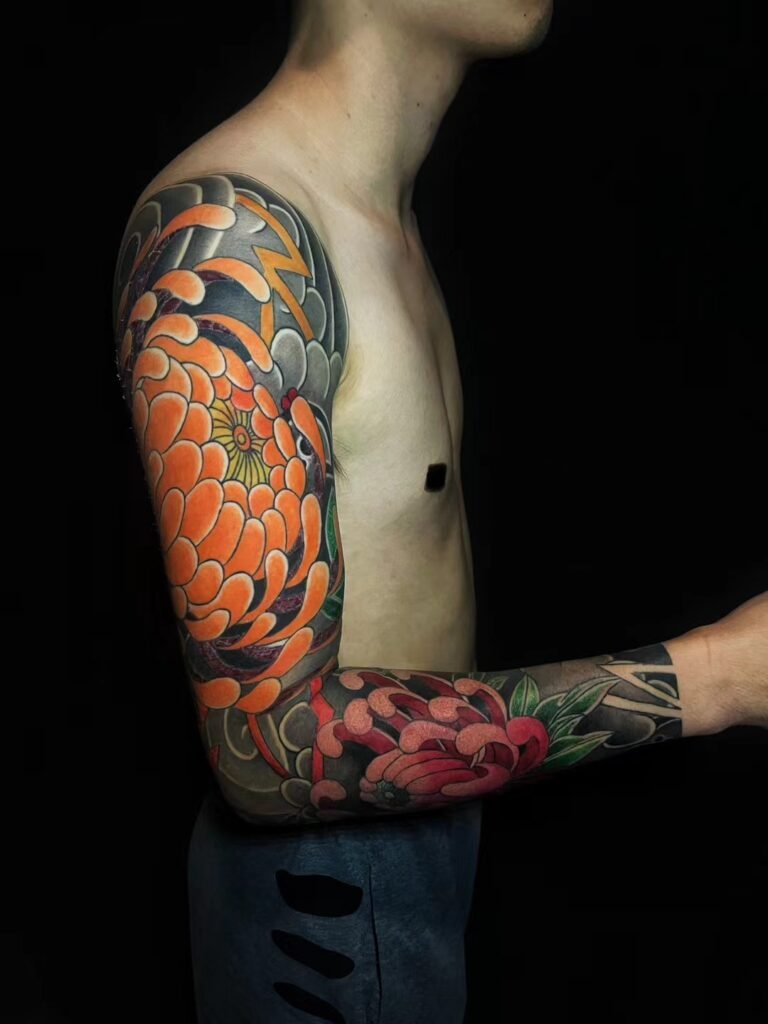
An elbow or elbow ditch tattoo can be worth choosing when the artwork is designed for bending, rotation and daily contact. The trade-off is that neither surface behaves like a quiet, flat patch of arm: the point is a prominent, frequently bumped landmark, while the ditch closes into a skin fold every time you bend your elbow.
Elbow tattoo pain and elbow ditch tattoo pain cannot be predicted from a chart alone. Exact position, design density, individual sensitivity and the length of the work all matter. Healing also needs practical planning because sleeves, desks, sleep positions and repeated arm movement can create pressure or rubbing. The useful question is therefore not simply “does it hurt?” but “which part of the joint can carry this design without depending on fragile detail?”
Three placements that should not be treated as one
“Elbow tattoo” may refer to work directly over the point, a design circling the joint, or an image that crosses the inner fold. Those options have different visual and practical demands.
| Placement | What happens when the arm bends | Design question to resolve |
|---|---|---|
| Point of the elbow | The central surface changes angle and makes frequent contact with chairs, bedding and other objects | Can the centre remain clear with a bold shape rather than tiny features? |
| Around the elbow | Inner and outer arm panels change their relationship as the forearm rotates | Does the composition connect in both a relaxed and bent view? |
| Elbow ditch | The inner crease closes, opens and gathers into a fold | Can important lines sit beside the deepest crease instead of relying on it? |
The NCBI Bookshelf anatomy review describes the elbow as a complex joint that supports flexion and extension as well as forearm pronation and supination. That combination explains why a stencil can appear aligned with the palm up, then look different when the palm turns or the arm bends. This is normal body movement, not necessarily a placement error.
Why pain rankings have limited value here
A tattoo pain chart can help you compare broad body regions, but it cannot tell you how one precise line across your elbow will feel. The outer point, the edges beside it and the inner ditch are distinct micro-placements. A design that occupies all three may produce changing sensations rather than one consistent level.
Several variables matter more than an online score:
- A compact outline and a densely shaded joint piece do not involve the same amount of work on one patch of skin.
- Moving a motif a small distance can shift it from the central bony landmark to a softer surrounding panel.
- Repeated work near one small feature may feel different from a composition that spreads marks across a wider area.
- Fatigue, stress and personal sensitivity vary, even for the same person on different days.
The inner side also contains the cubital tunnel, where the ulnar nerve has a relatively superficial course. That anatomy explains the familiar “funny bone” response when the area is struck, but it does not create a universal tattoo-pain formula. A tattoo needle works in skin; it is not meant to contact a nerve. Use the anatomical fact to understand why the region deserves care, not to diagnose every sharp sensation during or after an appointment.
If you develop unusual symptoms or have a medical concern, a pain guide is not the right decision tool. Speak to a qualified health professional rather than trying to identify the cause from a placement article.
Test the concept in straight, bent and rotated views
An elbow placement should be reviewed in more than one pose before the stencil is approved. Start with the arm hanging naturally. Then bend it to an everyday angle, extend it again, and turn the palm up and down. The aim is not to make the image identical in every pose. No design can cancel normal joint movement. The aim is to decide which view carries the primary read and which changes are acceptable.
A face, a line of lettering or a small circular emblem may be highly sensitive to distortion because viewers notice small changes in those forms. Leaves, petals, smoke, waves, scales and ornamental rays can absorb more change if their rhythm is planned around the hinge. That does not make one subject forbidden. It means the artist may need to move the focal feature, increase the scale or redraw the transition.
When a concept already feels crowded on a flat reference image, consult the tattoo size guide before trying to compress it onto the joint. Increasing the outer dimensions or reducing secondary elements can protect the main idea more effectively than shrinking every line.
Simplification is often a placement solution
Joint tattoos tend to benefit from a clear hierarchy. The elbow point can act as a centre, an opening or a gap. The ditch can act as a passage between upper and lower arm sections. Neither zone has to hold the most intricate part of the picture.
Useful design decisions include:
- Put the recognisable feature on the stable panel above or below the joint.
- Let broader background, controlled shading or open skin cross the most mobile part.
- Keep essential contours away from the deepest fold when a small shift would preserve them.
- Check the silhouette from normal conversation distance, not only in a close phone photograph.
- Decide whether the tattoo should read as a self-contained elbow piece or as a route for future arm coverage.
These choices relate to tattoo design readability, not to a promise about how any tattoo will age. Clear shapes and breathing room give a composition more margin when the arm moves. They cannot guarantee a particular healed result, and a highly detailed concept may still be appropriate if there is enough usable space around the joint.
Elbow tattoo healing is also a routine-planning problem
The public-health guidance cited below treats a new tattoo as skin that needs appropriate aftercare and observation. Instructions supplied for the actual tattoo should take priority for the dressing and care method. This guide stays at a general planning level because dressing types and individual circumstances differ.
Before choosing the date, map the ordinary contacts your elbow receives:
- Do you rest it on a desk, counter, armrest or vehicle door for long periods?
- Does a uniform or fitted sleeve repeatedly cross the point or bunch inside the ditch?
- Do you sleep with the arm tightly folded or with the elbow pressed into the mattress?
- Does your work involve lifting, climbing, sport or repeated full-range bending?
- Can you keep the area away from pools, hot tubs and other submersion while following your aftercare instructions?
You do not need to immobilise a healthy joint based on a blog post. You do need a realistic way to reduce avoidable rubbing and pressure without inventing a fixed recovery schedule. A loose sleeve may suit one person, while another may find that fabric gathers in the ditch. Test the relevant work clothing with the arm straight and bent before the appointment, then ask the artist how the planned dressing affects that choice.
For a broader explanation of normal surface changes and cautious escalation, read the tattoo healing stages guide. It is more useful than assuming the elbow must be fully settled by a particular day. Size, exact location, skin response and daily contact can all change the experience.
The ditch needs a different friction check
The elbow ditch is not simply a more hidden version of the outer elbow. When the arm closes, skin touches skin and a shirt may gather into the same space. A large adhesive dressing can also behave differently over a fold than it does on a flat forearm. Do not cut, replace or improvise a dressing from general internet advice. Confirm the artist’s instructions for the specific product used.
Think about the tasks that keep your elbow flexed: typing close to the body, holding a phone, carrying a bag, driving and sleeping with an arm under a pillow. The goal is not to eliminate every bend. It is to notice repeated positions that create heat, moisture, pulling or rubbing and make practical adjustments that fit the instructions you receive.
Know the boundary between aftercare and medical assessment
Some short-term redness, swelling or warmth may occur after tattooing, according to the US Food and Drug Administration. Those observations do not allow a reader or artist to diagnose what is happening. The FDA advises contacting the tattooist and a healthcare professional if an area seems not to be healing or a rash develops, especially with fever.
Michigan’s Department of Health and Human Services lists increasing redness or swelling, increasing soreness or pain, continued bleeding or discharge, fever, warmth, red streaks and swollen glands among signs for which medical attention should be sought. Use that list as an escalation prompt, not as a self-diagnosis checklist. Do not assume that a problem is “normal for an elbow” because the joint moves.
A focused placement brief for consultation
Good photographs make it easier to decide whether the design should cross the joint, circle it or stop beside it. Send:
- one relaxed view of the full arm from shoulder to wrist;
- outer, inner and side views with the elbow straight;
- the same inner and outer views with the elbow comfortably bent;
- a palm-up and palm-down view if the composition wraps onto the forearm;
- the approximate size marked with removable paper or a digital outline;
- notes about sleeves, desk contact, sport and any existing tattoos nearby.
Avoid a very close wide-angle selfie because it can exaggerate the centre of the frame. A second person can photograph the arm from a little farther away while you keep a natural posture. Include both joints in at least one image so the scale is understandable.
When you are ready, contact Yuyi Tattoo with the concept, approximate size and straight-and-bent photographs. Ask whether the key detail should be simplified, enlarged or moved away from the point or ditch. That conversation is about design suitability; it does not reserve a slot or establish a price until the studio confirms those details.
Sources and review date
- NCBI Bookshelf — Anatomy, Shoulder and Upper Limb, Elbow Joint — reviewed 24 August 2026.
- International Association for the Study of Pain — Pain assessment and measurements — reviewed 24 August 2026.
- US Food and Drug Administration — Think Before You Ink: Tattoo Safety — reviewed 24 August 2026.
- Michigan Department of Health and Human Services — Minimal Aftercare Instructions for Tattoo — reviewed 24 August 2026.
Frequently asked questions
Is the elbow point always more painful than the elbow ditch?
No fixed ranking applies to everyone. The point and ditch have different anatomy and contact patterns, while design density, exact position and personal sensitivity also affect the experience. Compare the actual stencil areas rather than treating the whole joint as one pain score.
Will an elbow tattoo look distorted whenever I bend my arm?
It will change with normal movement, but change is not automatically a flaw. A well-planned composition chooses a primary viewing position and keeps the most recognisable features on suitable surfaces. Testing the stencil straight, bent and rotated shows whether the change works with the design.
Should detailed work cross the deepest part of the elbow ditch?
Sometimes a design can cross the crease, but essential small features may be clearer beside it. The answer depends on scale, line placement and the role of the ditch in the composition. Ask whether background, shading or open skin can carry the transition instead.
How long does an elbow or elbow ditch tattoo take to heal?
There is no responsible fixed guarantee for an individual tattoo. Follow the aftercare instructions supplied for your tattoo and judge activity changes by those instructions, the surface condition and professional advice. Seek medical assessment for concerning symptoms rather than extending a guessed timeline.
What photos should I send before an elbow consultation?
Send the full arm relaxed, inner and outer views with the elbow straight and bent, and palm-up and palm-down views if the design wraps. Include nearby tattoos and an approximate size marker. These images let the artist compare the point, ditch and surrounding panels before drawing.