
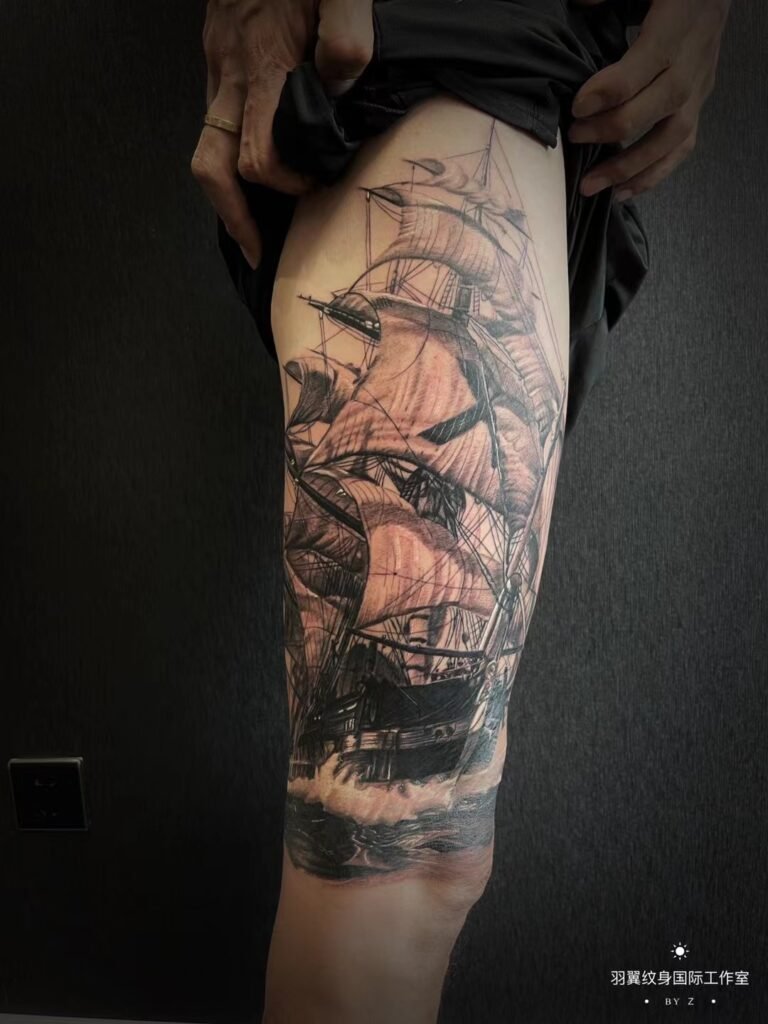
Before tattooing the knee or knee ditch, decide whether you want the joint to be a focal point, a bridge between thigh and lower leg, or a boundary the artwork avoids. The kneecap faces forward and changes angle as you stand, sit and walk. The ditch closes behind the leg when the knee bends, so delicate features placed in the deepest fold will not remain equally visible in every position.
Knee tattoo pain can be intense for some people, but neither the front nor the back has a reliable universal rating. Exact placement, design density, personal sensitivity and positioning all affect the experience. Early healing can also be awkward because walking, trousers, uniforms and sleep repeatedly bring movement or fabric across the area. A sound plan combines a movement test, simpler detail at the bend and a realistic routine for reducing avoidable pressure.
Start with the role of the knee in the design
The NCBI Bookshelf describes the knee as a weight-bearing joint used primarily for flexion and extension, with limited movement in other directions. It is central to ordinary actions such as walking. For tattoo planning, that means the knee cannot be evaluated only as a patch of skin in a straight, standing photograph.
There are four useful placement zones to discuss:
- Over the kneecap: a forward-facing focal area suited to a concept that can tolerate a rounded, changing surface.
- Above or below the cap: a way to keep the main feature close to the knee while placing it on a less central bend zone.
- Beside the knee: an inner or outer route that can connect thigh and calf without making the patella the centre.
- Across the knee ditch: a hidden transition that opens when standing and compresses when sitting or squatting.
Mark the proposed position while standing naturally, then look at it while seated and while the leg is comfortably bent. A stencil does not need to appear frozen in place. It does need to preserve the intended focal point when the body changes pose.
What a pain score cannot tell you
The tattoo pain chart provides broad context, but “the knee” covers too much variation for one number. Work centred on the patella differs from a design ending at its upper edge. A line that enters the ditch differs from shading spread across the side of the leg. The amount of repeated work in one small area also matters.
It is more useful to ask the artist these questions:
- Which part of the proposed design sits directly over the kneecap or deepest fold?
- Can the densest section move onto the thigh, shin or side panel without weakening the composition?
- Does the pose required for access feel sustainable for this particular piece?
- Can a pause be communicated before you move your leg?
- Would a larger or simpler version avoid crowding the joint?
People often expect the bony front to feel sharp and the softer ditch to be easy. That assumption is too simple. Vibration over a prominent landmark may feel pronounced, while work in a crease can bring a different kind of sensitivity and a demanding position. Personal experience remains the deciding factor. A previous tattoo elsewhere on the leg is not a guarantee of how either knee zone will feel.
If you have current knee pain, swelling, limited movement, a skin problem or a medical concern, do not use a tattoo-pain article to assess it. A healthcare professional can address the health question; the tattoo consultation can then focus on design and placement.
Plan the front around a changing circle
Many knee-cap concepts use radial structure: petals, an eye-like form, an ornamental centre, a mask, a web or another shape that can organise itself around the patella. A radial idea is not automatically suitable merely because it is circular. The artist still needs to decide where its visual centre belongs and how its outer edges meet the upper and lower leg.
Small differences in alignment can become obvious in a highly regular design. A natural body is not a perfect diagram, and a person may stand with one leg carrying more weight than the other. Review the design on your actual knee rather than asking for a mechanically perfect circle based on a flat template.
Representational subjects need extra care. If an eye, mouth, line of text or small face crosses the area that changes most, ordinary bending can alter the relationship between its features. Moving that feature slightly above the cap, increasing its scale or using the knee as background may preserve the idea better. The tattoo design readability guide explains why recognisable structure should lead and tiny texture should remain supportive.
Treat the knee ditch as an opening, not a flat panel
The back of the knee has a different visual rhythm. Standing photographs show an open vertical connection between the back of the thigh and calf. Once seated, the same route compresses into a fold. A design that depends on a narrow face, precise lettering or several parallel lines staying evenly spaced may struggle with that change.
Background elements can often make the transition more naturally. Smoke, wind, water, leaves, broad shadow or controlled open skin can cross the bend without asking one small feature to carry the entire image. This is a composition choice, not a rule that the ditch must be empty.
Ask to see the proposed path from behind with the leg straight, then from the side with the knee bent. If the important feature disappears completely in the ordinary seated view, decide whether that is acceptable. Some people want a detail that reveals itself only when standing. Others expect the tattoo to read from several angles. That preference belongs in the brief.
Walking comfort deserves its own plan
The knee is used continually during an ordinary day, so a knee tattoo appointment affects logistics even when no medical restriction has been given. Think through your first journeys and work routine before selecting the date.
Consider:
- how far you normally walk between home, transport and work;
- whether your route includes many stairs or long periods standing;
- whether you must wear fitted trousers, compression clothing, knee pads or a uniform;
- whether your job requires kneeling, crouching, climbing or repeated lifting;
- where the tattoo will contact a chair or bedding when the leg is bent;
- whether someone else can help with errands if the area feels uncomfortable.
This is not a direction to stop walking or to keep the joint rigid. Activity advice should come from the instructions supplied for your tattoo and, when relevant, a clinician. The planning goal is to avoid discovering after the appointment that essential work clothing presses directly on the fresh area or that required safety equipment cannot be worn correctly.
A knee-cap tattoo and a knee ditch tattoo also interact with garments differently. Trouser fabric may pull across the front with every step, while material can gather behind the knee when seated. Try the actual uniform or usual trousers in standing, seated and crouched positions. If a protective brace or work pad is mandatory, do not alter or skip it based on general tattoo advice; discuss timing before committing to the placement.
Keep knee tattoo healing guidance general and specific instructions personal
There is no single knee tattoo healing timetable that can be promised. Surface condition, coverage, dressing method, individual skin response and daily contact differ. Follow the written aftercare instructions provided for the tattoo rather than combining conflicting product routines found online.
Florida’s Department of Health advises tattoo clients to obtain and follow aftercare instructions, keep the area clean, and avoid swimming and sunbathing directly after tattooing. Those are useful high-level principles. The exact dressing duration, product use and return to particular activities should come from the instructions for your own tattoo.
During early healing, plan to reduce avoidable rubbing, do not pick at the surface, and do not submerge the tattoo while your aftercare guidance says it is still healing. The tattoo healing stages article provides broader context without turning a general sequence into a deadline for your knee.
Normal movement can make the surface look different in a straight and bent position. Do not judge the tattoo’s design, colour or detail while the skin is still changing, and do not assume an unexpected symptom is caused merely by the joint location.
When observation should become a health question
The US Food and Drug Administration notes that some redness, swelling or warmth can occur after tattooing. It also advises contacting the tattooist and a healthcare professional if the area seems not to be healing or a rash develops, particularly if fever is present.
The Florida Department of Health identifies excessive soreness, tenderness, redness, drainage, swelling or pain at the tattoo site as possible infection signs for which medical attention should be sought. These signs are not a home diagnostic tool. If you are concerned about the way the area is changing, seek appropriate professional assessment rather than waiting because knee tattoos are reputed to be difficult.
An artist can clarify the care instructions and identify what products or materials were used. A clinician evaluates a possible health problem. Keeping those roles separate prevents a design consultation from becoming an unsafe attempt at diagnosis.
Decide how the knee relates to the rest of the leg
If the project may later extend above or below the joint, the outer edges matter as much as the centre. A closed border around the cap can create a strong standalone piece, but it may also limit a future connection. An open path on the inner, outer or rear side can give later work somewhere to travel.
The leg sleeve tattoo planning guide covers thigh-to-calf flow, panels and viewing angles in depth. For this decision, keep the question narrower: will the knee be a feature, a bridge or a deliberate gap? You do not need to plan an entire leg sleeve to answer it, but you should disclose nearby tattoos and possible extension before the stencil is drawn.
If the knee is a standalone focal point, check how it sits with shorts and when seen from the side. If it is a bridge, check whether the dark and light areas lead naturally between thigh and lower leg. If it remains open, make sure the borders above and below look intentional rather than unfinished.
Send standing and bent reference photographs
A useful knee placement set includes:
- full-leg front, outer, inner and rear views while standing evenly;
- a seated side view showing the amount of bend you use normally;
- a rear view with the leg straight and another with it comfortably flexed;
- a close photograph of existing tattoos, scars or visible skin concerns in the proposed area;
- one image with the approximate design boundary marked;
- notes about work trousers, sports clothing and required protective gear.
Keep the camera level with the knee and include enough of the thigh and lower leg to show scale. A close phone photograph angled down from the waist can make the kneecap look disproportionately large. Natural posture is more useful than forcing the leg perfectly straight.
Send the images and concept through Yuyi Tattoo’s contact page and ask which features should be enlarged, simplified or shifted. A placement review can clarify the design direction. Pricing, timing and appointment availability still require a project-specific confirmation rather than an assumption from the article.
Sources and review date
- NCBI Bookshelf — Anatomy, Bony Pelvis and Lower Limb, Knee — reviewed 24 August 2026.
- International Association for the Study of Pain — Pain assessment and measurements — reviewed 24 August 2026.
- Florida Department of Health — Things to Know When Getting a Tattoo — reviewed 24 August 2026.
- US Food and Drug Administration — Think Before You Ink: Tattoo Safety — reviewed 24 August 2026.
Frequently asked questions
Does a tattoo over the kneecap hurt more than one in the knee ditch?
There is no universal winner. Direct work over the kneecap and work inside the rear fold create different sensations, and exact position, density, posture and personal sensitivity matter. Compare the proposed design areas instead of relying on one score for the entire knee.
What kind of design works over a kneecap?
A clear shape that can follow a rounded, moving surface is often easier to plan than a small feature-dependent image. Radial and ornamental ideas are common options, but they still need to be drawn for your anatomy. Faces, text and precise geometry may require more scale or a shift above or beside the cap.
Can a knee ditch tattoo remain readable when I sit down?
It will compress as the knee bends, so it cannot look identical in standing and seated views. Readability improves when the main feature does not depend on the deepest fold staying open. Review the stencil in both positions and agree on the primary viewing angle.
How should I plan clothing for knee tattoo healing?
Test your usual trousers or uniform while standing, sitting and walking to identify fabric that pulls across the cap or gathers in the ditch. Follow the specific aftercare and dressing instructions you receive. Required protective clothing or equipment should not be altered for a tattoo.
Should the knee be included when planning a future leg sleeve?
It should at least be considered. The joint can become a focal feature, a visual bridge or an open break between thigh and lower leg. Tell the artist about possible expansion now so the first tattoo does not close every future connection accidentally.

