
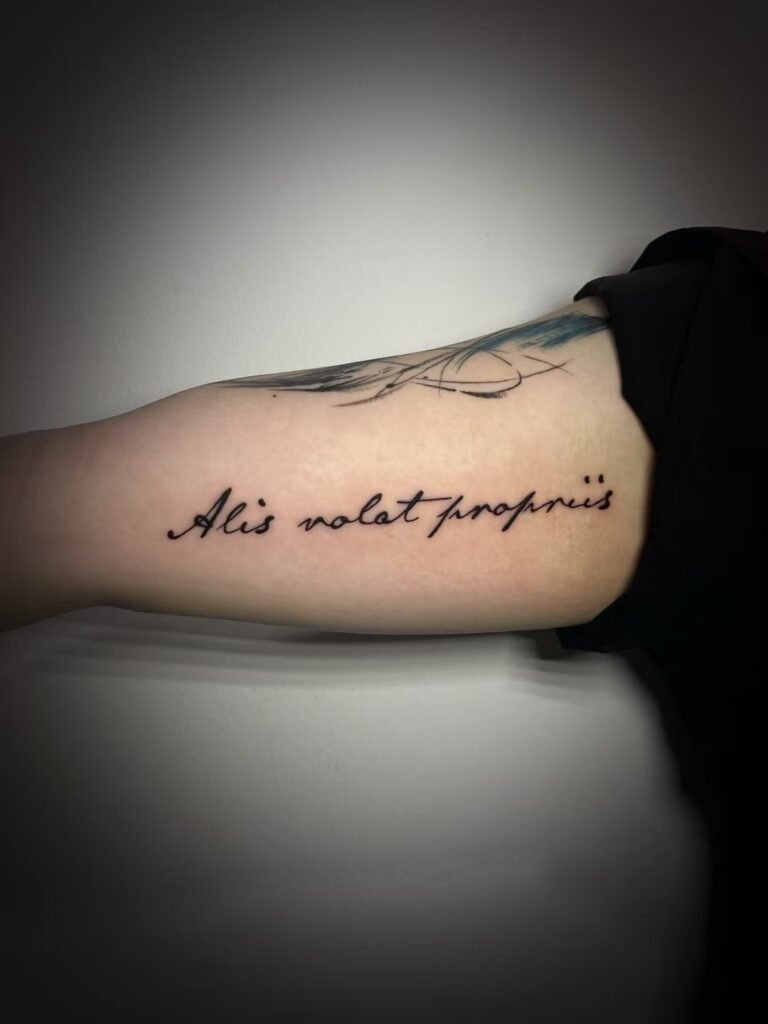
Choose the outer arm when you want the main subject to read clearly to other people while your arm hangs naturally, or when it may become a focal panel in a future sleeve. Choose the inner arm when you prefer a quieter placement that you can turn toward yourself and reveal more deliberately. Neither surface is automatically better; the design, exact height, daily clothing and intended viewing direction decide the fit.
Visibility is not the only difference. An inner arm tattoo can press against the torso, fold near the inner elbow and disappear from view in a relaxed stance. An outer arm tattoo usually faces the room more directly, but it can receive more incidental sun and external contact. Compare both surfaces with the arm relaxed, bent and rotated before approving the stencil.
First, define what “inner” and “outer” mean
“Inner arm” and “outer arm” are useful studio terms, not fixed flat panels. The shoulder rotates and the forearm turns, so a surface that faces inward in one pose may become visible from the front in another.
For placement planning, use these practical definitions:
- Inner upper arm: the surface that rests closer to the side of the chest, commonly called the inner bicep area.
- Outer upper arm: the deltoid, lateral upper arm and outward-facing triceps area visible from the side.
- Inner forearm: the palm-side surface when the palm faces forward or upward.
- Outer forearm: the back or outward-facing surface seen more readily when the hand rests in a neutral position.
Always add the exact segment and side. “Left inner upper arm, below the armpit and ending above the elbow crease” is far more useful than “inside my arm.” This article compares inward-facing and outward-facing surfaces along the arm. If your main question is lower arm versus upper arm, use the separate forearm vs upper arm tattoo guide.
Inner arm vs outer arm tattoo at a glance
| Decision point | Inner arm placement | Outer arm placement |
|---|---|---|
| Relaxed-arm view | Often partly hidden against the torso or turned away | Usually easier to see from the side and in photographs |
| Wearer’s view | Easy to turn toward yourself, especially on the forearm | May require a mirror for parts of the upper arm |
| Social visibility | More controllable, but not reliably concealed | More consistently public in short sleeves |
| Movement | Inner elbow folds; forearm surface changes with rotation | Shoulder and forearm still rotate, but the outer upper arm often gives a steadier main view |
| Common contact | Torso, sleeve seams, desk edges on the forearm | Bags, chair arms, door frames, outer sleeves and sun exposure |
| Design role | Personal-facing panel, secondary sleeve subjects, text or compact focal work | Main focal subject, broad silhouettes and outward sleeve read |
| Future expansion | Useful connection space, but easy to crowd near the ditch | Strong anchor for a sleeve, provided edges leave routes around the arm |
These are tendencies, not guarantees. A high inner-bicep tattoo behaves differently from an inner-forearm piece, so the artist needs the exact boundary.
Visibility changes between rest, conversation and photographs
Arm tattoo visibility is best judged in ordinary posture. Stand naturally with your shoulders down and hands relaxed. On many bodies, the inner upper arm turns toward the torso and the inner forearm faces partly forward. An inner bicep piece may be almost absent from a side view, while an inner forearm piece can still show during conversation, typing or holding a phone.
The outer arm generally offers a more immediate public read. A subject on the outer upper arm can face a person standing beside you, and a design on the outer forearm often appears when the hand is in a neutral working position. That makes the outer surface useful when the silhouette, face or emblem should be understood quickly without a deliberate pose.
Do not treat “inner” as a promise of concealment. A short sleeve may expose an inner bicep design when you lift your arm, and an inner forearm piece shows when you reach across a table. Test the proposed boundary with the clothes you actually wear.
Viewing direction also changes the emotional feel of a piece. A phrase or small subject that turns toward the wearer can feel private. A portrait or animal intended to meet the viewer may need an outward-facing main plane. The artist can let hair, smoke, leaves or background wrap inward while keeping essential facial features on the clearest view.
Movement is about the exact route, not the surface label
The elbow complex permits flexion and extension, while the forearm also pronates and supinates. In plain language, bending the elbow creates a fold at the inner ditch, and turning the palm rotates the forearm surface. The shoulder adds another layer of rotation to the upper arm. A stencil should therefore be checked in more than one pose.
On the inner arm, the greatest planning issue is often compression. Skin near the inner elbow folds when the arm bends. The upper inner arm can press toward the torso when the arm returns to the side. A rigid face, circle or line of text should not cross a fold accidentally. A flowing background can tolerate more change, but its important edge still needs to be checked while the joint moves.
On the outer upper arm, the main panel often stays readable through ordinary elbow bending, yet it is not motionless. Raising or rotating the shoulder shifts the deltoid and changes which part faces forward. On the outer forearm, pronation and supination can carry a design from a side view toward the back or front. This is why a photograph with a forcefully twisted wrist is a poor substitute for a relaxed-arm view.
A practical stencil test uses three positions: arm hanging naturally, elbow comfortably bent, and forearm gently rotated both ways. Focus on the portrait’s eyes, an emblem’s centre or lettering’s baseline. If it vanishes into a crease, adjust the placement before tattooing.
Friction, clothing and everyday contact
Inner and outer placements encounter different contact. The inner upper arm may touch the torso, while fitted armholes and sleeve seams can sit over it. The inner forearm may rest on a desk, and watches or cuffs can affect its lower boundary.
The outer arm is less compressed against the torso, but shoulder bags, chair arms, doorways and fitted sleeves can brush it. It may also receive more incidental daylight. The American Academy of Dermatology notes that ultraviolet light can fade some tattoo inks, so long-term exposure belongs in the decision without making an outer placement wrong.
No placement guarantees an easier healing experience. Dressing choice, aftercare, skin response, climate, work and the exact tattoo area all matter. Follow the aftercare instructions approved for your project rather than assuming the inner or outer surface follows a fixed timetable. If a skin reaction develops or the tattooed skin changes in a concerning way, seek assessment from a qualified healthcare professional.
Inner bicep tattoo pain versus outer arm pain
There is no universal pain score for either surface. “Inner bicep” can mean a central patch, a route near the armpit or a design extending toward the elbow ditch. “Outer arm” can mean the shoulder cap, lateral upper arm, triceps or outer forearm. These are not interchangeable locations.
Many clients describe the inner bicep and areas close to the axilla or elbow crease as more tender than the broad outer upper arm, but individual experience varies. The size of the design, shading density, duration, sleep, stress and personal pain response can matter as much as the surface name. Do not choose the outer arm because a chart gives it a low number, and do not reject the inner arm because someone else found it difficult.
Use the tattoo pain chart as a question guide, not a forecast. Mark the proposed top, bottom and side edges on a photo, then ask which parts approach a crease, bone or especially sensitive transition. That creates a more honest discussion than comparing two labels.
Which designs fit each surface?
The strongest placement gives the design a main view. Outer arm tattoo placement often suits work that needs an immediate outward read: a portrait, animal head, mask, emblem or broad black-and-grey focal subject. The outer upper arm has room for a large silhouette, while the outer forearm gives elongated subjects a clear vertical path.
Inner arm tattoo placement can suit wearer-facing subjects, deliberately oriented lettering or supporting elements in a larger composition. A quieter inner passage can balance a strong outer focal point, but inner-arm work does not have to be small or simple.
For faces, eyes and text, decide who should read the design and from which posture. For circular or symmetrical work, check whether the chosen plane is broad enough when relaxed. For long subjects, decide which end points toward the shoulder or hand. Background may wrap around the arm, but the part that carries identity should remain on the intended viewing plane.
Protect future sleeve connections
If a sleeve is possible later, judge the first tattoo as part of a cylinder rather than an isolated patch. The outer arm often carries the first focal subject because it is seen clearly, but filling that panel without planning its edges can still trap future work. The inner arm is not leftover space. It may need to carry transitions, secondary subjects and value balance around the limb.
Keep the elbow, shoulder and wrist in the discussion even if the first tattoo stops before them. A dense border above the elbow or a central inner-arm motif can block a useful connection route. Open background edges preserve more options than an accidental hard box.
Tell the artist whether expansion is “not planned,” “possible” or “the goal.” Those three answers lead to different edges. A standalone tattoo can finish decisively. A likely sleeve needs planned exits and a relationship between its inner and outer values. The full sleeve tattoo planning guide explains how a whole-arm hierarchy differs from adding one placement at a time.
Build a consultation-ready placement brief
Send a small, useful set of images rather than one close crop. Photograph the full arm from the inner and outer sides while it hangs naturally. Add a front view, a back view and one image with the elbow bent. For a forearm idea, include a palm-up and palm-down view without forcing the wrist. Keep the shoulder, elbow and wrist landmarks visible where relevant.
In the written brief, include:
- Left or right arm.
- Upper arm, forearm or both.
- Inner, outer or wrapping surface.
- Top and bottom boundaries using visible landmarks.
- Which part should face the viewer when the arm is relaxed.
- Clothing or work visibility limits.
- Existing tattoos and whether a sleeve may follow.
The guide to describing tattoo placement gives a fuller photo and measurement method. When you have both options photographed, contact Yuyi Tattoo with the design reference, approximate size and your reason for considering each surface. The consultation can then compare two real boundaries instead of guessing from “inner” and “outer.”
Sources and review date
- OpenStax: Types of Body Movements, reviewed 24 August 2026.
- NCBI Bookshelf: Anatomy, Shoulder and Upper Limb, Elbow Joint, reviewed 24 August 2026.
- NCBI Bookshelf: Anatomy, Shoulder and Upper Limb, Arm Nerves, reviewed 24 August 2026.
- American Academy of Dermatology: Caring for Tattooed Skin, reviewed 24 August 2026.
Frequently asked questions
Is an inner arm tattoo less visible than an outer arm tattoo?
Usually, especially on the upper arm, because the inner surface turns toward the torso at rest. It is not guaranteed to stay hidden: ordinary hand movements expose the inner forearm, and lifting the arm can reveal the inner bicep.
Does an inner bicep tattoo hurt more than an outer arm tattoo?
Many people find parts of the inner bicep more sensitive, particularly near the armpit or elbow crease, but pain varies by person and exact route. Compare the actual outline and scale with the artist rather than relying on a universal score.
Which side is better for a portrait tattoo?
The outer arm often gives a portrait a clearer public-facing view. The inner arm can work when the portrait is intended to feel more personal or when it forms a secondary panel. The face needs enough space, and its key features should avoid a deep fold or unstable viewing angle.
Will an inner arm tattoo be protected from the sun?
It may receive less incidental sun than an outward-facing surface, but it is not automatically protected. Arm position, sleeves, work and outdoor routines change exposure. Once the tattoo is healed, follow current dermatology guidance and the care advice appropriate to your skin.
Can an inner or outer arm tattoo become part of a sleeve later?
Either can. Successful extension depends on the first tattoo’s scale, edge, value and position relative to the shoulder, elbow and wrist. Mention the sleeve possibility before the first design is finalised so the artist can preserve usable connection routes.

