
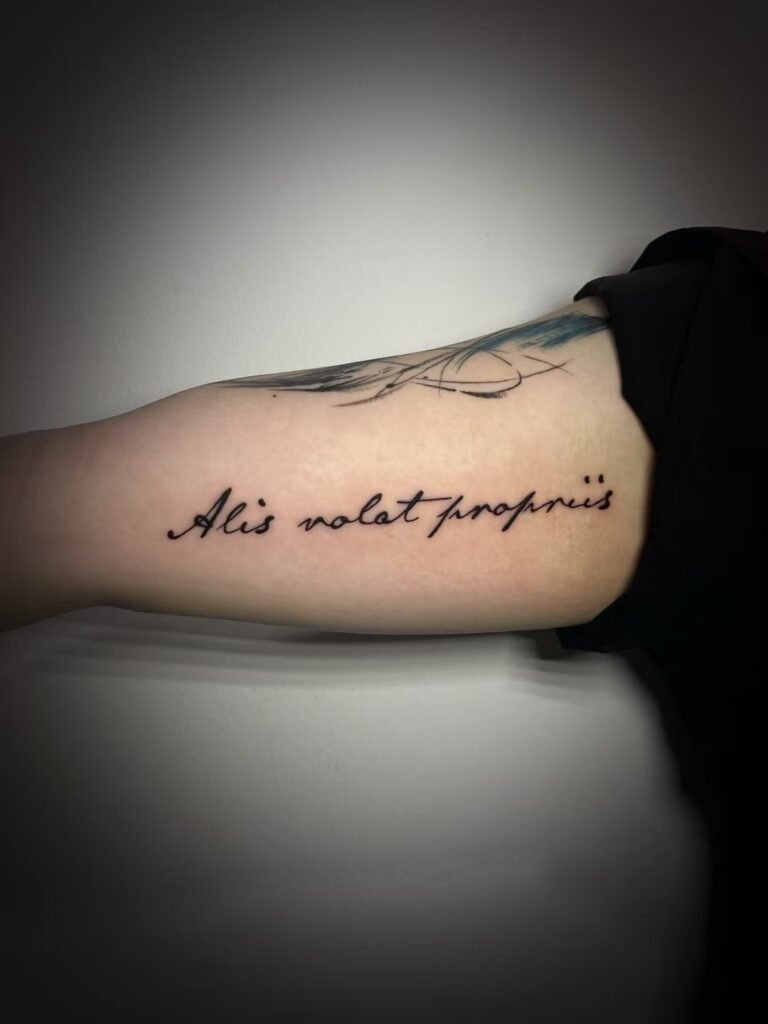
To avoid a spelling, translation or meaning mistake, complete a tattoo text translation check before the artist styles the words. Keep one plain-text master, confirm the original source and intended meaning, obtain independent language review when needed, then compare the approved text with the final stencil character by character.
Do not treat a translation app, dictionary result, attractive screenshot or confident friend as final proof. Translation and tattoo design are separate jobs. Bring language that has already been checked in context; the tattoo discussion can then focus on lettering, spacing, scale, placement and how the words sit on the body.
Separate what the text says from how it looks
Text tattoos can fail in two different ways. The wording can be wrong even though the lettering is beautiful, or the wording can be correct while the visual treatment makes it hard to read. Checking only one side leaves the other exposed.
Start with a version that has no design applied to it. It should be selectable text, not only pixels in an image. Record the exact capitalisation, accents, spaces, punctuation and line breaks. Beside it, save the visual reference that shows the lettering style you like. Label them clearly:
- Language master: the exact words or characters to be tattooed.
- Meaning note: what the full phrase is meant to communicate, in a language you understand well.
- Style reference: the handwriting, type or calligraphic movement you want to discuss.
This separation prevents a common mix-up. A reference may have the right brush energy but the wrong character. A font preview may contain the right words but replace an accent, join letters awkwardly or use forms that do not fit the language.
Trace the phrase back to its source
Write down where the wording came from. If it is a name, confirm it with the person or an authoritative record you are entitled to use. If it is a family phrase, ask who supplied the spelling and which language or regional form they use. If it comes from a poem, prayer, book or historical text, record the edition, page or official source rather than relying on a reposted image.
Then write the intended meaning as a full sentence. A single English gloss such as “strength,” “freedom” or “family” is too loose for translation. Does “strength” mean physical power, patience under pressure, moral courage or resilience? Does the phrase address one person or several? Is it formal, intimate, religious, archaic or deliberately playful?
The American Translators Association explains that accurate words are only part of translation; tone, register and cultural context affect how a message is received. A reviewer needs that context before deciding whether the target phrase says what you think it says.
Use an independent language review
If you do not confidently read and write the language, ask a qualified translator or a fluent reader with relevant language and cultural knowledge to review the complete phrase. A native speaker can be helpful, but everyday fluency alone does not guarantee knowledge of classical wording, religious language, regional usage or specialist calligraphy. Match the reviewer to the text.
Give the reviewer the source phrase, your meaning note, the intended language and region, and the exact target text. Ask for answers in writing:
- What is the literal meaning?
- What would a fluent reader normally understand?
- Does the wording sound natural for the intended setting and tone?
- Are there regional, historical or social associations worth knowing?
- Are the spelling, characters, accents and punctuation correct?
For names, idioms, religious text, classical language or a phrase with strong personal stakes, a second independent review is sensible. If reviewers disagree, stop. Do not choose the version that looks better. Ask them to explain the difference and settle the wording before design begins.
Check the risks that change by writing system
The same workflow works across languages, but the likely errors are different.
Latin-alphabet lettering
Check spelling against the source, then inspect accents, apostrophes, hyphens, capital letters and punctuation. Do not assume an accent is optional because the word remains recognisable without it. For handwriting, decide whether you want an exact facsimile, including unusual spelling, or corrected wording rendered in a similar hand. Those are separate requests.
Chinese characters and calligraphy
A Chinese calligraphy tattoo translation check should identify the exact language variety and whether the text uses simplified or traditional forms. Do not convert character by character and assume the phrase survives intact. Unicode’s Unihan documentation shows that simplified-to-traditional mappings can depend on context and can produce more than one possible character.
Unihan is useful for checking code points, readings and variant relationships, but it is not a phrase translator. Keep the verified characters as plain text even after choosing a brush reference. The Metropolitan Museum of Art describes seal, clerical, running, cursive and standard scripts as distinct forms; increasingly cursive writing may abbreviate or connect characters. Style therefore comes after the wording is fixed. For a deeper discussion of script and composition, use the Chinese calligraphy tattoo guide.
Japanese kanji and kana
A Japanese kanji tattoo translation check must review the whole Japanese expression, not a Chinese gloss attached to a shared-looking character. Confirm the kanji, kana, readings and any endings that belong to the phrase. Japan’s Agency for Cultural Affairs publishes the Jōyō Kanji table as guidance for kanji used to write modern Japanese in general social life. It is a reference point, not personalised approval for a name, idiom or tattoo phrase.
Right-to-left scripts
Arabic and Hebrew need an explicit direction check, especially when the text includes numbers, Latin letters or neutral punctuation. The Unicode Bidirectional Algorithm notes that these scripts display from right to left while embedded digits are written from left to right. A message window can therefore display a mixed string differently from the way its characters are stored.
Do not reverse the letters manually. Ask the language reviewer to approve both the selectable text and a final visual proof. Keep punctuation attached to the intended phrase, and have the reviewer inspect the exact layout that will become the stencil.
Mark direction, line breaks and punctuation
Once the words are settled, make a proof that shows how they should be read. Add an arrow outside the design to mark the reading path. Label the first character or first word. For several lines or columns, number the order. State whether the layout is horizontal or vertical and whether punctuation remains visible.
Line breaks can change emphasis and, in some languages, can make a phrase confusing. Ask the reviewer to approve the broken lines, not only the single-line master. If the design curves around an arm or follows the ribs, keep a flat proof as the language reference and a separate placement mock-up. This makes it easier to tell whether a concern is linguistic or compositional.
For a broader review of scale, subject, composition and placement, see what to check when reviewing a tattoo design. In this workflow, however, wording is the decisive gate. If the words are not final, the design is not ready for approval.
Compare the final stencil with the approved master
The last check happens after styling. Place the language master, approved visual proof and stencil side by side. Do not compare from memory.
Use a slow sequence:
- Count the words, characters, numerals and punctuation marks.
- Compare each item in order, pointing to both versions as you go.
- Check accents, dots, small marks, spaces and repeated characters.
- Confirm the first and last item and the reading direction.
- Have the language reviewer inspect the final proof if styling has changed the forms substantially.
- Check the transferred stencil directly on the body before tattooing begins.
Be careful with mirrors, selfie previews and flipped reference images. They can make correct text look reversed or hide an actual reversal. Ask which view represents the final result, then compare that view with the approved proof. If any mark is hard to identify, pause rather than guessing what the finished ink will show.
What Yuyi Tattoo can use in the design discussion
The wording boundary is straightforward. Yuyi’s fine-art background can inform proportion, visual balance, stroke weight, spacing, scale, placement and composition. It does not replace independent language verification. Yuyi Tattoo should not be treated as a certified translation service, and a tattoo consultation should not be used to invent or approve foreign-language wording on your behalf.
Bring the exact text after it has been checked. Yuyi can then work from that client-approved language master while discussing how the lettering functions as a tattoo design. If the master and visual reference conflict, the text remains the authority until the language reviewer confirms otherwise.
Send a clean text brief only after verification
When every language check is complete, prepare one compact message with:
- the exact selectable text;
- the source and intended meaning;
- the language, region and register;
- the reviewer’s approved version;
- a labelled style reference;
- horizontal or vertical direction and marked reading order;
- placement and approximate dimensions;
- any uncertainty that still needs to remain visible.
Use the Yuyi Tattoo contact page to send that brief and the reference images. The first design discussion can then start from fixed wording instead of spending time reconstructing text from screenshots.
Sources and review date
- American Translators Association — Translators as Cultural Consultants: Why We Bridge More than the Language Gap — reviewed 24 August 2026.
- Unicode Consortium — Unicode Standard Annex #38: Unicode Han Database — reviewed 24 August 2026.
- Unicode Consortium — Unicode Standard Annex #9: Unicode Bidirectional Algorithm — reviewed 24 August 2026.
- Agency for Cultural Affairs, Japan — Jōyō Kanji Table — reviewed 24 August 2026.
- The Metropolitan Museum of Art — Chinese Calligraphy — reviewed 24 August 2026.
Frequently asked questions
Can a tattoo artist translate my phrase for me?
Do not assume that tattoo design includes translation. Ask a qualified translator or suitable fluent reviewer to settle the exact wording first. The artist can then work with the approved text on spacing, scale, lettering and placement without being asked to certify its meaning.
Is a translation app enough for a one-word tattoo?
No. A short result can still have several meanings, tones or grammatical uses. Use the app only to begin research. Confirm the word in context, including the intended region, register and writing system, with someone qualified to review it.
How do I verify Chinese tattoo text?
Save the exact characters as selectable text, state the intended meaning in a full sentence, choose simplified or traditional Chinese deliberately, and obtain an independent phrase-level review. Check the final calligraphic proof against that master before approving the stencil.
Why should the reviewer check the final styled version too?
Lettering can introduce a new error even after the plain text is correct. A missing accent, joined stroke, ambiguous character, altered line break or reversed direction may appear during styling. The last proof confirms that the approved language survived the design process.
What should I do if two reviewers disagree?
Pause the design. Ask each reviewer to explain the literal meaning, natural reading, region and tone of their version. Resolve the difference with a translator or relevant language specialist before choosing a visual style. Appearance is not a safe tie-breaker.

