
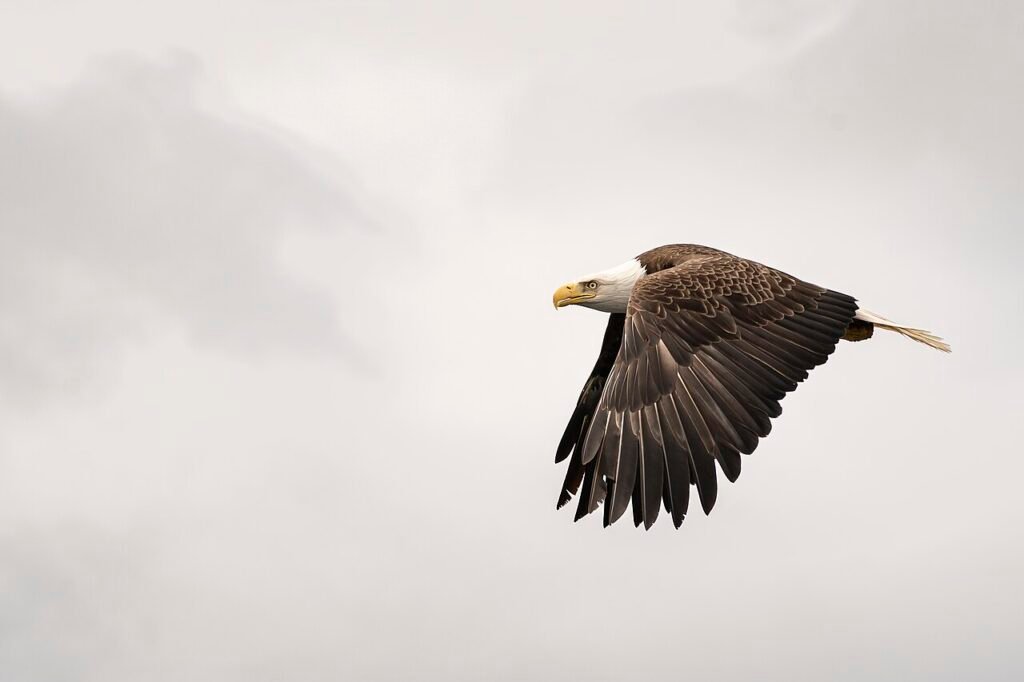
Eagle tattoo meaning varies with culture, period and personal context. Freedom, authority, focus, endurance and protection are possible personal readings, but the motif does not guarantee any one of them. A perched eagle, a broad soaring bird and a diving eagle communicate first through pose, gaze, wings and talons.
Decide the species and action before choosing background or text. A perched eagle needs a stable vertical shape. An open-wing eagle needs width. A dive needs a clear route through the body area. Once that geometry is settled, head direction, feather grouping and placement can turn a broad idea into a readable tattoo brief.
Choose a species or choose an intentionally generic bird
“Eagle” covers different species with different profiles, plumage and flight silhouettes. A bald eagle has a large projecting head and, as an adult, a white head and tail against a dark body. A golden eagle is generally dark brown with a golden nape; Cornell Lab identification material shows long broad wings, a relatively small head in flight and fingered wingtips often held in a slight V while soaring.
These differences matter even in black and grey. A white adult bald-eagle head creates a strong light focal point. A golden eagle relies more on the hooked beak, brow, nape and value changes within dark plumage. Mixing the white head of one species with the body proportions of another may be acceptable in a deliberate emblem, but it should not happen by accident.
Choose one of three directions:
- a recognisable species supported by clear natural-history references;
- a historical or heraldic eagle tied to a named source;
- an original, intentionally generic raptor that does not claim biological precision.
Write that choice in the brief. It prevents a folder of attractive eagle images from silently changing species between head, wings and talons.
Meaning belongs to a specific context
Eagles have appeared in many visual traditions, so a one-line worldwide definition is unreliable. Two Metropolitan Museum of Art objects show the range. A Toltec eagle relief dated 900–1200 depicts a bird of prey biting a stylised heart and was probably part of a larger architectural composition. A carved American eagle from 1800–1830 belongs to the patriotic decorative use that followed the bald eagle’s adoption for the United States national seal.
Those are distinct objects with distinct histories. They do not prove that every eagle tattoo means sacrifice, patriotism or imperial power. If your reference comes from a flag, military insignia, coin, Indigenous object, religious image or family emblem, identify the exact source and research its context. Do not combine several traditions under the label “ancient eagle symbolism”.
For a personal design, describe the intended mood in visual terms. “Still and watchful” suggests a perched body and controlled head turn. “Open and expansive” points toward soaring wings. “Fast and committed” may support a dive. The pose makes the reading visible without claiming that all viewers share your definition.
Perched: compact weight and controlled attention
A perched eagle folds most of its wings into the body, creating a vertical or slightly diagonal silhouette. The head, chest, feet and perch become more important because the wings no longer provide a wide outer boundary.
Choose where the head turns. A profile emphasises the hooked beak and long brow line. A three-quarter head can show both eyes but needs enough room to keep the far eye and beak centre aligned. A frontal head feels emblematic and direct, yet small errors in symmetry become obvious.
The feet should have a reason to grip. A branch gives an organic base; a rock creates heavier weight; an emblem may use a simplified support. Talons require space, but they should not receive so much contrast that they compete with the eye. On a forearm or calf, the folded wing can follow the long axis while the head turns toward the main view. On the upper arm or thigh, a three-quarter body has more room for chest and tail.
A perched pose works when the client wants the face and watchful posture to lead. It is less suitable if the main request is a dramatic wingspan, because adding half-open wings to a narrow vertical space often produces cramped elbows and cropped feathers.
Open wings: decide whether the design is an emblem or a bird in space
A fully spread eagle can be arranged as a near-symmetrical emblem or as a turning bird with one wing closer to the viewer. The first uses balance and a central axis. The second creates depth and movement.
A symmetrical spread needs a broad body area. The upper back and chest can support a left-to-right wingspan, but the spine or sternum becomes a structural centre that must be planned. Shoulder blades, pectoral movement and arm position change the wing edges. The drawing should be checked with the body relaxed, not only with arms held wide for a photograph.
An angled soaring pose can use the shoulder-to-upper-arm route, a thigh or a large side panel. One wing may appear shorter because it recedes in perspective. That is not necessarily an error. Forcing both wings to equal length can flatten a pose that was meant to turn.
Decide what the open wings are doing:
- Soaring: broad wing planes, calmer tail and clear air around the silhouette.
- Banking: one wing higher or more visible, body tilted and head redirected.
- Landing: wings braking, tail spread and talons prepared to meet a surface.
- Taking off: stronger diagonal through body and legs, with wings driving the movement.
The action affects every joint. Do not collect a head from a perched bird, wings from a soaring photograph and talons from a landing image without reconciling their light and anatomy.
Diving or striking: preserve the route before the details
A diving eagle narrows its silhouette. Wings may sweep back or change angle, the body points along a strong diagonal, and the gaze follows the target. This format can fit a side torso, thigh, shoulder-to-arm path or larger calf better than a perfectly horizontal wingspan.
The route needs an entry and exit. On an upper arm, the head may lead downward while a wing wraps toward the shoulder. On a thigh, the body can travel from outer hip toward the knee without placing the focal head on the most curved edge. On the back, a long dive can be dramatic, but it should not become a thin line floating in unused space.
Talons are optional in a pure dive and prominent in a strike or landing. If they are open, check that each foot belongs to the body angle. Overlarge talons, a frontal head and two fully spread wings can each be dramatic alone; demanding all three at equal scale often removes the sense of speed.
Background should reinforce the route. A cloud break, wind line, cliff edge or open skin can show direction. It is rarely necessary to fill the remaining area with a complete landscape.
Group feathers into a wing structure
A wing reads through a few large parts before it reads through individual feathers. Establish the leading edge, the outer fingered tips, the inner trailing mass and the relationship between both wings. Then decide where selected feather separations help the turn or light.
Drawing every feather with the same outline and contrast can make the wing look like a fan. Grouping feathers creates hierarchy. The outer tips may need clear negative gaps; the inner wing can use broader overlapping masses; only a few edges need sharp emphasis near the focal area.
The tail is a steering shape, not leftover decoration. A spread tail helps braking or landing. A narrower tail supports forward travel. It also links the body to a perch, cloud or lower background. If the tail disappears into a dark wing or landscape, the bird can look shortened.
Use the tattoo readability guide to test the silhouette at normal viewing distance. Zooming in should reveal texture, but zooming out should still show whether the eagle is perched, soaring or diving.
Head direction controls the viewing order
The eye and beak form a small but strong arrow. On a profile, the beak points the viewer toward the next part of the tattoo or out of the frame. A head turned against the body’s travel introduces tension. A head aligned with the dive makes the action direct.
Body language such as “facing inward” is too vague on a rotating limb. Specify left or right body side, front or outer surface, and where the beak points when you stand naturally. Use a second photograph with the limb moved so the artist can see where the wing will wrap. The placement-description guide provides a practical photo and direction format.
If the eagle is paired with lettering, a second animal or a circular element, decide whether the gaze leads toward it. An eye that points out of the composition while every background line points inward can feel accidental. Direction is a design choice, not a rule that an eagle must face the heart or face forward.
Match the pose to the available body field
| Placement | Eagle format that often fits | Main check |
|---|---|---|
| Forearm | Perched profile, folded wing, compact diving head | Does the beak point clearly in the relaxed arm view? |
| Upper arm and shoulder | Three-quarter head, banking bird, partial wing wrap | Does the near wing survive arm rotation? |
| Chest | Frontal emblem, open wings or broad landing pose | How do sternum and pectoral movement affect balance? |
| Back | Full wingspan, large bank, dive or environmental scene | Which element remains the first focal point? |
| Thigh | Perched full body, soaring angle, landing or strike | Does the silhouette work from front and side? |
| Calf | Vertical perch, folded-wing bird or narrow dive | Can head, feet and tail stay separate on the taper? |
A broad design does not have to use all available width, and a narrow placement does not require a cropped head. Change the pose before shrinking every feather. There is no universal minimum size; the workable scale depends on species, view, feather density, placement and background.
The crane tattoo composition guide offers a useful contrast. Cranes rely on a slender neck, long legs and spacious landscape rhythm. Eagles depend more on wing mass, hooked beak, chest weight and talons. Copying a crane’s light vertical structure will not automatically suit an eagle.
The angel wings tattoo guide deals with wings detached from bird anatomy and the meanings supplied by that separate motif. An eagle design should keep the body, species and action connected to its wings.
Prepare a useful eagle tattoo brief
Before contacting an artist, collect:
- the chosen eagle species or the named historical reference;
- perched, soaring, banking, landing, taking-off or diving action;
- head angle and beak direction;
- symmetrical emblem or natural three-dimensional view;
- one primary reference with clear wings, head and light direction;
- any essential background, object or text and its source;
- colour or black-and-grey direction;
- body side, surface, approximate boundaries and placement photographs.
Send the focused brief through the Yuyi Tattoo contact page. Yuyi Tattoo’s documented portfolio includes black-and-grey realism, large-scale work and Asian-inspired compositions. The suitability, scope, schedule and final design for an eagle tattoo in Singapore are assessed from the individual project.
Sources and review date
- US Fish and Wildlife Service: Bald Eagle; reviewed 24 August 2026.
- Cornell Lab of Ornithology: Golden Eagle Identification; reviewed 24 August 2026.
- The Metropolitan Museum of Art: Toltec Eagle Relief; reviewed 24 August 2026.
- The Metropolitan Museum of Art: American Eagle, 1800–1830; reviewed 24 August 2026.
Frequently asked questions
What does an eagle tattoo mean?
There is no universal eagle tattoo meaning. Freedom, authority, focus, endurance or protection may be personal readings, while historical eagles have specific cultural contexts. Pose, source, gaze and the wearer’s own reason determine the appropriate explanation.
Should an eagle tattoo be perched or flying?
Choose perched when the head, chest and watchful posture should lead. Choose flying when wingspan, direction and open space matter more. A dive or landing gives stronger action. The available body field may decide which pose remains readable.
Where should an open-wing eagle tattoo go?
A broad symmetrical wingspan often needs the chest or upper back. A banking or three-quarter eagle can fit the shoulder, upper arm or thigh because one wing may recede or wrap. Test the silhouette on the actual body rather than assigning a placement from a flat image.
Which way should an eagle tattoo face?
Set direction from the preferred relaxed-body view. The beak can lead into another element, follow the line of travel or turn against it for tension. State the body side and exact surface instead of relying on “inward” or a mirrored selfie.
Do all individual wing feathers need to be shown?
No. The wing should first read as a leading edge, outer tips and larger overlapping masses. Selective feather separation can support light and movement. Giving every feather equal outline and contrast can flatten the wing into a decorative fan.
What should I send for an eagle tattoo enquiry in Singapore?
Send the species or source, pose, head direction, one main reference, required background or text, colour direction and clear placement photographs. State whether you want a symmetrical emblem or a natural view so the wings can be planned for the correct body field.


