
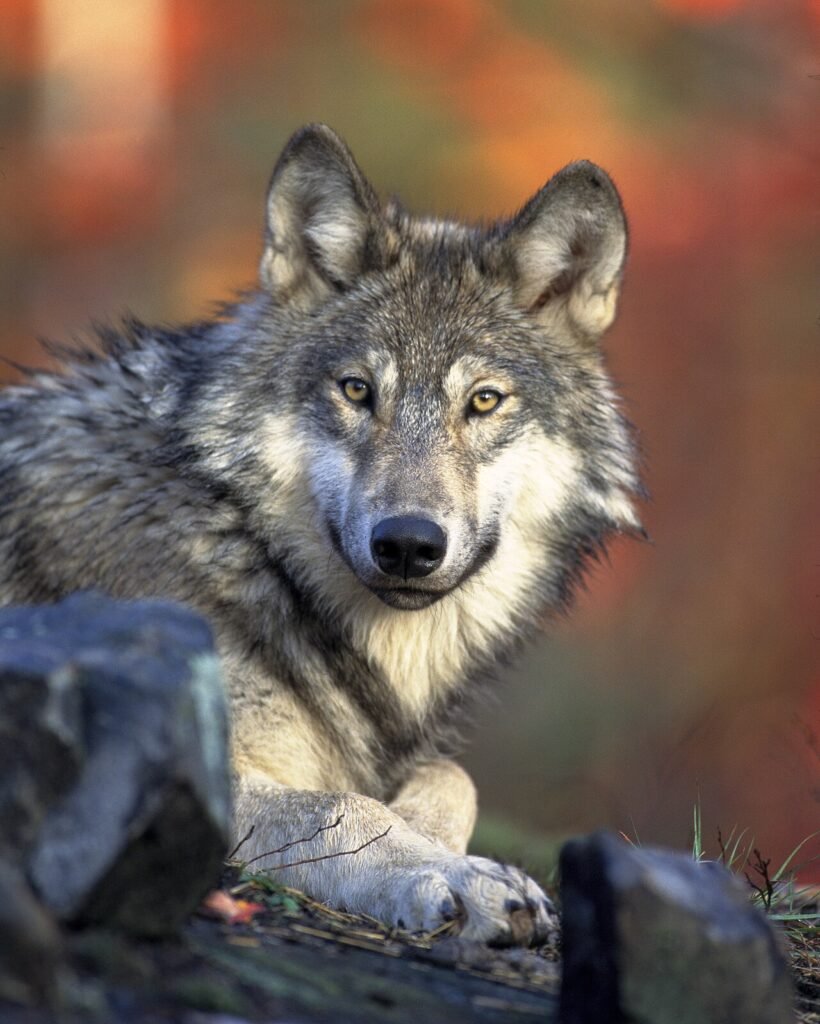
Wolf tattoo meaning is not universal. Independence, family, loyalty, vigilance, survival and wilderness are common personal associations, but none can be read automatically from every wolf image. The visible meaning comes from what the animal is doing, where it looks and whether it appears alone, with a partner or inside a group.
Choose the relationship first. A solitary wolf crossing a ridge, two wolves sharing a line of sight and a pack travelling in one direction are three different compositions. Posture, habitat, scale and placement should support that choice. They should not be added as interchangeable symbols after the main image is already crowded.
Start with a scene in one sentence
A useful wolf brief begins with a scene that could be photographed: “one wolf standing still and looking back”, “two wolves moving together through a sparse forest” or “a close head with a quiet, level gaze”. This tells the artist more than a list such as strength, freedom, mystery and protection.
Keep the personal reason in a second sentence. It may explain why a pair represents a relationship or why an isolated animal matters to you. The artist needs that context, but the drawing still has to communicate through visible decisions. If the private story and the desired mood do not match, decide which should control the image.
Natural-history sources help with credible behaviour without assigning a human moral. The US National Park Service explains that a wild wolf pack is normally a family unit, not the permanent contest implied by a simplified “alpha” ladder. The Smithsonian notes that wolves use posture, ears, tail, facial expression and gaze as communication. These observations can improve the drawing; they do not dictate what your tattoo must mean.
Let posture carry the first impression
A viewer recognises the outline and body angle before seeing individual hairs. Choose a posture with one clear verb.
| Posture | Main visual line | What the viewer is likely to notice first | Space requirement |
|---|---|---|---|
| Standing alert | Level back, lifted head, planted legs | Stillness and attention | Enough width to separate all four legs or simplify them |
| Walking or trotting | Long spine and forward step | Direction and travel | A horizontal or diagonal lane |
| Looking back | Torso and head point in different directions | Tension between movement and gaze | Room for the neck turn to remain believable |
| Howling | Raised muzzle and open throat | Vertical silhouette and sound implied by pose | Clear space above the nose and around the neck |
| Resting or crouched | Folded limbs and low body | Containment, waiting or calm | A compact shape with readable paws and tail |
A raised head is not automatically dominance, and a lowered body is not automatically fear. Ear angle, tail position and surrounding action all matter. Use behaviour references to draw a coherent posture, then attach personal meaning only where it belongs.
A howling wolf does not require a full moon. Howling is a form of communication, according to the NPS and Smithsonian. The moon can still be chosen as a circle, light source or environmental cue, but it should not be presented as a scientific trigger or universal spiritual code.
Build a recognisable wolf before adding atmosphere
A wolf can become a generic canine when the head and body are assembled from incompatible references. Protect the long muzzle, cheek shape, ear position, chest depth, back line, legs and tail as one animal. A close portrait spends most of the area on eyes, nose and fur planes. A full body spends it on movement, weight and silhouette.
Choose one primary reference that clearly shows the desired angle. A front-facing image needs both eyes and the nose aligned well enough to establish the head. A profile needs the muzzle, forehead and neck transition. A three-quarter head needs an unambiguous near eye, far eye and turning plane. The animal portrait reference guide explains how focus, lighting and crop affect animal likeness.
Supporting images can clarify winter coat, paw position or tail shape, but label the feature you want from each. Combining the eyes from one wolf, muzzle from another and body from a dog without a clear plan can remove the very anatomy that makes the subject readable.
Fur should be organised in directional masses. The cheek ruff, neck, shoulder and flank do not need identical strands. Preserve a few major light and dark groups, then use selective texture near the face or along the line of action. If every patch receives equal detail, the body can dissolve into grey noise.
A solitary wolf needs direction, not empty isolation
One wolf gives the clearest focal point. The challenge is making the surrounding space intentional. A profile can travel across the forearm, calf, thigh or side torso. A frontal head can hold a compact upper-arm or thigh field. A howling profile creates a strong vertical that may suit a calf, forearm or longer side panel.
Decide where the animal came from and where it is going, even if the landscape remains minimal. A low ridge under the paws can support movement. One tree line can establish depth. Open skin can become sky, snow or distance. Filling every gap with forest texture usually weakens the isolation that made the single figure appealing.
“Lone wolf” is a personal label, not a full biological account. Young wolves may leave a family pack and travel in search of territory or a mate. If independence is your theme, posture and direction can express it without inventing a permanent rule that wolves are naturally detached from social groups.
A pair is about interaction between two lines of sight
Two wolves should do something in relation to each other. They may travel in the same direction, stand back-to-back, meet at an angle or use one near figure with a smaller distant figure. Mirroring two identical heads is possible, but it often reads as an emblem rather than a living interaction.
Choose whether the pair is equal. Equal scale and contrast make both animals compete for the first look. A larger near wolf and quieter second figure create hierarchy. Overlapping bodies save space but require clear edges around the heads, chests and legs. Two separate portraits need a framing device so they do not look like unrelated stickers.
If the pair represents partners, siblings, parent and child or another relationship, state that as your own context. Do not rely on a generic online chart to certify it. Accurate age and size references matter if one animal is meant to be younger; simply shrinking an adult head can make the relationship visually unclear.
A pack needs a route through the image
A pack tattoo is not a row of equal wolf faces. It needs a lead focal animal, supporting figures and a shared direction. Start with silhouettes at different depths. One may be close and detailed, another partially hidden, and distant wolves can be reduced to simpler shapes.
Use overlap deliberately. Heads should not merge with another animal’s back, and legs should not become a forest of parallel marks. A diagonal travel line can move from the shoulder toward the upper arm, across a thigh, or through a back composition. A shallow arc can organise several animals across the chest or upper back.
Real packs are usually family groups, but the tattoo’s specific family meaning comes from the wearer. The biological fact prevents a false stereotype; it does not prove a personal story. If the pack stands for named people, decide whether each individual needs a distinct role or whether the group as a whole is enough.
Habitat should frame the animal, not certify its meaning
Forest, mountain, snow, moon and mist are composition tools. They establish depth, season and light. They do not automatically turn a wolf into a spiritual guide, nor does removing them make the tattoo less meaningful.
A dense conifer forest adds vertical rhythm and can suit a calf, forearm or back panel. A ridge gives a walking animal ground and a clear horizon. Snow can be represented through open skin and restrained texture. Mist can separate a near wolf from distant figures. The simplest background is often one that supplies only the line or contrast the silhouette needs.
Museum objects show why format matters. The Metropolitan Museum of Art’s nineteenth-century Japanese netsuke of a wolf compresses the subject into a small carved volume, while Rubens’s large Wolf and Fox Hunt uses multiple animals and diagonals across a monumental canvas. Neither provides a universal tattoo meaning. Together they show how scale and viewing format change what an animal image can carry.
Fit the viewing path to the body
Wolf tattoo placement should follow the composition’s direction. A long travelling body needs a lane; a frontal portrait needs a stable primary view; a pack needs enough area to establish depth.
- Outer upper arm and shoulder: useful for a turning head, compact portrait or body that begins on the shoulder and travels down the arm. Check rotation from front and side.
- Forearm: suits a profile, howling head or simplified walking animal. Decide which way the muzzle points when the arm hangs naturally.
- Chest: can hold a broad pair or one central head, but the sternum and pectoral movement affect symmetry.
- Back: provides room for a pack route, landscape depth or a single animal with substantial habitat. Name the primary viewing side rather than filling the whole field by default.
- Thigh: supports a portrait, full body, pair or layered scene. Test the silhouette from front and side while standing.
- Calf: favours a vertical howl, profile or compact body. Keep paws and landscape from crowding the taper toward the ankle.
The placement-description guide helps identify side, surface, boundaries and head direction in photographs. After the pose is placed, use the tattoo readability guide to test whether the face, body and supporting wolves still separate at normal viewing distance.
Prepare a wolf brief that can be drawn
Send the following before a consultation:
- one sentence for the visible scene and one for the personal context;
- solitary, paired or pack format;
- the chosen action, gaze and head direction;
- one primary wolf reference with its source or permission noted;
- any essential habitat element and anything you want excluded;
- colour or black-and-grey direction;
- left or right body side, surface and approximate boundaries;
- clear placement photographs taken without a mirror reversal.
Use the Yuyi Tattoo contact page when the scene and placement are ready. Yuyi Tattoo’s documented portfolio includes black-and-grey realism, large-scale work and Asian-inspired compositions. A wolf project’s suitability, scope, schedule and final design still need to be assessed from the individual brief.
For a useful contrast, the lion tattoo planning guide treats mane, feline weight and single-or-paired composition. A wolf brief should keep its canine anatomy, family-group logic and travelling silhouette rather than borrowing a lion structure with a different head.
Sources and review date
- US National Park Service: Wolf Ecology Basics; reviewed 24 August 2026.
- Smithsonian’s National Zoo: Gray Wolf; reviewed 24 August 2026.
- The Metropolitan Museum of Art: Netsuke of a Wolf; reviewed 24 August 2026.
- The Metropolitan Museum of Art: Wolf and Fox Hunt; reviewed 24 August 2026.
Frequently asked questions
What does a wolf tattoo mean?
There is no single wolf tattoo meaning. Independence, family, loyalty, vigilance and survival may be personal readings, but posture, group relationship, gaze and habitat determine what the image actually shows. State your own context instead of treating a motif list as a universal definition.
Is a lone wolf tattoo different from a pack tattoo?
Yes as a composition. One wolf can hold a clear focal point and directional silhouette. A pack needs hierarchy, overlap and a shared route. In natural history, wild packs are usually family units, while individual wolves may disperse; neither fact assigns your personal meaning.
Should a wolf tattoo be howling at the moon?
Only if the moon helps the composition or matters to your story. Wolves howl to communicate, not because a full moon is required. A circle behind the muzzle can be visually effective, but it should not be presented as a universal symbol or biological rule.
Where does a wolf tattoo fit best?
The pose decides. A vertical howl can suit a forearm or calf, a travelling body needs a longer lane, a frontal portrait needs a stable view, and a pack usually needs a broader area such as the thigh, chest or back. Test the design on photographs of the actual surface.
How should several wolves be arranged?
Choose one lead focal animal, then vary scale, overlap and detail for the supporting wolves. Give the group a common direction or interaction. Avoid a row of identical heads unless a deliberately emblematic layout is the goal.
What should I send for a wolf tattoo enquiry in Singapore?
Send one main reference, the number of wolves, posture, gaze, habitat, colour direction, placement side and clear body photographs. Add one sentence about personal context and identify any non-negotiable element. Project details are then reviewed from that focused brief.


