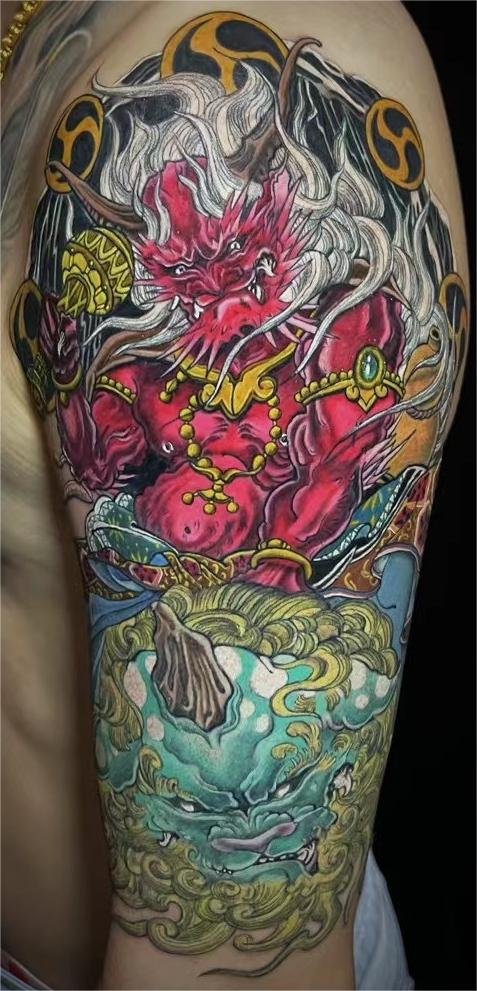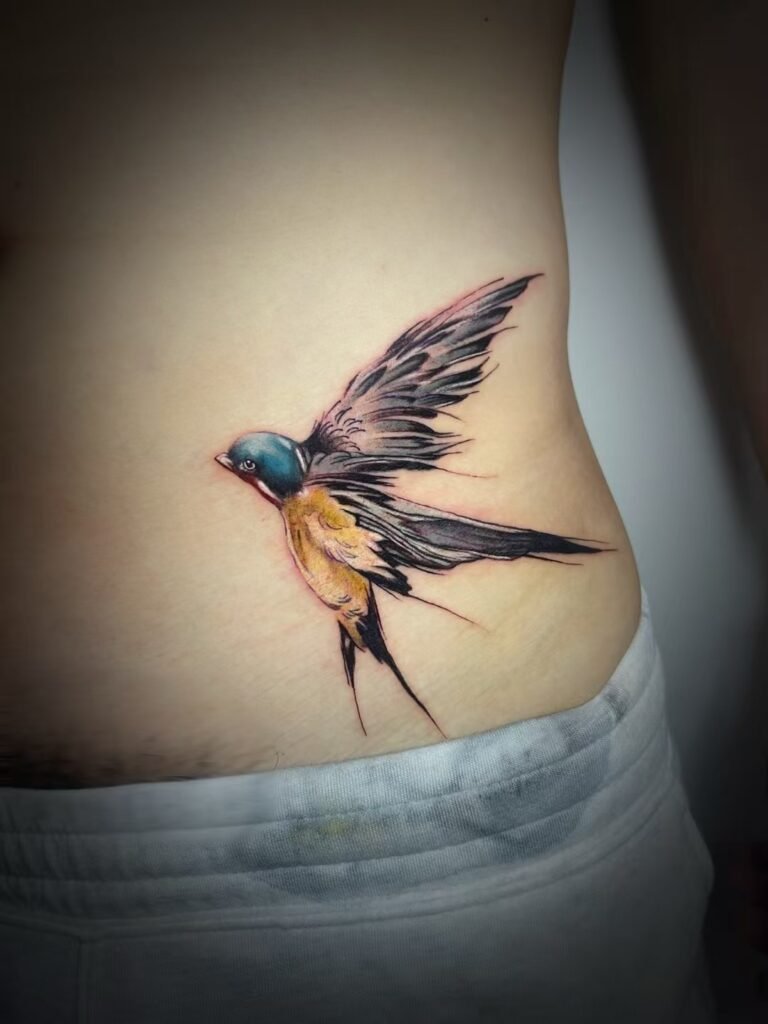
Choose a mountain composition when you want a broad horizon, an ocean composition when movement should lead the eye, and a tree composition when one vertical form should anchor the tattoo. The best option is the one whose silhouette fits the available body area before small scenery, texture or symbolism is added.
Placement follows that structure. A mountain ridge generally asks for width, water can turn and wrap, and a tree needs enough length for its trunk, crown and any visible roots. These are design starting points rather than rules about what a motif must mean. Your own place, memory or association should guide the meaning, while scale and body shape guide the drawing.
Begin with the shape you want people to see first
Nature references are often full of detail: mist between several peaks, foam on a wave, hundreds of needles on a pine, a moon, stars and a distant cabin. A tattoo cannot give every part equal visual weight. It needs one first read.
Reduce the idea to a dark paper cut-out in your mind. If all internal detail disappeared, would the outer shape still look like a mountain range, a turning wave or a tree? That silhouette is the design’s foundation. Negative space is the unfilled area around and between forms. In a tattoo, untouched or lighter skin beside the main shape can be as important as the marks inside it.
This test separates the three structures more clearly than a list of popular meanings:
| Main structure | First visual read | Space it usually needs | Common planning problem |
|---|---|---|---|
| Mountain horizon | A sequence of peaks across a baseline | Width for the ridge and depth layers | Too many peaks and tiny foreground details |
| Ocean movement | A curve, surge, current or repeated rhythm | Room to travel or wrap in a chosen direction | Foam and texture obscuring the main wave shape |
| Vertical tree | Trunk, branching crown and sometimes roots | Length plus enough width for the canopy | A large crown compressed onto a narrow placement |
Decide which row best describes the tattoo you want before choosing a species, coastline or mountain location.
Mountain tattoos are built around a horizon
Mountain tattoo placement works best when the ridge has enough lateral room to establish a recognisable profile. That does not require a panoramic back piece. It does mean that a long chain of peaks squeezed into a narrow vertical strip will either become very small or lose the feeling of distance.
A mountain composition has three useful layers. The skyline gives the design its identity. A middle layer may suggest overlapping slopes, cloud or a valley. A foreground can add trees, rock or a path, but it should not become a second landscape fighting the ridge. If the specific place matters, identify the peak from a clear photograph rather than relying on a generic triangular icon.
Body areas with visible width can support a longer horizon: the shoulder blade, upper back, upper arm viewed from the side, thigh or broad part of the calf. On a forearm, the design may work better as one dominant peak or a ridge that wraps, rather than a wide postcard reduced to fit. A band-like horizon around an arm or leg needs deliberate handling at the join so the ends do not meet awkwardly.
The horizon also decides how much visual weight belongs above and below the ridge. The National Gallery of Art’s account of Fragonard’s Mountain Landscape at Sunset describes a low horizon and a heavy tree mass balanced by smaller bushes and clouds. A tattoo does not need to imitate that painting, but the compositional lesson is useful: distant peaks, foreground trees and sky should not all carry equal weight.
Mountain meaning is not universal. The same peak may stand for a home landscape, a journey, religious geography, endurance or simply a shape the wearer loves. Museum sources show that mountains carry different roles in different art traditions. The Metropolitan Museum of Art’s survey of Chinese landscape traditions, for example, follows landscapes through poetic, magical, historical and other uses. That history should not be converted into a blanket claim that every mountain tattoo means the same thing.
Ocean tattoos need a direction, not only a wave symbol
An ocean tattoo can be calm, tidal, turbulent, deep or open, but those words do not yet form a composition. First decide how the water moves. Is there one crest turning over, several parallel currents, a low horizon, a circular eddy or water acting as background around another subject?
The answer changes placement. A single curling wave can sit within a compact area if the crest and hollow remain clear. Long current lines can travel along a forearm, calf or side of the body. Water can also wrap around the upper arm and connect a front view to a back view, but the main crest should still have a chosen face. If every angle contains the same amount of foam and texture, the tattoo may have motion everywhere and direction nowhere.
Scale hierarchy can make a water composition feel larger than its physical dimensions. The Met notes that Hokusai used perspective in Under the Wave off Kanagawa to place Mount Fuji as a small triangle inside the hollow of the cresting wave. The useful lesson is not to reproduce that famous print. It is that one strong curve, one quiet distant form and a clear gap between them can create depth without filling every part of the scene.
For an ocean tattoo meaning, start with the relationship you actually have to water. It may refer to a coast, work, migration, family, sport, weather or a private memory. Avoid borrowing a cultural wave style only because it appears in search results. If the visual language comes from a named art tradition, identify that source and discuss whether you want an informed reference or only the natural movement of water.
Water can also support an Asian-inspired composition, where waves, cloud and open skin help move the eye around a larger subject. You can review Japanese and Asian-inspired tattoo composition for examples of background movement, without treating that page as a dictionary for all ocean imagery.
Tree tattoos depend on trunk-to-crown proportion
A tree is the clearest vertical option of the three. The trunk creates an axis, branches spread into a crown, and roots may provide a lower counterweight. That structure suits a long body area, but the proportions must match it. A narrow forearm or calf can hold a tall trunk and a restrained crown. A broad shoulder blade, thigh or back panel gives the canopy more room to spread.
The species matters visually before it matters symbolically. A pine has a different outline from a banyan, willow, palm or leafless deciduous tree. One rises through clustered tiers, another hangs, another radiates from a slim trunk. If you name a species, send references that show its branching habit and overall outline. A generic trunk with mismatched leaves can undermine a tattoo intended to represent a particular place or family garden.
Tree tattoo meaning also depends on context. The Met’s essay on botanical imagery in European painting notes that a single plant could receive varied and even conflicting meanings from different sources. Its exhibition on scholars’ rocks documents pine symbolism within a particular Chinese pictorial genre. Neither source creates a universal tree dictionary. A personally significant rain tree can carry a completely different meaning. State whether the species, the individual tree or the general idea of growth is most important.
Roots are optional. They can make the design feel grounded and can balance a wide crown, but elaborate roots consume length and often create many thin intersections. If the placement is already short, choosing either roots or a broad canopy may preserve the tree better than shrinking both.
Combining land, water and trees without making a miniature poster
Mountains, ocean and trees can share one tattoo, but one structure should lead. A mountain-led design can use a small tree line as scale and a river or cloud as a route through the scene. A water-led design can carry a distant ridge as a quiet horizon. A tree-led design can frame a small landscape through its branches. Three equal motifs usually produce three competing focal points.
Choose the hierarchy in one sentence:
- “The mountain profile is the subject; trees only show scale.”
- “The current is the subject; the land is a distant boundary.”
- “The tree is the subject; the ocean appears through the open branches.”
That sentence is more useful than assembling many finished tattoos into a collage. If you need help assigning a role to each image, use the tattoo enquiry guide to label subject, placement, scale and reference priorities.
Match detail density to the body area
Nature scenes tempt people to ask for more: another ridge, a flock of birds, stars, coordinates, a compass, a cabin and the exact pattern of every leaf. Each addition takes space away from the main silhouette. Rather than asking whether all of it can fit, ask what must remain readable when the arm is relaxed and viewed at an ordinary distance.
Photograph the proposed placement from more than one angle. Mark the approximate top, bottom and side limits. Then test a simple outline at that size. A mountain may need fewer peaks. A wave may need a larger hollow and less foam. A tree may need grouped foliage rather than individual leaves. This is composition editing, not a loss of meaning.
Curved areas also change the view. A wide landscape wrapped far around an arm is never visible all at once. That can be intentional if the scene unfolds as the body turns. If you want an immediate emblem, keep the decisive silhouette on the main viewing plane and let secondary material turn away.
Decide meaning with a short evidence trail
Before attaching a meaning to a nature motif, write down where the interpretation comes from. There are three different kinds of answer:
- A personal association, such as a coastline where you grew up.
- A documented meaning from a specific artistic, religious or cultural tradition.
- A contemporary tattoo convention found in portfolios and search results.
All three can inform a design, but they should not be blended into a false universal definition. The Metropolitan Museum’s landscape resources show how even mountain, water, rock and plant forms change function across works and periods. A personal tattoo can depart from those histories, provided the brief is honest about what is personal and what is sourced.
What to send for a focused nature tattoo brief
Prepare a compact set instead of a large inspiration board:
- State the dominant structure: mountain horizon, ocean movement or vertical tree.
- Name the exact place, species or body of water if accuracy matters.
- Send one clear subject reference and one composition reference, labelled by role.
- Include placement, side of the body and approximate dimensions.
- Mark the direction the ridge, current or branches should travel.
- List one or two required details and identify everything else as flexible.
- Say whether any cultural art tradition is being referenced and provide its source.
When those decisions are ready, contact Yuyi Tattoo with the brief and placement photos. The first review can then focus on the shape that belongs on your body rather than trying to decode a folder of unrelated scenery.
Sources and review date
- National Gallery of Art — Mountain Landscape at Sunset — reviewed 24 August 2026.
- The Metropolitan Museum of Art — Under the Wave off Kanagawa — reviewed 24 August 2026.
- The Metropolitan Museum of Art — Streams and Mountains Without End: Exhibition Themes — reviewed 24 August 2026.
- The Metropolitan Museum of Art — The World of Scholars’ Rocks — reviewed 24 August 2026.
- The Metropolitan Museum of Art — Botanical Imagery in European Painting — reviewed 24 August 2026.
Frequently asked questions
What is the best placement for a mountain tattoo?
Choose an area that gives the ridge enough width at the intended scale. The upper back, shoulder blade, thigh, upper arm and broad calf can support a horizon, while a forearm may suit one dominant peak or a ridge designed to wrap. The exact choice depends on your body and how much foreground you want.
What does an ocean tattoo mean?
There is no single ocean tattoo meaning. It can refer to a real coast, movement, work, family history, travel or a private event. Name your own association and identify any cultural visual source separately instead of relying on a generic symbol list.
What does a tree tattoo mean?
A tree can carry personal ideas such as place, family or change, while particular species have documented associations in particular cultures. Choose whether the species, an individual remembered tree or the general silhouette matters most, then research any claimed traditional meaning at its source.
Can mountains, waves and trees fit in one small tattoo?
They can appear together, but a small design needs a strict hierarchy. Let one motif create the silhouette and reduce the others to supporting shapes. Trying to preserve a complete mountain panorama, detailed wave and full branching tree at small scale usually makes all three less clear.
Should a nature tattoo copy a photograph exactly?
A photograph can identify a real peak, coastline or tree, but the tattoo still needs editing for placement and scale. Send the original image and explain what must stay accurate. Let the composition simplify lighting, texture and secondary scenery rather than asking for every pixel to be reproduced.