
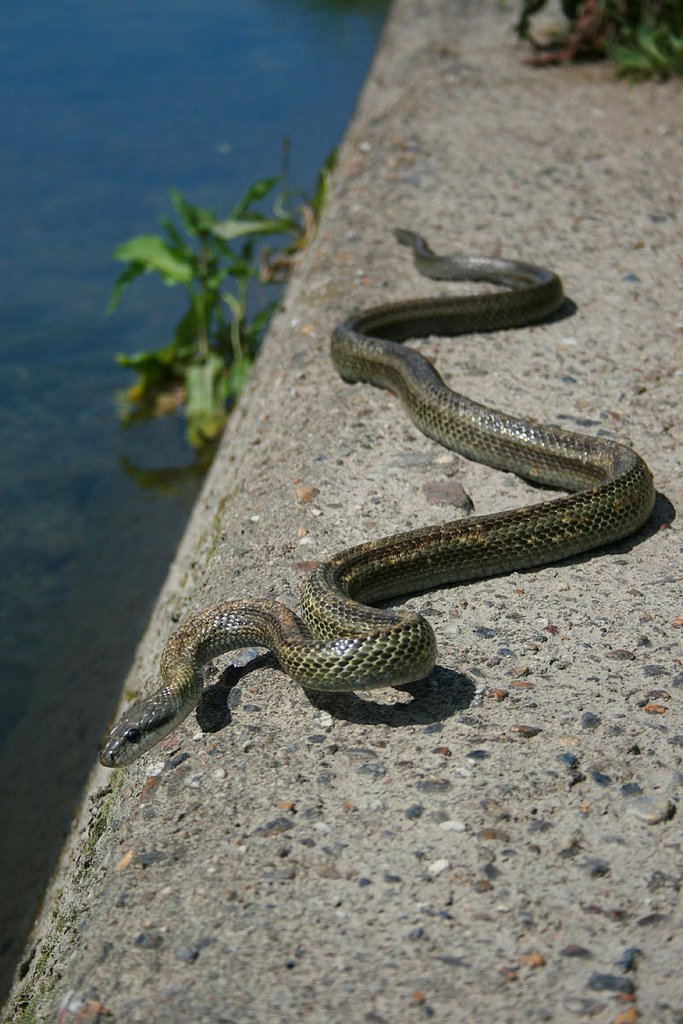
Japanese snake tattoo meaning depends on the source. A natural snake study, a zodiac image, the white serpent associated with Ugajin, and the many-headed Yamata-no-Orochi belong to different traditions. Choose one reference lane before assigning a personal meaning or adding supporting motifs.
The design should then follow the snake from head to tail. Head placement sets the focal point, the spine sets direction, and the coils decide how the image crosses an arm, leg or torso. A successful brief explains that movement in plain terms instead of asking for a generic snake wrapped around a body part.
Start with a named Japanese reference
There is no reliable one-line answer such as “a Japanese snake always means protection” or “a snake always means rebirth.” Museum collections show snakes in several distinct roles, and those roles should not be merged simply because they use the same animal.
One route is natural observation. The Metropolitan Museum of Art holds an Edo-period sheet of snake-head studies associated with the school of Hokusai. It records heads from several angles without presenting a myth or deity. This is useful for a tattoo led by animal form: jaw, eye, scale pattern and movement can be the subject without claiming a fixed symbolic story.
A second route is calendrical. Snake images appear as the sixth animal of the East Asian zodiac and may be made for a Year of the Snake. That context concerns a cycle of years; it should not automatically be turned into a statement about danger, healing or transformation.
Religious imagery requires greater precision. Japan’s Cultural Heritage Online records a fifteenth-century painting of Benzaiten with a small white serpent on her head. The object description identifies the serpent as Ugajin, a native deity of grain combined with the Buddhist goddess in that work. A white snake beside a lute-like biwa or Benzaiten reference therefore belongs to a specific iconographic setting. It is not evidence that every white snake in Japanese art has the same meaning.
Mythic serpents form another lane. Kokugakuin University’s account of Yamata-no-Orochi explains the many-headed, many-tailed serpent defeated by Susanoo in the Kojiki. The article also discusses a water and flood interpretation of the tale. That is a named monster in a named story, not a general label for an ordinary snake.
Pick the lane that actually matches your interest. If your saved references mix a realistic viper, a white Ugajin image, Hannya, and an eight-headed Orochi, separate them before asking an artist to combine them.
Let the head establish the subject
The head is the first decision in a Japanese snake tattoo design because it tells the viewer where the movement begins. It also reveals whether the reference is a recognisable species, a stylised Edo-era animal, or a supernatural serpent.
Choose an angle before choosing details. A side view makes the jaw line and direction clear. A three-quarter view gives more depth and can show both eyes without flattening the skull. A head turning back toward its own body creates a tight loop and a watchful mood. A frontal strike needs enough width for the jaw, and it can become visually blunt when squeezed into a narrow forearm or shin.
Mouth position changes the character. A closed mouth puts attention on the eye and line of the head. A partially open mouth shows tension without demanding a full display of fangs. An open strike creates a strong focal point but requires room around the jaw so teeth, tongue and background do not merge. Do not add venomous fangs to every design. If species accuracy matters, use a zoological reference for the chosen species rather than copying another tattoo.
Place the head on a surface that can carry it. The outer upper arm, shoulder, thigh and upper back offer broader planes. A smaller head can sit on the forearm or calf if the important landmarks remain together. Avoid placing one eye on the front of a limb and the other around the side merely to make the head larger.
Draw one continuous path before drawing scales
A snake-led composition can be reduced to one line running through the centre of the body. Sketch that line over a photograph of the placement. It should travel from the head through each major bend and reach the tail without abrupt changes that have no anatomical cause.
Long, open S-curves create speed and suit a vertical limb. A compact coil stores visual tension and can frame another subject. A spiral can wrap an arm or leg, but the turns should progress rather than forming identical rings. Repeated loops at equal spacing look like rope wound around a pole. A living body compresses on the inside of a bend and stretches on the outside.
The British Museum’s articulated iron snake figure by Myōchin Muneyoshi is a useful object reference for continuity. Its long linked construction can assume curves while remaining one body. It does not supply tattoo symbolism, but it demonstrates why the head, spine and tail should be considered as a connected system.
Before adding a scale pattern, check three views of the placement. The main curve may look clean from the outside and broken from the front. Mark which segment passes in front at every overlap. If the drawing cannot answer which part is nearer to the viewer, shading will not repair it later.
Coil direction and overlap need a clear logic
Clients often ask whether a Japanese snake must face upward or downward. No museum source establishes one compulsory direction for tattoo placement. Direction should follow the selected scene, body area and intended focal point.
An upward path can carry the eye from wrist to shoulder or ankle to thigh. A downward path can make the head the lower focal point while the body descends from a larger composition above. A snake that turns back on itself can connect two panels, but the return curve needs enough open space to be read.
Coils also control depth. Use fewer, larger overlaps when the tattoo will be seen from a distance. At each crossing, one edge should remain clear while the receding segment loses some contrast. The gap between adjacent turns is valuable. Filling every channel with small scales, smoke or petals makes the body harder to follow.
Scale direction must describe volume. Rows should turn around the cylinder of the snake and change as the body bends. A flat pattern pasted uniformly across every curve cancels the form. On smaller work, a restrained suggestion of scales may read better than a complete grid.
Snake placement by body path
Snake tattoo placement should be chosen for the path, not because a symbol chart attaches a different meaning to each body part.
Arm and shoulder
An arm offers a natural spiral, but it narrows sharply toward the wrist. Keep the largest head or coil on the upper arm or shoulder, then let the body taper. If the snake crosses the elbow, decide whether the joint sits inside a broad bend, under background, or within a simpler stretch of body. The face should have a primary viewing side when the arm rests naturally.
Leg and thigh
The thigh can hold a full head, a compact coil and a supporting subject. A longer snake can travel toward the calf, although the knee interrupts the path. Use the knee as a turn or transition rather than placing the most detailed part of the head there. On the calf, a long S-curve reads well from the side; a full spiral should also be checked from the back.
Chest, ribs and back
The torso allows broader curves. A snake can cross from chest to shoulder, climb the side body, or form a large diagonal on the back. These placements can show more of the body without repeated tight coils. Breathing and posture change the visible relationship between ribs, waist and shoulder, so photographs should include relaxed and raised-arm views.
For a large Japanese snake tattoo sleeve or torso project, identify the main path before choosing water, cloud, foliage or a second figure. You can use the Japanese and Asian-inspired tattoo page to compare the scale and hierarchy of larger compositions without treating any one example as a template.
Choose pairings by source, not by popularity
A pairing is strongest when the two elements share a documented scene or give each other a clear compositional role.
Susanoo and Yamata-no-Orochi belong to one mythic narrative. A painting in the British Museum shows Susanoo confronting the serpent, and the museum notes that the artist Kawanabe Kyōsai rendered Orochi in a dragon-like form amid waves and storm. If that is the chosen story, the multiple heads, water and weapon are narrative evidence. They should not be transferred automatically to an ordinary one-headed snake.
Benzaiten, Ugajin, a white serpent and a biwa belong to a different religious image family. Reference the actual museum object rather than using “white snake equals luck” as a shortcut. A zodiac snake can be paired with calendar or New Year imagery if that is the intended source. A natural snake can remain animal-led, supported by rock, foliage or open skin selected for habitat and composition rather than invented traditional meaning.
Hannya and snake imagery may refer to theatrical transformation stories, but that is only one branch of Japanese serpent imagery. If the snake is the primary subject, the mask should not take over the article’s full emotional narrative or the tattoo’s focal point. Verify the play and the character before presenting the pairing as historical.
Water, cloud and wind can guide a snake around the body. Their first job is structural: opening gaps, clarifying overlaps and connecting surfaces. Give them symbolic weight only when the selected artwork or story supports it.
What to send with a Japanese snake tattoo enquiry
Build a small reference packet rather than a large inspiration board. Include one source image that establishes the tradition, one clear head reference and one movement reference. Label what you want from each. State whether species accuracy matters or whether the snake is stylised.
Add front, side and back photographs of the placement. Mark the intended head position, the direction of travel and the finishing area of the tail. Note any existing tattoos that the body must pass around. If you want a pairing, name the character, deity, story or object instead of listing a general theme.
A useful sentence might be: “Japanese animal-led snake for the outer arm, three-quarter closed-mouth head on the shoulder, one open spiral toward the forearm, black and grey, with restrained rock and wind shapes.” The tattoo enquiry guide can help you organise the images and placement details.
Yuyi Tattoo’s documented portfolio includes Japanese and Asian-inspired compositions, but no article can confirm the suitability, schedule or terms of a particular project. Once the reference lane and body path are clear, send them through the contact page for an individual review.
Sources and review date
- The Metropolitan Museum of Art: Snake Heads, School of Hokusai — reviewed 24 August 2026.
- Cultural Heritage Online: The Goddess Benzaiten with Fifteen Child Attendants — reviewed 24 August 2026.
- Kokugakuin University: Yamata-no-Orochi, the eight-headed and eight-tailed serpent — reviewed 24 August 2026.
- British Museum: articulated iron snake by Myōchin Muneyoshi — reviewed 24 August 2026.
- British Museum: Susanoo and Yamata-no-Orochi by Kawanabe Kyōsai — reviewed 24 August 2026.
Frequently asked questions
What does a Japanese snake tattoo mean?
There is no single meaning. A snake may be an observed animal, a zodiac subject, part of Benzaiten and Ugajin iconography, or a named mythic serpent such as Yamata-no-Orochi. Identify the source before describing the meaning.
Should a Japanese snake tattoo face up or down?
Neither direction is compulsory. Choose according to the narrative, head position and way the design travels over the body. Check the path from several viewing angles before deciding.
How many coils should a snake tattoo have?
Use as many as the placement can show clearly. A few broad overlaps usually read more easily than many evenly spaced rings. Each crossing should make clear which section passes in front.
Can a snake work in a Japanese sleeve without a mask?
Yes. It can be animal-led, zodiac-led, deity-linked or mythic, depending on the source. A Hannya mask is one possible narrative pairing, not a requirement for a Japanese snake tattoo sleeve.
What references are most useful for the enquiry?
Send one source image for tradition, one head reference, one movement reference and photographs of the full placement. Mark where the head starts, how the body travels and where the tail should finish.


