
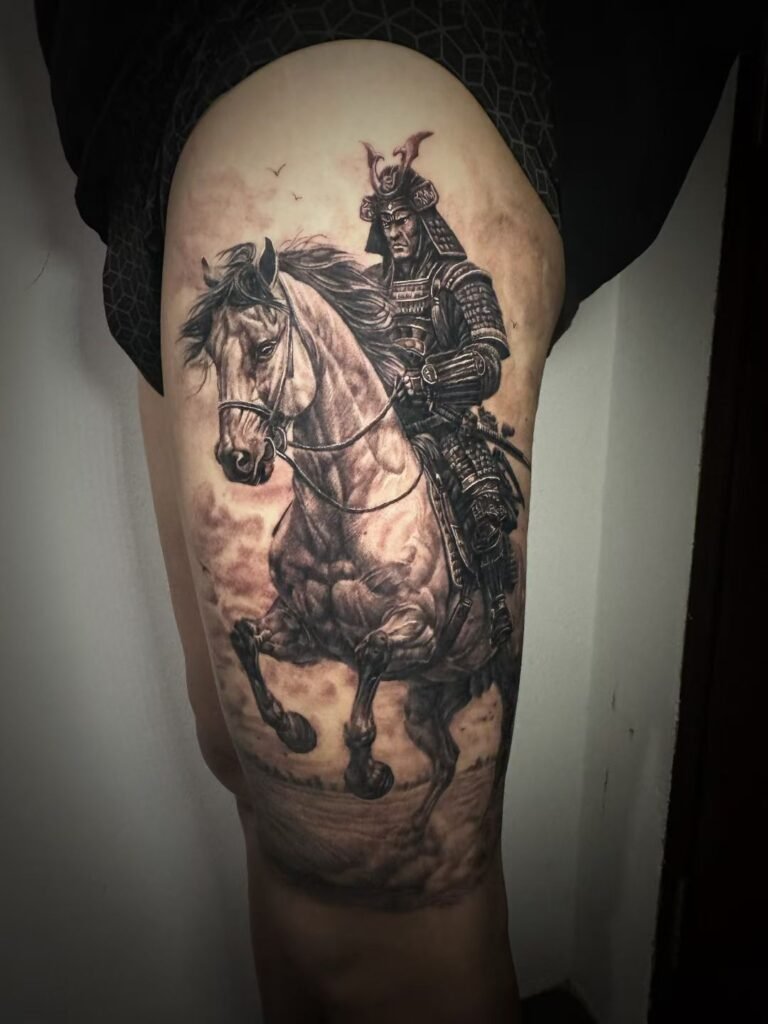
Samurai tattoo meaning is not one fixed code of honour. Samurai roles, armour and artistic representations changed over many centuries. A useful design brief names a period, person, story or museum object, then states the personal theme the wearer wants the figure to carry.
For the tattoo to work on skin, the figure must read before its armour decoration does. Posture, shoulder width, torso angle, hands, face visibility and the outside contour establish the character. Background should support that silhouette rather than conceal it with equal detail.
Decide whether the figure is historical, literary or theatrical
The word samurai covers a long history. The Metropolitan Museum of Art’s overview of the samurai describes a military elite that shaped Japanese politics and society from the twelfth through nineteenth centuries. It also notes that samurai required political, financial and cultural abilities as well as martial training. Honour and loyalty became formalised within an idealised Edo-period code, rather than existing as one unchanged meaning for every warrior image.
That matters when a search result is used as a tattoo reference. A formal portrait of a named commander, an armour display, a scene from a war tale, an actor in a Kabuki role and a modern fantasy warrior are different sources.
The British Museum’s seventeenth-century illustrated compendium of warrior scenes includes episodes from The Tale of the Heike, a Noh play and other narratives. Its figures are visual interpretations of named scenes, not neutral photographs of everyday samurai. The museum’s current Samurai exhibition also explains how popular warrior characters circulated through books, prints and other objects.
Choose one of four clear briefs:
- a named historical figure based on an identified portrait and armour record;
- a named literary or theatrical character from a stated scene;
- an anonymous period-based warrior assembled from museum objects of a compatible date;
- an openly modern, fantasy-influenced Samurai figure.
Do not attach a biography to an anonymous warrior. If the reference cannot be identified, describe only what is visible and treat the meaning as personal.
Armour type controls the silhouette
Armour is not a surface pattern placed over a generic human body. It changes the apparent width of the shoulders, depth of the torso, line of the waist and movement of the legs.
The Met’s Art of the Samurai collection guide describes yoroi, often called ō-yoroi or great armour, as the larger armour used by high-ranking mounted warriors from roughly the mid-twelfth through fourteenth centuries. Its broad shoulder guards and substantial skirt sections create a wide, box-like upper silhouette. That mass can look imposing in a tattoo, but it needs space around the arms and waist.
Dōmaru has a different body logic. Kyoto National Museum explains that the cuirass encircles the torso and fastens on the right. Its multi-section skirt was designed to allow movement, and the type moved from use by retainers and infantry toward adoption by senior mounted warriors over time. The museum’s fifteenth-century Dōmaru record also identifies period-specific scale, lacing and ornament.
The distinction changes the drawing:
| Armour reference | Main visual mass | Pose it naturally supports | Tattoo risk |
|---|---|---|---|
| Broad yoroi reference | Large shoulder guards, firm torso, layered skirt | Mounted, seated, formal or strongly planted figure | Compressing the shoulders until the armour looks like ordinary clothing |
| Dōmaru reference | Torso-wrapping cuirass and more divided lower protection | Turning, advancing, crouching or standing | Covering every plate with tiny decoration before the body action is clear |
| Later complete armour reference | More varied plate construction, helmet, face and limb defences | Formal portrait, command posture or battle scene depending on the object | Mixing parts from unrelated suits and dates without stating that it is a hybrid |
You do not need to reproduce every fastening cord. Choose the features that identify the armour family at the intended scale: shoulder shape, chest plate, skirt division, arm protection and the relation between helmet and torso. Use a museum diagram for parts, then use a full figure or portrait for how those parts sit on a person.
Make the pose readable as a single action
Write the pose as a verb. Standing, turning, advancing, bracing, kneeling and looking back produce clearer drawings than “strong” or “honourable.”
A planted standing pose uses a stable triangle between the feet and torso. It suits a formal portrait and lets the armour carry visual weight. An advancing pose shifts the chest over the front leg and opens the rear side of the body. A kneeling or seated figure is compact and works on a thigh, upper arm or lower back, though the skirt armour must fold around the hips rather than remain rigid. A turning pose can wrap a shoulder or limb because one shoulder comes forward while the other recedes.
The line of action should pass through the head, spine and supporting leg. If that line is clear, fabric, lacing and background can follow it. If it is unclear, extra wind and smoke only make the confusion busier.
Museum portraits are useful for quieter poses. In The Met’s exhibition guide, a portrait of Honda Tadakatsu is described seated on a folding stool with both feet planted and an intent gaze. That exact individual and armour should not be borrowed casually, but the record demonstrates how posture can communicate authority without an exaggerated battle action.
Hands and face decide whether the figure feels present
Hands explain what the body is doing. One hand may secure a scabbard, hold a command object, brace against the ground or reach across the torso. Their direction should match the shoulder and elbow. A hand added after the armour is finished often looks detached because the forearm has no path.
This guide treats a sword, bow, helmet or crest only as part of the figure’s gesture and silhouette. The history and construction of those objects require their own source checks. For a figure-led Samurai tattoo design, decide whether a weapon creates a vertical, horizontal or diagonal line, then keep it subordinate to the body unless the named scene makes it central.
Face visibility is another early choice. An uncovered face creates a human focal point and may support a named portrait, but a small face can disappear beneath a large helmet and shoulder mass. A face guard creates a more anonymous, armoured presence. A three-quarter face often fits a turning pose, while a frontal face suits a formal stance.
Protect a clear patch around the eyes and mouth. Hair, helmet cords, mask edges and background should not all cross the same small area. If the face will be only a few centimetres high, simplify the expression rather than forcing portrait-level detail into it.
Choose a viewing angle before adding armour detail
A front view is stable and ceremonial. It shows both shoulder guards but can become stiff, especially when both arms mirror each other. A three-quarter view is often more useful for tattooing because it creates depth between near and far shoulders. The near hand, knee and shoulder can be larger, while the far side becomes quieter.
A low viewpoint makes the torso and shoulder armour dominant. It can feel monumental on a thigh or back but compresses the face beneath the helmet. A higher viewpoint reveals more of the shoulder and skirt layers, although it is harder to fit on a narrow limb. Side views create a strong profile and can work on the calf or outer arm, provided the far arm is not lost completely.
Photograph the body area from the intended viewing angle. A flat sketch may show both shoulders perfectly while one vanishes around the arm when applied. The figure should still make sense when the wearer stands naturally, not only when the limb is rotated for a photograph.
Background should answer where the figure is
Background has three possible jobs: locate the scene, carry the figure’s movement, or frame the silhouette. It does not need to do all three.
A named battle, castle approach, shoreline or mountain setting requires research into the scene rather than a generic temple gate. A literary figure may need one recognisable environmental clue. An anonymous armour study can use restrained wind, cloud, rock or open skin without claiming a specific event.
Keep the highest contrast around the head, hands and main edge of the armour. Clouds or smoke can soften the far side of the body. Rocks can support a planted foot. Fabric or a banner can extend the action line, but a real family crest should not be invented or assigned to an anonymous figure.
The British Museum’s Samurai exhibition guide shows how armour, portraits, procession scenes and popular warrior prints belong to different contexts. Use that range to choose a setting, not to combine every recognisable Japanese object into one background.
Placement for a complete Samurai figure
A back piece offers room for a full figure, leg stance and environment. The figure does not have to stand upright in the centre. A diagonal advance can use more of the back and leave one side for background movement. Keep the head large enough to remain a focal point at normal viewing distance.
The thigh can hold a compact full figure or seated pose. Its broader surface accommodates shoulder armour and bent legs without excessive wrap. Check the design from the front and outside because the face and leading hand should not sit on opposite planes.
An upper arm suits a bust, turning half-figure or compact kneeling pose. A Samurai tattoo sleeve can include a full character, but this is a figure problem before it is a sleeve problem. Place the head and torso first; let cloth and background connect the rest of the arm. Do not distribute face, hand and weapon as three separate stickers.
The calf supports a vertical figure but provides less width for broad shoulder guards. A side-view stance or narrower armour reference may fit better than shrinking a square yoroi silhouette.
For examples of how large subjects are given hierarchy and body flow, review Japanese and Asian-inspired tattoo composition. Use those examples to discuss scale, not to request a copy.
Prepare a Samurai figure brief
Send one institutional source for identity or period, one armour view, and one pose reference. Label what each image contributes. If you choose a named person or story, include the museum or library title rather than relying on an uncited social post.
Add the exact placement, approximate coverage and main viewing side. State whether the face is visible, which hand action matters and whether the background represents a named place or only supports movement. The tattoo enquiry guide can help organise the body photographs and references.
A focused brief might read: “Anonymous fifteenth-century Dōmaru-based warrior, three-quarter advancing pose on the outer thigh, uncovered focused face, one hand at the waist, restrained wind and rock background, no invented crest.” It sets historical range, armour, action, placement and limits without inventing a biography.
Yuyi Tattoo’s documented portfolio includes large-scale and Japanese or Asian-inspired compositions. Suitability, schedule and project terms still require direct review. Send the source-led brief through the contact page when the figure and placement are defined.
Sources and review date
- The Metropolitan Museum of Art: Samurai — reviewed 24 August 2026.
- The Metropolitan Museum of Art: Art of the Samurai, Japanese Arms and Armor, 1156–1868 — reviewed 24 August 2026.
- Kyoto National Museum: The Significance of This Dōmaru Armor Conservation Project — reviewed 24 August 2026.
- Kyoto National Museum: Dōmaru Armor, fifteenth century — reviewed 24 August 2026.
- British Museum: Samurai exhibition large-print guide — reviewed 24 August 2026.
- British Museum: Picture Compendium of Bushido Past and Present — reviewed 24 August 2026.
Frequently asked questions
What does a Samurai tattoo mean?
It can express a personal idea such as discipline, courage, duty or endurance, but no single meaning covers every Samurai image. The historical role, period, named figure or story should be identified separately from the wearer’s personal interpretation.
Does Samurai armour have to be historically accurate?
Accuracy is a choice, but it should be stated. A period-led design should use compatible museum references. A modern hybrid can mix features deliberately, provided it is not presented as a documented historical suit.
Which pose works best for a Samurai tattoo?
The best pose fits the placement and intended character. Standing feels formal, advancing creates direction, kneeling is compact, and turning works well around a limb. The action should remain clear before background and armour decoration are added.
Should the Samurai’s face be visible?
It depends on the brief. A visible face creates a human focal point, while a face guard makes the figure more anonymous and armoured. Either choice needs enough scale and contrast around the eyes and mouth area.
Can a full Samurai figure fit in a sleeve?
Yes, if the head, torso and action are placed first and remain readable from one main angle. Cloth and background can carry the wrap. Avoid separating the face, hands and weapon into disconnected panels.

