Japanese architecture tattoo ideas work best when each structure has one clear spatial job. A torii can become the main frame or the entrance to a scene. A pagoda can lead as a vertical landmark or sit farther away as a scale cue. A lantern is often strongest in the foreground, where it gives the landscape a human measure.
Choose the hierarchy before collecting decoration. If the structure is the main subject, its silhouette and source details need room. If it is a distance cue, simplify it. If it is the closest foreground element, crop it deliberately and let it overlap the next layer. Torii, pagoda and lantern are not interchangeable Japanese symbols, even when all three appear in one composition.
Choose a spatial role before a symbolic reading
Search results often give each object a short meaning: a torii becomes transition, a pagoda becomes balance, and a lantern becomes guidance. A client may use any of those ideas personally, but the cultural objects themselves have more specific histories. Tattoo planning becomes clearer when the brief first identifies the object and then states what it must do in the picture.
The same torii can fill three different roles. Shown straight on and large, it is the subject. Cropped close to one side, it is a foreground frame. Repeated along a path, it creates recession and scale. Its personal meaning may stay the same, yet the tattoo reads differently because the viewer occupies a different place.
Use this comparison as a starting point:
| Object | Strong main-subject use | Strong supporting use | Shape to protect |
|---|---|---|---|
| Torii | Frontal or three-quarter gate framing a view | Near gate, repeated gates or distant threshold | Two posts, crossbeams and a readable opening |
| Pagoda | Vertical landmark with identifiable roof rhythm | Small destination beyond a path, gate or trees | Tier spacing, central rise and finial |
| Stone lantern | Sculptural object with weathered surface | Close scale cue beside steps, water or planting | Roof, light chamber and pedestal relationship |
| Hanging lantern | Suspended focal object or entrance detail | Warm light within a darker architectural crop | Support point, chamber and lower edge |
Equal size, contrast and detail create three competing subjects rather than one scene.
Identify the real object first
Architecture carries religious, local and historical context. A useful reference names a shrine, temple, museum object or specific lantern form. A generic search collage can merge parts that never belonged to one structure.
Torii: an open gateway
The Government of Japan’s account of Fushimi Inari explains that torii mark the boundary between the everyday world and the sacred precincts of the deities. This is a Shinto shrine context. A client can connect the open gateway with a private idea of passage, but that reading should be stated as personal rather than imposed on every torii.
Visually, the empty space beneath the crossbeams is as important as the timber. That opening can hold mist, a road, water, a distant figure or a pagoda. Filling it with dense texture removes the function that makes the gate useful as a frame.
Pagoda: a Buddhist architectural form
A pagoda is not a tall torii and should not be used as a substitute for a shrine gate. Horyuji Temple describes its five-storey pagoda as an Asuka-period structure erected to enshrine sacred relics of the Buddha. Its five roofs, central pillar line and upper finial form a distinct vertical silhouette.
Scale and construction vary. The Kyoto National Museum’s One Million Pagoda is a small three-storey wooden form that contains a Buddhist sutra. It is structurally and visually different from a full temple tower. Choose the reference before deciding how many tiers to draw or what pagoda tattoo meaning you want the design to carry.
Lantern: several forms, not one icon
The Kokugakuin University Encyclopedia of Shinto distinguishes large outdoor stone lanterns, suspended metal lanterns and other movable forms. It also notes that lanterns were used at Buddhist temples before their adoption at Shinto shrines. The setting therefore matters as much as the word “lantern.”
The Metropolitan Museum of Art holds an Edo-period lantern made in the shape of a pagoda. This hybrid form demonstrates why a source image is more reliable than a label. In a tattoo brief, identify whether the reference is a stone lantern, hanging metal lantern, paper lantern or another documented object.
When the torii should be the main subject
A torii deserves the main role when its opening contains the central idea. A frontal gate gives the composition stability and near-symmetry. It can sit on a calf, thigh, upper back or broader chest area, provided both posts remain visible from the intended view. A three-quarter gate creates more depth and often fits an outer upper arm or thigh because one post can sit nearer while the other recedes.
Torii gate tattoo ideas often include a famous site. If the reference is Itsukushima, Fushimi Inari or another identifiable place, preserve the features that establish that site rather than surrounding a generic gate with unrelated landmarks. If the scene is invented, describe it as a Japanese-inspired composition rather than a record of a real shrine.
The Met’s early seventeenth-century Torii Gate of Gion Shrine shows the gate embedded within a larger street and shrine setting. People, buildings and activity establish its scale. For tattoo planning, the useful lesson is hierarchy: the gate organises the view while the surrounding scene explains where it stands.
When a pagoda works better as a landmark
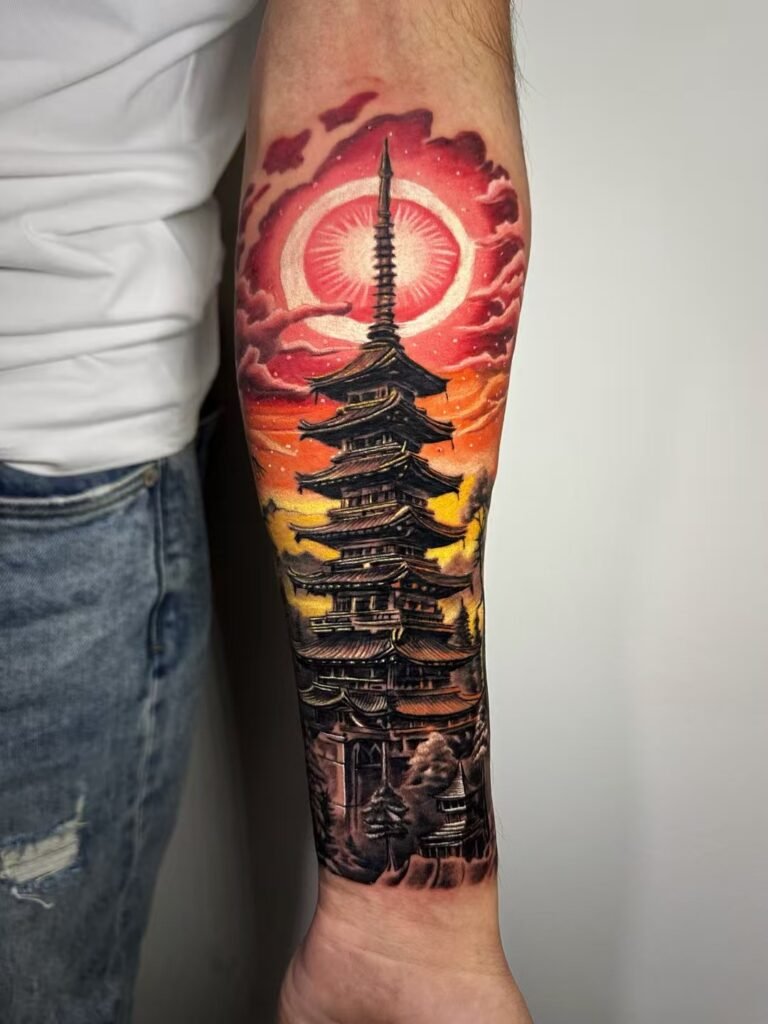
A pagoda naturally draws the eye upward. As the primary structure, it needs enough height for the roof tiers to remain separate. A low viewpoint makes the lower eaves wider and the upper levels taper quickly. A distant viewpoint makes the tier rhythm more regular but removes construction detail.
As a scale cue, the pagoda can be much smaller. Place it beyond a torii, steps, pines or mist, reduce its internal lines and keep its outer profile intact. The viewer understands distance because the near object is larger and darker. Trying to preserve roof tiles, railings and small brackets in the distant layer defeats that effect.
A vertical pagoda can suit the calf, outer forearm, thigh or a long back composition. The roof edges should not disappear alternately around a cylindrical limb. Photograph the placement from the main viewing angle, then decide how much wrap is acceptable before the drawing is finalised.
When a lantern should occupy the foreground
A stone lantern is a useful foreground object because its recognisable sections create both weight and scale. A large cropped roof or pedestal at one edge can imply that the viewer is standing near a path. The smaller gate, pagoda or tree beyond it then appears farther away without needing a complicated landscape.
Cropping should look intentional. Cutting a stone lantern through its light chamber may make the object difficult to identify. Cropping through the pedestal or allowing the roof to leave the frame usually preserves more of the silhouette. A row of lanterns can create repetition, but each distant lantern should lose detail rather than becoming a miniature copy of the nearest one.
A hanging lantern works differently. It needs a beam, eave or entrance that explains how it is suspended. Its lower edge can overlap a doorway or dark field. If it appears lit, leave a controlled pale centre and enough surrounding value for the glow to be visible. Warm colour alone will not create light if every nearby element is equally bright.
Build foreground, middle distance and destination
A scene becomes easier to plan when it is divided into three planes:
- Foreground: the closest cropped object, such as a lantern, gate post, step or branch.
- Middle distance: the route through the image, such as an opening, path, stair or open water.
- Destination: the smaller landmark or focal space, such as a pagoda, inner gate or light.
Not every tattoo needs all three. A compact forearm piece may use a torii as the foreground and mist as the destination. A thigh can hold a near lantern, a gate in the middle and a small pagoda beyond. A back offers room for several layers, but one must still receive the strongest contrast.
Overlap, scale change and value separation do most of the work. The nearest element overlaps the next. Distant structures become smaller. Strong edges sit closer to the viewer, while far roofs and posts use fewer marks. Waves, clouds and wind bars solve a different background problem; they should not replace accurate perspective inside the architecture.
Perspective must follow the body
A tattoo does not preserve the viewpoint of a flat photograph automatically. A straight crossbeam can appear bent around an upper arm. A pagoda may lose one side of every roof as it wraps toward the calf. A circular lantern roof can become an uneven oval when placed across a changing contour.
Decide which architectural line is allowed to wrap and which must remain in the main view. Usually, the torii opening, pagoda centre and lantern chamber deserve the clearest surface. Secondary posts, eaves or foliage can turn toward the side.
| Placement | Architecture that often fits | Perspective check |
|---|---|---|
| Outer forearm | Narrow pagoda, single lantern or cropped three-quarter gate | Does the main silhouette stay visible without rotating the wrist? |
| Calf | Vertical pagoda or frontal gate | Do the far roof edges or posts vanish around the taper? |
| Upper arm | Three-quarter torii or cropped lantern-to-landmark scene | Which structure remains readable when the arm hangs naturally? |
| Thigh | Several depth planes and a larger structure | Does the main view work from the front and outside? |
| Chest | Frontal gate or broad architectural crop | Does the frame respect the sternum and collarbone? |
| Back | Landscape with clear foreground and destination | Is there one dominant route through the scene? |
Simplify construction without losing identity
Architectural detail should explain the structure. Torii joinery, roof pitch, finials, lantern apertures and stone sections can help recognition. Repeating every tile or wood joint at a small scale does not.
Begin with a solid black silhouette test. If the torii no longer has a clear opening, the pagoda looks like a generic tower or the lantern becomes an unidentifiable block, fix the outer shape first. Next, add the few internal divisions that identify the source. Surface texture comes last.
Colour can separate planes, but it should not become a substitute for structure. A sourced vermilion gate can lead against quieter greens and greys. A black-and-grey pagoda can remain clear through alternating roof edges and open sky. A warm lantern can attract attention if it is the intended focal point; if the pagoda should lead, keep the lantern’s light restrained.
Prepare a source-led architecture brief
Before contacting the studio, organise:
- the lead object: torii, pagoda, stone lantern or hanging lantern;
- its role: main subject, scale cue or foreground frame;
- one identified site or museum reference, if accuracy matters;
- the preferred viewpoint: frontal, three-quarter, low angle or distant;
- what should be visible through or behind the structure;
- placement side, approximate boundaries and relaxed body photographs;
- black-and-grey or colour direction;
- essential elements, optional elements and items you do not want.
Review Yuyi’s Japanese and Asian-inspired tattoo work for examples of hierarchy and body flow, then use the tattoo enquiry guide to label the reference and placement images. When the spatial role is clear, send the focused brief through the Yuyi Tattoo contact page. Project scope and availability can then be confirmed from the actual composition rather than assumed from the motif.
Sources and review date
- Government of Japan: Vermilion Tunnels of Thanks — reviewed 24 August 2026.
- Horyuji Temple: Five-storied Pagoda — reviewed 24 August 2026.
- Kyoto National Museum: What is a One Million Pagoda? — reviewed 24 August 2026.
- Kokugakuin University Digital Museum: Tōrō — reviewed 24 August 2026.
- The Metropolitan Museum of Art: Lantern in Shape of a Pagoda — reviewed 24 August 2026.
- The Metropolitan Museum of Art: The Torii Gate of Gion Shrine — reviewed 24 August 2026.
Frequently asked questions
Should a torii be the main subject or a foreground element?
Use it as the main subject when the opening and the view beyond carry the idea. Use it as a foreground element when the gate establishes the viewer’s position and frames a smaller destination. The chosen body area must keep both posts and the opening readable.
What is the difference between a torii and a pagoda tattoo?
A torii is associated with a Shinto shrine gateway. A pagoda belongs to Buddhist architectural history and may function as a reliquary. They also have different shapes: one frames an opening, while the other creates a tiered vertical landmark.
Does a pagoda tattoo need every roof detail?
No. The number and spacing of tiers, overall taper and finial matter more than a literal record of every tile. A distant pagoda should be simpler than a primary one. Start with an identified source, then reduce detail to suit the scale.
What does a Japanese lantern tattoo mean?
There is no single meaning shared by every lantern. A wearer may connect light with memory, welcome or guidance, but stone, hanging metal and other lantern forms have different settings. Identify the object first and state the personal reading separately.
Can a torii, pagoda and lantern appear in one tattoo?
Yes, when their hierarchy is clear. A lantern can sit nearest, a torii can create the middle frame and a pagoda can act as the distant destination. On a smaller placement, one strong structure with one supporting cue will usually read more clearly.
What should I send with a Japanese architecture tattoo enquiry?
Send one primary structure reference, its intended spatial role, the viewpoint, placement photographs, approximate boundaries and the atmosphere you want. Label any second structure as essential or optional so the composition does not give every object equal weight.