
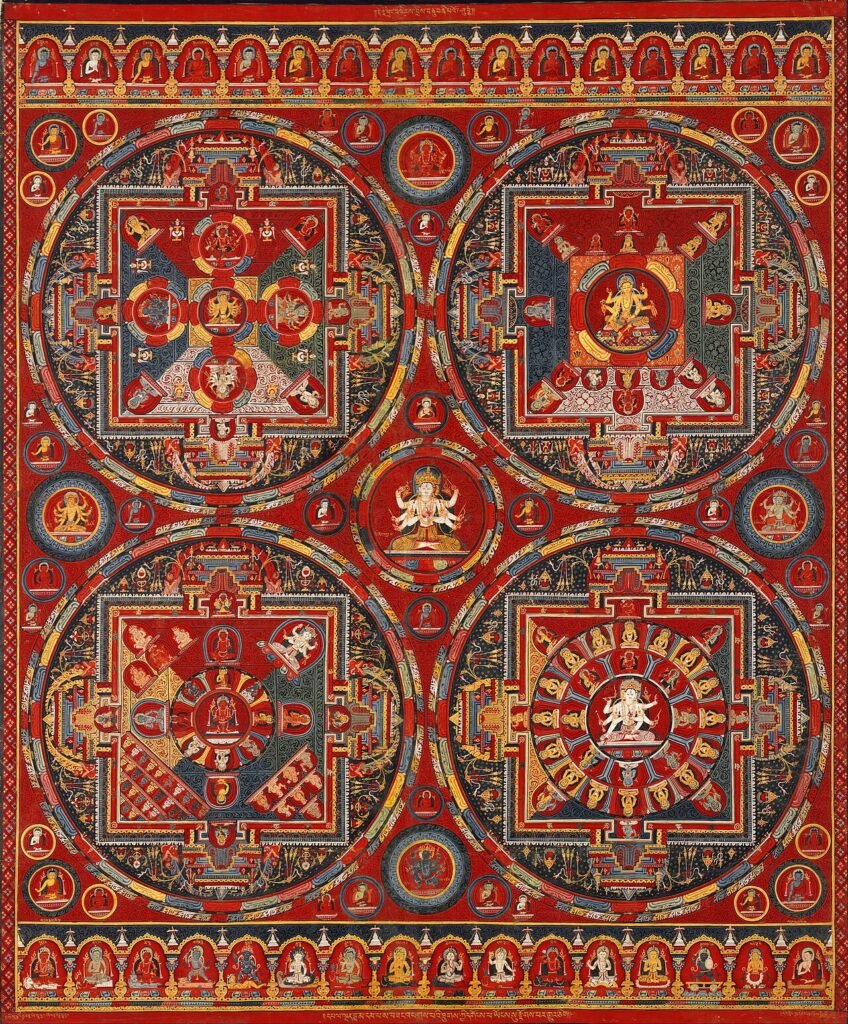
To fit a Mandala to the body without losing clarity, choose the centre point and the usable outer boundary first. Build the repeated rings inside that space, keeping enough separation between them for the centre, inner pattern and outer silhouette to remain distinct. Check the stencil from one agreed main view while the body is relaxed, then check how the design changes with ordinary movement.
Mandala tattoo meaning depends on the source. A named Buddhist mandala can be a ritual image with prescribed figures and spatial relationships, while a contemporary radial tattoo may be decorative geometry chosen for its order, repetition or personal association. Similar-looking circles do not automatically share the same religious meaning. Establish which type you want before deciding what belongs at the centre.
What makes a design a Mandala?
In contemporary tattoo use, the word often describes a composition organised around a deliberate centre. Shapes repeat, rotate or change as they move outwards. The useful design test is structural: if the centre moves, does the logic of the whole image move with it? If the answer is yes, the centre is doing real work rather than merely filling a round border.
Historical and religious mandalas can be much more specific. The Smithsonian’s National Museum of Asian Art describes mandalas in Tibetan Buddhist contexts as objects with concentric circles that may combine with squares to represent a three-dimensional palace. The central deity is the most important figure in that arrangement. The Rubin Museum likewise describes Buddhist mandalas as aids for meditation and visualisation, and notes that a similar concept in Hinduism is the yantra.
Those descriptions do not create a universal tattoo dictionary. The Metropolitan Museum of Art’s Chakrasamvara Mandala, for example, is a particular ritual diagram centred on Chakrasamvara and Vajravarahi, surrounded by named figures and settings. Its iconography cannot be reduced to “balance” and transferred to every radial flower or geometric tattoo.
Use one of two clear briefs:
- A source-based design identifies the tradition, object or text being referenced and preserves the elements that give that form its identity.
- A decorative radial design uses centred repetition without claiming a prescribed religious function. Its meaning can be personal, but it should be stated as personal.
Place the centre before drawing the rings
The centre controls every radius, division and outer edge. It should be chosen on the body, not copied blindly from the middle of a rectangular photograph.
Start with the view in which the Mandala matters most. For an upper-back piece, that may be a straight rear view. For a thigh or shoulder, a three-quarter view may show the usable surface more honestly. Mark the intended centre in that view, then note nearby landmarks such as the spine, sternum, shoulder cap, kneecap or elbow point. A landmark helps everyone find the same location again during stencil fitting.
The geometric centre and the apparent centre are not always identical. A circle placed mathematically between two body landmarks can look shifted if one side curves away sooner, if the outer rings wrap, or if the viewer normally sees the area at an angle. The aim is a controlled main view, not a claim that the tattoo will look perfectly circular from every direction.
Before approving the point, test three things:
- Can the whole outer boundary fit without an important segment disappearing around the body?
- Does the centre stay visually stable in the normal relaxed posture?
- If the design approaches a joint, what happens when that joint bends?
If any answer is unclear, move or resize the boundary before adding detail.
Give the radial structure a hierarchy
A readable Mandala should not treat every ring as equally loud. The eye needs an entry point, a route and an outer stopping point. One practical structure is a compact centre, a clear inner pattern, one or two developing rings, and an outer frame with a recognisable silhouette. The exact number changes with the concept and size.
Hierarchy can come from several choices:
- a quieter centre surrounded by a stronger first ring;
- alternating open and detailed bands;
- a repeated petal or geometric unit that grows as it moves outwards;
- darker weight in selected rings rather than equal shading everywhere;
- an outer edge that is simpler than the interior.
Repetition count also affects space. Adding more spokes or petals at the same diameter creates narrower cells. That may look intricate on a large screen, but it leaves less room between adjacent marks on skin. Choose the count for the available circumference. Do not attach numerological or spiritual meaning to a number unless the chosen tradition and source support it.
A source-based Buddhist design may require a square, gates, figures or directional relationships that a decorative rosette does not. In that case, those elements are part of the iconographic brief, not optional texture. If the body area cannot carry them clearly, the honest options are more scale, a different placement or a less specific design.
Ring density decides whether the pattern can breathe
Mandala tattoo readability depends heavily on what happens between rings. A dense centre, dense middle and dense edge can merge into one dark disc even when every individual line is accurate. Open intervals let the viewer distinguish the stages of the radial pattern.
Think in terms of separation rather than a fixed rule for line thickness. Each important boundary needs enough contrast from the one beside it. Dotwork can create a soft transition, but it should not fill every open area by default. Small dots, fine lines and tiny repeated shapes all consume the same limited visual space.
When a draft feels crowded, revise in this order:
| Problem in the draft | Useful adjustment |
|---|---|
| Centre reads as a dark knot | Remove one inner ring or enlarge the central interval |
| Middle bands look identical | Change the repeat size or leave one band quieter |
| Outer edge disappears | Simplify the last ring and strengthen its silhouette |
| Pattern only reads in a close-up | Increase the diameter or reduce the repeat count |
| Shading closes the open spaces | Reserve clear skin breaks before adding texture |
Long-term clarity cannot be guaranteed by geometry alone. Skin, application, exposure and care all affect how a tattoo looks over time. The American Academy of Dermatology notes that ultraviolet light can fade some tattoo inks. Design planning therefore creates visual margin; it does not promise that every fine interval will remain unchanged.
Symmetry on paper and symmetry on a body are different tests
A radial drawing can be measured on a flat plane. A tattoo sits on a curved, naturally uneven body that changes with posture. Careful Mandala tattoo symmetry means preserving the intended relationships from the agreed main view while adapting the stencil to that surface.
Use axes during fitting. Check vertical and horizontal directions through the centre, then check several diagonal repeats. Looking at only the outside circle can hide an inner rotation. Looking only at the centre can hide an outer ring that climbs on one side. Photograph the relaxed placement straight on, at a sensible distance, without a wide-angle camera view that stretches the edges.
Movement is a separate check, not a reason to chase impossible perfection. A shoulder cap rotates, a chest rises, and an elbow or knee changes shape when bent. Decide which posture defines alignment. The tattoo can then be judged consistently instead of being declared “wrong” whenever the body moves.
For matching radial pieces on two sides of the body, compare their centres, overall diameter and main axes. Do not assume two anatomical sides are exact mirror images. Small fitting adjustments may make the pair look more balanced than using two stencils at mechanically identical measurements.
Match Mandala placement to the outer boundary
There is no single best Mandala tattoo placement. The useful choice is the area that can support the intended diameter, main view and edge treatment.
| Body area | What the centre can organise | Main question before fitting |
|---|---|---|
| Upper back or shoulder blade | A broad standalone circle or a radial anchor within a larger back composition | Is the centre tied to the spine, one shoulder blade or the visual centre of the full panel? |
| Sternum or central chest | A strong vertical axis with rings extending across both sides | Which relaxed standing view defines level and centre? |
| Shoulder cap | A centre over a rounded surface with outer sections wrapping away | How much of the circle must remain visible from the main side view? |
| Thigh | A larger radial field with room for a clear outer silhouette | Is the primary view front-facing or three-quarter? |
| Forearm or calf | A narrower design that may need fewer rings or a controlled crop | Will the outer edge wrap beyond recognition from the chosen view? |
| Elbow or knee | A joint-centred structure that changes markedly when bent | Is alignment judged with the limb straight, softly bent or in another agreed posture? |
A Mandala can also become an anchor inside a wider composition. If the project extends into a sleeve or back piece, plan where background movement enters and exits the radial edge. A hard circular border may read as a separate medallion; a broken or tapered edge can connect more gradually.
For a broader Asian-inspired project, review the visual language and scale of the surrounding Japanese and Asian-inspired tattoo work before deciding whether a radial element should stand alone or support the larger subject. This does not turn a decorative Mandala into a traditional Japanese symbol. The source and role still need to be named accurately.
Choose Mandala tattoo ideas by structure, not by decoration alone
Several designs may share a circular outline while needing different planning:
- A floral radial design uses petal rhythm and can vary the spacing between inner and outer blooms.
- An abstract geometric design may rely on polygons, arcs and repeated divisions without religious iconography.
- A sourced palace Mandala may require a square within circles, directional gates and a specific centre.
- A partial Mandala uses a cropped radial field at the edge of a larger composition. Its implied centre may sit inside or outside the visible tattoo.
- An expanding medallion keeps a complete centre but allows selected outer elements to connect with another motif.
An eye-centred tattoo is a different design problem because gaze direction, eyelid crop and facial anatomy become the focal decisions. This guide keeps the discussion on centre point, rings and radial structure rather than using an eye as interchangeable decoration.
Prepare a focused Mandala enquiry
The first message should let the artist assess structure rather than guess from a folder of unrelated images. Use the tattoo enquiry guide and include:
- whether the design is tied to a named religious or cultural source, or is decorative radial geometry;
- one primary reference and a note explaining which features matter;
- the body side, proposed centre and approximate outer boundary;
- relaxed front, side and three-quarter placement photographs where relevant;
- the preferred main viewing angle;
- the central motif, repeat count or rings that must stay;
- any elements that may be simplified if the available size is too small;
- nearby tattoos and any future plan to extend the composition.
Do not submit a finished tattoo by another artist as an instruction to copy it. Use references to identify spacing, radial rhythm, edge treatment and mood, then ask for a composition fitted to your body and source context.
When those decisions are ready, contact Yuyi Tattoo with the focused brief. Feasibility, final size, placement and project arrangements can be confirmed after the references and body area are reviewed.
Sources and review date
- Smithsonian’s National Museum of Asian Art: Sacred Spaces key terms, reviewed 24 August 2026.
- Rubin Museum of Himalayan Art: Mandala, reviewed 24 August 2026.
- The Metropolitan Museum of Art: Chakrasamvara Mandala, reviewed 24 August 2026.
- American Academy of Dermatology: Caring for tattooed skin, reviewed 24 August 2026.
Frequently asked questions
What does a Mandala tattoo mean?
There is no single Mandala tattoo meaning. A specific Buddhist mandala can have a prescribed ritual, cosmological and iconographic context. A contemporary radial tattoo may be decorative or carry a meaning chosen by the wearer. Identify the source before assigning a meaning to the shape.
Does a Mandala tattoo have to be perfectly symmetrical?
The repeated structure should be deliberate and carefully aligned, but a tattoo is viewed on a curved, moving body. Agree on the main posture and viewing angle, then judge the centre, axes and repeated sections in that view. No placement will look geometrically identical from every angle and body position.
Can a small Mandala tattoo remain readable?
It can if the design is simplified for the available diameter. Use fewer rings, fewer repeated units, wider intervals and a clear outer silhouette. Shrinking a dense large reference while preserving every line usually leaves too little separation between the parts.
Where should the centre of a Mandala sit?
Choose it from the intended main view and relate it to a repeatable body landmark. The spine, sternum, shoulder cap, elbow point or kneecap may help, depending on placement. Then check whether the full outer boundary remains visible and balanced around that point.
Which placement is best for a Mandala tattoo?
The best placement is the one that supports the required diameter and main view. Broad areas can carry more rings, while a forearm, calf or rounded shoulder may require a simpler pattern or controlled wrap. Joint-centred designs also need a clearly agreed alignment posture.


