
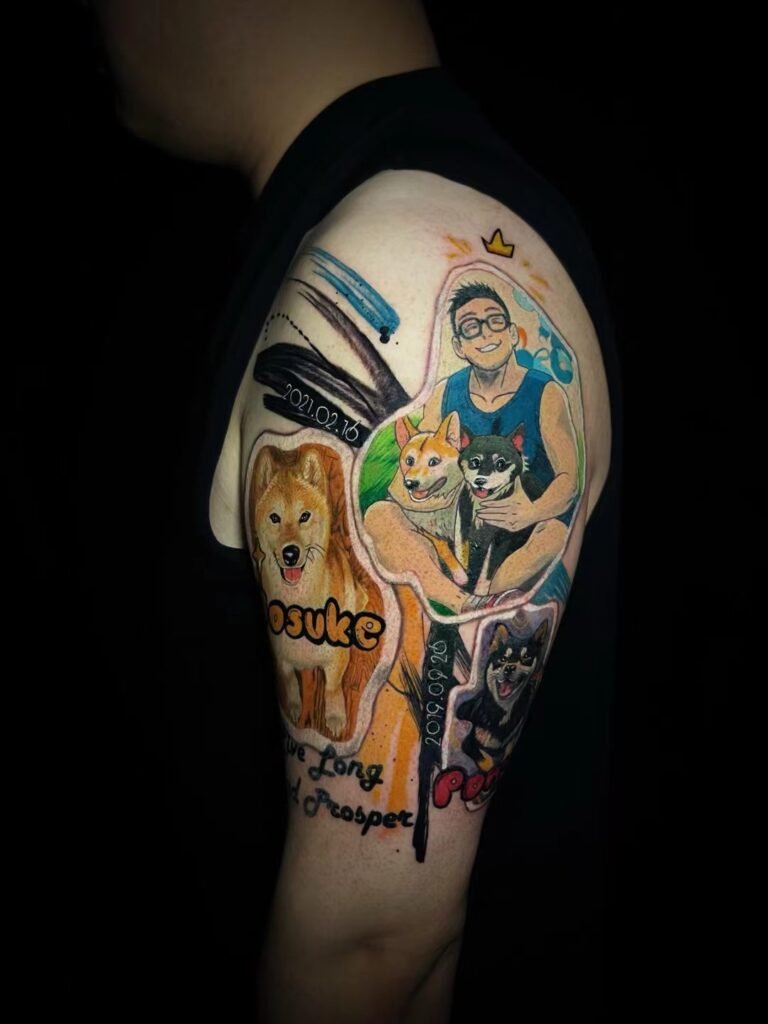
A clear family tattoo starts with one relationship idea, then chooses the simplest visual evidence that can carry it. That may be a shared object, a place, handwriting, a portrait, initials or a set of related marks. The tattoo does not need every family member’s name, birthday and favourite symbol to prove that the connection matters.
Family tattoo meaning is personal rather than fixed. Decide who is represented, what quality of the relationship you want to hold, and how much of that information should be readable to other people. Then choose a design structure and placement that give the important element enough room.
Define the relationship before searching for a symbol
“Family” is too broad to draw. A sibling relationship may be built around humour and a shared childhood object. A parent and adult child may care about handwriting or a place. A couple raising children may want a design that includes the household without listing legal relationships. Chosen family may have no useful connection to ancestry imagery at all.
Write one sentence that contains a subject and an action. For example:
- “My sisters and I kept returning to the same beach.”
- “My father taught me to repair bicycles.”
- “Our family cooks this dish together every year.”
- “Three of us want related tattoos, but each person wants a different placement.”
The nouns in those sentences create better family tattoo ideas than a generic web list. A shoreline, a small tool, a kitchen object or a three-part visual system can belong to the relationship. A random infinity sign labelled “family” may say less because it could have been chosen for anyone.
The National Portrait Gallery explains that identity can be communicated through pose, clothing, props, background and location, rather than appearance alone. The same principle helps here. A person can be represented by an object or setting that is genuinely connected to them, without putting a literal face or full name in the tattoo.
Choose one of four representation routes
Most family tattoos become clearer when they use one primary route. A second route can support it, but should not compete.
Direct identifiers
Names, initials, dates and short phrases are explicit. They suit a client who wants the tattoo to be understood rather than decoded. Their weakness is that text demands accuracy and can become crowded quickly. Check spelling, punctuation, accents and date format from a reliable family record, not from memory typed into a message.
If privacy matters, reduce the amount of identifying information. An initial, month, year or private abbreviation may carry the relationship without displaying a child’s full name and date of birth together. Decide that boundary before choosing the lettering style.
Personal evidence
Handwriting, a drawing, a household object, a map fragment or the outline of a meaningful place can be specific without becoming a list. The source needs to be clear. If you want a handwritten word, scan or photograph enough of the original page to show the writer’s natural rhythm. If you want an object, send several angles and state what detail makes it recognisable to your family.
This route works well for living relationships because it celebrates something that continues now. It does not need the grief language or commemorative structure of a memorial tattoo.
Portrait or figure
A portrait makes the person the main subject. It usually needs a strong image source and more space than a small symbol. A group portrait adds another layer: each face must remain identifiable, and the composition still needs a focal order. Cropping a group photograph to two people can produce a clearer tattoo than trying to preserve a whole event scene.
Before using a professional or family photograph, clarify who created it and what usage rights or permissions apply. Holding a print or appearing in a photograph does not always answer who owns the image or who is comfortable with its use.
Shared symbolic system
Flowers, animals, stars, tools, landscapes and geometric forms can represent several people without using names. The system needs a reason. Three different birds might represent three siblings because of an actual family memory, not because a search result assigns each bird a personality.
If the imagery comes from a cultural or religious tradition, research the source rather than selecting a meaning from an unsourced chart. The Japanese and Asian-inspired tattoo page can help when that is the visual direction, but no motif should be treated as a universal family symbol.
Use a representation map to prevent overload
Before adding anything to the design, make a small private map. Give each person no more than one essential visual marker at first.
| Person or relationship | Essential marker | Optional support | Private information to omit |
|---|---|---|---|
| Person A | One object, initial or form | Colour, leaf or small secondary mark | Full date or identifying detail |
| Person B | One object, initial or form | Colour, leaf or small secondary mark | Full date or identifying detail |
| Group as a whole | Shared frame, rhythm or location | Background or connecting line | Explanation intended only for family |
Now look for repetition. If three people are represented by three flowers, the shared botanical structure already links them. Three names, dates, zodiac signs and birthstones on top of the flowers would repeat the same information four times. Keep the version that has the strongest personal connection and the clearest silhouette.
A family tree is a useful example. It can show ancestry, but a trunk, roots, branches, leaves, names and dates all consume space. Decide whether the tree itself carries the family meaning, whether named branches are essential, or whether the idea is really about one living household rather than a genealogy. The answer may lead to a compact group of leaves instead of a full chart.
Matching tattoos do not have to be identical
When several relatives want tattoos, there are three workable levels of connection.
An identical set repeats the same drawing. This is straightforward, but the design must work on every person’s chosen body area and at every approved size. A drawing that fits one broad forearm may not transfer unchanged to a narrow ankle.
A related set uses one visual grammar with individual variations. Each person might choose a different object drawn with the same framing shape, or the same plant at a different stage. This gives everyone some authorship while keeping the relationship visible.
A distributed design is complete only as a concept. Each tattoo stands alone, but the group shares a hidden rule, such as fragments of one map or objects from one room. Avoid designs that only look correct when bodies are pressed together in one exact pose. Most of the time, each person will wear and view their tattoo separately.
Consent also belongs to each person separately. One enthusiastic family member should not decide the design, size or placement for everyone else. Agree on the common element, then allow individual limits. If someone withdraws before the appointment, the remaining designs should still make sense.
Be careful with crests, heraldry and inherited symbols
A symbol that appears under your surname in an online shop may not be your family’s historical arms. The College of Arms states that coats of arms do not belong to surnames as a whole; they are granted to particular people and inherited within defined lines. If heraldry matters to the family tattoo meaning, trace the actual provenance instead of buying a generic surname graphic.
The same caution applies to clan marks, religious emblems and Indigenous designs. Ask which community, period or authority supports the claim. If that cannot be established, either research further or treat the image as a contemporary decorative reference rather than an inherited entitlement.
This does not make a family tattoo less personal. It prevents an attractive but unrelated symbol from carrying a false history.
Plan privacy while the family members are living
Family designs often concern people who can express preferences now. Ask whether they are comfortable with a portrait, name, handwriting sample or story being used. Tattoo consent and permission to publish a photograph of the finished tattoo are separate conversations.
Singapore’s IPOS and PDPC joint factsheet on portrait photography separates copyright ownership from personal-data responsibilities. Its practical relevance to a tattoo brief is that possession of a family image does not give every participant unlimited control over every later use. Tell the artist if reference files are private and whether any finished-work photography needs a separate decision.
Children deserve particular restraint. You can represent a child without placing their full legal name, complete birth date, school reference or face in a highly visible design. Think about what you want the tattoo to reveal to strangers as well as what it means within the family.
Relationships can also change. A design does not need to predict every future marriage, birth, separation or reconciliation, but it should not depend on a false promise that the family structure will never move. If additions are likely, use a repeatable system and reserve real space. Do not add tiny blank branches everywhere for people who may never be represented.
Choose placement by visibility, shape and future additions
Family tattoo placement is partly a privacy decision. A forearm is easy for the wearer and others to see. An upper arm, shoulder blade, chest, ribs or thigh can be more selective depending on clothing. There is no morally “closer” body area; proximity to the heart is a personal metaphor, not a design requirement.
The motif’s shape should narrow the options. A line of handwriting needs length. A portrait needs enough area for facial relationships. A circular group symbol benefits from width. A vertical plant or object needs a longer field. Test the design on a photo of the body area rather than choosing placement only from an isolated online image.
If the tattoo may later include another person or symbol, mark where that addition could go. A design with a clean finished edge can still expand, but the extension needs a visual route. Reserving one intentional area is better than shrinking the first tattoo in the hope that many unknown pieces will fit around it.
Build a clear family tattoo enquiry
If you are planning a family tattoo in Singapore, use the tattoo enquiry guide and include:
- Who or which relationship the tattoo represents.
- The one sentence that explains the shared action, place or object.
- Your chosen route: identifier, personal evidence, portrait or symbolic system.
- Exact files for handwriting, photographs, objects or verified cultural sources.
- Placement, side and approximate size.
- Which details are essential and which can be removed.
- Whether other family members are getting related designs.
- Privacy limits for the references and any finished-work photography.
When the brief is focused, contact Yuyi Tattoo to discuss how the relationship can become a readable composition. Project details, timing and availability can be confirmed only after the actual brief is reviewed.
Sources and review date
- National Portrait Gallery — Expressing Identity Through Portraiture — reviewed 24 August 2026.
- College of Arms — FAQs: Heraldry — reviewed 24 August 2026.
- IPOS and PDPC — Copyright and Personal Data in Portrait Photography — reviewed 24 August 2026.
Frequently asked questions
What does a family tattoo mean?
It means what the chosen relationship and source make it mean. A family tattoo may represent care, shared work, humour, ancestry, place or a present-day household. Write the personal connection first, then use cultural sources only for meanings that genuinely come from those traditions.
How can I represent several family members without using every name?
Give each person one marker within a shared system. Different leaves, objects, shapes or parts of one location can identify individuals while the repeated visual grammar links the group. Remove duplicate dates, labels and symbols when they repeat the same information.
Do matching family tattoos need the same placement?
No. Related tattoos can share a drawing, proportion or motif while adapting to different body areas. Each person should choose a placement and size that suits their body and comfort. The design should still look complete when the family is not posing together.
Can I use my child’s drawing or a relative’s handwriting?
Yes, with a clear source and the person’s permission where appropriate. Send a flat, well-lit scan or photograph with enough surrounding marks to show the natural line quality. Decide whether accidental smudges and paper damage should be removed from the tattoo design.
Is a family crest found online accurate?
Not necessarily. The College of Arms explains that coats of arms are associated with particular grantees and lines of descent, not everyone sharing a surname. Verify provenance before presenting a heraldic image as your inherited family arms.
Is a family tattoo the same as a memorial tattoo?
No. A family tattoo can celebrate living relationships, shared routines and connections that are still changing. A memorial tattoo has different questions around remembrance, grief, legacy and source material. The two can overlap, but they should not be planned through the same emotional template by default.

