
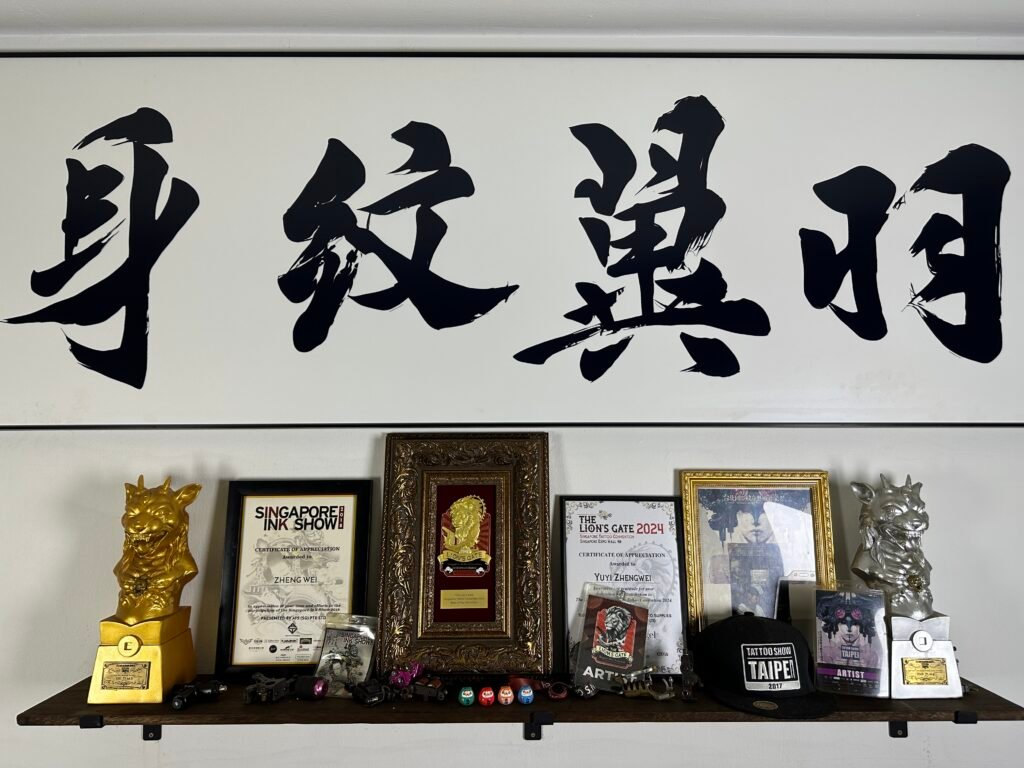
You can use Chinese characters, Japanese kanji or both in one tattoo, but decide which language each part is meant to express before choosing the artwork. The scripts share many characters, yet a matching shape does not guarantee the same pronunciation, everyday meaning, word formation or preferred written form. A design that looks coherent can still read oddly in one of the languages.
The safest order is language, exact wording, character form, reading direction and then composition. Have Chinese text checked in the intended Chinese context and Japanese text checked in Japanese context. If the piece is deliberately bilingual, have reviewers of both languages examine the final combined layout. A tattoo artist can plan scale, flow and placement after that review, but visual composition should not be used as a substitute for language verification.
Start with the language, not the character shape
Chinese characters are generally called hanzi in Chinese. Kanji are the Han characters used in Japanese, where they normally appear alongside hiragana and katakana. Their shared ancestry explains why some forms are identical or closely related. It does not turn Chinese and Japanese into interchangeable languages.
The Unicode Standard gives a simple example: 山 is read shān in Mandarin Chinese, while common Japanese readings include san and yama. The broad idea of “mountain” is recognisable across both languages, but the mark does not contain one universal pronunciation. A personal name, phrase or compound adds much more context than a single character.
Before looking at Chinese calligraphy tattoo ideas or kanji reference sheets, answer four questions:
| Decision | What to record |
|---|---|
| Intended language | Chinese, Japanese, or a deliberately bilingual text |
| Intended message | The full thought in plain language, not only an English keyword |
| Intended reading | Pronunciation and word division, including the Chinese variety or Japanese reading where relevant |
| Intended audience | Who should be able to read it naturally and which regional form they expect |
“Courage,” “love” or “family” is a concept brief, not approved tattoo text. Several words can sit near one English concept while differing in tone, grammar and ordinary use. The reviewer needs the whole intention, not a one-word search result.
A shared character is not a shared word
Language lives in words and sentences, not in isolated symbols. The same character may keep a related core idea while its usual reading or use changes. Unicode notes that 湯 developed the everyday sense “soup” in Chinese while “hot water” remains a primary Japanese sense. It also uses 切手 as an example of a character combination that means “postage stamp” in Japanese but does not carry that word meaning for a Chinese reader.
This is why reading two characters one by one is not a reliable translation method. It is also why a kanji tattoo translation check should cover the complete expression. A reviewer should confirm whether the sequence is an ordinary word, a literary expression, a name, an abbreviation or an unnatural string assembled from dictionary entries.
Single-character tattoos still need a declared language. One shared form may be understood broadly by readers of both languages, but they may say it differently or attach different associations to it. Decide which reading and context are yours, then keep that answer with the design brief.
Is kanji plus kana a Chinese-Japanese mix?
Not usually. Modern Japanese commonly combines kanji with hiragana or katakana. Kana can carry grammatical endings, particles, pronunciation or words that are normally not written only in kanji. Removing it simply to produce an all-kanji tattoo can change the wording or make it look unnatural.
A normal Japanese expression containing kanji and kana is Japanese text, not a bilingual mixture. By contrast, placing an independently written Chinese phrase beside a Japanese phrase is bilingual. Those two cases need different reviews.
There are three workable planning categories:
- A Chinese text is checked as a complete Chinese expression, including the chosen written form and intended spoken reading if pronunciation matters.
- A Japanese text is checked as complete Japanese, including any kana that belongs in the phrase and the intended kanji readings.
- A bilingual design gives each language a clear boundary, reading order and visual role. Both final lines are reviewed together, not only as separate typed strings.
Interleaving Chinese and Japanese characters in one invented sequence is the riskiest option. A reader may not see where the language changes, and a shared character may make the switch even less obvious. Separate lines, panels or clearly labelled parts are easier to review than an ornamental blend.
Simplified, traditional and Japanese forms are separate choices
Simplified and traditional Chinese are written varieties, not decorative font categories. The Unicode Standard identifies simplified Chinese as the main variety used in mainland China and Singapore, while traditional Chinese is used predominantly in Taiwan, Hong Kong and Macao. It also warns that conversion is not always a one-for-one character swap because vocabulary and one-to-many mappings can matter.
Japanese has its own current and older character-form conventions. The Agency for Cultural Affairs’ official Jōyō Kanji table records common-use Japanese characters, readings and notes on printed and handwritten forms. Japanese simplification did not simply copy every simplified Chinese choice. Some forms match across regions, some remain close, and others differ.
For a Chinese character tattoo in Singapore, simplified Chinese may be a familiar default, but location alone should not decide the form. A family name, quotation, heritage reference or intended reader may call for a different verified form. The same principle applies to a Japanese kanji tattoo in Singapore: choose Japanese usage because the text is Japanese, not because one version looks more complex.
Do not mix simplified, traditional and Japanese forms merely to balance the number of strokes. First obtain one approved text in one stated convention. If an older or variant form is intentional, the reviewer should identify it and confirm why it belongs in that wording.
Font and regional glyph differences can alter what you see
Even when text uses the same encoded character, Chinese and Japanese fonts can draw some components differently. Unicode advises using language-appropriate fonts because a generic or wrong-region font may look unusual to local readers. A screenshot without its language and font information is therefore a weak master reference.
Keep the approved text as selectable characters as well as an image. Record the language tag, source and font used for the reference. If a calligrapher creates a handwritten version, compare it with the approved text rather than replacing the typed record. That gives the language reviewer something stable to check if a stroke, component or abbreviation becomes unclear.
Fix the reading direction before styling the piece
Chinese and Japanese can both be set horizontally or vertically. W3C’s Japanese layout requirements describe horizontal text running left to right and vertical characters running top to bottom, with multiple vertical lines conventionally progressing from right to left. A one-column tattoo is simpler, but its top and bottom still need to be marked.
Do not use “vertical” as the entire instruction. It could mean upright characters stacked from top to bottom, a horizontal phrase rotated sideways, or several traditional vertical columns. Draw an arrow to the first character and number every line. For a multi-column piece, show which column is read first.
Body orientation adds another decision. A forearm turns, and a photograph or selfie may be mirrored. Review the placement while the body is in the chosen neutral position, then confirm that the stencil has not reversed the text. The tattoo design review guide gives a broader checklist for spelling, direction, scale and placement before an appointment.
Calligraphic style comes after language accuracy
Calligraphy changes more than surface texture. The Metropolitan Museum of Art distinguishes standard, running and cursive scripts, noting that running and cursive forms may abbreviate or connect characters while standard script articulates individual strokes more clearly. A loose brush treatment can therefore make a correct typed character harder to identify.
Choose style only after the exact wording is frozen. The Chinese calligraphy tattoo guide covers the visual questions of script, structure and placement. This article addresses the earlier gate: deciding whether the text is Chinese, Japanese or bilingual and verifying what it says.
Language review should happen twice when the final artwork is strongly stylised. First, check the plain text for wording and form. Then show the reviewer the final calligraphic rendering in its intended order. The second pass is not a new translation. It checks that the artwork has not lost, merged, mirrored or transformed a meaningful stroke.
Use two different reviews before the tattoo appointment
A language reviewer and a tattoo artist answer different questions. Neither role should be stretched to cover the other without evidence.
Language review
Ask a qualified reader of the intended language to confirm:
- the complete text rather than isolated characters;
- the intended meaning, tone and normal usage;
- the reading or pronunciation you want attached to it;
- simplified, traditional, current Japanese or deliberately older forms;
- names, quotations and any source wording;
- punctuation, line breaks and reading order;
- the final calligraphic rendering, if it differs from plain type.
Machine translation can help someone begin research, but it is not final approval. Avoid asking a reviewer only, “Does this mean strength?” Give them the intended message and context, then ask what the exact text says to a natural reader. If Chinese and Japanese both appear, use reviewers competent in each language and let both see the combined design.
Composition review
Once the language record is fixed, the tattoo discussion can focus on scale, spacing, body flow and whether the chosen strokes remain distinct at the proposed size. Text can also be planned beside imagery, but it should keep a clear visual hierarchy. If the wider piece uses Japanese or Asian-inspired imagery, review Japanese tattoo composition examples without treating the motifs as proof that the lettering is correct.
Changing a character to fill a gap is a language change, not a routine layout adjustment. Send it back through language review before approving the composition again.
What to prepare before asking for composition
A useful brief contains:
- the intended message in a language you fully understand;
- the exact approved Chinese or Japanese text in selectable form;
- the language, regional convention and intended reading;
- the reviewer or authoritative reference used, with the review date;
- a plain-text version and a clear image of the approved written form;
- an arrow or numbered diagram showing reading order;
- one or two calligraphic references, labelled as style references only;
- the body area and approximate space available for the design.
This sequence prevents the composition from becoming the place where translation is guessed. Once these items are settled, contact Yuyi Tattoo to discuss how the verified text might fit the chosen placement. Keep the language approval with the latest artwork, and repeat the check whenever wording, form or order changes.
Sources and review date
- The Unicode Consortium — The Unicode Standard 17.0, Chapter 18: East Asia — reviewed 24 August 2026.
- National Institute for Japanese Language and Linguistics — Why the same kanji has different pronunciations in Japanese and Chinese — reviewed 24 August 2026.
- Agency for Cultural Affairs, Japan — Jōyō Kanji readings index and official table — reviewed 24 August 2026.
- The Metropolitan Museum of Art — Chinese Calligraphy — reviewed 24 August 2026.
- W3C — Requirements for Japanese Text Layout — reviewed 24 August 2026.
Frequently asked questions
Are Chinese characters and Japanese kanji the same?
They overlap, but they are not interchangeable as language. Many kanji originated from the same Han-character tradition used for Chinese, so forms and broad meanings may be shared. Japanese assigns its own readings and combines kanji with kana, while Chinese has its own words, readings and written-form conventions. Verify the full expression in its intended language.
Can one character work in both Chinese and Japanese?
Sometimes one form is recognisable with a related broad meaning in both languages. It may still have different pronunciations, nuances or common uses. State which language and reading you intend, even for a single character, and have that choice checked before styling it.
Can I combine Chinese and Japanese in one tattoo?
Yes, if the bilingual choice is deliberate. Keep each phrase complete, make the language boundary and reading order clear, and have reviewers of both languages inspect the final combined layout. Avoid building a new sequence by alternating characters because they look compatible.
Should I choose simplified or traditional Chinese for a tattoo?
Choose according to the wording, source, personal context and intended readers, not by stroke count alone. Simplified Chinese is common in Singapore, while a name, quotation or heritage source may use a verified traditional form. Ask the language reviewer to approve one complete version and do not mix conventions casually.
Who should check a kanji tattoo translation?
Use a qualified Japanese-language reviewer who understands the full intended phrase, tone and reading. For a name, literary quotation or older character form, ask someone with relevant language expertise rather than relying on a generic symbol chart. The final styled artwork should be checked again after the plain text is approved.

