
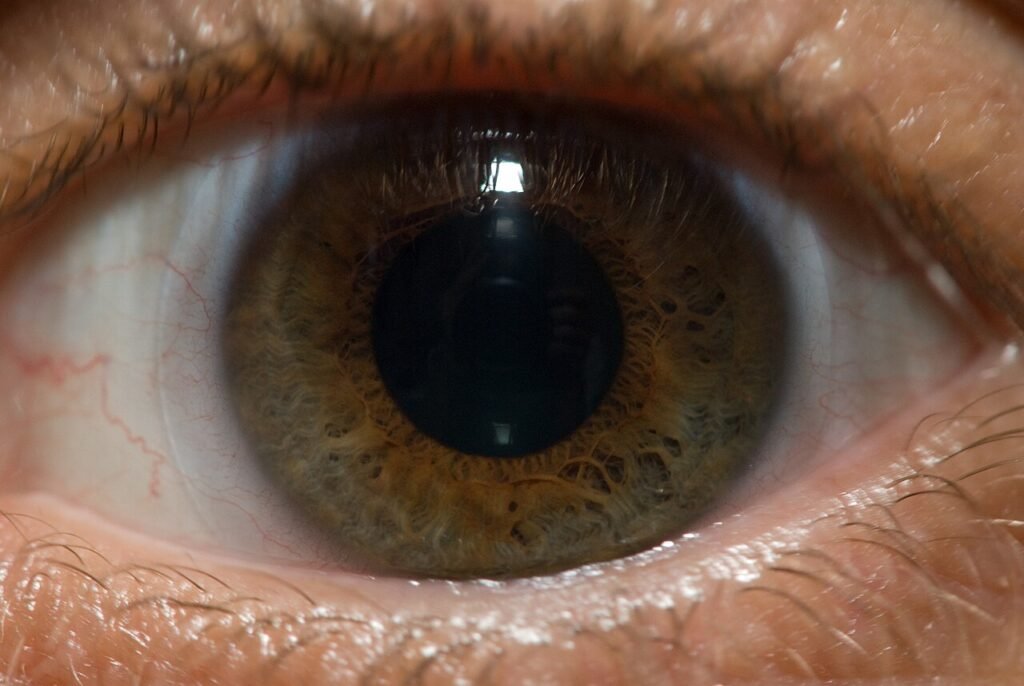
Choose the gaze before choosing the final eye tattoo placement. A forward-looking eye addresses the person viewing it and usually benefits from a clear, centred presentation. A sideways gaze creates a visual destination, so the design needs room in the direction it looks. A close crop makes the iris, lid or brow the main shape and can fit a narrower area, but the cut must look deliberate rather than accidental.
The most useful starting brief contains one eye reference, one gaze direction and one photograph of the intended body area in a relaxed position. Those three choices show whether the composition should be horizontal, vertical or wrapped, and whether the full brow, both eye corners or surrounding symbols can remain without crowding the focal point.
Start with the gaze, not a list of meanings
An eye can suggest attention, memory, vigilance or personal identity, but none of those meanings is automatic. Gaze, crop and neighbouring imagery all change the reading. Describe the specific idea you want the design to carry instead of asking for a generic “meaningful eye.”
Separate an illustrative human eye from an established cultural symbol. For example, The Metropolitan Museum of Art identifies the ancient Egyptian wedjat as the healed eye of Horus and documents its association with recovery and regeneration. That history is not a universal label for every eye tattoo. If a reference comes from a religious object or traditional emblem, identify and research that exact source before adapting it.
For an original illustrative eye, start with a simpler question: who or what is the eye looking at? The answer gives the composition a direction before any leaves, geometry, clouds, tears or lettering are added.
Forward gaze: make the eye meet the main viewer
A forward gaze aligns the iris and pupil toward someone looking from the intended main angle. It reads directly, but does not force one emotion. A relaxed upper lid, raised brow, compressed lid or heavy shadow can each change the expression without changing the gaze.
This option works best when the eye has an obvious front view. A shoulder blade, broad upper arm panel or thigh can provide enough width for both corners of the eye and some brow structure. On a curved limb, decide where “front” is when the arm or leg rests naturally. If the pupil sits on one plane while an eye corner wraps out of sight, the design may look centred in a flat drawing but off-centre on the body.
Check a forward eye from an ordinary viewing distance. Iris detail only works when the lid shape, dark accents and open skin still form one image. Use the principles in tattoo design readability to decide how much texture the chosen scale can carry.
Sideways gaze: leave space for the look to travel
A sideways-looking eye creates an implied line from the pupil toward something outside the eye. That line may lead along a forearm, across a shoulder or toward another part of a larger composition. The direction is more useful when described with a body landmark: toward the hand, shoulder, chest, spine, knee or ankle. “Looking left” can become confusing when a selfie is mirrored or when left refers to the viewer rather than the wearer.
Give the gaze breathing room. If the eye looks toward the hand but the design ends at the outer corner, it may feel blocked. Open skin, a fading shadow or one secondary element can continue the movement. If the eye looks at a flower or symbol, decide whether that element is part of the story or only framing.
Keep the visible anatomy coherent even in a stylised piece. The pupil is the central opening of the iris, so the iris and pupil should travel as one unit when the gaze shifts. Moving the pupil alone to one edge of a fixed iris produces a different, deliberately surreal effect. In a natural-looking side gaze, the changed spacing between the iris and the inner and outer eye corners is what makes the direction legible.
The eyelid and brow decide how much expression survives
Many eye tattoo ideas focus on iris colour or pupil detail, yet the eyelids and brow do much of the framing. Cropping below the brow removes some expression, while a heavy shadow may merge the brow and upper lid when reduced. Either choice should be intentional.
Think of the eye as four connected layers:
- The iris and pupil establish the focal point and gaze.
- The upper and lower lids define the opening around that focal point.
- The inner and outer corners establish the eye’s span and tilt.
- The brow, crease and nearby shadow provide context and expression.
For a neutral result, use clear lid shapes. For a graphic result, the brow and lid can become bold framing lines while the iris stays simple. Compare the complete reference with the proposed crop. The portrait tattoo reference photo guide explains why an original, uncropped image gives the artist more framing options, even when portrait likeness is not the goal.
Choose a crop that looks intentional
Cropping changes what the viewer believes the subject is. A complete eye study is about the whole opening and its expression. A brow-and-eye crop feels more like a fragment of a face. An extreme iris crop becomes an abstract field of rings, highlights and shadow.
| Crop | What remains visible | What it needs from the placement |
|---|---|---|
| Full eye | Both corners, upper and lower lids, most of the iris | Enough width to keep the span and lid curves clear |
| Eye with brow | Full eye plus crease, brow and surrounding shadow | More height and room for expression above the iris |
| Half-face fragment | Eye, bridge of nose, cheek or temple | A larger panel and a clear decision about which facial edge exits the frame |
| Extreme iris crop | Iris texture, pupil and only part of the lids | Strong value separation so the crop reads as deliberate |
A close crop should not cut through every landmark at once. If the brow, corners and lower lid all disappear, the image may read as a circular pattern instead of an eye. Keeping the brow, nose bridge, lashes, tears and background can create the opposite problem. Decide what the crop owns and let secondary information go.
Museum and photography collections show how a frame can cut a subject and still produce a complete composition. Use that principle as inspiration, not as permission to copy an artwork.
Horizontal and vertical compositions solve different placement problems
A complete eye is wider than it is tall, so it begins as a horizontal form. The shoulder blade, upper back or thigh can preserve that span. It can also cross the upper arm when the main view stays visible and the corners are checked around the curve.
A narrow forearm or calf often invites a vertical design. Keep the eye level while shadows, leaves, smoke or geometric lines extend above and below it. This creates a vertical silhouette without making the eye look accidentally tilted.
A circular frame is a third option. It can contain a centred gaze on the upper arm, shoulder or thigh, but the frame must support rather than overpower the iris. If you are considering radial geometry, compare the role of symmetry in mandala tattoo design before combining the two ideas. An eye inside a symmetrical frame still needs a clear hierarchy.
Match the main viewing direction to the body area
Eye tattoo placement is not only the name of a body part. It includes the side, surface, resting posture and person who will see the design most often.
| Body area | Composition that often fits | Placement question to settle |
|---|---|---|
| Outer forearm | Side gaze with a vertical outer silhouette | Should it look toward the hand or the elbow when the arm hangs? |
| Inner forearm | Compact eye or close crop | Is the main view meant for the wearer or someone facing them? |
| Outer upper arm | Centred eye, oval frame or eye with brow | Which part must remain visible without rotating the arm? |
| Shoulder blade or upper back | Full eye with a wider crop and surrounding space | Where is the centre when the shoulders are relaxed? |
| Thigh | Horizontal full eye, half-face crop or framed eye | Should the design read primarily while standing or seated? |
| Calf | Side gaze with elements above and below | How much of the eye disappears as the leg turns? |
Photograph the area straight on and add a three-quarter view if it curves. Keep nearby joints and existing tattoos in frame. Mark the boundaries on a copy while retaining one unmarked image. For a first project, weigh visibility and future expansion with the first tattoo placement guide.
Add surrounding symbols only after the eye works alone
An eye can sit with flowers, geometry, clouds, lettering or abstract marks. Give each surrounding element one job: extend direction, create a frame, identify a personal story or balance the body area. Otherwise it is likely to compete with the gaze.
Use the gaze to test the relationship. A flower in its path becomes an object of attention; a shape behind the eye becomes a frame. These are compositional effects, not universal meanings. Define the pairing personally rather than borrowing a cultural claim from an image-search caption.
Also choose one visual priority. If the iris, frame, flower and text all demand the darkest contrast, the viewer has no clear entry point. Let the eye lead, then reduce the contrast, detail or scale of supporting forms.
Prepare a three-part eye tattoo brief
You do not need a finished drawing before making an enquiry. Prepare these items instead:
- One clear, uncropped eye reference. State whether it is your own eye, a permitted photograph or a general anatomical reference.
- One gaze instruction. Use a destination such as “toward my wrist” or “straight toward the viewer,” not an ambiguous left or right.
- One relaxed placement photograph. Include the body side, surface and approximate height and width, plus an angled view if the area wraps.
Add the crop and one surrounding symbol: “Keep both eye corners and part of the brow. The iris should look toward my hand, with a small flower in that direction.” This begins the design conversation without locking the composition prematurely.
When those choices are ready, send the reference, gaze note and placement photographs through Yuyi Tattoo’s contact page. The final scale, crop and feasibility can then be discussed against the actual body area rather than guessed from a standalone image.
Sources and review date
- NCBI Bookshelf, Webvision — Gross Anatomy of the Eye — reviewed 24 August 2026.
- NCBI Bookshelf — Anatomy, Head and Neck, Eye Extraocular Muscles — reviewed 24 August 2026.
- The Museum of Modern Art — Looking at Photographs — reviewed 24 August 2026.
- The Metropolitan Museum of Art — Wedjat Eye Amulet — reviewed 24 August 2026.
Frequently asked questions
Should an eye tattoo look straight ahead or to the side?
Choose straight ahead when you want the eye to meet its main viewer directly and the placement offers a stable front view. Choose a side gaze when you want movement along a limb or toward another element. Neither has one fixed meaning; the crop, lids, brow and surrounding imagery change how it reads.
Which direction should an eye tattoo face on the forearm?
Describe the direction with a landmark. It can look toward the wrist, toward the elbow, toward the body or away from it. Check the option while the arm hangs naturally, because a direction that works in a posed photograph may turn away in everyday posture.
Can an eye tattoo be cropped to show only the iris?
Yes, but an extreme crop needs enough lid edge, shadow or surrounding structure to make the cut look intentional. If the design keeps only a detailed circle with no eye-corner or lid cues, it may read more like an abstract radial pattern. The intended scale and contrast should be reviewed first.
Does an eye tattoo always symbolise protection?
No. A generic illustrative eye has no single universal meaning. Some named historical eye symbols have documented cultural associations, but those meanings belong to those specific traditions and objects. Identify and research a cultural motif rather than transferring its meaning to every eye design.
What should I send for an eye tattoo enquiry?
Send one clear eye reference, your chosen gaze direction, and a relaxed photograph of the intended placement. Add the body side, approximate size, preferred crop and any one supporting symbol. This gives the artist enough information to discuss composition without requiring you to design the tattoo yourself.


